Jun 26, 2026·Accuracy, Reliability & CriticismWhy a Norm Sample Matters for IQ Test Accuracy
Discover why the norm sample is the most critical factor for accurate IQ test results. Read the full article and take the professional RIOT IQ test today!
Dr. Russell T. WarneChief Scientist
When most people think about what makes an IQ test accurate, they think about the questions. Are the questions hard enough? Do they test the right skills? Are they fair? These are important considerations, but they are not the most important factor in determining whether an IQ score is meaningful. That distinction belongs to the norm sample. The norm sample is the group of people whose test performance serves as the standard against which all future test takers are compared. It is the foundation of every IQ score. Without a proper norm sample, even the best questions in the world cannot produce an accurate IQ.
What Is a Norm Sample?
An IQ score is not a percentage correct, the way a classroom test might be scored. Instead, it is a relative measure: it tells an examinee how their performance compares to a specific reference group. That reference group is the norm sample.
On professionally developed IQ tests, the norm sample is carefully selected to be representative of the intended population. For a test designed for American adults, the norm sample should reflect the demographic characteristics of the U.S. adult population. This means it must include people of different ages, sexes, racial and ethnic backgrounds, education levels, and geographic regions — in the same proportions as the U.S. Census [1].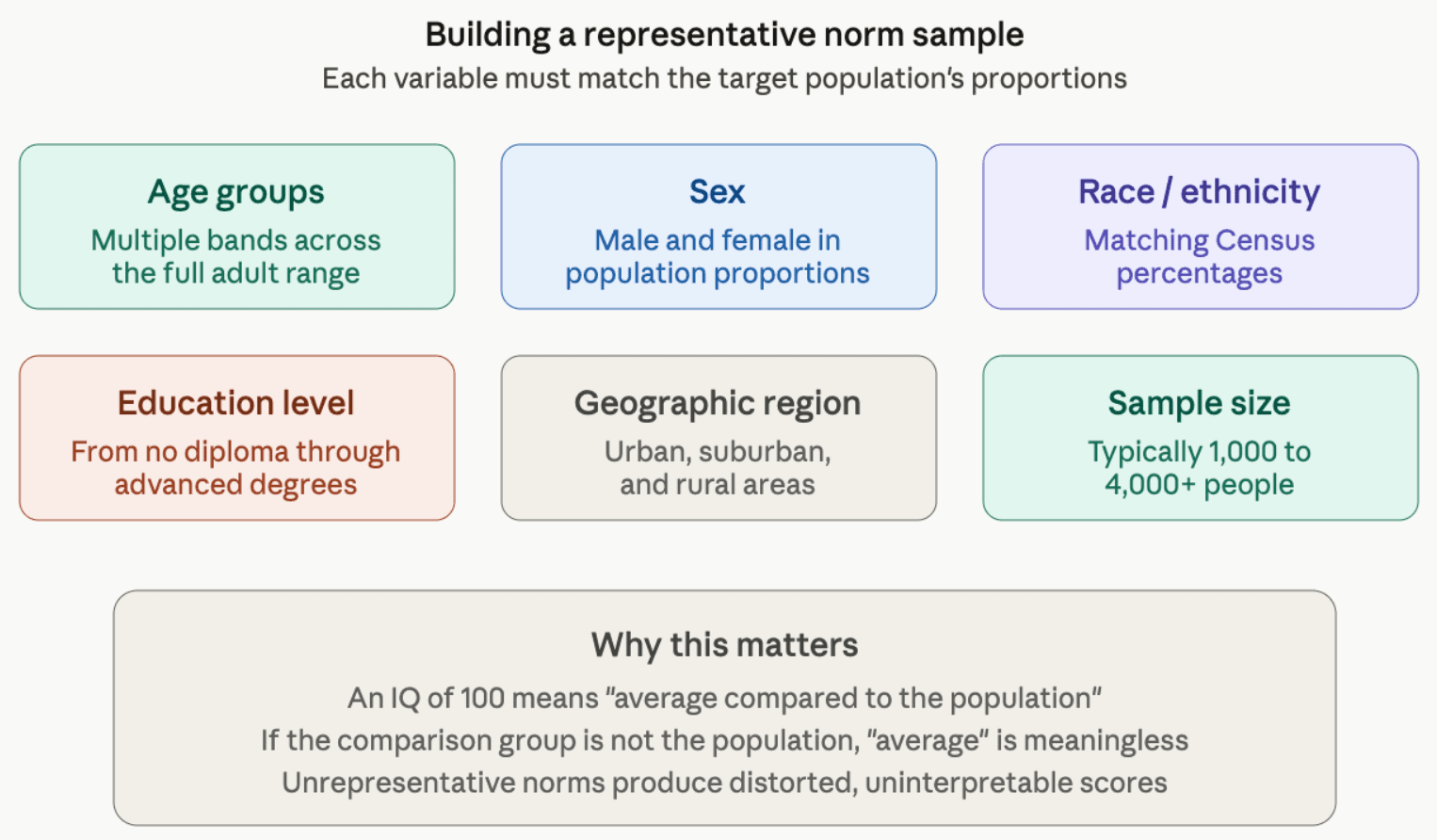 This is why the norm sample is so important: it defines what "average" means. An IQ of 100 means a person performed as well as the average person in the norm sample. An IQ of 130 means a person outperformed approximately 98% of the norm sample. These interpretations only hold if the norm sample actually represents the population.
What Happens When the Norm Sample Is Wrong?
To understand the impact of a flawed norm sample, consider a simple example. Suppose a test is normed on a group of university students who voluntarily took the test out of curiosity. This group will, on average, be smarter than the general population because they are university students (who already passed academic selection) and because they chose to take an IQ test (which suggests interest in cognitive performance). If a member of the general public takes this test and is compared to this overly-capable norm group, their score will be deflated — they will appear less intelligent than they actually are.
The reverse also occurs. If a test attracts a broad, unfiltered audience through social media and many test takers are not trying seriously, the norm group's average performance will be depressed. Serious test takers compared to this group will receive inflated scores. This is why many online IQ tests give nearly everyone a score above 120 [2].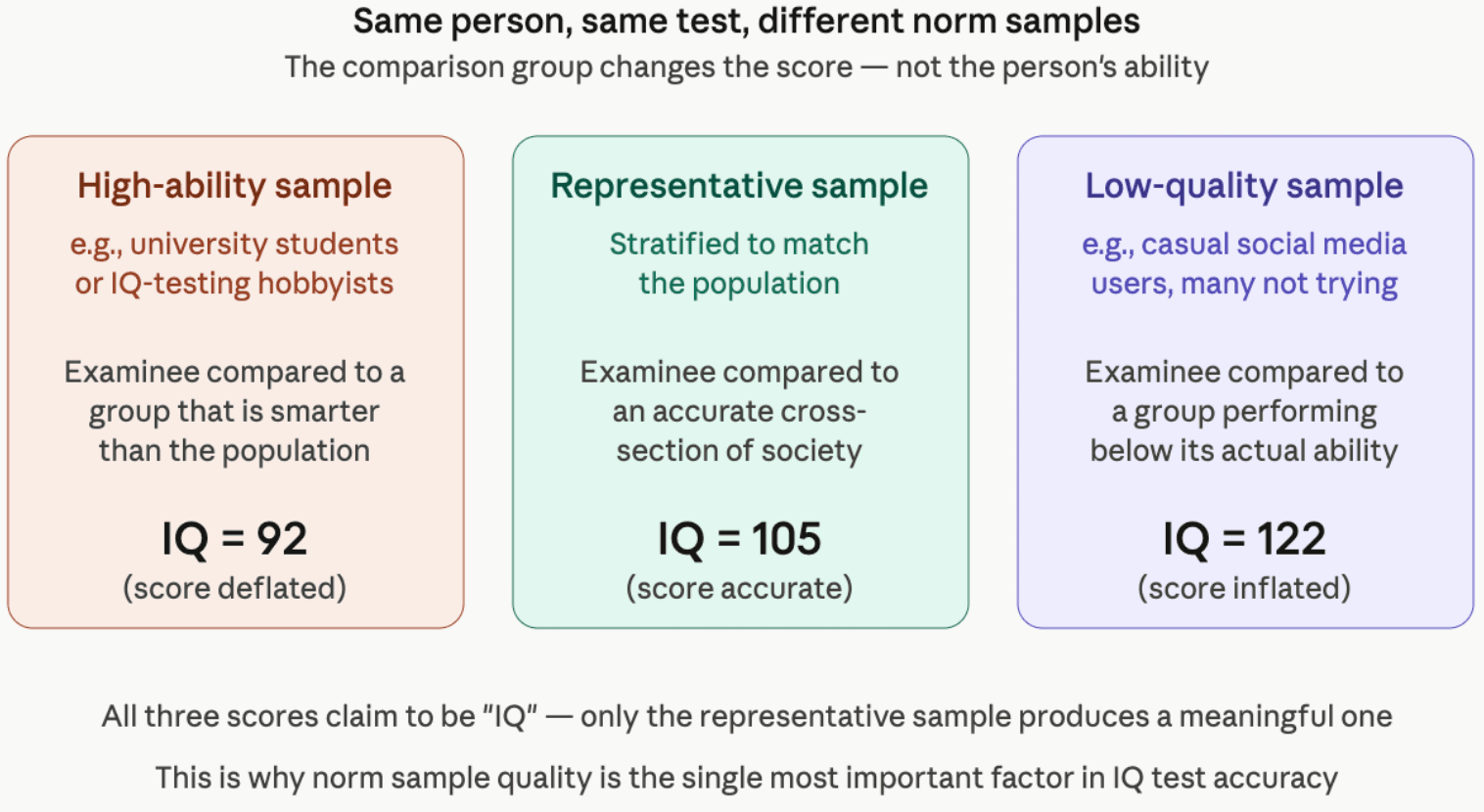
Using Old Norms From Other Tests
A related problem occurs when a website offers tests that were originally normed decades ago — such as military classification tests from the mid-20th century — and claims that the original norms still apply.
This approach has a well-known flaw: the Flynn effect. Average performance on IQ tests has increased substantially over the 20th century, at a rate of roughly 3 points per decade [3]. This means that norms from the 1940s or 1950s are dramatically outdated. A person who scores "average" compared to a 1940s norm group would be scoring well below average compared to a modern, representative sample. Using old norms without proper recalibration inflates every score the test produces. Even if a website claims to have "updated" old norms, the critical question is whether they collected a new, representative norm sample or simply applied a statistical correction to the old data. A new, representative norm sample is the only reliable approach. Statistical adjustments based on assumptions about the Flynn effect are approximations that introduce additional uncertainty.
What Does a Proper Norm Sample Look Like?
To put this in context, consider what major professional IQ tests invest in their norming process. The Wechsler Adult Intelligence Scale — Fifth Edition was normed on over 2,000 adults stratified to match the U.S. Census [4]. The Woodcock-Johnson IV was normed on over 7,000 individuals ranging from age 2 to 90+ [5]. These are massive investments in time and money, but they are necessary because the entire scoring system depends on the norm sample being right.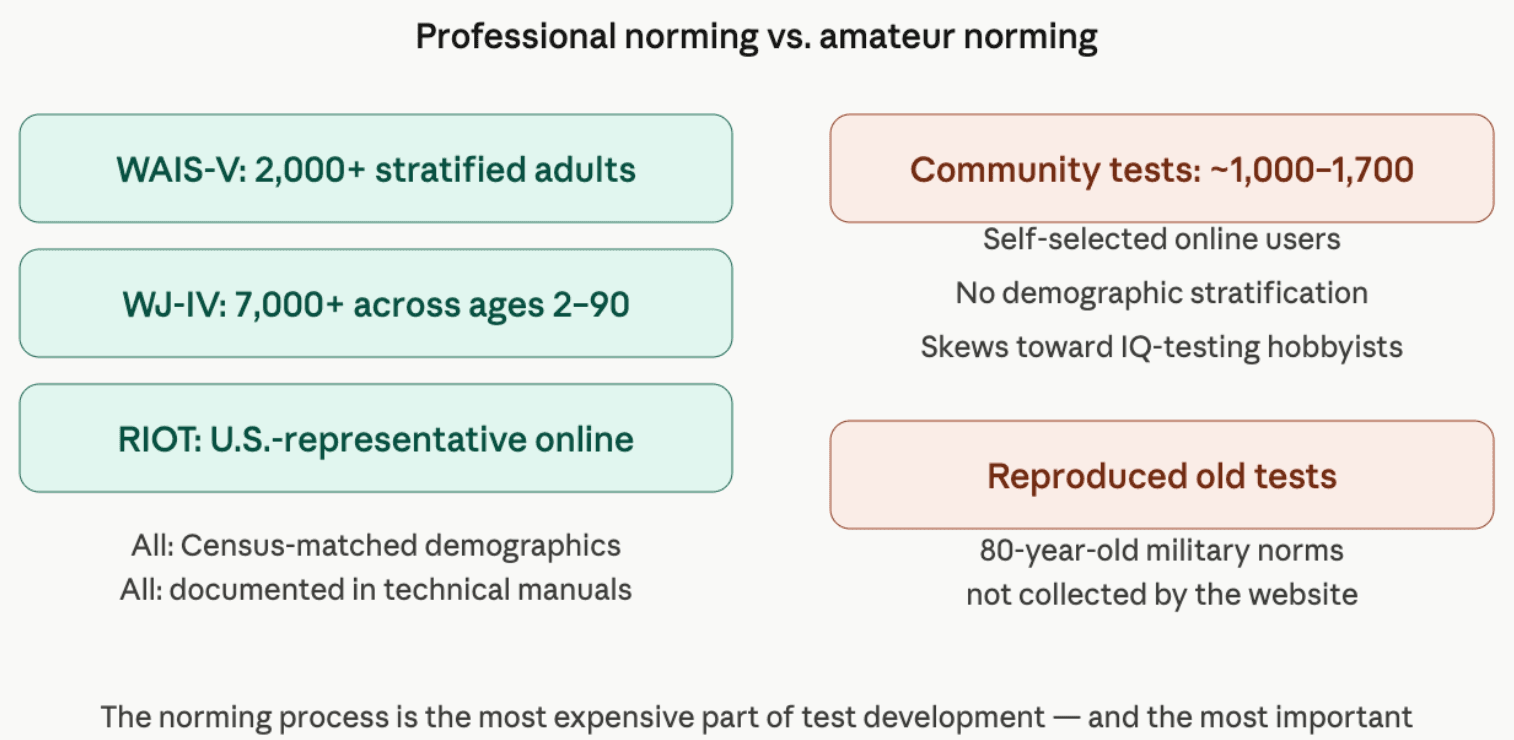
By contrast, some online platforms rely on norms from self-selected internet users or from decades-old testing programs. The CAIT test on cognitivemetrics.com, for instance, filtered its sample down to approximately 1,692 first-time attempts from English-speaking countries — a convenience sample with no demographic stratification, no Census matching, and no documentation of how the sample compares to any target population. The AGCT test on the same platform references a norm sample of "12 million soldiers" — but that data is from World War II and belongs to the U.S. Army, not to the website.
Putting It All Together
A norm sample is not an optional extra or a technical detail that only experts need to worry about. It is the single most important factor in determining whether an IQ score is accurate. Without a representative, properly documented norm sample, an IQ score is just a number — it cannot tell an examinee how they compare to the population, and it cannot support the interpretations that make IQ meaningful.
Before taking any IQ test, it is worth asking a simple question: who is the comparison group? If the answer is "a representative sample of the target population, documented in a technical manual," then the test has the foundation needed for accurate scores. If the answer is "whoever happened to take the test online" or "a military sample from 80 years ago," then the scores should be treated with extreme caution.
Take the First Ever Professional Online IQ Test
The Reasoning and Intelligence Online Test is the first online IQ test that actually meets professional standards for psychological assessment. It was created by Dr. Russell Warne, who has over 15 years of experience in intelligence research.
What makes the RIOT different from the countless online IQ tests found with a quick internet search? Most of those tests are created by amateurs without proper training in psychometrics. The RIOT clearly stands out as the first-ever professional online IQ test. The RIOT underwent the same rigorous development process as traditional in-person IQ tests used by psychologists, including expert review, the first-ever proper U.S.-based online norm sample, and compliance with educational and psychological testing standards from APA, AERA, and NCME. The RIOT reports not just an overall IQ score but six index scores — Verbal Reasoning, Fluid Reasoning, Spatial Ability, Working Memory, Processing Speed, and Reaction Time — providing a comprehensive picture of cognitive strengths and areas for growth.
References
[1] Warne, R. T. (2020). In the know: Debunking 35 myths about human intelligence. Cambridge University Press. https://doi.org/10.1017/9781108593298 [2] te Nijenhuis, J., van Vianen, A. E. M., & van der Flier, H. (2007). Score gains on g-loaded tests: No g. Intelligence, 35(3), 283–300. https://doi.org/10.1016/j.intell.2018.01.003 [3] Flynn, J. R. (1984). The mean IQ of Americans: Massive gains 1932 to 1978. Psychological Bulletin, 95(1), 29–51. https://doi.org/10.1037/0033-2909.95.1.29 [4] Weiss, L. G., Saklofske, D. H., Holdnack, J. A., & Prifitera, A. (Eds.). (2019). WAIS-V clinical use and interpretation. Academic Press.
[5] Schrank, F. A., McGrew, K. S., & Mather, N. (2014). Woodcock-Johnson IV tests of cognitive abilities. Riverside Publishing.
[6] American Educational Research Association, American Psychological Association, & National Council on Measurement in Education. (2014). Standards for educational and psychological testing. AERA. https://www.testingstandards.net/ [7] Flynn, J. R. (1987). Massive IQ gains in 14 nations: What IQ tests really measure. Psychological Bulletin, 101(2), 171–191. https://doi.org/10.1037/h0090408 [8] Warne, R. T. (2025). Technical manual for the Reasoning and Intelligence Online Test, version 1.0. Riot IQ.
[9] Carroll, J. B. (1993). Human cognitive abilities: A survey of factor-analytic studies. Cambridge University Press.
[10] Lenhard, A., Lenhard, W., & Gary, S. (2019). Continuous norming. Psychometrika, 84(1), 257–282. https://doi.org/10.1007/s11336-018-9648-7 Take our professional IQ test
Want to know your IQ? Try the first ever professional online IQ test.
AuthorDr. Russell T. WarneChief Scientist
