Aug 3, 2026·Special Population & Related ConditionsIs There a Link Between IQ Score and Depression?
Does high or low intelligence increase depression risk? Discover the surprising science of IQ, rumination, and mental health. Read the guide and try RIOT!
Dr. Russell T. WarneChief Scientist

The relationship between intelligence and depression is one of the most contested and counterintuitive findings in cognitive epidemiology. Taking an IQ test and worrying about whether a high score means you're more likely to struggle with mood disorders — or wondering whether depression itself has cognitive roots — are both legitimate questions that the research has started to answer with greater precision. The honest summary is that the link exists in multiple directions, it operates through specific mechanisms, and the picture looks different depending on whether you're asking about low IQ or high IQ as the starting point.
Direction One: Lower IQ Is Associated With Higher Depression Risk
The largest and most statistically powered body of evidence concerns the lower end of the IQ spectrum. A 2025 multilevel multiverse meta-analysis published in Communications Psychology — covering 49 studies with a combined sample of over 2.9 million individuals — found that a 15-point IQ disadvantage in early life was associated with a 22% higher risk of later mental and physical illness. This is one of the largest and most methodologically robust estimates of the IQ-illness relationship to date, and its sheer sample size gives it considerably more statistical power than any individual study. Why does lower cognitive ability associate with higher depression risk? The proposed mechanisms are multiple and interacting. Lower IQ is associated with less educational attainment, lower socioeconomic status, less stable employment, poorer health literacy, reduced access to mental healthcare, and reduced ability to navigate complex healthcare systems when depression does occur. Each of these downstream consequences of cognitive disadvantage creates independent risk for depression — meaning the relationship is not direct but mediated through a cascade of environmental and socioeconomic pathways that lower IQ makes more likely.
The longitudinal Lothian Birth Cohort study — which I've cited across multiple articles in this series for its extraordinary methodological quality — provides the most temporally rigorous estimate. Examining 53,037 Scottish participants whose intelligence was measured at age 11 and followed up to age 85 through electronic health records, the study found that greater childhood intelligence test scores were associated with a reduced risk of depression in an unadjusted analysis, with a hazard ratio of 0.95 per standard deviation increase in childhood IQ. The association attenuated but remained present after controlling for socioeconomic factors — suggesting both direct and mediated pathways. The most comprehensive systematic review covering this question — a meta-analysis of 18 articles across 19 cohorts with a combined sample of 45,786 participants — found no significant association between childhood cognitive ability and depression in adulthood when pooling most-adjusted estimates (r = −0.04, 95% CI = −0.09 to 0.01). This near-zero pooled effect, after adjustment for confounders, suggests that the raw IQ-depression correlation in the lower IQ range is largely explained by the socioeconomic and health pathways through which lower cognitive ability operates — rather than reflecting a direct neurobiological relationship.
Direction Two: Higher IQ Is Associated With Specific Depression Vulnerabilities
Here is where the research becomes genuinely counterintuitive — and where the popular understanding of intelligence as protective against psychological problems breaks down most clearly.
Gifted individuals show elevated rates of depression compared to the general population — partly because the traits that confer intellectual advantage also increase emotional vulnerability. The mechanism is specific and well-described: rumination. Depression connects to a different but related mechanism: rumination. Gifted people often have exceptional working memory and a tendency toward deep analysis. In a negative emotional state, these traits fuel the exact cognitive pattern that sustains depression — repeatedly cycling through painful memories, perceived failures, and unanswerable questions about meaning and purpose. The rumination-depression link is firmly established in the clinical literature. A longitudinal study of 658 adolescents found that elevated rumination scores predicted onset of depressive disorders over the subsequent year after adjustment for prior depression and anxiety symptoms — meaning rumination is not just a correlate but a prospective predictor of depression. The problem for high-IQ individuals is that the same cognitive architecture that makes them exceptional reasoners also makes them exceptionally effective ruminators. The working memory that holds complex problems in mind doesn't distinguish between a theoretical physics problem and a painful social memory. A ScienceDirect study with neuroimaging data found that participants with very superior intelligence (IQ 130 and above) were significantly prone to rumination leading to mood disorders, and worry leading to anxiety disorders, compared to those with average cognitive ability. The study linked this to Dabrowski's concept of overexcitabilities — a heightened responsiveness to environmental stimuli that manifests more strongly in gifted populations and that creates both the intellectual intensity associated with exceptional performance and the emotional vulnerability associated with elevated mood disorder rates. Additional mechanisms contribute beyond rumination. High IQ and hypersensitivity tend to travel together. Many gifted people process sensory and emotional information more intensely than average — louder sounds feel louder, social slights feel sharper, existential questions feel more urgent. The greater social isolation that frequently accompanies exceptional cognitive ability — a consequence of difficulty finding intellectual peers and of the social mismatch that high ability creates in average environments — further elevates depression risk. Trying to have a real conversation about a complex idea, only to be met with polite disinterest, is a small but repeated wound. Over years, that adds up.
The Misdiagnosis Problem for High-IQ Individuals
One finding that deserves particular emphasis is how depression presents differently in gifted adults — in ways that frequently lead to underdiagnosis or misdiagnosis.
High-IQ individuals may intellectualize their mental health struggles, develop sophisticated coping mechanisms, or rationalize symptoms away, preventing early intervention. Their articulate self-awareness can paradoxically obscure the severity of underlying mental illness from both themselves and healthcare providers. A gifted person who constructs an elegant narrative about why their persistent hopelessness is philosophically justified is harder to identify as clinically depressed than a person who presents with more straightforward symptom reporting.
The problem compounds at the clinical level. A therapist unfamiliar with giftedness may misread existential rumination as clinical depression, or mistake rapid, associative thinking for mania — and in the opposite direction, may miss genuine clinical depression because the gifted patient's verbal sophistication and high-functioning presentation doesn't match the expected profile. Seeking out therapy approaches tailored for highly intelligent individuals tends to produce far better outcomes than a one-size-fits-all approach.
The Perfectionism Mechanism
Perfectionism is a second mechanism connecting high cognitive ability to depression risk that operates partly independently of rumination. Perfectionism in gifted people is strongly linked to anxiety and depression, with research distinguishing maladaptive forms that tie self-worth to performance outcomes. The cognitive capacity that allows a high-IQ person to recognize exactly what they're failing to achieve — and to construct a precise internal model of the gap between current performance and their own standard — becomes a source of persistent self-criticism when maladaptive perfectionism is the operating framework. This is not unique to gifted individuals, but the cognitive precision available to them makes the self-critical process more thorough and more damaging when it goes wrong. A high-IQ perfectionist doesn't just notice that they failed; they notice every specific dimension of the failure, construct a detailed causal model of why it happened, and generate elaborate predictions about what it implies for the future. That precision, directed inward and negatively, is a potent driver of depressive symptomatology.
What the Age-Dependent Pattern Shows
One of the most interesting methodological findings in the IQ-depression literature is the age-dependent pattern of the relationship. A study examining individuals across the lifespan found that higher intelligence (assessed between ages 15 and 23) was associated with an increased risk of depression prior to age 50, but a lower risk of depression at age 50 and beyond. If this finding replicates, it would suggest that the mechanisms operate differently at different life stages: the rumination and social isolation vulnerabilities associated with high IQ may dominate in early and mid-adulthood, while the cognitive reserve and health literacy advantages of higher cognitive ability may increasingly protect against depression in later life. This age-dependent pattern is consistent with the broader trajectory of crystallized intelligence and cognitive reserve — the accumulated advantages of a cognitively active life may offer increasing protection against depression as the mechanisms through which lower IQ elevates depression risk (socioeconomic, health-related, health literacy) become more dominant in later life.
The Net Picture: A U-Shaped Risk Curve?
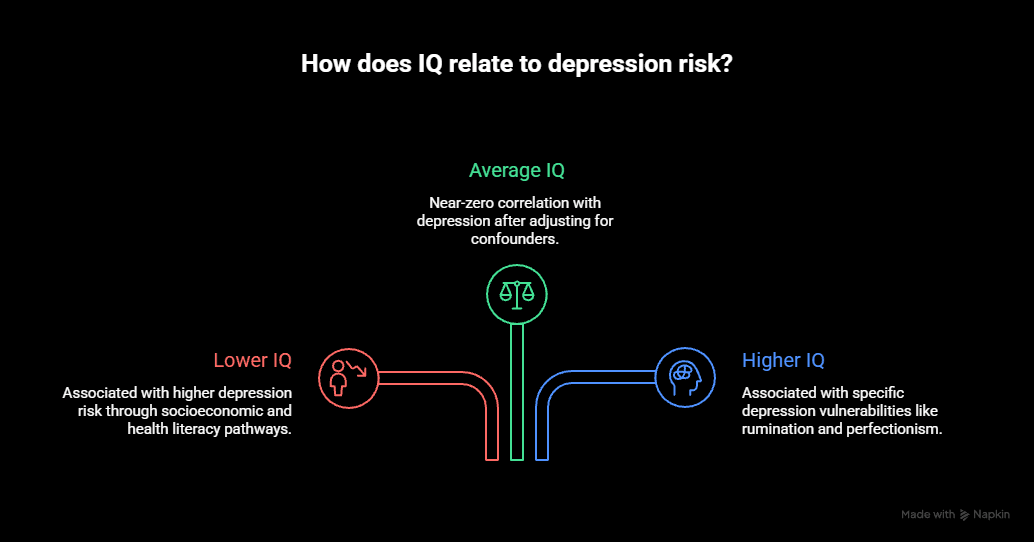
Synthesizing the evidence across both directions, what emerges looks something like a U-shaped risk curve. At the lower end of the IQ distribution, depression risk is elevated through socioeconomic, health literacy, and direct cognitive pathways. In the average range, the relationship approaches zero — the pooled meta-analytic estimate across most studies is near zero after adjustment for confounders. At the upper end — particularly in the gifted range above IQ 130 — depression vulnerability increases again through the rumination, perfectionism, social isolation, and emotional overexcitability mechanisms described above. This U-shaped pattern, if it holds up in future research, would explain why the literature has produced such mixed findings: studies that sample from the lower IQ range find a protective effect of higher IQ; studies that sample from gifted populations find elevated depression risk; and studies that sample the full range find a near-zero correlation overall, because the two trends partially cancel each other out.
The Takeaway
The relationship between IQ and depression is genuinely bidirectional and operates through multiple mechanisms that differ depending on where on the cognitive spectrum you're starting from. Lower IQ associates with higher depression risk primarily through socioeconomic and health literacy pathways, with the raw correlation largely explained by confounders. Higher IQ associates with elevated depression vulnerability through the rumination, perfectionism, social isolation, and emotional overexcitability mechanisms that the gifted population research consistently identifies.
Neither relationship is deterministic. Cognitive ability is one input into a complex system that includes personality, social environment, early life experience, neurobiological predisposition, and the quality of support available. What the research does support is that understanding your cognitive profile — and understanding how the specific strengths of that profile can become liabilities in certain emotional contexts — is genuinely useful for anyone navigating mental health across the ability spectrum.
If you or someone you know is experiencing depression, please reach out to a qualified mental health professional. In the United States, the 988 Suicide & Crisis Lifeline is available 24/7 by calling or texting 988.
References
Nature / Communications Psychology. (2025). Multilevel multiverse meta-analysis indicates lower IQ as a risk factor for physical and mental illness — 49 studies, N > 2.9 million. https://www.nature.com/articles/s44271-025-00245-2 PubMed Central / SSM Population Health. (2023). Childhood intelligence and risk of depression in later-life: A longitudinal data-linkage study — Lothian Birth Cohort 1947, n = 53,037. https://www.ncbi.nlm.nih.gov/pmc/articles/PMC10709490/ ScienceDirect / SSM Population Health. (2024). Childhood intelligence and risk of depression in later-life — meta-analysis r = −0.04, 19 cohorts, N = 45,786. https://www.sciencedirect.com/science/article/pii/S2352827323002252 ScienceDirect / Intelligence. (2017). High intelligence: A risk factor for psychological and physiological overexcitabilities — IQ 130+ and rumination/worry significantly elevated. https://www.sciencedirect.com/article/pii/S0160289616303324 Neurolaunch. (2026). High IQ Mental Illness: The Complex Relationship Between Intelligence and Psychological Disorders — rumination mechanism, masking, and misdiagnosis. https://neurolaunch.com/high-iq-mental-illness/ Neurolaunch. (2026). Gifted Adult Depression: Understanding, Coping, and Thriving — perfectionism, existential rumination, and elevated rates. https://neurolaunch.com/gifted-adult-depression/ PubMed Central / BMC Psychiatry. (2013). Rumination, anxiety, depressive symptoms and subsequent depression in adolescents at risk — rumination predicts depressive disorder at 12 months. https://www.ncbi.nlm.nih.gov/pmc/articles/PMC3851454/ Integrative Psychiatry. (2025). Intelligence and Depression: Unraveling the Complex Connection — rumination, social isolation, and introspection mechanisms. https://www.integrative-psych.org/resources/intelligence-and-depression-unraveling-the-complex-connection
Take our professional IQ test
Want to know your IQ? Try the first ever professional online IQ test.
AuthorDr. Russell T. WarneChief Scientist