Oct 17, 2026·Special Population & Related Conditions
Is Sleepwalking a Sign of Intelligence? What Sleep Research Shows
Is sleepwalking a sign of intelligence? No study links it to higher IQ. Sleepwalkers test like everyone else when rested; the trait is mostly genetic.
Dr. Russell T. WarneChief Scientist
Share
Sleepwalking is not a sign of intelligence: no study has found that sleepwalkers score higher on IQ tests, and in the one controlled study of their daytime thinking, adults who sleepwalk performed no differently from matched non-sleepwalkers after a normal night's sleep. No researcher has published a direct comparison of IQ scores in sleepwalkers and non-sleepwalkers, so the honest effect size is "unknown, with no sign of a link." What the research does show clearly is that sleepwalking is common in childhood and strongly inherited, and that episodes are set off by sleep loss and disturbed sleep.
This page covers what sleepwalking is, what studies of sleepwalkers' memory and attention found, why the trait runs in families, where the intelligence claim may come from and what actually triggers episodes. It describes research and is not medical advice.
What sleepwalking is and how common it is
Sleepwalking (the medical term is "somnambulism") is one of the "disorders of arousal," parasomnias that arise out of deep non-REM sleep, usually in the first part of the night. A review in Nature Reviews Neurology by Anna Castelnovo and colleagues describes how the brain of a sleepwalker shows a mix of sleep-like and wake-like activity at the same time: some regions behave as if awake while others stay asleep. That is why a sleepwalker can open doors and walk down stairs while remaining largely unresponsive and, usually, remembering little afterward.
The best estimate of how common it is comes from a meta-analysis by Helen Stallman and Mark Kohler, who pooled 51 studies with a total of 100,490 people:
• Lifetime prevalence: about 6.9% of people have sleepwalked at some point.
• In the past year: about 5.0% of children and 1.5% of adults.
The authors warned that every included study carried a significant risk of bias, so these figures are approximate. A Quebec birth cohort of 1,940 children followed by Dominique Petit and colleagues found that sleepwalking peaked at age 10, when 13.4% of children did it. In US adults, Maurice Ohayon and colleagues surveyed 19,136 people and found a lifetime prevalence of 29.2% for "nocturnal wandering," a broader category than clinical sleepwalking, with 3.6% reporting an episode in the past year.
What studies of sleepwalkers' thinking found
The closest thing to a test of the intelligence claim is a study by Marc-Antoine Labelle and colleagues in Montreal. They gave 15 adults with sleepwalking and 15 matched controls two standard tests of attention and inhibition, the Continuous Performance Test and the Stroop Colour-Word Test. After a normal night of sleep in the laboratory, there were no significant differences between the groups on any test.
The picture changed after 25 hours without sleep. Then the sleepwalkers made more errors than the controls on the Stroop test and more impulsive errors on the attention test, which suggests that sleepwalkers' inhibitory control is more fragile under sleep loss. With only 15 people per group and no IQ measure, this study cannot rule out small differences in either direction, but it gives no hint of a cognitive advantage.
A second study points the same way on memory. Delphine Oudiette and colleagues trained 19 sleepwalkers, 20 people with REM sleep behaviour disorder and 18 healthy controls on a sequence of arm movements, then filmed them overnight. Both patient groups improved on the task after sleep, which shows that their overnight memory consolidation was intact. In one sleepwalking episode, a patient re-enacted a fragment of the trained movements, which the authors described as the first evidence of a learned behaviour being replayed during human sleep. Intact memory is not the same as superior memory, and nothing in the study compared IQ.
I could not find any published study, in children or adults, that compared full-scale IQ scores between sleepwalkers and non-sleepwalkers. The UK's Avon Longitudinal Study of Parents and Children (ALSPAC), which recorded both, used IQ only as a variable to adjust for in its study of childhood parasomnias and psychotic experiences.
Why sleepwalking runs in families
Sleepwalking is strongly heritable. In the Finnish Twin Cohort, Christer Hublin and colleagues studied 11,220 adults, including 1,045 identical and 1,899 non-identical twin pairs. Genetic influences explained 66% of the variation in childhood sleepwalking in men and 57% in women. Of the adults who sleepwalked, 88.9% of men and 84.5% of women had also done so as children.
Family history predicts it strongly in children too. In the Quebec cohort, 22.5% of children with no parental history sleepwalked at some point in childhood, compared with 47.4% of children with one parent who had sleepwalked and 61.5% when both parents had. A single four-generation family studied by Anna Licis and colleagues provided the first gene location linked to sleepwalking, on chromosome 20 (20q12-q13.12), inherited in a dominant pattern with "reduced penetrance," meaning not everyone who carries it sleepwalks.
That genetic picture matters for the intelligence question. If sleepwalking shared genes with IQ, twin and family studies would be the place to see it, and none of the studies described here reported such an overlap.
Where the intelligence claim comes from
I have found no study or expert source behind the claim that sleepwalking signals high intelligence. It seems to grow from a few real findings that are easy to misread:
• The "half-awake brain": descriptions of sleepwalking as parts of the brain switching on during sleep can sound like a brain working overtime. In fact the awake-like activity is local and poorly controlled, and the person is not thinking in any useful sense.
• Memory replay: the Oudiette finding that learned movements can be replayed during sleepwalking is sometimes retold as sleepwalkers "learning in their sleep." The study showed ordinary consolidation, not an advantage.
• Famous anecdotes: literature and opera from Shakespeare's Lady Macbeth to Bellini's La sonnambula gave sleepwalking a romantic image, and stories about gifted people who sleepwalked are memorable, while the many ordinary sleepwalkers are not.
Two confounds work against any simple comparison. Sleepwalking is much more common in children than adults, so an age difference between groups would swamp any real effect on raw test scores. And the conditions that trigger sleepwalking are themselves linked to lower test performance, as the next section explains.
What actually triggers sleepwalking
The research on triggers is clearer than anything about intelligence. Antonio Zadra and colleagues recorded 40 sleepwalkers in the laboratory: 20 of them (50%) had an episode on a normal night, rising to 36 (90%) during recovery sleep after 25 hours awake. The authors proposed sleep deprivation as a practical way to confirm the diagnosis in the laboratory.
Disturbed breathing during sleep is another trigger in children. Christian Guilleminault and colleagues found that 49 of 84 children with frequent sleep terrors or sleepwalking also had sleep-disordered breathing, and when the breathing problem (or, in 2 children, restless legs) was treated, the parasomnia disappeared in all 45 treated children. What sleep-disordered breathing does to children's test scores is discussed in our article on sleep apnea and IQ. In adults, Ohayon's survey found frequent nocturnal wandering more common in people with obstructive sleep apnea, alcohol abuse, major depression or obsessive-compulsive disorder, and in those taking SSRI antidepressants.
For anyone taking an IQ test, the practical point is about sleep, not sleepwalking. A short night hurts attention and inhibition in everyone, and Labelle's study suggests sleepwalkers may be more vulnerable, a topic covered in our guide to how sleep affects IQ and cognitive performance.
The NHS advises that most children grow out of sleepwalking by their teenage years and that it often needs no treatment. If episodes are frequent, risky (leaving the house, injuries), disturb sleep or come with daytime tiredness or pauses in breathing at night, a GP or pediatrician can assess it and may refer to a sleep clinic or sleep specialist.
Frequently asked questions
Are sleepwalkers smarter?
There is no evidence that they are. No study has compared IQ scores between sleepwalkers and non-sleepwalkers, and a controlled study of attention and inhibition found no difference after a normal night's sleep.
Is sleepwalking linked to high IQ in children?
No published study has shown this. Sleepwalking is common in children, peaking at about 13% at age 10 in one large cohort, and it is better predicted by family history than by any measure of ability.
Does sleepwalking damage the brain or lower IQ?
There is no evidence that sleepwalking itself lowers intelligence. The main risks are injuries during episodes and the sleep problems that can trigger it, such as sleep loss or disordered breathing.
Is sleepwalking genetic?
Largely. Twin studies estimate that genes explain about 57% to 66% of the variation in childhood sleepwalking, and a child with two sleepwalking parents is far more likely to sleepwalk.
What should I do if my child sleepwalks?
Most children grow out of it. A GP or pediatrician is the right first contact if episodes are frequent or dangerous, or if the child snores heavily or stops breathing at night.
The takeaway
Sleepwalking says a lot about a person's genes and sleep and nothing measurable about their intelligence. Sleepwalkers perform like everyone else on attention tests when rested, and the triggers that matter most, sleep loss and disturbed breathing, are worth taking seriously for their own sake. If you want to know your reasoning ability instead of reading it into your night-time habits, you can take a full-length online IQ test.
References
1. Castelnovo, A., Lopez, R., Proserpio, P., Nobili, L., & Dauvilliers, Y. (2018). NREM sleep parasomnias as disorders of sleep-state dissociation. Nature Reviews Neurology, 14(8), 470-481. [doi.org/10.1038/s41582-018-0030-y](. doi.org
2. Stallman, H. M., & Kohler, M. (2016). Prevalence of sleepwalking: A systematic review and meta-analysis. PLOS ONE, 11(11), e0164769. [doi.org/10.1371/journal.pone.0164769](. doi.org
3. Petit, D., Pennestri, M.-H., Paquet, J., Desautels, A., Zadra, A., Vitaro, F., Tremblay, R. E., Boivin, M., & Montplaisir, J. (2015). Childhood sleepwalking and sleep terrors: A longitudinal study of prevalence and familial aggregation. JAMA Pediatrics, 169(7), 653-658. [doi.org/10.1001/jamapediatrics.2015.127](. doi.org
4. Ohayon, M. M., Mahowald, M. W., Dauvilliers, Y., Krystal, A. D., & Léger, D. (2012). Prevalence and comorbidity of nocturnal wandering in the US adult general population. Neurology, 78(20), 1583-1589. [doi.org/10.1212/WNL.0b013e3182563be5](. doi.org
5. Labelle, M.-A., Dang-Vu, T. T., Petit, D., Desautels, A., Montplaisir, J., & Zadra, A. (2015). Sleep deprivation impairs inhibitory control during wakefulness in adult sleepwalkers. Journal of Sleep Research, 24(6), 658-665. [doi.org/10.1111/jsr.12315](. doi.org
6. Oudiette, D., Constantinescu, I., Leclair-Visonneau, L., Vidailhet, M., Schwartz, S., & Arnulf, I. (2011). Evidence for the re-enactment of a recently learned behavior during sleepwalking. PLOS ONE, 6(3), e18056. [doi.org/10.1371/journal.pone.0018056](. doi.org
7. Fisher, H. L., Lereya, S. T., Thompson, A., Lewis, G., Zammit, S., & Wolke, D. (2014). Childhood parasomnias and psychotic experiences at age 12 years in a United Kingdom birth cohort. Sleep, 37(3), 475-482. [doi.org/10.5665/sleep.3478](. doi.org
8. Hublin, C., Kaprio, J., Partinen, M., Heikkilä, K., & Koskenvuo, M. (1997). Prevalence and genetics of sleepwalking: A population-based twin study. Neurology, 48(1), 177-181. [doi.org/10.1212/WNL.48.1.177](. doi.org
9. Licis, A. K., Desruisseau, D. M., Yamada, K. A., Duntley, S. P., & Gurnett, C. A. (2011). Novel genetic findings in an extended family pedigree with sleepwalking. Neurology, 76(1), 49-52. [doi.org/10.1212/WNL.0b013e318203e964](. doi.org
10. Zadra, A., Pilon, M., & Montplaisir, J. (2008). Polysomnographic diagnosis of sleepwalking: Effects of sleep deprivation. Annals of Neurology, 63(4), 513-519. [doi.org/10.1002/ana.21339](. doi.org
11. Guilleminault, C., Palombini, L., Pelayo, R., & Chervin, R. D. (2003). Sleepwalking and sleep terrors in prepubertal children: What triggers them? Pediatrics, 111(1), e17-e25. [doi.org/10.1542/peds.111.1.e17](. doi.org
12. NHS. (2025). Sleepwalking. National Health Service. [nhs.uk/conditions/sleepwalking](. nhs.uk
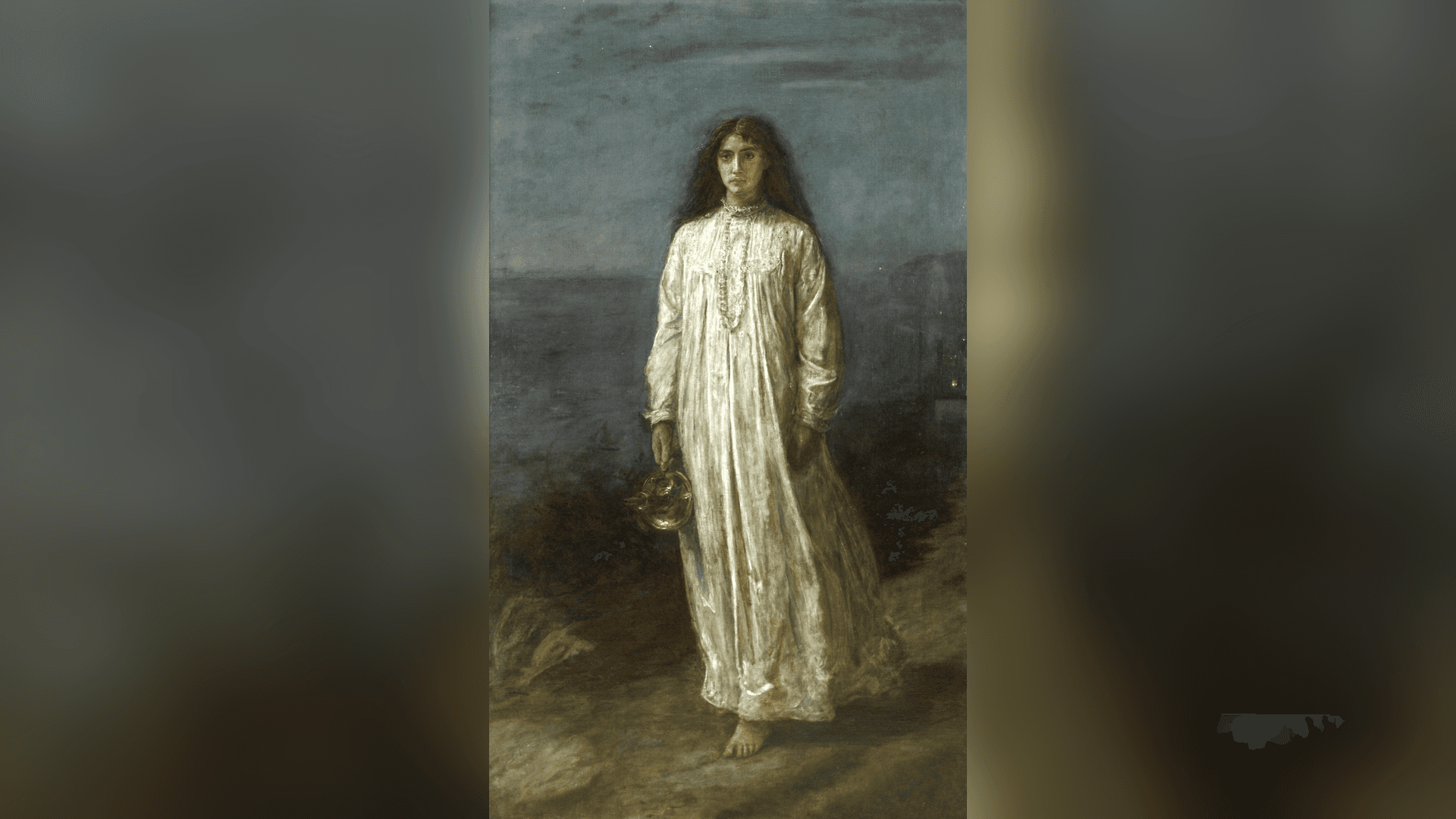
Hero image: The Somnambulist (1871), by John Everett Millais, public domain. Via Wikimedia Commons.
Take our professional IQ test
Want to know your IQ? Try the first ever professional online IQ test.