Aug 3, 2026·Special Population & Related ConditionsWhat Is the Average IQ in Germany?
Where does Germany rank in global IQ scores? Discover the 101–102 average, its institutional infrastructure, and European context. Try the RIOT test!
Dr. Russell T. WarneChief Scientist

Germany sits in an interesting position in the national IQ literature. Its estimated average consistently places it in the upper tier of European nations — but the country has become one of the most important case studies for the reversal of the Flynn Effect, with peer-reviewed research documenting a decline in fluid reasoning scores among German students that is among the steepest and best-evidenced in the developed world. Taking an IQ test and comparing your score to Germany's national figure requires understanding both where the estimate comes from and the significant recent trend that a static number doesn't capture.
What the Data Shows
Estimates of Germany's average IQ span a meaningful range across different sources and methodologies.
The Lynn and Vanhanen dataset — the most academically cited source for national IQ comparisons — places Germany at approximately 102, a figure that appears across multiple aggregators drawing on the same underlying data. IQ Career Lab, which combines the Becker 2019 compilation with World Population Review's 2025 update, places Germany at 103, ranked 6th globally. CogniDNA placed it at 100.7 before shutting down. BrainApps.io places it at 102, ranked 7th. The range across sources — 100.7 to 103 — reflects the same methodological variation present in all national IQ estimates: different underlying studies, different norming periods, different treatment of migration and demographic change, and different weighting of historical versus contemporary data. The most defensible central estimate, weighted toward the most methodologically careful aggregations, places Germany at approximately 101–102 — solidly in the upper tier of European nations, above the global mean of 100, and comparable to its closest regional neighbors including the Netherlands, Austria, and Switzerland.
In the European context, Germany consistently ranks among the top 10 countries, alongside the UK, the Netherlands, Sweden, and Finland. It sits below the East Asian cluster (Hong Kong, South Korea, China) by approximately 4–6 points, and modestly above the United States (approximately 98–100) and the UK (approximately 99–100) depending on the source/
What Germany's Educational and Institutional Infrastructure Explains
Germany's above-average national IQ estimate reflects the product of several structural features of its educational and social environment that the cognitive development research literature consistently identifies as IQ-positive.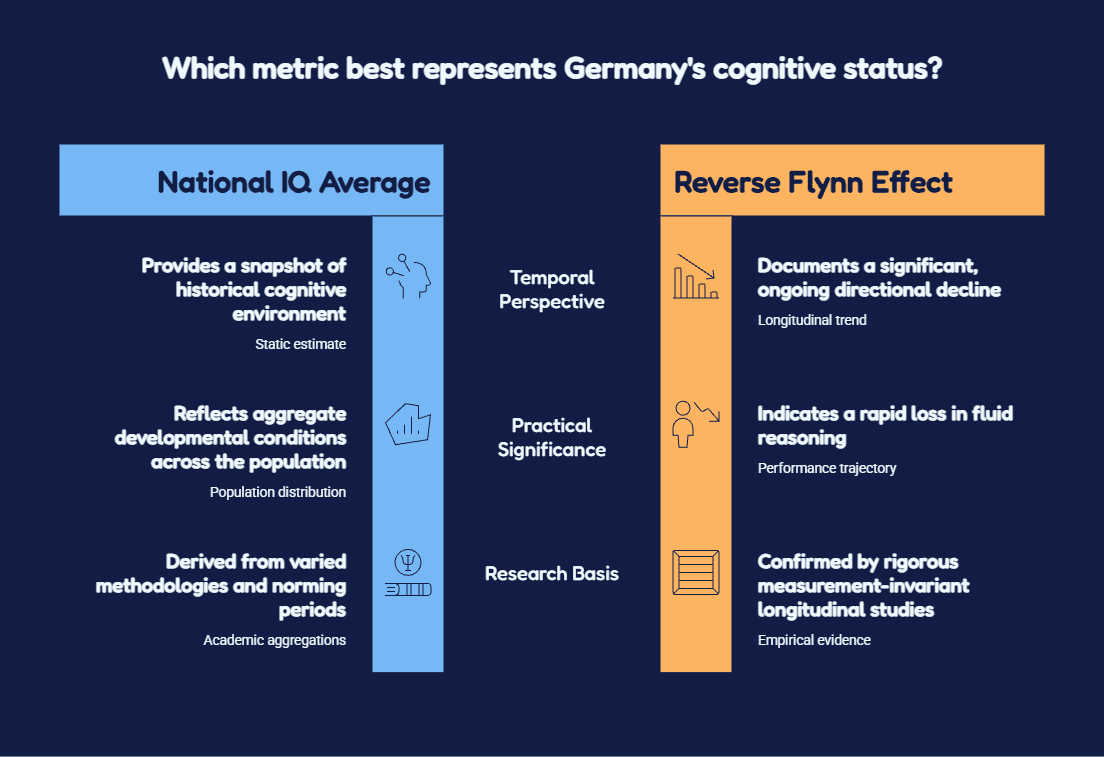
The dual education system. Germany's apprenticeship model — in which roughly half of all secondary school students combine vocational training with workplace learning — is one of the most cognitively demanding and practically effective education systems in the world for producing economically functional adults. Unlike systems that sort the non-academically inclined into low-expectation tracks, the German dual system maintains high cognitive and practical standards for vocational trainees. The sustained intellectual demand this creates across a large fraction of the population is consistent with Flynn Effect dynamics — the cognitive engagement that drives population-level IQ gains.
University and research infrastructure. Germany's university system, free tuition for domestic students, and substantial public investment in research and development create an environment in which cognitive engagement at the highest levels is broadly accessible rather than restricted by income. The country's per capita output of scientific publications and patents, and its concentration of Nobel laureates in physics, chemistry, and medicine, reflect a culture of sustained intellectual development that extends across institutional levels.
Healthcare and nutrition standards. Germany's universal healthcare system, strong food security, and public health infrastructure address the environmental suppressors of cognitive development — iodine deficiency, lead exposure, malnutrition — that depress IQ averages in lower-income countries. These are the foundational conditions that allow whatever genetic and educational advantages exist to actually express in measured cognitive performance.
Historical cognitive infrastructure. Germany's tradition of systematic engineering, science, philosophy, and craft — embedded in institutions from the Fraunhofer Society to the Max Planck Institutes — represents a centuries-long investment in building and transmitting the kind of analytical, systematic thinking that IQ tests directly assess. This crystallized cognitive culture doesn't cause IQ scores directly, but it creates the environmental conditions — demanding schools, high-quality instruction, expectation of analytical competence — that the research consistently shows drive measurable cognitive gains.
The Flynn Effect Reversal: Germany's Most Significant Recent Finding
Germany's average IQ estimate is a static figure. What's more significant — and more concerning — is what longitudinal data shows about the direction of travel in recent cohorts.
Gains in cognitive abilities in the past have turned into losses, which nonlinear regression models show particularly well for German-speaking countries. An evaluation of 43 surveys from PISA, TIMSS, IGLU, and IQB over 20 years found that ability levels in German student populations have been declining. This is not a minor statistical fluctuation — it is a sustained directional trend that appears across multiple independent assessment instruments.
The most methodologically rigorous specific evidence comes from a 2024 study published in the Journal of Intelligence, using three large-scale, population-representative samples of German secondary school students with a combined N of 19,474. Analyses revealed a consistent pattern of significant and meaningful declines in performance from 2012 to 2022 — a decrease in figural reasoning of 4.68 to 5.17 IQ points per decade, corresponding to small-to-medium effect sizes (Cohen's d = 0.34 to 0.38). The study used measurement invariance testing — a methodological control that rules out the possibility that the decline reflects changes in test design rather than genuine performance — and confirmed that the decline is real and not an artifact. A 4.68 to 5.17 point decline per decade is not trivial. By comparison, the historical Flynn Effect produced gains of approximately 3 points per decade across most of the 20th century. What is being observed in Germany is a reversal that exceeds the historical gain rate — meaning the population is losing cognitive performance in fluid reasoning faster than earlier generations gained it.
The study's authors interpreted this as tentative evidence for a decreasing strength of the positive manifold of intelligence — the pattern where performance on different cognitive tasks correlates positively — as a potential cause of the increasing number of reports about inconsistent IQ change trajectories in recent cohorts. In plainer terms: not only are scores declining, but the structure of how different cognitive abilities relate to each other may itself be changing in younger German cohorts.
Why This Is Happening
The causes of Germany's reverse Flynn Effect are contested in the research literature, with several plausible mechanisms proposed.
Digital technology and attention fragmentation. The most widely cited contemporary explanation attributes cognitive score declines in German and other developed-world students to the replacement of deep, sustained reading and structured learning with fragmented, screen-mediated information consumption. The prefrontal cortex-dependent capacities that figural reasoning tasks assess — sustained attention, working memory, abstract pattern detection — are precisely the ones most sensitive to the kind of shallow, interruptive cognitive environment that digital technology creates as a default learning context.
Changes in educational culture. According to research, gains in German student achievement have reversed across PISA, TIMSS, IGLU, and IQB assessments over the past 20 years, suggesting that something about the educational environment itself has changed rather than just the technology context. Reduced emphasis on demanding abstract reasoning in curricula, grade inflation that reduces the cognitive pressure of academic standards, and the replacement of cognitively demanding analogue tasks with digital shortcuts all represent plausible contributing mechanisms. Demographic and immigration dynamics. Germany has received substantial immigration over the past two decades, including significant flows from countries with lower average educational attainment. The within-family design of the Norwegian study that most robustly addressed this question found that the reverse Flynn Effect appeared even within families — ruling out immigration as the primary driver. But in cross-sectional comparisons, the integration of large numbers of immigrants who arrived without the educational preparation typical of the existing German population creates compositional effects on population averages that are distinct from genuine cognitive decline in any sub-population.
Germany in the European Context
Within Europe, Germany's estimated average of 101–102 places it in a cluster of high-performing nations that includes the Netherlands, Finland, Sweden, Austria, and Switzerland — all within a few points of each other and all above the global mean of 100.
The within-Europe variation is itself remarkably compressed. Most European countries cluster between 98 and 103, packed so tightly that a few points in either direction changes a country's ranking considerably without representing a meaningful cognitive difference between the populations. The practical significance of a 2-point difference between Germany and the UK, or between Germany and France, should not be overstated — these are estimates with margins of error that overlap substantially. Germany's performance on internationally comparable achievement assessments — PISA, TIMSS — is broadly consistent with its estimated IQ average, though the post-2012 decline documented in the figural reasoning study is starting to appear in PISA trajectories as well. Germany's 2022 PISA results showed declines across mathematics, reading, and science relative to its 2018 performance — a pattern consistent with the broader reverse Flynn Effect literature.
What the Average Doesn't Tell You
Germany's estimated average of 101–102 reflects aggregate developmental conditions across a country of 84 million people with meaningful variation across states, urban and rural populations, socioeconomic strata, and immigrant versus non-immigrant populations. It tells you something real about the quality of the cognitive environment Germany has historically provided — good schools, universal healthcare, strong nutrition, a demanding vocational and academic education pipeline.
What it doesn't tell you is anything meaningful about any individual German person's cognitive profile. Individual variation within Germany far exceeds the variation between Germany and comparable European nations. A national average of 102 means exactly nothing about where any specific person scores — it describes a population distribution, not an individual capacity. The more practically significant piece of information for Germany in 2026 is not the static average but the directional trend: figural reasoning scores have been declining at a rate of approximately 4.68 to 5.17 IQ points per decade since 2012. If that trend continues, the next decade's estimates will look different from today's, and the country's ranking among its European peers may shift accordingly.
The Takeaway
Germany's average IQ of approximately 101–102 places it in the upper tier of European nations and modestly above the global mean of 100, reflecting decades of investment in universal education, healthcare, and the kind of intellectually demanding culture that the research literature consistently links to above-average population cognitive performance.
The more concerning and more recent finding is Germany's documented reverse Flynn Effect — a decline in figural reasoning of approximately 4.68 to 5.17 IQ points per decade between 2012 and 2022, measured in large-scale representative student samples and confirmed using methodological controls that rule out test design changes as the explanation. Germany is not alone in this trend — it is part of a broader pattern affecting most developed nations — but the magnitude of the decline documented in German student populations is among the best-evidenced in the research literature.
If you want to understand where your own cognitive profile sits — across the fluid reasoning domain where the German decline has been most pronounced, and across the other indices that a national average cannot reveal — the RIOT gives you a domain-level picture that is considerably more informative than any country-level estimate.
References
IQ Career Lab. (2026). Average IQ in Germany: 103 (#6 Globally) — Becker 2019 and World Population Review 2025 methodology. https://www.iqcareerlab.com/tools/iq-by-country/germany Life Score Test. (2026). Average IQ in Germany: 102 — Data, Sources & Context. https://lifescoretest.com/statistics/country/germany BrainApps.io. (2026). Average IQ in Germany: Score, Rank and Country IQ Context — 102, ranked 7th. https://brainapps.io/iq/rating/germanija PubMed Central / Journal of Intelligence. (2024). Measurement-Invariant Fluid Anti-Flynn Effects in Population-Representative German Student Samples (2012–2022) — 4.68 to 5.17 IQ points per decade decline. https://www.ncbi.nlm.nih.gov/pmc/articles/PMC10816863/ ScienceDirect / Intelligence. (2022). Ongoing trends of human intelligence — German-speaking countries show strongest reversal of Flynn Effect in Europe. https://www.sciencedirect.com/science/article/abs/pii/S0160289622000897 World Population Review. (2026). Average IQ by Country 2026 — Hong Kong, South Korea, China lead; Germany in European upper tier. https://worldpopulationreview.com/country-rankings/average-iq-by-country DataPandas. (2026). Average IQ by Country — European compression and East Asian outliers. https://www.datapandas.org/ranking/average-iq-by-country Pressenza. (2025). The decline of the intelligence quotient in the digital age: cognitive reconfiguration and global trends — German IQ trends in broader context. https://www.pressenza.com/2025/07/the-decline-of-the-intelligence-quotient-in-the-digital-age-cognitive-reconfiguration-and-global-trends/
Take our professional IQ test
Want to know your IQ? Try the first ever professional online IQ test.
AuthorDr. Russell T. WarneChief Scientist
