Nov 20, 2025·Special Population & Related Conditions
Is IQ Genetic?
Is IQ genetic? Yes—about 50-60% heritable, but environment also shapes it. Discover what determines your IQ: genes, education, and more.
Dr. Russell T. WarneChief Scientist
Share
One of the most persistent questions in psychology is whether intelligence is genetic. The short answer is yes, but that's far from the whole story. Intelligence is influenced by both genes and environment, and understanding how they interact is more nuanced than most people realize.
Behavioral geneticists measure genetic influence through a statistic called "heritability," which ranges from 0 to 1 (or 0% to 100%). Heritability tells us what proportion of the differences in IQ scores within a population can be attributed to genetic differences between people. Critically, it does not reveal how much of an individual person's IQ comes from their genes.
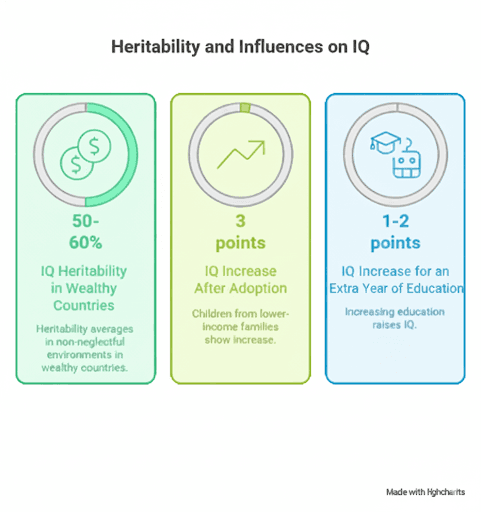
The heritability of IQ is not a fixed number. It varies depending on the population studied and the environment. In non-neglectful environments in wealthy countries, theheritability of IQ tends to average about .50 to .60 (50-60%). Interestingly, heritability for IQ is higher in adults than in young children, suggesting that genetic influences on intelligence become more apparent as people age and create environments that match their genetic predispositions.
Heritability is one of the most misunderstood concepts in genetics. Consider two extreme examples: If a population of clones took an IQ test, heritability would be 0% because there are no genetic differences to cause IQ score differences. Conversely, if every person had an identical environment, heritability would be 100% because only genetic differences could explain IQ variations.
This reveals something important: heritability describes differences between people in a specific population and environment, not the origins of an individual's traits. Saying that IQ is 60% heritable does not mean that 60% of a person’s IQ comes from their parents' DNA and 40% comes from their environment. Both genes and environment are necessary for any trait to develop. Without genes, there's no blueprint; without environment, that blueprint cannot be expressed.
Perhaps most importantly, high heritability does not mean a trait cannot be changed. Height is highly heritable, yet average height increased in many countries during the 20th century due to improved nutrition. Similarly, IQ scores have risen over time through what's known as the Flynn effect, despite IQ's substantial heritability.
Specific Genes for Intelligence
While heritability studies show that genes matter, heritability statistics don’t identify which specific genes are involved. That's where molecular genetics comes in. The search for these genes has been remarkably successful. Currently, there are hundreds of known genetic variants associated with differences in IQ. Researchers can combine these variants to create "polygenic scores" that predict IQ withmodest accuracy, and these predictions should improve as genetic datasets expand and methodologies improve.
The fact that hundreds of genes influence intelligence tells us something important: for the normal range of intelligence, there is no single "intelligence gene." Intelligence emerges from the complex interplay of many genetic variants, each contributing a small effect.
Environmental Influences on IQ
Heritability for IQ may be substantial, but it is never 100%. Some of the clearest evidence for environmental effects comes from adoption studies. When children from lower-income families are adopted into families wealthy enough to meet adoption requirements, the adopted children showan IQ increase of about 3 points compared to what would be expected if they had grown up with their birth families.
Education also matters. Research on the Flynn effect and direct studies of schooling show thatincreasing education by one year raises IQ by about 1-2 points. This measures the effect of the marginal year of schooling, not necessarily the cumulative effect of all years combined, which may be larger.
On the negative side, several environmental factors lower IQ: traumatic brain injury, lead poisoning, and prenatal exposure to alcohol or other toxins. Reducing these occurrences can help someone develop to their full intellectual potential.
Dive into the discussion on what actually makes an IQ test biased, where we break down common misconceptions about fairness in testing, on the RIOT IQ YouTube channel:
Take our professional IQ test
Want to know your IQ? Try the first ever professional online IQ test.