Oct 4, 2026·Special Population & Related Conditions
PKU and IQ: How Phenylketonuria and Its Treatment Shape Intelligence
PKU IQ depends on treatment: untreated phenylketonuria causes severe intellectual disability, while early-treated people usually score in the average range.
Dr. Russell T. WarneChief Scientist
Share
PKU's effect on IQ depends almost entirely on treatment. Untreated phenylketonuria causes severe intellectual disability, but children who are diagnosed through newborn screening and start a low-phenylalanine diet in the first weeks of life usually score in the average range, typically a few points below their siblings and peers.
PKU (phenylketonuria) is an inherited metabolic condition in which the body cannot break down "phenylalanine" (Phe), an amino acid found in protein. Phe builds up in the blood and brain, and the developing brain is especially vulnerable. Hillert and colleagues estimate a global birth prevalence of about 1 in 23,930, and the European PKU guidelines put the average in Europe at about 1 in 10,000. This page covers what untreated PKU did to IQ, how early-treated people score today, the dose-response link between blood Phe and IQ, the cognitive profile beneath the full-scale score, and maternal PKU.
From severe disability to near-average scores
The European guidelines summarise the history. Asbjørn Følling identified PKU in 1934 after finding phenylketone bodies in the urine of affected people. Left untreated, high Phe causes severe intellectual disability, epilepsy and behaviour problems. In 1953 Bickel and colleagues reported that a diet low in phenylalanine helped a child with PKU, and in 1963 Guthrie and Susi published a simple blood test that could screen large populations of newborns. The heel-prick blood spot introduced for PKU is now used to screen for many other conditions, including congenital hypothyroidism.
PKU is often used to show that a genetic condition does not fix an outcome. The cause is a pair of variants in a single gene, yet the cognitive result depends on an environmental factor, diet, applied early enough. Our article on whether IQ is genetic explains why high heritability and changeability can coexist.
The UK Phenylketonuria Register shows how outcomes improved as treatment matured. Smith, Beasley and Ades followed 808 children who started diet before 4 months of age. Among those born between 1964 and 1971, mean IQ at age 4 rose with year of birth from 24 points below revised norms to 10 points below. For children born between 1972 and 1980 it stayed about 8 points below the norms. A subgroup of 46 children with the most favourable treatment averaged 112.6 after adjusting for social class, similar to population norms for that period.
IQ in early-treated PKU today
Early treatment prevents the intellectual disability seen before screening, but it does not always produce an exact match with peers. In a 2025 systematic review of 28 studies of early-treated patients, O'Sullivan and colleagues found that mean full-scale IQ in samples of children ranged from 94.0 to 104.0, and 8 of 11 child studies reported a mean below 100. In adults, study means ranged from 90.0 to 107.6, with 7 of 9 below 100.
Comparisons within the same study are more informative than comparisons with test norms, because they hold the test edition and sample constant. Control groups of healthy children or unaffected siblings scored between 5.2 and 12.9 points higher than children with PKU. In adults the gap ranged from 2 points (unaffected siblings) to 16.4 points (matched healthy controls). Adults who stayed on the diet continuously tended to show the smallest differences. The review was funded by a company that makes a PKU drug, which readers should weigh, though its numbers come from the published studies it pooled.
Blood phenylalanine and IQ: a dose-response link
Within treated PKU, higher blood Phe goes with lower IQ. Waisbren and colleagues pooled within-study correlations from 40 studies. During the critical period from birth to 12 years, the correlation between Phe level and IQ was about -0.35, and each 100 µmol/L increase in Phe predicted a 1.3- to 3.1-point reduction in IQ. Using lifetime Phe levels, each 100 µmol/L increase predicted a 1.9- to 4.1-point reduction.
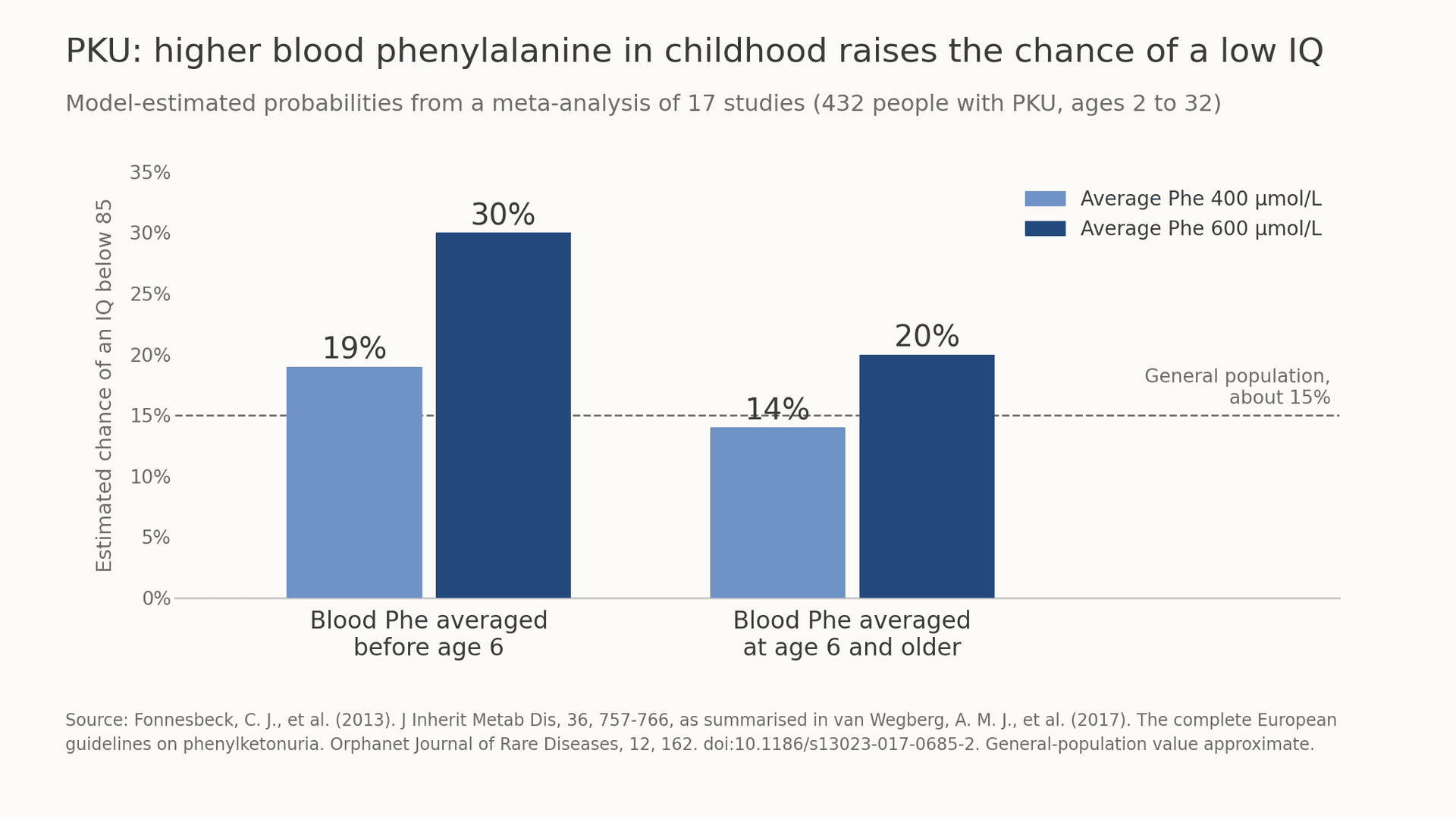
Fonnesbeck and colleagues framed the same relationship as risk. Pooling 17 studies of 432 people with PKU, they estimated the chance of an IQ below 85, which is about 15% in the general population. With average Phe of 400 µmol/L before age 6, the estimated chance was 19%; at 600 µmol/L it was 30%. Levels measured from age 6 onward mattered less (14% and 20%), which fits the idea that early childhood is the most sensitive window.
Timing matters too. In the UK Register data, IQ fell by roughly 4 points for each 4 weeks' delay in starting treatment and for each 300 µmol/L rise in mean Phe during treatment. It also fell by about 4 points for each five months in the first two years during which Phe was kept below 120 µmol/L, a reminder that over-restriction carries its own risk. On this evidence, the European guidelines recommend starting treatment before 10 days of age, keeping Phe between 120 and 360 µmol/L up to age 12 and between 120 and 600 µmol/L after that, and continuing treatment for life. Decisions about targets belong to a specialist metabolic clinic.
The cognitive profile beneath the full-scale score
A near-average full-scale IQ can hide specific weaknesses. In a review of executive function in early-treated PKU, Christ and colleagues found the most consistent problems in working memory and in "prepotent response inhibition", the ability to stop an automatic response. Moyle and colleagues' meta-analysis of continuously treated adolescents and adults found significant differences from controls on full-scale IQ, processing speed, attention, inhibition and motor control. In adults, Hofman and colleagues' systematic review found the most consistent deficits in vigilance, working memory and motor skills.
These findings matter for testing. Slower processing speed can pull down scores on timed subtests, so the index profile is often more useful than the full-scale number alone. A clinician concerned about planning and self-control can add an executive function test to a standard IQ battery. Because current Phe levels can affect attention and speed on the day, recording a recent Phe value alongside the scores helps interpretation.
Maternal PKU: when the mother has the condition
High Phe in a pregnant woman with PKU crosses the placenta, and the fetus is exposed whether or not it inherited PKU. In an international survey of 524 pregnancies, Lenke and Levy found that 95% of mothers with untreated blood Phe of 20 mg/dL or higher had at least one child with intellectual disability.
The Maternal PKU Collaborative Study showed that control before or early in pregnancy largely prevents this. Waisbren and colleagues followed children to age 4 and found that scores on the McCarthy General Cognitive Index fell as weeks to metabolic control increased (r = -0.58). Children whose mothers were in control before pregnancy averaged 99, while 47% of children whose mothers were not in control by 20 weeks scored 2 standard deviations below the norm. Widaman and Azen found a nonlinear relationship, with damage to the developing fetus when average Phe exceeded about 360 µmol/L. Koch and colleagues reported the best birth outcomes when maternal Phe of 120 to 360 µmol/L was reached by 8 to 10 weeks of gestation and maintained. Women with PKU planning a pregnancy are usually advised by their metabolic team well before conception.
Frequently asked questions
Does PKU lower IQ?
Untreated PKU causes severe intellectual disability. With newborn screening and early, continuous treatment, most people score in the average range, though group averages tend to sit a few points below siblings and healthy peers.
What is the average IQ of someone with treated PKU?
Study means for early-treated children range from about 94 to 104, and for adults from about 90 to 108. Individual scores vary widely, and higher blood phenylalanine in early childhood is linked to lower scores.
How much does phenylalanine affect IQ?
A meta-analysis of 40 studies found that each 100 µmol/L increase in blood Phe during childhood predicted an IQ about 1.3 to 3.1 points lower. The relationship is strongest for levels in early childhood.
Can adults with PKU lose IQ if they stop the diet?
In the studies pooled by O'Sullivan and colleagues, adults who stopped the diet early averaged 81, against 112 in adults who stayed on it continuously, and current guidelines recommend treatment for life. Anyone considering a change should discuss it with their metabolic clinic.
Can a mother with PKU have a child with normal intelligence?
Yes. When blood Phe is controlled before conception or very early in pregnancy, children's cognitive scores are typically in the average range.
The takeaway
PKU IQ outcomes are one of medicine's clearest prevention stories. A condition that once caused severe intellectual disability now usually leaves people with average-range scores, provided screening catches it in the first days of life and blood phenylalanine stays controlled, especially in early childhood. Small group differences from siblings remain, and they track how well Phe was controlled. Formal assessment of a person with PKU belongs with a psychologist working alongside the metabolic team. For adults who simply want to see where their reasoning abilities stand, a professionally developed IQ test offers a normed starting point.
References
1. van Wegberg, A. M. J., MacDonald, A., Ahring, K., Bélanger-Quintana, A., Blau, N., Bosch, A. M., ... van Spronsen, F. J. (2017). The complete European guidelines on phenylketonuria: Diagnosis and treatment. Orphanet Journal of Rare Diseases, 12, 162. doi.org
2. Hillert, A., Anikster, Y., Belanger-Quintana, A., Burlina, A., Burton, B. K., Carducci, C., ... Blau, N. (2020). The genetic landscape and epidemiology of phenylketonuria. American Journal of Human Genetics, 107(2), 234-250. doi.org
3. Bickel, H., Gerrard, J., & Hickmans, E. M. (1953). Influence of phenylalanine intake on phenylketonuria [Preliminary communication]. The Lancet, 262(6790), 812-813. doi.org
4. Guthrie, R., & Susi, A. (1963). A simple phenylalanine method for detecting phenylketonuria in large populations of newborn infants. Pediatrics, 32(3), 338-343. doi.org
5. Smith, I., Beasley, M. G., & Ades, A. E. (1990). Intelligence and quality of dietary treatment in phenylketonuria. Archives of Disease in Childhood, 65(5), 472-478. doi.org
6. O'Sullivan, F., Tomazos, I., van Spronsen, F. J., Szabo, S. M., Venkataraman, M., Huria, L., ... Harding, C. O. (2025). Intelligence quotient scores among early-treated phenylketonuria patients: Results from a systematic literature review. Orphanet Journal of Rare Diseases, 20, 314. doi.org
7. Waisbren, S. E., Noel, K., Fahrbach, K., Cella, C., Frame, D., Dorenbaum, A., & Levy, H. (2007). Phenylalanine blood levels and clinical outcomes in phenylketonuria: A systematic literature review and meta-analysis. Molecular Genetics and Metabolism, 92(1-2), 63-70. doi.org
8. Fonnesbeck, C. J., McPheeters, M. L., Krishnaswami, S., Lindegren, M. L., & Reimschisel, T. (2013). Estimating the probability of IQ impairment from blood phenylalanine for phenylketonuria patients: A hierarchical meta-analysis. Journal of Inherited Metabolic Disease, 36(5), 757-766. doi.org
9. Christ, S. E., Huijbregts, S. C. J., de Sonneville, L. M. J., & White, D. A. (2010). Executive function in early-treated phenylketonuria: Profile and underlying mechanisms. Molecular Genetics and Metabolism, 99(Suppl. 1), S22-S32. doi.org
10. Moyle, J. J., Fox, A. M., Arthur, M., Bynevelt, M., & Burnett, J. R. (2007). Meta-analysis of neuropsychological symptoms of adolescents and adults with PKU. Neuropsychology Review, 17(2), 91-101. doi.org
11. Hofman, D. L., Champ, C. L., Lawton, C. L., Henderson, M., & Dye, L. (2018). A systematic review of cognitive functioning in early treated adults with phenylketonuria. Orphanet Journal of Rare Diseases, 13, 150. doi.org
12. Lenke, R. R., & Levy, H. L. (1980). Maternal phenylketonuria and hyperphenylalaninemia: An international survey of the outcome of untreated and treated pregnancies. New England Journal of Medicine, 303(21), 1202-1208. doi.org
13. Waisbren, S. E., Hanley, W., Levy, H. L., Shifrin, H., Allred, E., Azen, C., ... Koch, R. (2000). Outcome at age 4 years in offspring of women with maternal phenylketonuria: The Maternal PKU Collaborative Study. JAMA, 283(6), 756-762. doi.org
14. Widaman, K. F., & Azen, C. (2003). Relation of prenatal phenylalanine exposure to infant and childhood cognitive outcomes: Results from the International Maternal PKU Collaborative Study. Pediatrics, 112(6, Pt. 2), 1537-1543. doi.org
15. Koch, R., Hanley, W., Levy, H., Matalon, K., Matalon, R., Rouse, B., ... de la Cruz, F. (2003). The Maternal Phenylketonuria International Study: 1984-2002. Pediatrics, 112(6, Pt. 2), 1523-1529. doi.org
Figure by RIOT IQ. Data from Fonnesbeck et al. (2013), J Inherit Metab Dis 36, 757-766, as summarised in van Wegberg et al. (2017), Orphanet Journal of Rare Diseases 12, 162 (doi.org/10.1186/s13023-017-0685-2).
Take our professional IQ test
Want to know your IQ? Try the first ever professional online IQ test.