Oct 1, 2026·Special Population & Related Conditions
How Is Autism Assessed? What a Childhood Autism Evaluation Involves
An autism evaluation combines DSM-5-TR criteria, a caregiver developmental history and structured observation of the child. Here is how the process runs.
Dr. Russell T. WarneChief Scientist
Share
An autism evaluation is a multi-source clinical assessment rather than a test with a score. A clinician takes a developmental history from caregivers, observes the child in structured social situations built to press on social communication, collects rating-scale data from parents and teachers, rules out competing explanations, and judges the whole pattern against the DSM-5-TR criteria for autism spectrum disorder.
This page follows that process for children and adolescents: which criteria must be met, which instruments do what, who may diagnose, and why a school's decision and a clinic's decision are separate determinations. Assessment in adulthood is a different exercise, since the instruments were normed on children and the early developmental history often has no available informant, so it has its own page.
What an autism evaluation is looking for
Autism spectrum disorder in the DSM-5-TR is one diagnosis with graded severity rather than a set of subtypes, and it requires evidence in two separate symptom domains. A child who shows only one does not meet criteria.
• Criterion A, social communication: "Persistent deficits in social communication and social interaction across multiple contexts." All three listed features must be present currently or by history: social-emotional reciprocity, nonverbal communicative behaviors used for social interaction, and the developing, maintaining and understanding of relationships.
• Criterion B, restricted and repetitive behavior: "Restricted, repetitive patterns of behavior, interests, or activities," where at least two of four features apply: stereotyped or repetitive motor movements, use of objects or speech; insistence on sameness and inflexible routines; highly restricted and fixated interests; hyper- or hyporeactivity to sensory input.
• Criterion C, timing: Symptoms must be present in the early developmental period, though the manual notes they may not become fully manifest until social demands exceed the child's capacities, and may be masked by learned strategies later in life.
• Criteria D and E: The symptoms cause clinically significant impairment and are not better explained by intellectual disability or global developmental delay. A child with marked social communication difficulty who does not meet Criterion B is directed toward social (pragmatic) communication disorder.
Severity is rated on three levels, from "requiring support" to "requiring very substantial support," separately for each domain, so a child can be a level 1 socially and a level 3 on repetitive behavior. Specifiers record accompanying intellectual or language impairment, an associated genetic or medical condition, and catatonia.
Measured ability varies widely within this diagnosis. Among 8-year-olds with autism in the 2022 ADDM surveillance year who had cognitive data on record, 39.6% were classified as having an intellectual disability, leaving the majority at or above that threshold. Our article on IQ and autism covers that distribution and the uneven cognitive profiles behind it.
The instruments, and what each one can settle
No instrument diagnoses autism. In the diagnostic-accuracy literature the reference standard against which these tools are judged is the clinical judgment of a multidisciplinary team, which tells you where the authority sits.
• The caregiver developmental interview: The Autism Diagnostic Interview-Revised is a long investigator-based interview covering early language, social development and repetitive behavior. In the Cochrane review of preschool diagnostic tests, pooled across five analyses of 634 children, its summary sensitivity was 0.52 (95% CI 0.32 to 0.71) and its specificity 0.84 (95% CI 0.61 to 0.95). Our page on the ADI-R describes the algorithm.
• The structured observation: The Autism Diagnostic Observation Schedule, Second Edition applies graded social pressure through play or conversation, with five modules chosen by age and expressive language level. Across 12 analyses of 1,625 children, summary sensitivity for the ADOS was 0.94 (95% CI 0.89 to 0.97) and specificity 0.80 (95% CI 0.68 to 0.88), the most sensitive of the tools compared. See our guide to the ADOS-2.
• Rating scales: The Social Responsiveness Scale, Second Edition and the Childhood Autism Rating Scale, Second Edition quantify trait level from multiple raters. Cochrane's four CARS analyses gave a summary sensitivity of 0.80 and specificity of 0.88.
• Qualitative and sensory-based interviews: The MIGDAS-2 structures a sensory-focused conversation with the child plus parent and teacher interviews. It was not among the instruments with pooled accuracy data in the Cochrane review, and independent accuracy evidence remains thin, so treat its output as description rather than confirmation.
• Adaptive and cognitive measures: These are usually added, partly to address Criterion E and partly because service eligibility turns on functioning rather than on the label.
One caveat governs these numbers. Autism prevalence in the pooled Cochrane analyses was 74%, because the samples came from specialist clinics. In a community population the same sensitivity and specificity produce far more false positives, which is why a positive screen is a referral rather than an answer.
Who may diagnose, and in what order the steps happen
• Surveillance, then a screener: The American Academy of Pediatrics recommends standardized autism-specific screening at 18 and 24 months alongside ongoing developmental surveillance. The most used screener, the M-CHAT-R/F, was validated on 16,071 toddlers: children scoring 3 or higher initially and 2 or higher after the structured follow-up interview had a 47.5% risk of an autism diagnosis and a 94.6% risk of some developmental delay or concern. The US Preventive Services Task Force reached a different conclusion for 18-to-30-month-olds whose parents and clinicians have raised no concerns, finding the evidence insufficient to weigh benefits against harms. That disagreement concerns universal screening rather than the evaluation of a child whose caregivers are already worried.
• Referral to a team: The evaluation is usually run by a developmental-behavioral pediatrician, a child psychiatrist, a child neurologist, or a licensed clinical or school psychologist, often with a speech-language pathologist and an occupational therapist contributing. Psychology licensure and its scope are set state by state, so who may sign a diagnosis depends on your state's licensing statute.
• How young is possible: In a cohort of 1,269 toddlers first evaluated between 12 and 36 months, the diagnostic stability of autism was 0.84 overall, higher than for any other diagnostic group. Stability was 0.50 in the 12-to-13-month band, rising to 0.79 by 14 months and 0.83 by 16 months. In the same cohort 23.8% of the children eventually identified were missed at their first visit, which is the argument for re-evaluating rather than discharging.
School eligibility and a clinical diagnosis are different determinations
Parents routinely assume that a clinic diagnosis entitles a child to school services, or that a school team has diagnosed their child. Neither follows.
IDEA's autism category is defined in regulation as "a developmental disability significantly affecting verbal and nonverbal communication and social interaction, generally evident before age three, that adversely affects a child's educational performance" (34 CFR 300.8(c)(1)(i)). That is an educational classification with an educational-impact requirement written into it, and a child qualifies as a child with a disability only if, by reason of the impairment, the child "needs special education and related services" (34 CFR 300.8(a)(1)). A child who has the condition and needs only a related service is expressly not a child with a disability under the statute (34 CFR 300.8(a)(2)(i)).
The procedure differs too. Eligibility is decided by a group of qualified professionals together with the parent (34 CFR 300.306(a)(1)), no single measure may be the sole criterion (34 CFR 300.304(b)(2)), and the evaluation must be completed within 60 days of parental consent unless the state sets its own timeframe (34 CFR 300.301(c)(1)). The evaluation costs the family nothing, and the agency must supply a free copy of the report and the eligibility documentation (34 CFR 300.306(a)(2)).
Surveillance data show how little the two systems overlap. Of 8,613 8-year-olds meeting the ADDM case definition in 2022, 68.4% had a documented diagnostic statement and 67.3% had an autism special education eligibility, yet only 34.6% had all three elements of the case definition on record.
What the timeline looks like, and what stretches it
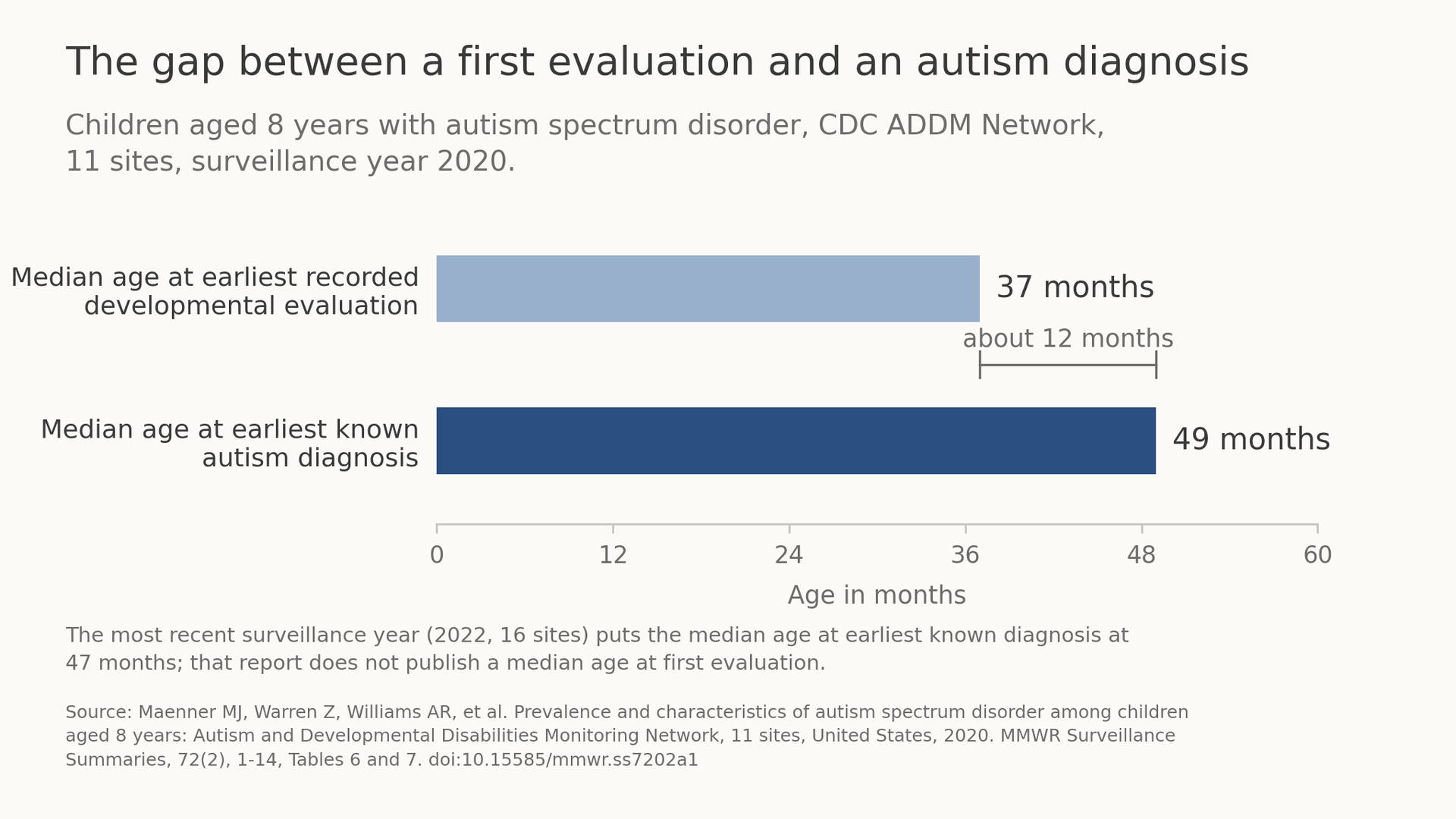
Median age at earliest known autism diagnosis in the 2022 surveillance year was 47 months across 16 sites, ranging from 36 months in California to 69.5 months in Texas (Laredo). The lag is the interesting part. In the previous report, covering 11 sites in 2020, the median age at first recorded developmental evaluation was 37 months while the median age at earliest known diagnosis was 49 months, roughly a year inside the system between the first professional look and the name. An older single-metro study found a mean first evaluation at 48 months against a mean first diagnosis at 61 months, with 24% undiagnosed until they entered school and 70% of practitioners assigning that first diagnosis using no instrument.
Where a family lands in that distribution is partly predictable. Co-occurring intellectual disability pulls diagnosis earlier (43 months against 49 months in the 2022 data), and site matters enormously, as does documented instrument use, which ranged from 24.7% of children in New Jersey to 93.5% in Puerto Rico. Sex matters too: a meta-analysis of 54 studies put the true male-to-female ratio among children meeting criteria closer to 3:1 than the 4:1 usually quoted, with studies counting only children who already held a diagnosis producing a ratio of 4.56.
Frequently asked questions
Is there a single test for autism?
No. Every instrument in use is judged against multidisciplinary clinical judgment as the reference standard, and IDEA evaluations are separately forbidden from resting on any single measure (34 CFR 300.304(b)(2)).
At what age can autism be reliably diagnosed?
Diagnostic stability in a large primary-care-referred cohort was 0.50 at 12 to 13 months and 0.83 by 16 months, so a diagnosis made from about 14 months onward tends to hold. Screening is recommended at 18 and 24 months.
Does an autism evaluation include an IQ test?
Usually, though not to establish the diagnosis. Cognitive and adaptive measures address the differential with intellectual disability and document functioning for service planning.
Can a school diagnose autism?
No. A school team determines eligibility under IDEA's autism category, an educational classification with its own criteria and procedure, which is not a medical or psychiatric diagnosis.
What if a first evaluation finds nothing?
Ask what the alternative explanation is and what will be rechecked. Roughly a quarter of the children eventually identified in the San Diego cohort were missed at their first visit.
The takeaway
An autism evaluation earns its conclusion from convergence. A developmental history, a structured observation, rating scales from people who see the child in different settings, and a worked-through differential are what make the judgment defensible, and a report leaning on one score is weaker than it looks. Ask which instruments were administered, who observed the child and for how long, whether teacher report was collected, and whether the document in your hand is a diagnosis or an eligibility determination. To see how a carefully normed cognitive measure reports its results, you can take a professionally developed IQ test, the Reasoning and Intelligence Online Test.
References
1. American Psychiatric Association. (2022). Diagnostic and statistical manual of mental disorders (5th ed., text rev.). American Psychiatric Association Publishing. doi.org
2. Hyman, S. L., Levy, S. E., Myers, S. M., & Council on Children With Disabilities, Section on Developmental and Behavioral Pediatrics. (2020). Identification, evaluation, and management of children with autism spectrum disorder. Pediatrics, 145(1), e20193447. doi.org
3. Robins, D. L., Casagrande, K., Barton, M., Chen, C.-M. A., Dumont-Mathieu, T., & Fein, D. (2014). Validation of the Modified Checklist for Autism in Toddlers, Revised with Follow-up (M-CHAT-R/F). Pediatrics, 133(1), 37-45. doi.org
4. Siu, A. L., & US Preventive Services Task Force. (2016). Screening for autism spectrum disorder in young children: US Preventive Services Task Force recommendation statement. JAMA, 315(7), 691-696. doi.org
5. Randall, M., Egberts, K. J., Samtani, A., Scholten, R. J., Hooft, L., Livingstone, N., Sterling-Levis, K., Woolfenden, S., & Williams, K. (2018). Diagnostic tests for autism spectrum disorder (ASD) in preschool children. Cochrane Database of Systematic Reviews, 2018(7), CD009044. doi.org
6. Lord, C., Risi, S., Lambrecht, L., Cook, E. H., Leventhal, B. L., DiLavore, P. C., Pickles, A., & Rutter, M. (2000). The Autism Diagnostic Observation Schedule-Generic: A standard measure of social and communication deficits associated with the spectrum of autism. Journal of Autism and Developmental Disorders, 30(3), 205-223. doi.org
7. Lord, C., Rutter, M., & Le Couteur, A. (1994). Autism Diagnostic Interview-Revised: A revised version of a diagnostic interview for caregivers of individuals with possible pervasive developmental disorders. Journal of Autism and Developmental Disorders, 24(5), 659-685. doi.org
8. Constantino, J. N., Davis, S. A., Todd, R. D., Schindler, M. K., Gross, M. M., Brophy, S. L., Metzger, L. M., Shoushtari, C. S., Splinter, R., & Reich, W. (2003). Validation of a brief quantitative measure of autistic traits: Comparison of the Social Responsiveness Scale with the Autism Diagnostic Interview-Revised. Journal of Autism and Developmental Disorders, 33(4), 427-433. doi.org
9. Schopler, E., Reichler, R. J., DeVellis, R. F., & Daly, K. (1980). Toward objective classification of childhood autism: Childhood Autism Rating Scale (CARS). Journal of Autism and Developmental Disorders, 10(1), 91-103. doi.org
10. Pierce, K., Gazestani, V. H., Bacon, E., Barnes, C. C., Cha, D., Nalabolu, S., Lopez, L., Moore, A., Pence-Stophaeros, S., & Courchesne, E. (2019). Evaluation of the diagnostic stability of the early autism spectrum disorder phenotype in the general population starting at 12 months. JAMA Pediatrics, 173(6), 578-587. doi.org
11. Shaw, K. A., Williams, S., Patrick, M. E., Valencia-Prado, M., Durkin, M. S., Howerton, E. M., ... Maenner, M. J. (2025). Prevalence and early identification of autism spectrum disorder among children aged 4 and 8 years: Autism and Developmental Disabilities Monitoring Network, 16 sites, United States, 2022. MMWR Surveillance Summaries, 74(2), 1-22. doi.org
12. Maenner, M. J., Warren, Z., Williams, A. R., Amoakohene, E., Bakian, A. V., Bilder, D. A., ... Shaw, K. A. (2023). Prevalence and characteristics of autism spectrum disorder among children aged 8 years: Autism and Developmental Disabilities Monitoring Network, 11 sites, United States, 2020. MMWR Surveillance Summaries, 72(2), 1-14. doi.org
13. Wiggins, L. D., Baio, J., & Rice, C. (2006). Examination of the time between first evaluation and first autism spectrum diagnosis in a population-based sample. Journal of Developmental and Behavioral Pediatrics, 27(2 Suppl.), S79-S87. doi.org
14. Loomes, R., Hull, L., & Mandy, W. P. L. (2017). What is the male-to-female ratio in autism spectrum disorder? A systematic review and meta-analysis. Journal of the American Academy of Child and Adolescent Psychiatry, 56(6), 466-474. doi.org
15. U.S. Department of Education. (2024). Assistance to states for the education of children with disabilities, 34 CFR part 300 (child with a disability and the autism category at 300.8; evaluation procedures at 300.304; initial evaluation timeline at 300.301; eligibility determination at 300.306). Electronic Code of Federal Regulations. ecfr.gov
Figure by Riot IQ. Data from Maenner, Warren, Williams et al. (2023), MMWR Surveillance Summaries 72(2), 1-14, Tables 6 and 7 (doi.org/10.15585/mmwr.ss7202a1).
Take our professional IQ test
Want to know your IQ? Try the first ever professional online IQ test.