Aug 3, 2026·Special Population & Related ConditionsWhat Is the Average IQ of a Doctor?
From NLSY79 datasets to the limits of IQ in clinical practice: discover what intelligence predicts in medicine and measure your own profile with RIOT!
Dr. Russell T. WarneChief Scientist

Doctors occupy a consistent position near the top of every occupational IQ ranking — and for reasons that go beyond cultural prestige. The cognitive selection process for medicine is among the most sustained and multi-stage of any profession, filtering candidates across undergraduate performance, a demanding admissions test, four years of medical school, licensing examinations, and years of specialty training. Taking an IQ test and comparing your score to a physician's average is a natural impulse — and the data on where that average sits is now specific enough to be genuinely informative.
What the Best Available Data Shows
The most methodologically rigorous source for occupational IQ estimates is the NLSY79 — the National Longitudinal Survey of Youth, a nationally representative cohort study that tracked participants from 1979 onward and administered the Armed Forces Qualifying Test (AFQT), a well-validated proxy for general cognitive ability that correlates strongly with IQ measures. Because the NLSY79 followed participants over decades and recorded their eventual occupations, it allows for genuine occupation-level cognitive ability estimates from a large, representative sample rather than from self-selected test-takers.
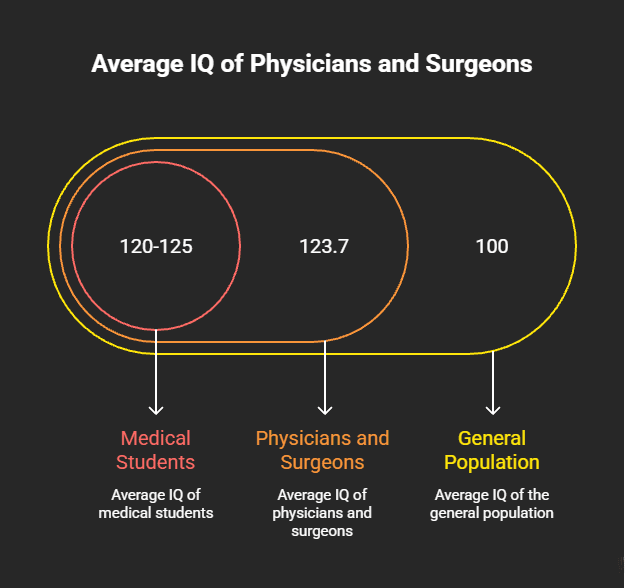
The NLSY79 data places the average IQ of physicians and surgeons at 123.7 — in the Superior classification at approximately the 94th percentile of the general population, based on a sample of 30 physicians in the dataset. The small sample size is a genuine limitation — it reflects the rarity of physicians in any population-representative sample — and should temper confidence in the precision of the specific figure. But the directional finding is consistent across multiple data sources: physicians consistently land in the 120–130 range across different estimation approaches. Broader estimates from multiple sources converge on the same range. Studies suggest the average IQ for doctors typically falls between 120 and 130, placing them in the "Very Superior" intelligence category achieved by only a small fraction of the general population. Medical students — the cohort most directly studied since they're accessible in institutional settings — are estimated at a mean IQ of 120–125, with the eventual physician population sitting slightly higher due to ongoing selection through residency and licensure. For practical purposes, the most defensible single estimate for the average practicing physician's IQ sits at approximately 120–125, with surgeons trending toward the higher end.
How the Medical Selection Process Drives Cognitive Selection
The physician IQ average doesn't emerge by accident — it is the product of one of the most extended cognitive filtering processes any profession applies. Understanding the stages clarifies why the average lands where it does.
Undergraduate GPA in demanding science coursework. Pre-medical coursework — general chemistry, organic chemistry, physics, biochemistry, and biology — is designed to be cognitively demanding in ways that systematically filter out candidates who cannot sustain high academic performance across multiple quantitative and scientific disciplines simultaneously. The competition for medical school admission means that applicants with lower cognitive profiles are progressively eliminated at the undergraduate stage.
The MCAT. The Medical College Admission Test is the most direct cognitive ability proxy in the medical admission pipeline. MCAT scores correlate with general reasoning ability, and longitudinal research tracking Jefferson Medical College graduates over 36 graduating classes found that MCAT performance predicted outcomes across medical school, residency, and licensing exams. The MCAT assesses critical analysis and reasoning, biological and biochemical foundations of living systems, and psychological and social foundations of behavior — a multi-domain cognitive battery that functions as a de facto IQ screen even though it was not designed as one.
Medical school and USMLE licensing. Four years of medical school require continuous high-level cognitive performance across an expanding knowledge base. The United States Medical Licensing Examination (USMLE) — the three-step licensing process that determines whether graduates can practice — creates additional cognitive filtering. Candidates who do not demonstrate sufficient reasoning ability across clinical and basic science domains do not advance.
Residency match and specialty selection. The residency matching process introduces a final layer of cognitive selection, with the most competitive specialties — neurosurgery, dermatology, radiology, orthopedic surgery — attracting applicants with the strongest academic profiles and implicitly the highest cognitive ability. Each stage compounds the selection pressure, which is why the higher occupation-level IQ compared to the education-level mean for professional degree holders suggests additional cognitive selection within this education band.
Variation by Specialty
The average across all physicians conceals meaningful variation by specialty, though the evidence base here is thinner than the overall average and most differences are modest rather than dramatic.
Surgeons and academic medicine professionals often score near or above 130, reflecting the additional cognitive demands of procedural precision and research-intensive careers. The cognitive demands of surgery are specific: spatial reasoning for three-dimensional anatomical navigation, processing speed for rapid intraoperative decision-making, and working memory for simultaneous management of multiple procedural variables under time pressure. Surgeons who require quick decision-making and advanced problem-solving skills may average closer to the higher end of the 120–130 spectrum.
At the top of the specialty IQ rankings in most analyses sit physicians and surgeons alongside professors and researchers, both clustering in the low 130s. Below that, in the high 120s, are lawyers, followed by accountants in the low 120s, with pharmacists averaging around 120.
The specialty variation is best understood through the lens of cognitive profile rather than overall level. Different specialties draw on different cognitive strengths: radiology requires exceptional pattern recognition and spatial reasoning for interpreting imaging; pathology requires deep pattern classification; psychiatry emphasizes verbal reasoning and interpersonal cognition; emergency medicine emphasizes rapid processing speed and decision-making under uncertainty. The average IQ across specialties is comparable — it's the specific cognitive profile that differs more than the overall level.
What the IQ Does and Doesn't Explain About Clinical Performance
One of the most consistently documented findings in the medical education literature is that beyond a threshold of approximately IQ 115–120, additional cognitive ability shows diminishing returns for clinical performance. Beyond an IQ threshold of roughly 115–120, additional cognitive ability produces diminishing returns for clinical performance. Nearly everyone who completes medical training has cleared that threshold. What differentiates performance within the physician population is not primarily additional IQ points — it is non-cognitive attributes including conscientiousness, emotional intelligence, and sustained motivation. Research on emotional intelligence among physicians reinforces this. A 2025 cross-sectional study of 100 residents and physicians in Jordan found a significant association between EI and medical specialty, with psychiatrists showing the highest mean global trait EI and general surgeons showing the lowest — consistent with the different interpersonal demands of these specialties. Higher EI has been linked to reduced physician burnout, stronger patient rapport, and improved communication outcomes, none of which are directly captured by IQ. The broader framework from the personnel selection literature applies directly here: meta-analyses consistently find that general cognitive ability is the single best predictor of job performance across occupations, with validity coefficients of approximately r ≈ .5 for complex jobs like medicine. But that coefficient of .5 leaves considerable variance explained by other factors — personality, experience, domain knowledge, and clinical judgment developed through years of practice.
How Doctors Compare to Other High-IQ Professions
Placing the physician average in context: at the top of occupational IQ lists, in the low 130s, are either physicians and surgeons or professors and researchers, depending on the study. Both groups cluster near each other, with the range among physicians and surgeons more tightly distributed than the broader range for professors and researchers — reflecting the more standardized selection pipeline of medicine versus the more varied paths into academic careers.
Among healthcare professionals, the cognitive gradient within the profession is steep. Registered nurses average approximately IQ 104, licensed practical nurses approximately 95, and nursing aides approximately 87 — a pattern that reflects the different educational and cognitive selection pressures across healthcare roles. The 20-point gap between the average physician and the average nurse reflects the difference in training length, complexity, and admission selectivity more than any inherent cognitive difference between the people who enter these tracks.
The Takeaway
The average IQ of a doctor sits at approximately 120–125, with the NLSY79 data producing a specific estimate of 123.7 for physicians and surgeons at the 94th percentile of the general population. Surgeons and academic physicians trend toward the higher end of the 120–130 range. The average reflects the product of one of the longest and most multi-stage cognitive selection processes of any profession — a pipeline that begins with undergraduate science performance and continues through MCAT, medical school, licensing examinations, and specialty training.
What the IQ average doesn't tell you is everything important about clinical competence. Beyond the 115–120 threshold that medical training has already filtered for, additional IQ points show diminishing returns for clinical performance. What differentiates good physicians from exceptional ones within that already cognitively selected population is predominantly non-cognitive: conscientiousness, emotional regulation, clinical judgment, and the kind of domain expertise built through years of patient contact that no IQ test was ever designed to measure.
If you want to understand where your own cognitive profile sits relative to the occupational averages — and see which specific indices are strongest in your individual profile — the RIOT gives you a domain-level picture that goes considerably further than a single occupational average.
References
Cogn-IQ.org. (2026). Average IQ of a Physician / Surgeon: 123.7 (NLSY79 Data) — 94th percentile, n=30. https://www.cogn-iq.org/iq-by-occupation/physician/ Neurolaunch. (2026). Medical Students' IQ: Exploring Intelligence in Aspiring Doctors — mean 120–125, MCAT correlation, threshold effect. https://neurolaunch.com/average-iq-of-medical-students/ IQ Free Tests. (2025). What is the Average IQ of a Doctor? A Data-Driven Analysis — specialty variation and selection pipeline. https://iqfreetests.com/what-is-the-average-iq-of-a-doctor IQ Tests. (2024). Average IQ of Doctors By Specialty — surgeons near 130, academic medicine exceeding 130. https://iqtests.com/blog/blog-iq-by-profession/average-doctor-iq Med School Insiders. (2025). Are Doctors Smart? IQ by Profession — low 130s at top, specialty ranking and comparison. https://medschoolinsiders.com/lifestyle/are-doctors-smart-iq-by-profession/ The Fit Finance. (2026). IQ of Doctors vs Engineers: Average IQ by Profession — 120s to 130 range, specialties at 130. https://thefitfinance.com/average-iq-by-profession/ Real IQ Test Online. (2024). Average IQ of Doctors — 125 for medical school applicants, specialty variation. https://realiqtestonline.com/blog/average-iq-of-doctors/ PubMed Central. (2025). Emotional Intelligence Among Physicians of Different Specialties in Jordan — psychiatrists highest EI, surgeons lowest. https://www.ncbi.nlm.nih.gov/pmc/articles/PMC12456851/
Take our professional IQ test
Want to know your IQ? Try the first ever professional online IQ test.
AuthorDr. Russell T. WarneChief Scientist
