Oct 6, 2026·Special Population & Related Conditions
Type 1 Diabetes and IQ: Does Childhood Diabetes Affect Intelligence?
Type 1 diabetes and IQ: most children with the condition score in the normal range, slightly below peers, with larger gaps when diabetes starts before age 7.
Dr. Russell T. WarneChief Scientist
Share
Type 1 diabetes has only a small average effect on IQ: in a meta-analysis of children, those with diabetes scored about 1 to 3 points below their peers, and most were squarely in the normal range. The gap is larger, up to about half a standard deviation on some measures, for children diagnosed before age 7.
This article covers what the research shows in children and adults, why early onset matters, what role low and high blood sugar play, and how to read a test score from someone with diabetes. It describes research findings only. Questions about diabetes care belong with the person's diabetes team, and questions about learning or memory with a psychologist or clinical neuropsychologist.
What the research shows in children
The best summary of childhood findings is a 2008 meta-analysis in Diabetes Care by Patricia Gaudieri and colleagues. Their main analysis compared 1,029 children with type 1 diabetes, average age about 13, with 751 children without diabetes.
Children with diabetes scored slightly lower than controls across most cognitive areas, including measured intelligence, processing speed, attention and academic achievement. The overall effect size was -0.13 standard deviations. On a scale where the average is 100 and the standard deviation is 15, that is a difference of about 1 to 3 points, which the authors described as unlikely to be clinically detectable. Learning and memory showed no overall difference.
In plain terms, the typical child with type 1 diabetes has typical cognitive ability. The averages hide some variation, and the authors noted that a minority of children may be more clearly affected.
Why age at diagnosis matters
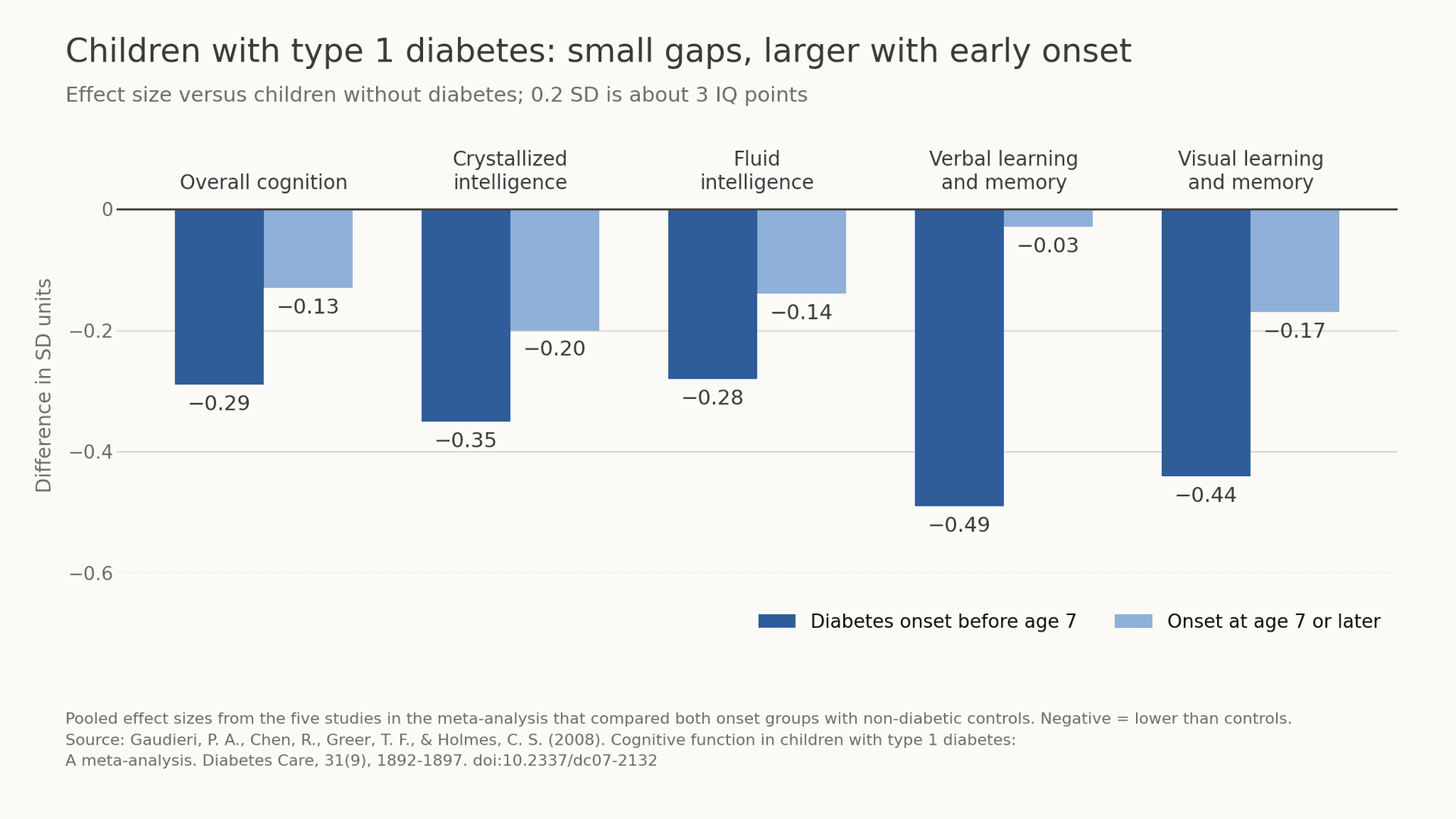
The clearest finding is about timing. The chart above shows results from the five studies in the Gaudieri meta-analysis that compared both early-onset and later-onset groups with children without diabetes.
• Diagnosed before age 7: These children scored about 0.3 standard deviations lower overall, and around 0.35 lower on crystallized intelligence (knowledge and vocabulary) and 0.28 lower on fluid intelligence (reasoning with new problems). The largest gaps were in verbal learning and memory (-0.49) and visual learning and memory (-0.44), equal to roughly 6.5 to 7 points on a standard scale.
• Diagnosed at 7 or later: These children scored about 0.13 standard deviations lower overall, with small gaps on crystallized (-0.20) and fluid (-0.14) intelligence and almost none on verbal memory (-0.03).
An Australian study by Northam and colleagues followed 90 children from diagnosis and tested them again six years later alongside 84 community controls. The children with diabetes did worse on intelligence, attention, processing speed, long-term memory and executive skills. Attention, processing speed and executive skills were especially affected in children diagnosed before age 4.
School records show the same pattern on a national scale. Dahlquist and Källén linked the Swedish childhood diabetes register to school grades for 5,159 children with diabetes and more than 1.3 million without. Children with diabetes had slightly lower average marks at the end of compulsory school (3.15 versus 3.23 on the Swedish scale), and the lowest average, though not statistically different from the other onset groups, was among those diagnosed before age 2.
Northam and colleagues suggested that severe hypoglycemia in very young children is the most plausible explanation, with a possible contribution from long periods of high blood sugar. The studies cannot fully separate early onset from the longer duration of illness that it brings.
Low blood sugar, high blood sugar and test scores
Two kinds of glucose effect matter for IQ testing.
• Acute effects on the day: A review by Warren and Frier found that cognitive performance becomes impaired during hypoglycemia (low blood sugar), that complex tasks are more sensitive than simple ones, and that recovery can lag behind the return of normal glucose. High blood sugar also matters. In a study by Cox and colleagues, adults with diabetes who completed tasks on a handheld computer were slower on all tests when their glucose was high, an effect seen in about half of participants.
• Long-term effects of severe episodes: The evidence here is mixed. Northam's study linked severe hypoglycemia with lower verbal and full-scale IQ. In the Gaudieri meta-analysis, a history of hypoglycemic seizures had only a negligible overall effect (-0.06), with small, inconsistent differences on some measures.
The practical point is that a score obtained during a low or very high glucose reading may understate a person's usual ability. A clinical neuropsychologist can take medical factors like this into account when interpreting results, as described in our guide to neuropsychological testing.
Type 1 diabetes and IQ in adults
In adults, a 2005 meta-analysis of 33 studies by Brands and colleagues found lower performance in people with type 1 diabetes in several areas, including the domain labelled intelligence (d = -0.7), processing speed, mental flexibility and attention. Learning and memory were spared. The lower performance was associated with microvascular complications, such as damage to the small blood vessels of the eyes and kidneys, and not with severe hypoglycemia or poor metabolic control in the studies available.
The longest follow-up comes from the Diabetes Control and Complications Trial and its follow-up study (DCCT/EDIC). In 1,144 adults first tested at an average age of 27 and retested about 18 years later, neither the original treatment group nor the frequency of severe hypoglycemia was linked to cognitive decline, even though 40% had had at least one hypoglycemic coma or seizure. Higher average glucose was linked to moderate declines in motor speed and psychomotor efficiency only.
By the 32-year follow-up, when the median age was 59, the picture had changed. Participants showed substantial declines in memory and in psychomotor and mental efficiency, and higher glucose levels, more severe hypoglycemia and higher blood pressure each predicted larger declines in psychomotor and mental efficiency. Together these three risk factors had an effect equivalent to about 9.4 extra years of age. This mirrors the slowing described in our article on measuring cognitive aging, arriving earlier in people with more risk factors.
Type 2 diabetes is a separate condition, usually diagnosed in adulthood, and a systematic review by Biessels and colleagues links diabetes in later life to a higher risk of dementia.
Frequently asked questions
Does type 1 diabetes lower IQ?
On average only slightly. Children with type 1 diabetes score about 1 to 3 points below peers, and most are in the normal range.
Does age at diagnosis affect intelligence in type 1 diabetes?
Yes. Children diagnosed before age 7 show larger differences, up to about half a standard deviation on learning and memory, while children diagnosed later differ very little from peers.
Can low blood sugar affect an IQ test result?
Yes. Hypoglycemia impairs performance during the episode and for a while afterwards, so a score obtained during a low may not reflect a person's usual ability.
Do severe hypoglycemic episodes cause lasting IQ loss?
The evidence is mixed. Some childhood studies link severe episodes to lower verbal IQ, while the large DCCT/EDIC adult study found no link to decline over 18 years, though severe episodes did predict decline by 32 years.
Who should assess a child with diabetes who is struggling at school?
A school or educational psychologist can assess learning, and a clinical neuropsychologist can carry out a full cognitive assessment. The child's diabetes team can advise on any medical factors.
The takeaway
The link between type 1 diabetes and IQ is real but small for most people. Children diagnosed before age 7 show the clearest differences, mainly in learning and memory, while those diagnosed later are close to their peers. In adults, the DCCT/EDIC study found little change over 18 years and more decline by later life among people with more risk factors. If you would like a clear baseline of your own reasoning ability, you can try a professionally developed IQ test on a day when you feel well.
References
1. Gaudieri, P. A., Chen, R., Greer, T. F., & Holmes, C. S. (2008). Cognitive function in children with type 1 diabetes: A meta-analysis. Diabetes Care, 31(9), 1892-1897. [doi.org/10.2337/dc07-2132](. doi.org
2. Northam, E. A., Anderson, P. J., Jacobs, R., Hughes, M., Warne, G. L., & Werther, G. A. (2001). Neuropsychological profiles of children with type 1 diabetes 6 years after disease onset. Diabetes Care, 24(9), 1541-1546. [doi.org/10.2337/diacare.24.9.1541](. doi.org
3. Dahlquist, G., & Källén, B. (2007). School performance in children with type 1 diabetes: A population-based register study. Diabetologia, 50(5), 957-964. [doi.org/10.1007/s00125-007-0615-2](. doi.org
4. Warren, R. E., & Frier, B. M. (2005). Hypoglycaemia and cognitive function. Diabetes, Obesity and Metabolism, 7(5), 493-503. [doi.org/10.1111/j.1463-1326.2004.00421.x](. doi.org
5. Cox, D. J., Kovatchev, B. P., Gonder-Frederick, L. A., Summers, K. H., McCall, A., Grimm, K. J., & Clarke, W. L. (2005). Relationships between hyperglycemia and cognitive performance among adults with type 1 and type 2 diabetes. Diabetes Care, 28(1), 71-77. [doi.org/10.2337/diacare.28.1.71](. doi.org
6. Brands, A. M. A., Biessels, G. J., de Haan, E. H. F., Kappelle, L. J., & Kessels, R. P. C. (2005). The effects of type 1 diabetes on cognitive performance: A meta-analysis. Diabetes Care, 28(3), 726-735. [doi.org/10.2337/diacare.28.3.726](. doi.org
7. Diabetes Control and Complications Trial/Epidemiology of Diabetes Interventions and Complications Study Research Group. (2007). Long-term effect of diabetes and its treatment on cognitive function. New England Journal of Medicine, 356(18), 1842-1852. [doi.org/10.1056/NEJMoa066397](. doi.org
8. Jacobson, A. M., Ryan, C. M., Braffett, B. H., Gubitosi-Klug, R. A., Lorenzi, G. M., Luchsinger, J. A., ... DCCT/EDIC Research Group. (2021). Cognitive performance declines in older adults with type 1 diabetes: Results from 32 years of follow-up in the DCCT and EDIC Study. The Lancet Diabetes & Endocrinology, 9(7), 436-445. [doi.org/10.1016/S2213-8587(21)00086-3](. doi.org
9. Biessels, G. J., Staekenborg, S., Brunner, E., Brayne, C., & Scheltens, P. (2006). Risk of dementia in diabetes mellitus: A systematic review. The Lancet Neurology, 5(1), 64-74. [doi.org/10.1016/S1474-4422(05)70284-2](. doi.org
Figure by RIOT IQ. Data from Gaudieri, Chen, Greer & Holmes (2008), Diabetes Care 31(9), 1892-1897 (doi.org/10.2337/dc07-2132).
Take our professional IQ test
Want to know your IQ? Try the first ever professional online IQ test.