Oct 5, 2026·Special Population & Related Conditions
Angelman Syndrome and IQ: Why Standard Tests Rarely Apply and What Developmental Scores Show
Angelman syndrome IQ is rarely measurable: nearly everyone with the condition has severe intellectual disability, so infant scales are used instead.
Dr. Russell T. WarneChief Scientist
Share
Nearly everyone with Angelman syndrome has severe intellectual disability, and most people with the condition cannot be given a standard IQ test because their skills fall below the floor of tests built for school-age children and adults. Clinicians and researchers use infant developmental scales instead, and in those studies school-age children with Angelman syndrome usually show cognitive skills similar to those of a typically developing child somewhere between about 1 and 2½ years of age, with the exact level depending strongly on the genetic cause.
This page explains why an Angelman syndrome IQ score is rarely reported, what developmental scores show, how the genetic subtype changes the picture, and what is known about change with age. The diagnostic criteria for intellectual disability are covered in our article on low IQ and intellectual disability and are not repeated here.
What Angelman syndrome is
Angelman syndrome affects an estimated 1 in 12,000 to 20,000 people, according to MedlinePlus Genetics. Its core features are delayed development (usually noticeable by 6 to 12 months of age), intellectual disability, severe speech impairment and problems with movement and balance. Most affected children also have seizures and a small head size, and many have a happy, excitable demeanor with frequent smiling and laughter. Life expectancy appears to be nearly normal.
The cause is a loss of function of a gene called UBE3A. In most of the body both copies of the gene are active, but in brain cells only the copy inherited from the mother works, a parent-of-origin effect called "genomic imprinting." MedlinePlus reports that about 70% of cases come from a deletion of part of the mother's chromosome 15, and about 10% to 20% from a variant in the mother's copy of UBE3A. Smaller shares come from "paternal uniparental disomy" (inheriting both copies of chromosome 15 from the father) and from defects in the region that switches the gene on, called imprinting defects. The cause is unknown in 10% to 15% of people with the syndrome.
The same stretch of chromosome 15 (15q11-q13) is involved in Prader-Willi syndrome and IQ, but with the opposite parent: Prader-Willi syndrome results from losing genes active on the father's copy, and Angelman syndrome from losing the mother's active UBE3A. The cognitive outcomes differ sharply: as that article describes, most people with Prader-Willi syndrome score in the mild to moderate range.
Why a standard IQ score is rarely available
An IQ test compares a person's performance with that of people the same age. When nearly every answer is beyond a person's current skills, the score lands at or near the lowest value the test can report, and it no longer distinguishes one person from another. This is called a "floor effect," and it is the usual situation for people with Angelman syndrome on tests designed for their age group.
Researchers therefore use the Bayley Scales of Infant and Toddler Development, which are designed and normed for children from birth to 42 months. In a study of 92 children aged 5 months to 5 years, Gentile and colleagues found that most participants younger than 42 months still scored at or near the floor of the Bayley, so the team calculated a "developmental quotient" (DQ) instead: developmental age divided by chronological age, multiplied by 100. The mean cognitive DQ was 40.5, with a standard deviation of 15.5. None of the children showed a developmental age beyond 34 months in any domain.
In a later longitudinal study of 236 children by Sadhwani and colleagues, most participants were older than the age limit for the Bayley's standard scores, so the analysis relied on age-equivalent scores and growth scores. A DQ or age-equivalent score is a description of current developmental level. It should not be read as an IQ, even though, as Gentile's team notes, early developmental scores in children with intellectual disabilities have correlated with later IQ.
Speech adds a second problem. Sadhwani's team describes people with Angelman syndrome as predominantly nonverbal, and many communicate with gestures, manual signs or electronic communication devices. The Bayley expressive communication scale credits only vocalizations and spoken words, so it misses that kind of communication. In a 2025 study of 142 children, Ten Hooven-Radstaake and colleagues found that speech difficulties invalidated scoring on the expressive language scale, and that scores were unstable across visits on every scale except gross motor: more than half the children missed items they had passed before. The authors suggest that motivation, concentration, on-task behavior and anxiety may explain some of these drops, and they caution against reading too much into a single score. A structured interview about everyday skills, described in our article on adaptive behavior assessment, is a standard companion to direct testing.
The typical developmental level and cognitive profile
A frequently cited estimate, repeated in Gentile's paper, is that most people with Angelman syndrome reach a developmental level between 24 and 30 months. The newer longitudinal data give a more detailed picture. At age 6, Sadhwani's team estimated a mean cognitive age-equivalent of about 15 months for children with the most common (class II) deletion and about 27 months for children with a UBE3A variant, with the other non-deletion subtypes in between.
The profile across skills is uneven. In Gentile's study, cognitive scores were higher than scores for language and for fine and gross motor skills, and children understood more language than they could express. In Sadhwani's data, expressive language was the lowest domain for children with the common deletion, which matches the severe speech impairment that defines the condition. On the Vineland adaptive behavior interview, children with UBE3A variants were the least delayed in every domain, and children with deletions were the most delayed in all domains except socialization.
How the genetic subtype changes outcomes
The clearest and most consistent finding is that a deletion leads to the greatest delay. Gentile's team found that children with deletions were more delayed than non-deletion children in every Bayley domain except expressive language. Sadhwani's team found that children with a deletion had lower scores at baseline and gained skills more slowly, while children with a UBE3A variant had the highest scores and the fastest skill gains.
Keute and colleagues analyzed 848 assessments from 250 people and reached a similar conclusion. Deletions were associated with the most impairment, followed by paternal uniparental disomy, while UBE3A variants and imprinting defects were associated with the least. Among UBE3A variants, truncating changes were associated with more impairment than missense changes. The size of the deletion (class I compared with class II) made little difference. The authors interpret this as evidence that genes beyond UBE3A in the deleted region contribute to severity.
The ordering among the non-deletion groups is less settled. An earlier study of 104 people by Lossie and colleagues found that people with uniparental disomy or imprinting defects were the least severely affected, and Sadhwani's team found that those two groups had similar profiles. For any one person, the subtype gives only a rough expectation.
Change with age
Development continues, slowly. Sadhwani's team found that children kept gaining skills through at least age 12, at roughly 1 to 2 months of age-equivalent progress per year depending on subtype and domain. The authors describe loss of skills as rare, although the Ten Hooven-Radstaake findings show that an apparent drop between two visits can reflect testing conditions as much as a real change.
MedlinePlus notes that people with Angelman syndrome tend to become less excitable with age and that sleep problems often improve, while intellectual disability, severe speech impairment and seizures continue through adult life. Formal cognitive data on adults are much thinner than data on children, so most of what is known about the adult cognitive level is extrapolated from childhood studies.
Frequently asked questions
What is the average IQ of a person with Angelman syndrome?
There is no reliable average, because most people with Angelman syndrome score at the floor of standard IQ tests. In a study of young children on an infant scale, the mean cognitive developmental quotient was about 40.
What developmental age do people with Angelman syndrome reach?
A widely cited estimate is a level of about 24 to 30 months. In one longitudinal study, 6-year-olds averaged about 15 months on cognitive skills with a deletion and about 27 months with a UBE3A variant.
Does the genetic type of Angelman syndrome affect intelligence?
Yes. People with a deletion are, on average, the most delayed, and people with a UBE3A variant or an imprinting defect tend to be the least delayed, although individuals vary.
Can people with Angelman syndrome understand more than they can say?
Studies consistently find that receptive language is stronger than expressive language, and many people communicate with gestures, signs or communication devices that standard test items do not credit.
Who assesses development in Angelman syndrome?
A psychologist or developmental pediatrician experienced with severe disabilities, usually working with the person's genetics or neurology team and combining direct testing with an adaptive behavior interview.
The takeaway
An Angelman syndrome IQ score is rarely available, because standard IQ tests have a floor that most people with the condition fall below. Infant developmental scales show cognitive skills typically in the range of a child between about 1 and 2½ years old, with understanding ahead of speech and with the deletion subtype associated with the greatest delay. Children continue to gain skills slowly through at least age 12, and single scores should be read cautiously. For readers interested in how a standardized score is built for the general adult population, an online IQ test built by psychometricians shows the process from the other end of the scale.
References
1. MedlinePlus Genetics. (2022). Angelman syndrome. National Library of Medicine. [medlineplus.gov](. medlineplus.gov
2. Gentile, J. K., Tan, W.-H., Horowitz, L. T., Bacino, C. A., Skinner, S. A., Barbieri-Welge, R., Bauer-Carlin, A., Beaudet, A. L., Bichell, T. J., Lee, H.-S., Sahoo, T., Waisbren, S. E., Bird, L. M., & Peters, S. U. (2010). A neurodevelopmental survey of Angelman syndrome with genotype-phenotype correlations. Journal of Developmental & Behavioral Pediatrics, 31(7), 592-601. [doi.org/10.1097/DBP.0b013e3181ee408e](. doi.org
3. Sadhwani, A., Wheeler, A., Gwaltney, A., Peters, S. U., Barbieri-Welge, R. L., Horowitz, L. T., Noll, L. M., Hundley, R. J., Bird, L. M., & Tan, W.-H. (2023). Developmental skills of individuals with Angelman syndrome assessed using the Bayley-III. Journal of Autism and Developmental Disorders, 53(2), 720-737. [doi.org/10.1007/s10803-020-04861-1](. doi.org
4. Ten Hooven-Radstaake, M., Herrman-Mous, S., Sadhwani, A., Wheeler, A., DeRamus, M., Dieleman, G., Navis, C., Legerstee, J., Ten Hoopen, L., van der Ende, J., Okoniewski, C., Hiruma, L., ENCORE group, & Rietman, A. (2025). Criterion validity, scalability and stability of scoring on the Bayley-III in children with Angelman syndrome. Journal of Intellectual Disability Research, 69(12), 1382-1393. [doi.org/10.1111/jir.70026](. doi.org
5. Keute, M., Miller, M. T., Krishnan, M. L., Sadhwani, A., Chamberlain, S., Thibert, R. L., Tan, W.-H., Bird, L. M., & Hipp, J. F. (2021). Angelman syndrome genotypes manifest varying degrees of clinical severity and developmental impairment. Molecular Psychiatry, 26(7), 3625-3633. [doi.org/10.1038/s41380-020-0858-6](. doi.org
6. Lossie, A. C., Whitney, M. M., Amidon, D., Dong, H. J., Chen, P., Theriaque, D., Hutson, A., Nicholls, R. D., Zori, R. T., Williams, C. A., & Driscoll, D. J. (2001). Distinct phenotypes distinguish the molecular classes of Angelman syndrome. Journal of Medical Genetics, 38(12), 834-845. [doi.org/10.1136/jmg.38.12.834](. doi.org
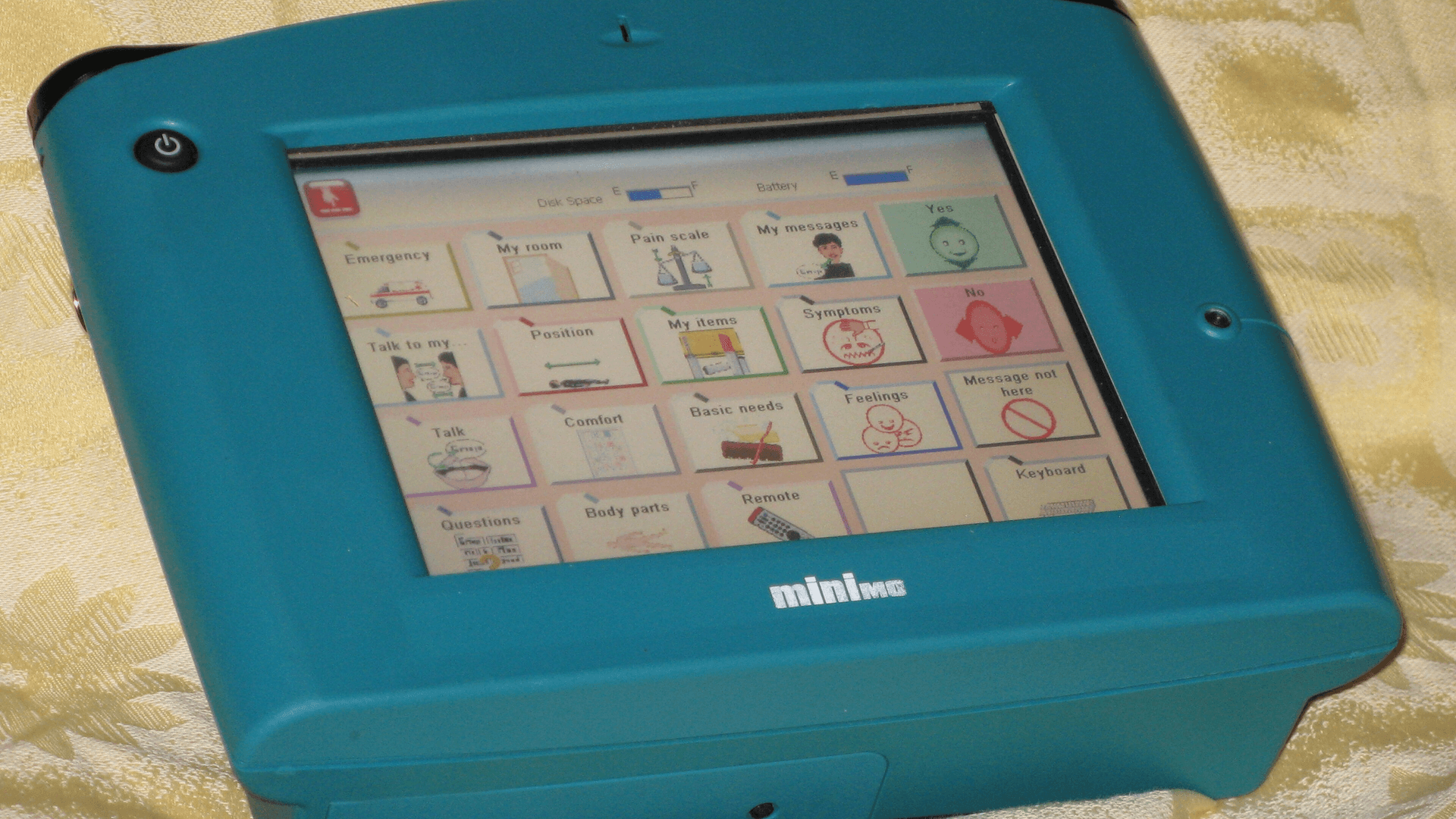
Hero image: Minimo speech generating device, by Poule, licensed CC BY-SA 3.0 (creativecommons.org/licenses/by-sa/3.0). Via Wikimedia Commons.
Take our professional IQ test
Want to know your IQ? Try the first ever professional online IQ test.