Oct 4, 2026·Special Population & Related Conditions
Congenital Hypothyroidism and IQ: How Newborn Screening Changed the Outcome
Congenital hypothyroidism and IQ: before screening, average IQ was about 85; with treatment in the first two weeks, most children now score like their siblings.
Dr. Russell T. WarneChief Scientist
Share
Congenital hypothyroidism can lower IQ substantially when it is found late, but with newborn screening and thyroid hormone treatment started in the first two weeks of life, most children now reach a normal IQ. Before screening, affected children averaged about 85, a full standard deviation below the population mean, while recent sibling-controlled studies of early, adequately dosed treatment find no gap at all.
"Congenital hypothyroidism" (CH) means a baby is born with too little thyroid hormone, usually because the thyroid gland is missing, misplaced or underdeveloped, or because it cannot make the hormone properly. Thyroid hormone is essential for brain development in the first years of life. The 2020-2021 European consensus guidelines put the incidence of primary CH at between 1 in 3,000 and 1 in 2,000 births. This page covers IQ before screening, what screening and early treatment changed, the factors that still matter, and the cognitive profile into adulthood.
IQ before newborn screening
Before screening, CH was diagnosed only when symptoms appeared, often months after birth, and the age at which treatment began made a large difference. In a classic series from Pittsburgh Children's Hospital reported by Klein, Meltzer and Kenny in 1972, children treated between birth and 3 months averaged an IQ of 89 (range 64 to 107). Those treated between 3 and 6 months averaged 71 (range 35 to 96), and those treated after 6 months averaged 54 (range 25 to 80).
Grosse and Van Vliet reviewed population-based studies of children born before screening. Across four studies in high-income countries, 8% to 28% of children with clinically diagnosed CH had an IQ below 70, the threshold used for intellectual disability, and the mean IQ was 85. They also found that recognised prevalence rose from about 1 in 6,500 before screening to about 1 in 3,000 with screening, because screening finds milder cases that were previously missed.
How screening and early treatment changed outcomes
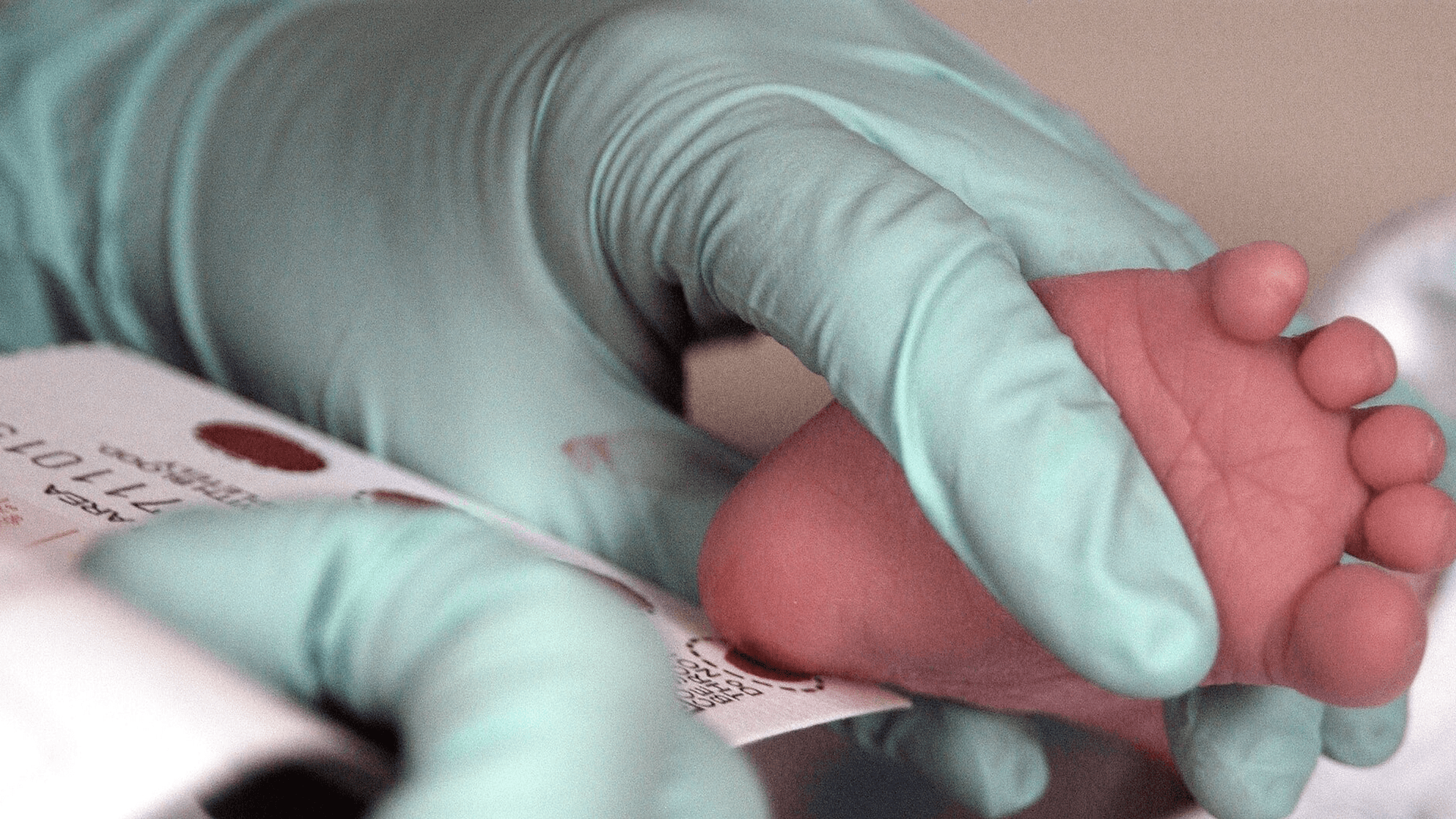
Mass screening began in Quebec in April 1974. Dussault and colleagues reported a method that measured thyroxine in a small blood spot dried on filter paper on the fifth day of life, and within the first 47,000 tests it had identified seven babies with hypothyroidism. Many screening programmes now measure thyroid-stimulating hormone (TSH) from the same heel-prick card. Treatment is a daily dose of levothyroxine, a synthetic form of the missing hormone. Like phenylketonuria (PKU), congenital hypothyroidism is a newborn-screening success story, but the treatment replaces a missing hormone with a daily tablet instead of restricting the diet for life.
Screening did not erase the gap at once. In a 1996 meta-analysis of seven studies covering 675 children with CH and 570 controls, all aged 5 or older, Derksen-Lubsen and Verkerk found a pooled IQ deficit of 6.3 points (95% confidence interval 4.7 to 7.8). Rovet compared 42 children with CH, detected between 1975 and 1985, with their own siblings tested at the same age, and found that the children with CH scored 8.1 points lower on the McCarthy scales and 6.2 points lower on the WISC-R. In Norway, Oerbeck and colleagues tested young adults from the first three years of screening and found a mean full-scale IQ of 102.4, against 111.4 in their siblings.
Later cohorts, treated sooner and with higher starting doses, show no measurable gap. In Auckland, Albert and colleagues found that 44 children with CH and 53 sibling controls had similar IQs (95.2 versus 98.6, not a statistically significant difference). In Berlin, Aleksander and colleagues studied 76 young adults treated with a mean starting dose of 13.5 µg/kg per day and 40 siblings, and found no significant difference in IQ. The European guidelines conclude that intellectual disability has virtually disappeared in early and adequately treated children, and they recommend starting treatment as soon as possible and no later than 2 weeks after birth.
What still affects IQ after early treatment
Outcome studies keep returning to how severe the hypothyroidism was at birth and how quickly and strongly it was treated, and the balance between these has shifted as treatment has improved.
• Severity: Derksen-Lubsen and Verkerk identified severity, judged by thyroxine level and bone maturation at diagnosis, as the most important risk factor in early screening cohorts. In the Netherlands, Kempers and colleagues retested 70 young adults (mean age 21.5) treated from a median of 28 days and found a mean full-scale IQ of 95.8. Severity, not the starting day of treatment, was correlated with IQ, and IQ did not change significantly between childhood and adulthood.
• Starting dose and timing: Rovet found smaller sibling gaps when the starting dose was at least 8.2 µg/kg per day. A meta-analysis included in the Berlin study found a significant IQ difference between severe and mild cases only when the starting dose was below 10 µg/kg. A review by Rastogi and LaFranchi describes a US programme in which infants given the higher starting dose scored 11 points higher. On timing, in a French cohort, Boileau and colleagues found that children treated by 15 days of age had a mean global IQ of 119 at age 7, compared with 107.7 when treatment started after 3 weeks. Other cohorts have found little effect of timing once treatment begins within the first weeks, which is why researchers now consider dose and timing together.
The European guidelines also note that periods of overtreatment in infancy were linked to lower IQ and more attention problems in two studies, although the Berlin cohort found no such effect. Choosing and adjusting the dose is the job of a paediatric endocrinologist.
Iodine deficiency during pregnancy is a separate, environmental cause of low thyroid hormone in the developing brain, covered in our list of the top environmental factors that influence IQ.
The cognitive profile and outcomes in adulthood
A normal full-scale IQ can still sit above specific weaknesses, particularly in the older, lower-dose cohorts. Rovet followed more than 100 children with CH into adolescence. They functioned within the normal range but below expectation, with weaker visuospatial, language and fine motor skills, plus problems with selective attention and memory. Arithmetic was initially below par but caught up by grade 6. In Oerbeck's Norwegian adults, severity at diagnosis was linked mainly to motor scores, while treatment levels in early childhood were linked to verbal IQ and school-related tests, suggesting that some effects begin before birth and others reflect treatment.
For testing, this means the index scores, motor tasks and attention measures can be more informative than the full-scale IQ alone. The European guidelines recommend extra evaluation for children who show developmental delay or school difficulties, and repeated hearing tests before school age, since mild or subclinical hearing impairment has been reported in about 20% to 25% of adolescents with CH and can affect speech and school performance. Families with concerns usually start with the child's paediatric endocrinologist or paediatrician, and routine developmental screening can flag children who need a full psychological assessment.
Frequently asked questions
Does congenital hypothyroidism cause low IQ?
It can when treatment starts late. Before screening, children averaged about 85 and up to 28% had an IQ below 70; with early, adequately dosed treatment, most children score in the normal range.
What is the IQ of children treated early for congenital hypothyroidism?
In recent sibling-controlled studies from New Zealand and Germany, children and young adults treated early with higher starting doses scored the same as their siblings. Older screening cohorts showed average gaps of about 6 to 9 points.
Does the age at which treatment starts affect IQ?
Before screening it mattered enormously: average IQ fell from 89 with treatment before 3 months to 54 after 6 months. Today guidelines call for treatment within the first 2 weeks, and starting dose and severity also matter.
Do the IQ effects of congenital hypothyroidism last into adulthood?
Where gaps exist, they tend to persist. In a Dutch screening cohort, IQ did not change significantly between childhood and age 21, and Norwegian young adults from early screening years still scored below their siblings.
Is congenital hypothyroidism the same as iodine deficiency?
No. Congenital hypothyroidism usually reflects a problem with the baby's own thyroid gland, while iodine deficiency is an environmental shortage of the nutrient the gland needs, and it affects whole populations.
The takeaway
Congenital hypothyroidism and IQ research traces one of the largest preventable effects on intelligence ever measured. Late treatment once meant average scores near 85 or lower, and screening on a few drops of blood, followed by prompt, adequately dosed levothyroxine, has brought outcomes in recent cohorts level with unaffected siblings. Some older cohorts still show small gaps and specific weaknesses in motor, visuospatial and attention skills. Questions about a child's development belong with the endocrinology team and a psychologist. For adults curious about their own reasoning abilities, you can take a full-length online IQ test built on a properly normed scale.
References
1. van Trotsenburg, P., Stoupa, A., Léger, J., Rohrer, T., Peters, C., Fugazzola, L., ... Polak, M. (2021). Congenital hypothyroidism: A 2020-2021 consensus guidelines update. An ENDO-European Reference Network initiative endorsed by the European Society for Pediatric Endocrinology and the European Society for Endocrinology. Thyroid, 31(3), 387-419. doi.org
2. Klein, A. H., Meltzer, S., & Kenny, F. M. (1972). Improved prognosis in congenital hypothyroidism treated before age three months. Journal of Pediatrics, 81(5), 912-915. doi.org
3. Rastogi, M. V., & LaFranchi, S. H. (2010). Congenital hypothyroidism. Orphanet Journal of Rare Diseases, 5, 17. doi.org
4. Grosse, S. D., & Van Vliet, G. (2011). Prevention of intellectual disability through screening for congenital hypothyroidism: How much and at what level? Archives of Disease in Childhood, 96(4), 374-379. doi.org
5. Boelen, A., Zwaveling-Soonawala, N., Heijboer, A. C., & van Trotsenburg, A. S. P. (2023). Neonatal screening for primary and central congenital hypothyroidism: Is it time to go Dutch? European Thyroid Journal, 12(4), e230041. doi.org
6. Dussault, J. H., Coulombe, P., Laberge, C., Letarte, J., Guyda, H., & Khoury, K. (1975). Preliminary report on a mass screening program for neonatal hypothyroidism. Journal of Pediatrics, 86(5), 670-674. doi.org
7. Derksen-Lubsen, G., & Verkerk, P. H. (1996). Neuropsychologic development in early treated congenital hypothyroidism: Analysis of literature data. Pediatric Research, 39(3), 561-566. doi.org
8. Rovet, J. F. (2005). Children with congenital hypothyroidism and their siblings: Do they really differ? Pediatrics, 115(1), e52-e57. doi.org
9. Oerbeck, B., Sundet, K., Kase, B. F., & Heyerdahl, S. (2003). Congenital hypothyroidism: Influence of disease severity and L-thyroxine treatment on intellectual, motor, and school-associated outcomes in young adults. Pediatrics, 112(4), 923-930. doi.org
10. Albert, B. B., Heather, N., Derraik, J. G. B., Cutfield, W. S., Wouldes, T., Tregurtha, S., ... Hofman, P. L. (2013). Neurodevelopmental and body composition outcomes in children with congenital hypothyroidism treated with high-dose initial replacement and close monitoring. Journal of Clinical Endocrinology & Metabolism, 98(9), 3663-3670. doi.org
11. Aleksander, P. E., Brückner-Spieler, M., Stoehr, A. M., Lankes, E., Kühnen, P., Schnabel, D., ... Krude, H. (2018). Mean high-dose l-thyroxine treatment is efficient and safe to achieve a normal IQ in young adult patients with congenital hypothyroidism. Journal of Clinical Endocrinology & Metabolism, 103(4), 1459-1469. doi.org
12. Kempers, M. J. E., van der Sluijs Veer, L., Nijhuis-van der Sanden, M. W. G., Kooistra, L., Wiedijk, B. M., Faber, I., ... Vulsma, T. (2006). Intellectual and motor development of young adults with congenital hypothyroidism diagnosed by neonatal screening. Journal of Clinical Endocrinology & Metabolism, 91(2), 418-424. doi.org
13. Boileau, P., Bain, P., Rives, S., & Toublanc, J. E. (2004). Earlier onset of treatment or increment in LT4 dose in screened congenital hypothyroidism: Which as the more important factor for IQ at 7 years? Hormone Research, 61(5), 228-233. doi.org
14. Rovet, J. F. (1999). Long-term neuropsychological sequelae of early-treated congenital hypothyroidism: Effects in adolescence. Acta Paediatrica, 88(Suppl. 432), 88-95. doi.org
Hero image: Phenylketonuria testing, U.S. Air Force photo by Staff Sgt. Eric T. Sheler, public domain. Via Wikimedia Commons.
Take our professional IQ test
Want to know your IQ? Try the first ever professional online IQ test.