Oct 4, 2026·Special Population & Related Conditions
PTSD and IQ: Pre-Trauma Scores, the Direction Question and the Memory Profile
PTSD and IQ: lower IQ measured before a trauma predicts a higher risk of PTSD afterward, and twin studies suggest much of the gap exists before the trauma.
Dr. Russell T. WarneChief Scientist
Share
PTSD and IQ research shows that people with lower IQ scores measured before a traumatic event are somewhat more likely to develop posttraumatic stress disorder afterward, while higher scores appear to be protective. Studies that measured IQ before the trauma, including twin studies of Vietnam-era veterans, suggest that much of the IQ gap seen in people with PTSD was already present beforehand, although PTSD is also linked to specific problems with verbal learning, memory, attention and processing speed.
This article covers the evidence on pre-trauma IQ as a risk factor, what twin designs add, the question of whether PTSD lowers IQ, the cognitive profile seen in PTSD, and why brain injury complicates the research on veterans. All findings describe groups, and a lower score is one risk factor among many.
Lower pre-trauma IQ predicts higher PTSD risk
The key to this research is timing. If IQ is measured only after the trauma, a low score could be a cause of PTSD, a consequence of it, or both. Military records solve part of the problem, because recruits take aptitude tests before they ever see combat.
Macklin and colleagues obtained military aptitude scores from before combat for 59 Vietnam combat veterans with PTSD and 31 without it. Lower precombat scores predicted more PTSD symptoms even after adjusting for how much combat each man had experienced. The authors concluded that lower pretrauma intelligence increases the risk of developing PTSD symptoms.
Larger samples confirmed the pattern. Kremen and colleagues studied 2,386 male Vietnam-era twin veterans whose Armed Forces Qualification Test scores were recorded at induction, at an average age of 19.7. There was a dose-response relationship: after controlling for confounders, men in the highest ability quartile had a 48% lower risk of PTSD than men in the lowest quartile. In the Vietnam Experience Study, Gale and colleagues found that among 1,659 combat-exposed veterans, each one standard deviation lower ability score at enlistment went with 1.39 times the odds of current PTSD, and the association was only slightly weakened by adjustment for army income.
Civilian studies: exposure and response
Civilian birth cohorts show that IQ appears to work at two stages, affecting both who encounters trauma and how they respond to it.
• Exposure to trauma: Breslau, Lucia and Alvarado followed 713 young people in southeast Michigan from age 6 to 17. Children with an IQ above 115 at age 6 were less likely to experience assaultive violence (adjusted odds ratio 0.3) and nonassaultive trauma (0.6) by 17.
• Response to trauma: Among those who did experience a traumatic event, the children with IQ above 115 also had a lower risk of developing PTSD (adjusted odds ratio 0.2). In New Zealand's Dunedin cohort, Koenen and colleagues found that low IQ in early childhood raised the risk of PTSD without raising the risk of trauma exposure, and low IQ at age 5 still predicted PTSD from events that happened between ages 26 and 32. The same cohort linked lower childhood IQ to adult anxiety disorders, including generalized anxiety disorder and social phobia.
Why higher ability might protect is not settled. Kremen's team suggested lower cognitive ability may be "a marker of less adaptive coping," and Breslau's team called for research on the cognitive processes involved in responding to trauma.
Does PTSD lower IQ?
People with PTSD do score lower on average on many cognitive tests, which raises the obvious question of whether the disorder causes the drop. The best-designed studies suggest most of the overall IQ gap comes first.
• Before and after scores: In Macklin's study, the link between current IQ and PTSD was no longer significant once precombat intelligence was taken into account. The authors wrote that their results suggest lower pretrauma intelligence increases risk "not that PTSD lowers performance on intelligence tests."
• Identical twins: Gilbertson and colleagues tested identical twin pairs in which one brother served in combat and the other did not. The combat-free co-twins of veterans with PTSD largely performed the same as their brothers, and both scored lower than veterans without PTSD and their co-twins. Because the unexposed twin never went to war, his lower scores cannot be a result of combat trauma.
• Shared genes: In Kremen's twin sample, genetic influences on pre-induction cognitive ability explained 5% of the variation in PTSD, and all of that overlap was accounted for by genes shared between the two traits.
These designs do not rule out every effect of PTSD on thinking. They show that a lower full-scale score in someone with PTSD should not be assumed to be damage caused by the trauma.
The cognitive profile in PTSD
The specific profile matters more than the full-scale score. Scott and colleagues meta-analyzed 60 studies with 4,108 participants, including 1,779 with PTSD. The largest differences were in verbal learning (d = -0.62), speed of information processing (d = -0.59), attention and working memory (d = -0.50) and verbal memory (d = -0.46). An effect size "d" expresses the gap in standard deviation units, so -0.5 is about 7 or 8 points on an IQ-style scale.
The authors also flagged a measurement problem. In 35 of the 60 studies, the PTSD and healthy comparison groups were not matched on premorbid IQ, and the size of that IQ mismatch influenced how large the deficits looked. Effects were also larger in treatment-seeking samples than in community samples. Processing speed is one of the indexes on modern IQ tests, and our explainer on the processing speed index covers what it measures.
In veterans, brain injury is a further confound: Hoge and colleagues surveyed 2,525 U.S. Army soldiers after a year in Iraq and found that 43.9% of those who reported a head injury with loss of consciousness met criteria for PTSD, compared with 9.1% of soldiers with no injury, so cognitive problems in this group can reflect either condition, as discussed in our article on IQ and traumatic brain injury. Untangling the two usually takes a full neuropsychological evaluation, which covers far more ground than an IQ score. PTSD is diagnosed by a psychologist, psychiatrist or other qualified clinician, and questions about symptoms or care belong with them.
Frequently asked questions
Does PTSD lower IQ?
The best evidence suggests most of the IQ gap seen in PTSD was present before the trauma. In twin and pre-combat studies, lower scores came first, although PTSD is linked to specific difficulties with verbal memory, attention and processing speed.
Does a high IQ protect against PTSD?
On average, higher IQ goes with lower PTSD risk. In one twin study, men in the top ability quartile had 48% lower risk than those in the bottom quartile, but people at every IQ level can develop PTSD.
Do people with PTSD have a low IQ?
Not as a rule. Group averages are somewhat lower, but individual scores span the full range, and IQ is one risk factor among many.
Why do people with PTSD have memory problems?
A meta-analysis of 60 studies found the largest differences in verbal learning and verbal memory, along with processing speed and attention. Part of the gap in some studies reflects groups that were not matched on IQ before the trauma.
Can an IQ test diagnose PTSD?
No. PTSD is diagnosed by a qualified clinician through interviews and standardized measures, and IQ findings describe group-level risk.
The takeaway
Research on PTSD and IQ consistently finds that lower ability measured before a trauma predicts a higher chance of developing PTSD, in combat veterans and in civilian birth cohorts. Twin studies indicate that much of the IQ gap seen in people with PTSD predates the trauma and shares genetic roots with PTSD risk. PTSD is also associated with a recognizable profile of weaker verbal learning, memory, attention and processing speed, which a specialist assessment can separate from brain injury and from pre-existing ability. If you want to see how a standardized score is built and reported, you can take a full-length online IQ test that reports results against a defined norm group.
References
1. Macklin, M. L., Metzger, L. J., Litz, B. T., McNally, R. J., Lasko, N. B., Orr, S. P., & Pitman, R. K. (1998). Lower precombat intelligence is a risk factor for posttraumatic stress disorder. Journal of Consulting and Clinical Psychology, 66(2), 323-326. doi.org
2. Kremen, W. S., Koenen, K. C., Boake, C., Purcell, S., Eisen, S. A., Franz, C. E., Tsuang, M. T., & Lyons, M. J. (2007). Pretrauma cognitive ability and risk for posttraumatic stress disorder: A twin study. Archives of General Psychiatry, 64(3), 361-368. doi.org
3. Gale, C. R., Deary, I. J., Boyle, S. H., Barefoot, J., Mortensen, L. H., & Batty, G. D. (2008). Cognitive ability in early adulthood and risk of 5 specific psychiatric disorders in middle age: The Vietnam Experience Study. Archives of General Psychiatry, 65(12), 1410-1418. doi.org
4. Breslau, N., Lucia, V. C., & Alvarado, G. F. (2006). Intelligence and other predisposing factors in exposure to trauma and posttraumatic stress disorder: A follow-up study at age 17 years. Archives of General Psychiatry, 63(11), 1238-1245. doi.org
5. Koenen, K. C., Moffitt, T. E., Poulton, R., Martin, J., & Caspi, A. (2007). Early childhood factors associated with the development of post-traumatic stress disorder: Results from a longitudinal birth cohort. Psychological Medicine, 37(2), 181-192. doi.org
6. Koenen, K. C., Moffitt, T. E., Roberts, A. L., Martin, L. T., Kubzansky, L., Harrington, H., Poulton, R., & Caspi, A. (2009). Childhood IQ and adult mental disorders: A test of the cognitive reserve hypothesis. American Journal of Psychiatry, 166(1), 50-57. doi.org
7. Gilbertson, M. W., Paulus, L. A., Williston, S. K., Gurvits, T. V., Lasko, N. B., Pitman, R. K., & Orr, S. P. (2006). Neurocognitive function in monozygotic twins discordant for combat exposure: Relationship to posttraumatic stress disorder. Journal of Abnormal Psychology, 115(3), 484-495. doi.org
8. Scott, J. C., Matt, G. E., Wrocklage, K. M., Crnich, C., Jordan, J., Southwick, S. M., Krystal, J. H., & Schweinsburg, B. C. (2015). A quantitative meta-analysis of neurocognitive functioning in posttraumatic stress disorder. Psychological Bulletin, 141(1), 105-140. doi.org
9. Hoge, C. W., McGurk, D., Thomas, J. L., Cox, A. L., Engel, C. C., & Castro, C. A. (2008). Mild traumatic brain injury in U.S. soldiers returning from Iraq. New England Journal of Medicine, 358(5), 453-463. doi.org
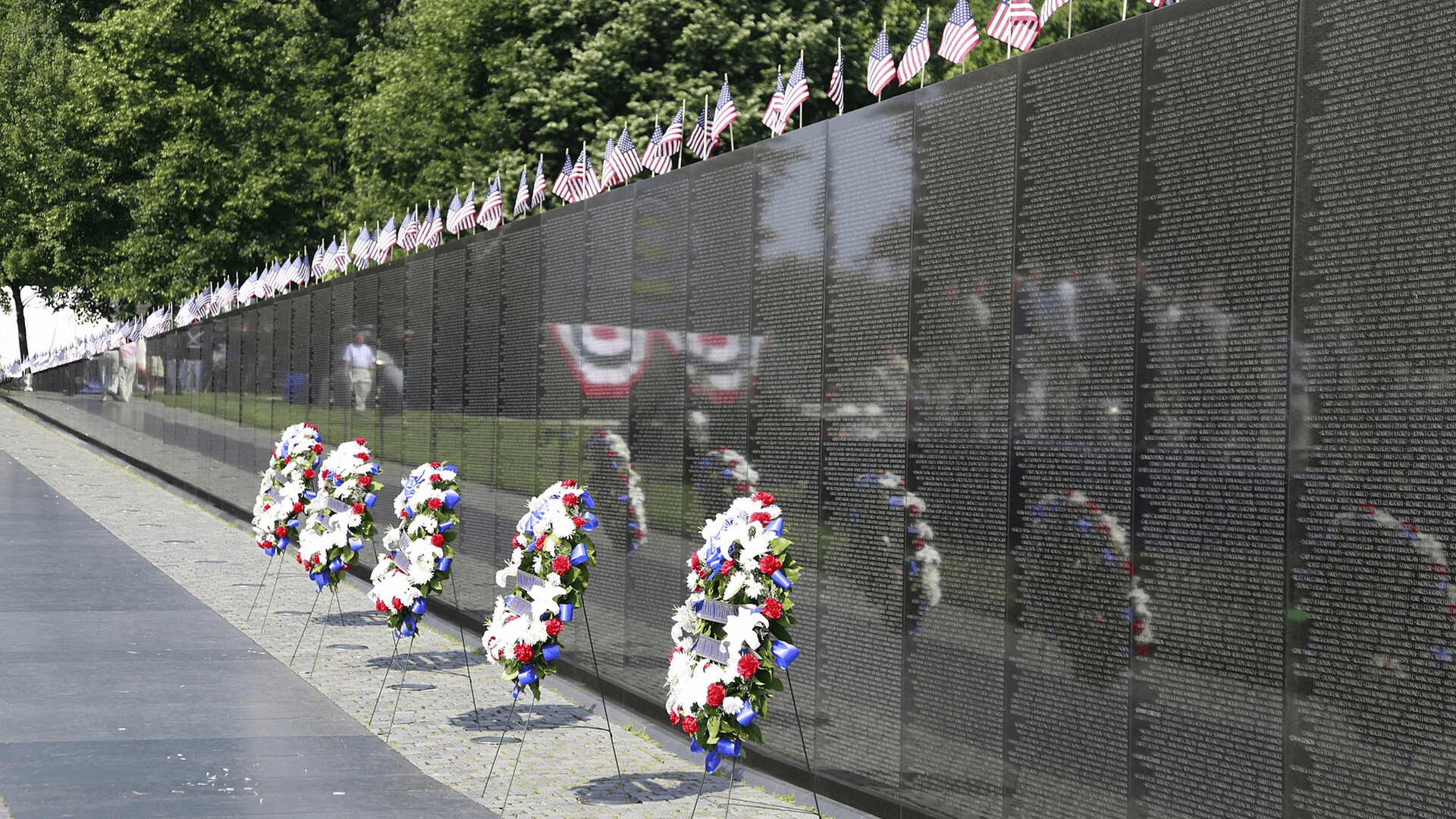
Hero image: Vietnam Veterans Memorial, District of Columbia, National Park Service photo, public domain. Via Wikimedia Commons.
Take our professional IQ test
Want to know your IQ? Try the first ever professional online IQ test.