Oct 4, 2026·Special Population & Related Conditions
Bipolar Disorder and IQ: What the High-IQ Link Really Shows
Bipolar IQ research finds no broad high-IQ link: in a million Swedish men, bipolar risk fell as IQ rose, with a faint rise at the top only for pure cases.
Dr. Russell T. WarneChief Scientist
Share
Bipolar IQ research does not support the popular idea that bipolar disorder is a high-IQ condition: in the largest study, of over a million Swedish men, the risk of being hospitalized with bipolar disorder fell steadily as IQ at age 18 rose. A weaker signal does exist at the top of the range, but only for "pure" bipolar disorder without other psychiatric diagnoses, and mainly for verbal ability.
This article covers what the large population studies found, where the high-IQ idea comes from, how bipolar disorder differs from schizophrenia before illness onset, the thinking skills that tend to be affected between mood episodes, and what an IQ score can and cannot say about one person. Bipolar disorder is less common than many people assume: a World Health Organization survey of 61,392 adults in 11 countries put lifetime prevalence at 0.6% for bipolar I disorder and 0.4% for bipolar II.
Is bipolar disorder more common in people with high IQ?
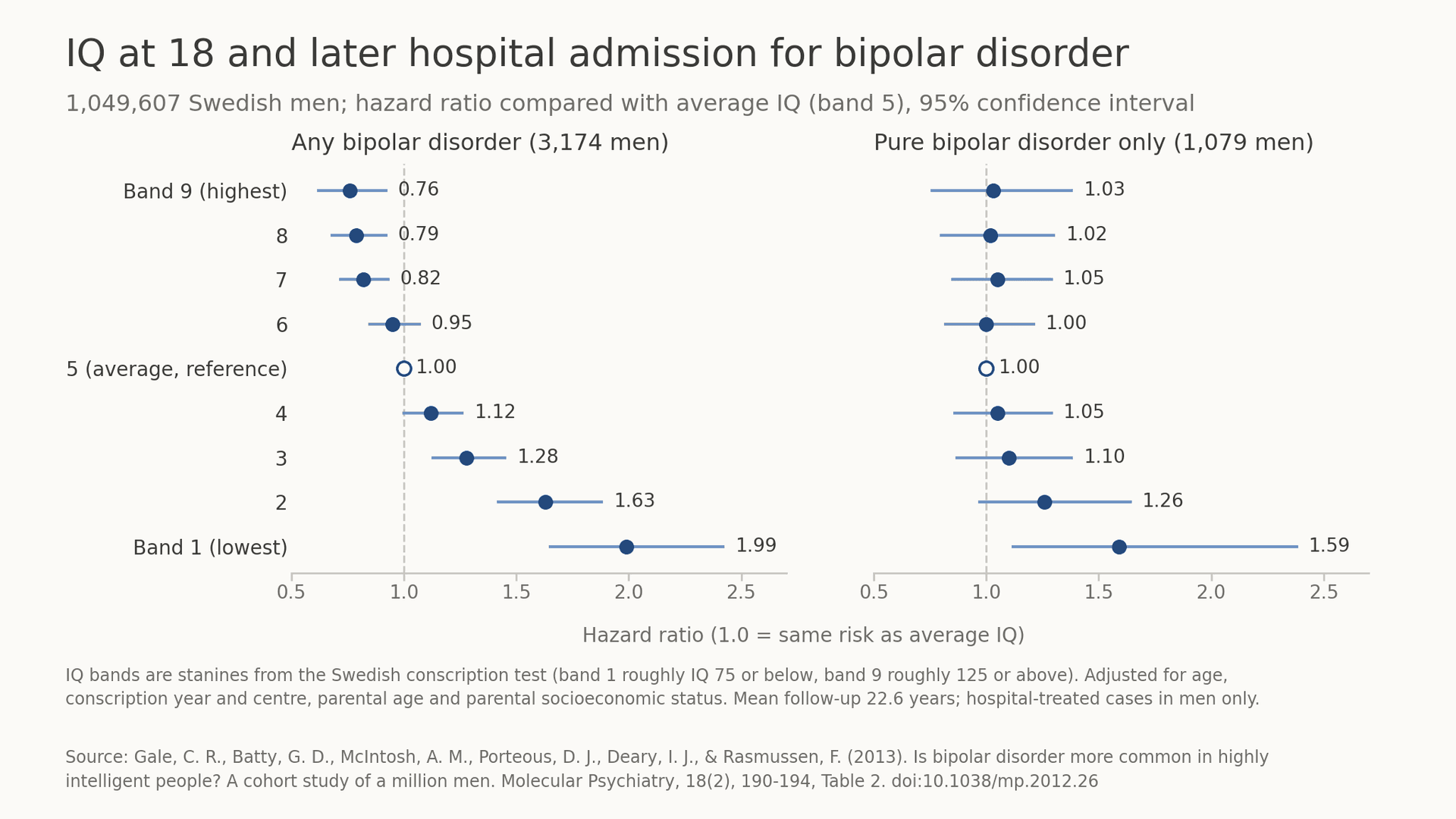
The most direct test is the study by Gale and colleagues, who linked the conscription test scores of 1,049,607 Swedish men (tested at a mean age of 18.3) to national hospital records over a mean follow-up of 22.6 years. Men already diagnosed with a psychiatric disorder at conscription were excluded, so the scores were measured before illness. In total, 3,174 men (0.3%) were later admitted to hospital with bipolar disorder.
The headline finding runs against the stereotype. Compared with men of average IQ, risk of admission with any form of bipolar disorder was about twice as high in the lowest IQ band (hazard ratio 1.99) and fell in steps to 0.76 in the highest band. A "hazard ratio" compares the rate of an outcome in one group with a reference group; 1.0 means the same rate.
The picture changed for a subgroup. Of the 3,174 men, 74% also had another psychiatric diagnosis, and only 1,079 had bipolar disorder in a pure form. For pure bipolar disorder, risk was still highest in the lowest IQ band (1.59), while the higher bands sat close to average, with a statistically significant curve (p = 0.03). The high-IQ signal became clearer with narrower definitions:
• Verbal ability: Men with the highest verbal scores had a 41% higher risk of pure bipolar disorder than men of average verbal ability, and men with the lowest verbal scores a 34% higher risk.
• A stricter definition: When the authors also removed men whose only extra diagnosis was another mood disorder, the lowest-IQ group had a 56% higher risk and the highest-IQ group a 24% higher risk.
The authors concluded that high intelligence "may indeed be a risk factor for bipolar disorder, but only in the minority of cases who have the disorder in a pure form." Two limits matter: the study counted only hospital admissions, which favors severe cases, and it included only men.
School grades, childhood IQ and manic features
Three other studies are often cited for the high-IQ link, and each has its own caveats.
• Swedish school grades: MacCabe and colleagues followed everyone who finished compulsory school in Sweden between 1988 and 1997. Students with excellent grades at 15 to 16 had a nearly fourfold risk of later hospital admission for bipolar disorder compared with average students (hazard ratio 3.79), an effect that appeared to be confined to males. Students with the poorest grades also had a raised risk (1.86). Grades reflect effort and motivation as well as ability, so this is indirect evidence about IQ.
• The Dunedin cohort: Koenen and colleagues followed 1,037 New Zealanders tested on the WISC-R at ages 7, 9 and 11. Lower childhood IQ predicted adult depression, anxiety and schizophrenia spectrum disorder, while higher IQ predicted mania. Only eight cohort members had mania, all with childhood IQs above 100, and the authors warned the result might be due to chance.
• The ALSPAC cohort: Smith and colleagues linked IQ at age 8 in 1,881 British children to a checklist of lifetime manic features at 22 to 23. Higher IQ went with more manic features (correlation 0.159). Young adults in the highest tenth for manic features had a mean childhood IQ of 110.14, against 100.71 in the lowest tenth, with the link strongest for verbal IQ. A symptom checklist is not a diagnosis, so this measures traits across the population.
Taken together, these studies suggest that a small part of the bipolar population may have unusually strong verbal ability before illness. Most people with bipolar disorder score in the ordinary range, and most people with high IQ never develop it.
How bipolar disorder differs from schizophrenia before onset
Schizophrenia is preceded by a measurable IQ gap years before symptoms, a pattern covered in our article on schizophrenia and IQ. Bipolar disorder looks different. Trotta, Murray and MacCabe meta-analyzed studies that measured both conditions with the same methods. People who later developed schizophrenia showed a clear premorbid deficit (standardized mean difference -0.597). For bipolar disorder, premorbid IQ was slightly low only when estimated after the fact (-0.147) and showed no difference when measured prospectively (-0.029). After illness onset, both groups scored lower than controls, with a moderate gap in bipolar disorder (-0.623) and a larger one in schizophrenia (-1.369).
Thinking skills between mood episodes
Mood episodes affect concentration and speed, so researchers study people who are "euthymic," meaning in a stable mood between episodes. Even then, modest differences remain on average.
Bora, Yücel and Pantelis pooled 45 studies of 1,423 euthymic patients. Patients showed medium to large deficits in response inhibition, set shifting, verbal memory and sustained attention. Smaller versions of several of these appeared in unaffected first-degree relatives, which the authors read as a marker of inherited risk. Slower processing speed was found in patients but not relatives, and medication contributed to it. A later re-analysis of raw data from 31 studies (2,876 participants) by Bourne and colleagues found impairments on all 11 test measures after controlling for age, IQ and gender, with effect sizes from 0.26 to 0.63, and suggested earlier estimates may have been somewhat too large.
The average hides a lot of variety. In 136 patients, Burdick and colleagues found three distinct subgroups: one performing like healthy controls, one with selective deficits in processing speed, attention, verbal learning and social cognition, and one with broad deficits similar to those in schizophrenia. They summarize earlier work as finding significant impairment in about 60% of patients and none in about 40%.
On the question of change over time, a meta-analysis by Samamé, Martino and Strejilevich found that patients' scores on 14 cognitive measures stayed stable over a mean of 4.62 years, with no difference in change compared with healthy controls. The available evidence does not show a steady decline for the group as a whole, although individual courses vary. For the related question of mood and test scores in depression, see our article on IQ and depression.
What an IQ score can and cannot show
Even in a study of a million people, IQ was a poor predictor for any individual. Gale and colleagues reported that all hazard ratios were under 3 and that IQ classified who would later be hospitalized only slightly better than chance (area under the curve 0.57, where 0.5 is chance and 1.0 is perfect). A high score does not signal risk, and a low one does not either.
For an individual with bipolar disorder, a full-scale IQ taken during a mood episode can understate usual ability, and a single score can hide specific weaknesses in memory or attention. Cognitive concerns are best assessed by a clinical psychologist or neuropsychologist using a fuller battery, as described in our overview of neuropsychological testing. Questions about diagnosis, mood symptoms or medication belong with a psychiatrist or the person's care team.
Frequently asked questions
Do people with bipolar disorder have a high IQ?
As a group, no. Most score in the average range, and in the largest study the risk of hospitalization with bipolar disorder was lower at higher IQ levels.
Is there any link between high intelligence and bipolar disorder?
A weak one, in a subgroup. Pure bipolar disorder without other diagnoses was somewhat more common in Swedish men with very high verbal ability, and two cohort studies linked higher childhood IQ to mania or manic traits.
Does bipolar disorder lower IQ?
Average scores after onset are moderately lower than those of healthy controls, but longitudinal studies find that scores stay stable over several years. Earlier clinical studies found that about 40% of patients show no significant cognitive impairment.
Which thinking skills are most affected between episodes?
Response inhibition, set shifting, verbal memory and sustained attention show the most consistent differences in euthymic patients, with processing speed partly affected by medication.
Can an IQ test detect bipolar disorder?
No. Bipolar disorder is diagnosed clinically by a psychiatrist or other qualified clinician, and IQ predicts later illness only slightly better than chance.
The takeaway
Bipolar IQ findings are more nuanced than the "mad genius" stereotype suggests. Across a million Swedish men, higher IQ went with a lower overall risk of hospitalization for bipolar disorder, and a modest high-IQ signal appeared only in pure cases and mostly for verbal ability. Before onset, people who develop bipolar disorder score close to their peers, which sets the condition apart from schizophrenia. Between episodes, many show modest deficits in memory and executive skills, while a large minority show none. If you want to see how a standardized score is built and reported with its margin of error, you can take a full-length online IQ test that reports results against a defined norm group.
References
1. Merikangas, K. R., Jin, R., He, J.-P., Kessler, R. C., Lee, S., Sampson, N. A., Viana, M. C., Andrade, L. H., Hu, C., Karam, E. G., Ladea, M., Medina-Mora, M. E., Ono, Y., Posada-Villa, J., Sagar, R., Wells, J. E., & Zarkov, Z. (2011). Prevalence and correlates of bipolar spectrum disorder in the World Mental Health Survey Initiative. Archives of General Psychiatry, 68(3), 241-251. doi.org
2. Gale, C. R., Batty, G. D., McIntosh, A. M., Porteous, D. J., Deary, I. J., & Rasmussen, F. (2013). Is bipolar disorder more common in highly intelligent people? A cohort study of a million men. Molecular Psychiatry, 18(2), 190-194. doi.org
3. MacCabe, J. H., Lambe, M. P., Cnattingius, S., Sham, P. C., David, A. S., Reichenberg, A., Murray, R. M., & Hultman, C. M. (2010). Excellent school performance at age 16 and risk of adult bipolar disorder: National cohort study. British Journal of Psychiatry, 196(2), 109-115. doi.org
4. Koenen, K. C., Moffitt, T. E., Roberts, A. L., Martin, L. T., Kubzansky, L., Harrington, H., Poulton, R., & Caspi, A. (2009). Childhood IQ and adult mental disorders: A test of the cognitive reserve hypothesis. American Journal of Psychiatry, 166(1), 50-57. doi.org
5. Smith, D. J., Anderson, J., Zammit, S., Meyer, T. D., Pell, J. P., & Mackay, D. (2015). Childhood IQ and risk of bipolar disorder in adulthood: Prospective birth cohort study. BJPsych Open, 1(1), 74-80. doi.org
6. Trotta, A., Murray, R. M., & MacCabe, J. H. (2015). Do premorbid and post-onset cognitive functioning differ between schizophrenia and bipolar disorder? A systematic review and meta-analysis. Psychological Medicine, 45(2), 381-394. doi.org
7. Bora, E., Yücel, M., & Pantelis, C. (2009). Cognitive endophenotypes of bipolar disorder: A meta-analysis of neuropsychological deficits in euthymic patients and their first-degree relatives. Journal of Affective Disorders, 113(1-2), 1-20. doi.org
8. Bourne, C., Aydemir, Ö., Balanzá-Martínez, V., Bora, E., Brissos, S., Cavanagh, J. T. O., Clark, L., Cubukcuoglu, Z., Dias, V. V., Dittmann, S., Ferrier, I. N., Fleck, D. E., Frangou, S., Gallagher, P., Jones, L., Kieseppä, T., Martínez-Aran, A., Melle, I., Moore, P. B., ... Goodwin, G. M. (2013). Neuropsychological testing of cognitive impairment in euthymic bipolar disorder: An individual patient data meta-analysis. Acta Psychiatrica Scandinavica, 128(3), 149-162. doi.org
9. Burdick, K. E., Russo, M., Frangou, S., Mahon, K., Braga, R. J., Shanahan, M., & Malhotra, A. K. (2014). Empirical evidence for discrete neurocognitive subgroups in bipolar disorder: Clinical implications. Psychological Medicine, 44(14), 3083-3096. doi.org
10. Samamé, C., Martino, D. J., & Strejilevich, S. A. (2014). Longitudinal course of cognitive deficits in bipolar disorder: A meta-analytic study. Journal of Affective Disorders, 164, 130-138. doi.org
Figure by RIOT IQ. Data from Gale, Batty, McIntosh, Porteous, Deary & Rasmussen (2013), Molecular Psychiatry 18(2), 190-194, Table 2 (doi.org/10.1038/mp.2012.26).
Take our professional IQ test
Want to know your IQ? Try the first ever professional online IQ test.