🇺🇸The official website of Riot IQ
Log in
  • Home
  • About

Measure your
intelligence online.

Google

Assessments

  • All IQ Tests
  • Basic IQ Test
  • Full IQ Test
  • Custom IQ Test
  • Free IQ Test

Our Socials

  • X
  • YouTube
  • Facebook
  • LinkedIn

Other IQ Tests

  • WAIS-V
  • SB-5
  • Raven's 2
  • RIAS-2
  • CogAT 9
  • WISC-V

Community

  • Join Subreddit
  • Join Discord

Other Pages

  • Test Manual
  • Administer IQ Tests
  • About Us
  • Articles
  • Data
  • FAQ

Research

  • What do polygenic scores really predict?
  • Working speed and ability on the RIOT

Intelligence Journals & Organizations

  • Human Intelligence Research & Education (HIRE) Foundation
  • International Society for Intelligence Research (ISIR)
  • Intelligence & Cognitive Abilities Journal (ICA)
  • Intelligence Journal
  • Mensa Foundation

Contact

  • Email
  • Support

News & Press

  • International Society for Intelligence Research
  • American Thinker
  • Mensa Foundation (1/2)
  • Mensa Northern New Jersey
  • The University of Western Australia
  • Prolific
  • Quillette
  • Brainz

Our Articles

  • Gmatclub (1/2)
  • ApolloTechnical
  • LessWrong
  • Psychreg
  • Study in Switzerland
  • SuccessConsciousness
  • Creative Organizational Design (1/2)
  • ABNewsWire
  • Vanderbilt University

Our Articles

  • The Globe and Mail
  • Barchart
  • Journal
  • Mensa Foundation (2/2)
  • Psychologs
  • Creative Organizational Design (2/2)
  • AZBigMedia
  • Thoughts on Life and Love
  • Anxiety and Depression Association of America

Our Articles

  • Before It's News
  • Siglo XXI
  • TechBullion
  • Medium
  • Gmatclub (2/2)
  • MSN
  • National Review
  • Minding the Campus
  • Launching Next

Our Articles

  • Comparing Cronbach’s Alpha and McDonald’s Omega Reliability
  • Breaking the Intelligence & IQ Taboo
  • What is the Flynn Effect?
  • A Comprehensive History of IQ Tests
  • The 15 Subtests of the RIOT

Our Articles

  • How to Take an IQ Test
  • How to Calculate IQ
  • What is the RIOT IQ Test?
  • The Pro-Human Aspects of Intelligence Research
  • What is an IQ Test? A Beginner's Guide.

Our Articles

  • 5 Best IQ Tests in 2025
  • Cognitive Profiles on the RIOT IQ Test Results
  • 6 Cognitive Abilities of the RIOT
  • Are There Any Professional and Real Online IQ Tests?

Our Articles

  • Resources to Learn About IQ and Intelligence
  • Studying IQ Matters
  • The Search for Albert Einstein's IQ
  • Do Non-g Gains from the Flynn Effect Matter?

Riot IQ © 2026

  • Terms of Service
  • Privacy Policy
  • BAA Agreement
  • Test Administrator Terms
  • Terms of Service
  • •Privacy Policy
  • •BAA Agreement
  • •Test Administrator Terms

Table of Contents

  • References
May 23, 2025·Advanced Topics & Research

Measuring Cognitive Aging with Memory and Processing Speed Tasks

Measuring cognitive aging with memory and processing speed tasks

Dr. Russell T. WarneChief Scientist

Share
Measuring Cognitive Aging with Memory and Processing Speed Tasks
The work continues on the IQ test, and the team is getting closer to launch. As I dive into the data, I am discovering insights that I have started to share. One of the most practical things I have learned is that online tasks can be extremely useful for measuring cognitive aging. This is especially true for the RIOT’s processing speed and working memory tasks.

Psychologists have known for many years that people experience a mental slowing as they age (Tucker-Drob et al., 2019). Memory declines (even when dementia is not present) are also well documented (Schaie, 2013). These insights are not the special knowledge of scientists. Everyday people know what “senior moments” are, and there is a general familiarity with a mental slowdown in old age.

These declines are observable in the RIOT’s working memory and processing speed subtests. The graph below shows the scores at the 10th, 25th, 50th, 75th, and 90th percentiles on the Visual Reversal subtest of the RIOT. In the test’s norm sample, even the best individuals in their 70s and 80s are performing worse than the median young adult.
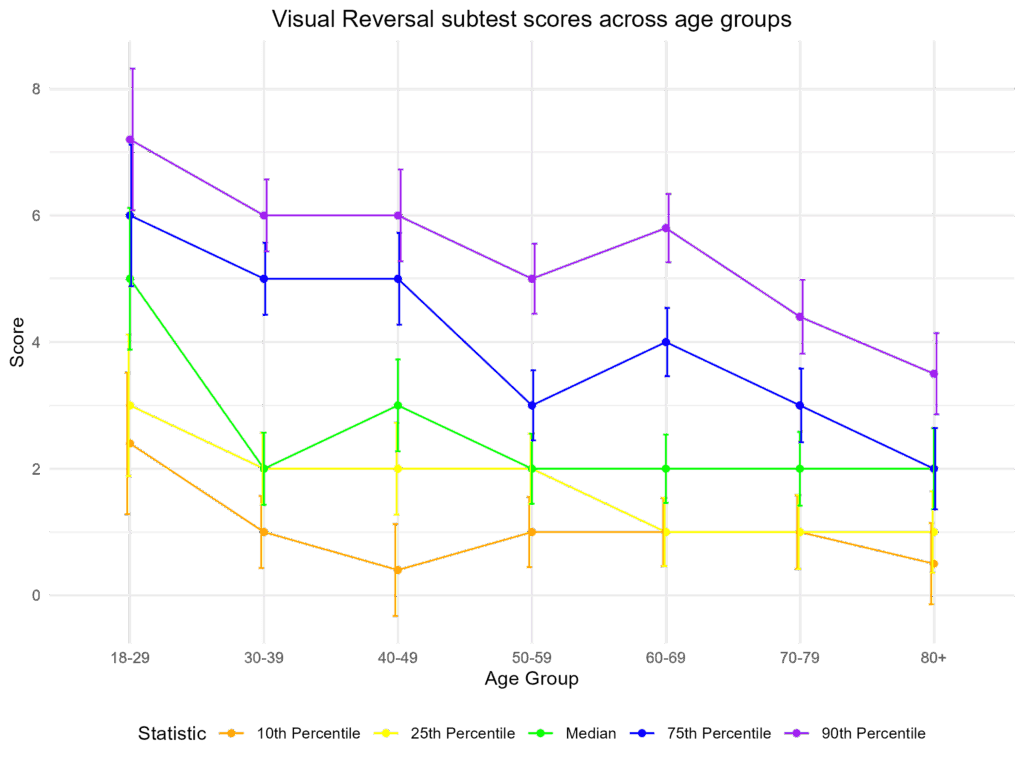
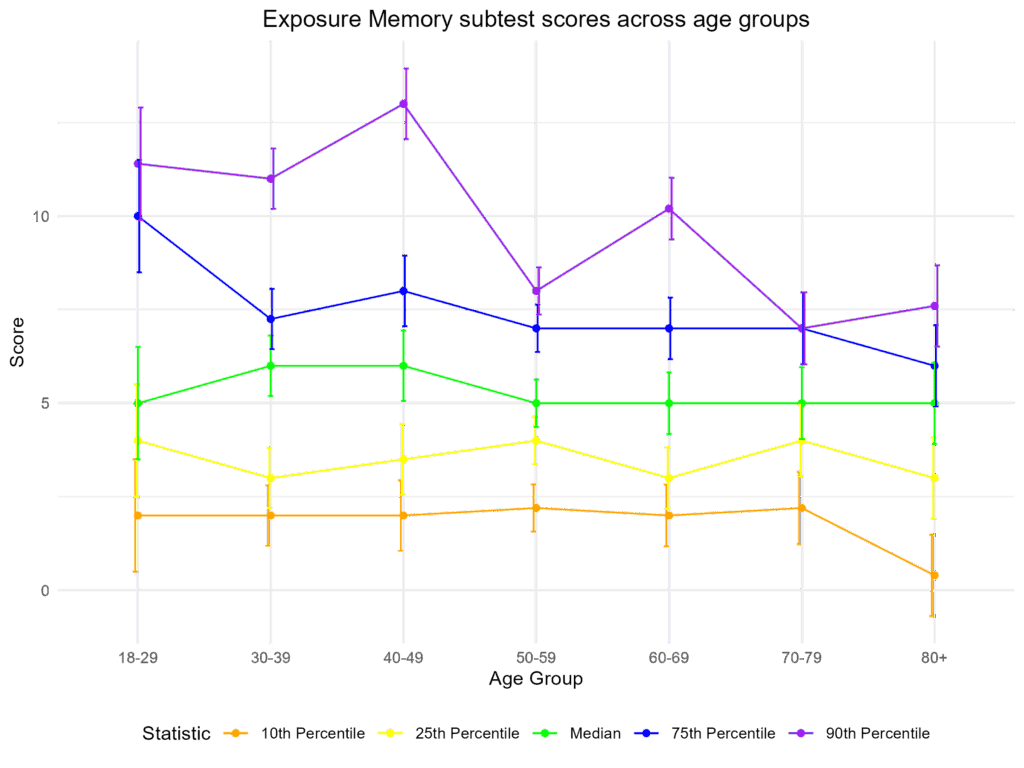
The Visual Reversal subtest is memory task has two components: remembering a sequence and then repeating it in reverse order. The reversal part makes the task more difficult than most memory tasks. But a decline is also apparent in the Exposure Memory subtest, which is an even simpler memory task that requires only recognition of images immediately after they were shown.
It is interesting, though, that on the simpler task, the declines are only present in the top 25% of sample members. There is little or no decline in the middle or bottom of the distribution.

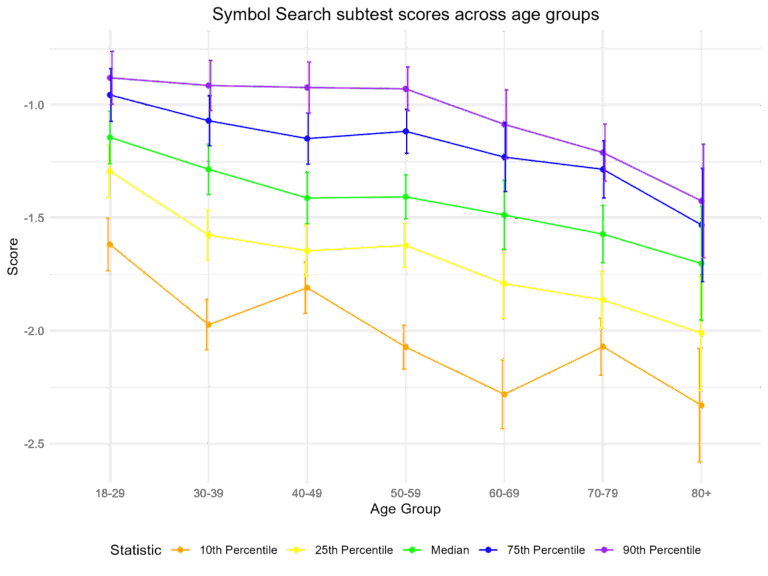
The RIOT also shows the decline in processing speed in adulthood. This is most apparent on the Symbol Search subtest, which asks examinees to respond “yes” or “no” as many times as possible to questions like the example below. There is a 2-minute time limit for this subtest.

The task is extremely easy for everyone. The average norm sample member completes 32.2 items in 2 minutes, with an accuracy of 96.4%. The vast majority (80.2%) of sample members did not commit any errors at all. Therefore, there is little variation in correct vs. incorrect scores. Instead, the Symbol Search subtest is almost entirely a measure of speed. This makes it unsurprising that it shows a stark decline in adulthood:
The decrease in performance in older cohorts in Symbol Search is so strong that a person at the 90th percentile in the group aged 80 or above performs worse than over 75% of individuals under 30!

These graphs show how useful the RIOT is as a measure of cognitive aging. The test effectively tracks decreases in working memory and processing speed in old age, and its results track closely with those of prior research.

Readers should be aware that these graphs show results from a cross-sectional sample. That means that the graph compares data collected from people at different ages in 2025. This is not a longitudinal study that follows the aging process in a group of people as they advance from young adulthood to their senior years. The exact magnitude of score declines differ in cross-sectional and longitudinal research, but the pattern of decrease in working memory and processing speed is present in both designs. The fact that the RIOT can show this decrease in a cross-sectional sample means it can probably also track this decline longitudinally in a group of people over time.

My hope is that the RIOT will become a tool that helps researchers, physicians, and clinicians monitor and understand the mental aging process. The RIOT team is willing to partner with anyone who wants to use the RIOT in their work with aging individuals. I hope interested readers will reach out to me. It would be a lot of fun to build a testing schedule, expand the RIOT’s assessment portfolio, and work to understand this important aspect of the aging process.


References


Schaie, K. W. (2013). Developmental influences on adult intelligence (2nd ed.). Oxford University Press.

Tucker-Drob, E. M., Brandmaier, A. M., & Lindenberger, U. (2019). Coupled cognitive changes in adulthood: A meta-analysis. Psychological Bulletin, 145(3), 273-301. https://doi.org/10.1037/bul0000179

Take our professional IQ test

Want to know your IQ? Try the first ever professional online IQ test.

Try our IQ test
Author
Dr. Russell T. WarneChief Scientist

Contact

Table of Contents

  • References
Article Categories
All ArticlesUnderstanding IQ ScoresTaking an IQ TestRIOT-Specific InformationGeneral IQ & IntelligenceAdvanced Topics & ResearchIQ Scores & InterpretationMensa & High-IQ SocietiesOnline IQ Tests IQ Test Basics & FundamentalsAverage IQ & DemographicsFamous People & IQHistory & Origins Of IQ TestingAccuracy, Reliability & CriticismSpecial Population & Related ConditionsImproving IQ / PreparationSpecific IQ Tests & FormatsIQ Testing for HR & RecruitmentSkills Assessment
Related Articles
What Is the Difference Between Intellectual Disability and Learning Disability? What Jobs Need High Spatial Ability?Is IQ Correlated With Dementia?Does High IQ Actually Correlate With Higher Salary After Age 30?High IQ vs. High EQ: Which One Predicts Long-Term Relationship Happiness?Are You Left-Brained or Right-Brained? What Neuroscience Actually SaysWhat Does Too Much Screen Time Do to Children's Brains?Types of IQ: The Quotients Explained (IQ, EQ, SQ, AQ, CQ)What Is the Dunning-Kruger Effect? What the Research Actually ShowsSame Test, Different Patterns: How ADHD and Autism Show Up Differently Across IQ SubtestsGeneral Intelligence vs. Multiple Intelligences: What Each Theory Gets RightNeuroplasticity in Your 30s and 40s: What the Science Actually SaysThe G-Factor vs. Gardner's Multiple Intelligences: What the Evidence Actually ShowsCan Hyperlexia Make You Seem Smarter Than You Actually Are?Is There a Correlation Between IQ and Reaction Time?Can Exercise Affect Your IQ Score?How Does IQ Change as a Person Ages?What Is the Flynn Effect and Why Are IQ Scores Rising?What Part of the Brain Controls IQ and Cognitive Function?Unlocking Your Potential: The Role of Online IQ TestingLogical Reasoning on an IQ Test: How It's Defined, Measured, and Why It Predicts So MuchThe Science Behind IQ Tests: Understanding Intelligence AssessmentExploring the Controversies Surrounding IQ TestsThe Future of IQ Testing: Trends and InnovationsVisual & Spatial Reasoning: What It Is and Why It Shows Up on an IQ TestFluid vs. Crystallized Intelligence: What the Difference Actually MeansIs Everyone About as Smart as I Am???Does Intelligence Research Undermine the Fight against Inequality?Does Intelligence Research Lead to Negative Social Policies?Do Past Controversies Taint Modern Research on Intelligence?Should Controversial or Unpopular Ideas Be Held to a Higher Standard of Evidence?Does Stereotype Threat Explain Score Gaps among Demographic Groups?Do Unique Influences Operate on One Group’s Intelligence Test Scores?Are Racial/Ethnic Group IQ Differences Completely Environmental in Origin?Do Males and Females Have the Same Distribution of IQ Scores?Is Emotional Intelligence a Real Ability that Is Helpful in Life?Is Very High Intelligence More Beneficial than Moderately High Intelligence?Are Intelligence Tests Designed to Create or Perpetuate a False Meritocracy?Is Intelligence Important in the Workplace?Do IQ Scores Just Measure How Good Someone is at Taking Tests?Are Admissions Tests A Barrier to College for Underrepresented Students? Do Non-Cognitive Variables Have Powerful Effects on Academic Achievement?Can Effective Schools Make Every Child Academically Proficient?Is Every Child Gifted?Does Improvability of IQ Mean Intelligence Can Be Equalized?Can Braining-Training Programs Raise IQ?Can Social Interventions Drastically Raise IQ?Are Genes Important for Determining Intelligence?Is Raising IQ Possible?Does IQ Reflect A Person’s Socioeconomic Status?Are Intelligence Tests Biased Against Diverse Populations?Is Practical Intelligence a Real Ability Separate from General Intelligence?Is Intelligence Just A Western Concept?Does IQ Correspond to Brain Anatomy or Functioning?Measuring Cognitive Aging with Memory and Processing Speed TasksComparing Cronbach’s Alpha and McDonald’s Omega ReliabilityWhat is the Flynn Effect? Is the World’s Collective IQ Increasing or Decreasing?How Do You Test Cognitive Functions?Does High IQ Correlate with Success?Creating an IQ TestIncreasing Your IQCulture-Fair Intelligence TestsFlynn EffectCognitive DevelopmentIQ Test QualityDo Non-g Gains from the Flynn Effect Matter?
Take our IQ tests

Basic IQ Test

5 subtests + 5 cognitive abilities

Take the IQ test

Features

  • ~13 Minutes
  • IQ score
  • Cognitive abilities breakdown
  • ±5.6 IQ margin of error

5/15 Subtests

Learn more
Vocabulary
Matrix Reasoning
SToVeS
Visual Reversal
Symbol Search
Most comprehensive

Full IQ Test

15 subtests + all cognitive abilities

Take the IQ test

Features

  • ~52 Minutes
  • IQ score
  • Cognitive abilities breakdown
  • ±3.7 IQ margin of error

15/15 Subtests

Learn more
Vocabulary, Information, Analogies
Matrix Reasoning, Visual Puzzles, Figure Weights
Object Rotation, SToVeS, Spatial Orientation
Computation Span, Exposure Memory, Visual Reversal
Symbol Search, Abstract Matching
Simple Reaction Time, Choice Reaction Time
Compare all tests