Napping and Intelligence: Do Naps Make You Smarter?
Napping and intelligence: a short nap gives a small, temporary lift to alertness and memory (about 0.18 SD in a meta-analysis), but no study shows naps raise IQ.
Dr. Russell T. WarneChief Scientist
Share
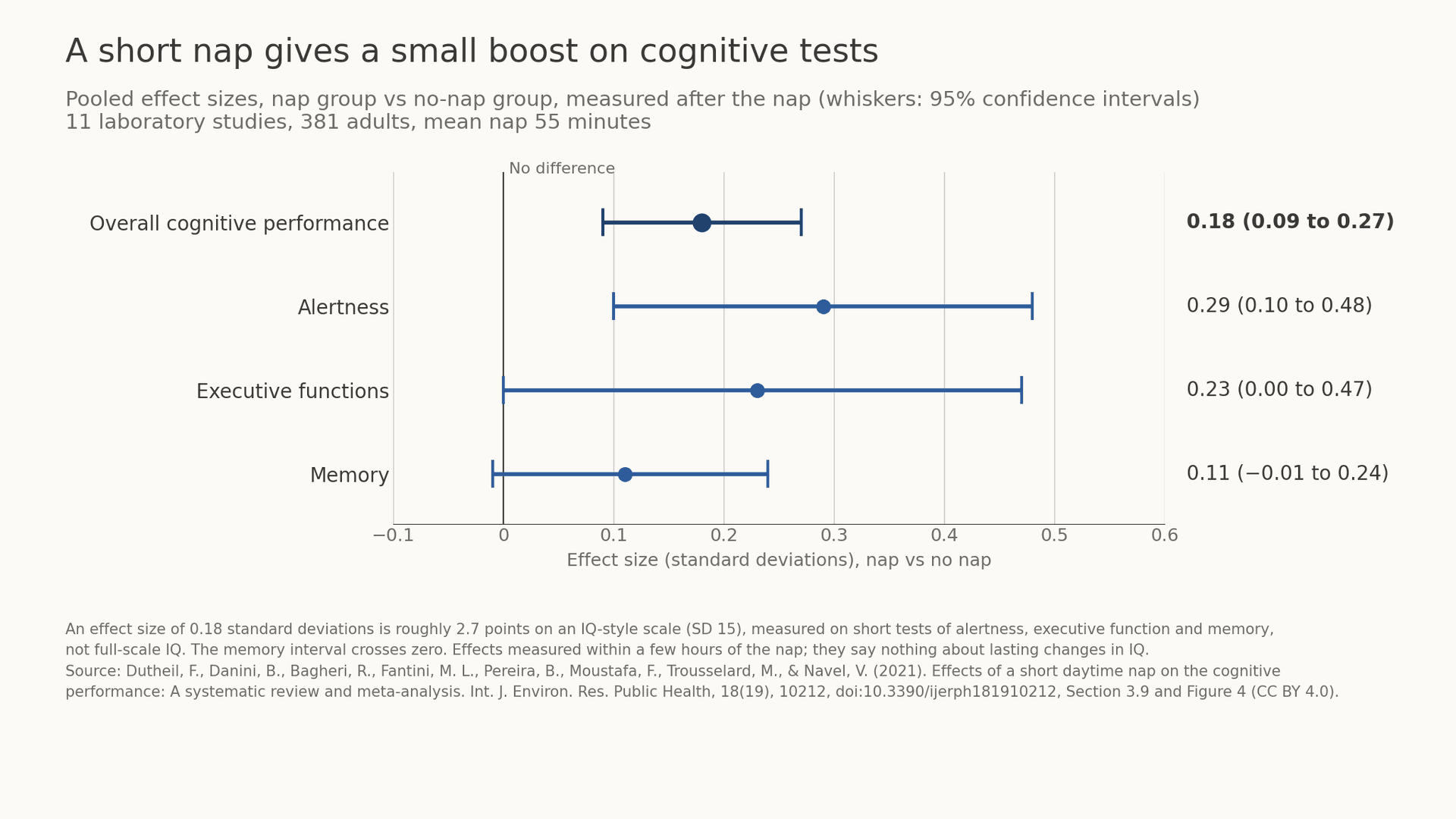
A nap does not make you more intelligent. What a short daytime nap can do is give a small, temporary lift to how well you perform on cognitive tasks. In a meta-analysis of 11 laboratory studies, people who napped scored about 0.18 standard deviations higher on cognitive tests afterward than people who stayed awake, an effect that would be roughly 3 points on the IQ scale if it applied to a whole IQ test, which it has not been shown to do.
This article covers what the experiments on naps and memory show, the famous NASA pilot study, a genetic study of habitual napping and brain size, why long naps in older adults can be a warning sign, and what this means for anyone taking a test.
What a nap does to cognitive performance
The best single summary comes from Frédéric Dutheil and colleagues, who pooled 11 studies with 381 working-age adults. The average nap lasted about 55 minutes. Before napping, the nap and no-nap groups performed the same. After the nap, the nap groups did better:
• Overall cognitive performance: an effect size of 0.18 (95% confidence interval 0.09 to 0.27).
• Alertness: 0.29 (0.10 to 0.48), the clearest benefit.
• Executive functions: 0.23 (0.00 to 0.47), where the lower limit touches zero.
• Memory: 0.11 (-0.01 to 0.24), which was not clearly different from zero.
The gains appeared mainly in the first two hours after waking, and results during the groggy period straight after waking were mixed. Almost every study took place in a laboratory, so the authors called for research in real workplaces before recommending naps at work.
To put these numbers on a familiar scale, an IQ score has a "standard deviation" (a measure of how spread out scores are) of 15 points, so 0.18 SD corresponds to about 2.7 points and 0.29 SD to about 4.4 points. That conversion is only illustrative. These studies measured reaction time, attention and recall on specific tasks, and they compared rested people with tired ones. They did not test full-scale IQ, and nothing suggests the benefit lasts beyond the day.
Timing and length matter. In a review of the experimental literature, Nicole Lovato and Leon Lack concluded that brief naps of 5 to 15 minutes improve performance almost immediately, with benefits lasting 1 to 3 hours. Naps longer than 30 minutes can leave people groggy for a while from "sleep inertia" (the impaired, disoriented state just after waking) before producing longer-lasting gains. Early afternoon was the most favourable time.
Naps, memory and learning
Some of the most cited nap research looks at learning. Sara Mednick, Ken Nakayama and Robert Stickgold trained people on a visual texture discrimination task and found that a 60- to 90-minute nap containing both deep slow-wave sleep and REM sleep produced as much improvement as a full night's sleep. That finding is the source of the phrase "a nap is as good as a night," but it applied to one perceptual skill.
Children show a similar pattern. Laura Kurdziel, Kasey Duclos and Rebecca Spencer compared preschoolers' memory for a visual-spatial game after a classroom nap and after the same time spent awake. The children remembered more after napping, the benefit was largest for children who napped habitually, and the loss from skipping the nap was not made up by sleep that night. The nap benefit was linked to "sleep spindles," bursts of brain activity during light sleep that are thought to support memory.
These studies show that sleep helps people hold on to what they have just learned. Memory consolidation is a real effect, but it concerns specific material, and better recall of a texture task or a picture-location game is different from higher general intelligence. Our article on how sleep affects IQ and cognitive performance covers what happens when people get too little sleep overall.
The NASA pilot nap study
The most famous practical nap study was a NASA and Federal Aviation Administration project led by Mark Rosekind. Pilots on long-haul transpacific flights were randomly assigned to a rest group, allowed a planned 40-minute opportunity to sleep in their cockpit seat during the cruise phase, or a no-rest group that worked as usual.
Rested pilots managed to sleep on 93% of their rest opportunities, fell asleep in about 5.6 minutes on average and slept for about 26 minutes. On a reaction-time test given during and after flights, the no-rest pilots were on average 10% to 16% slower than the rest group. The no-rest pilots also showed more brief lapses into sleep-like brain activity late in the flight, and four of them fell asleep during a control period when they were supposed to be awake.
This is strong evidence that a short nap counters fatigue in a tiring job. It says nothing about intelligence, because the pilots were all highly trained and the outcome was alertness.
Do habitual nappers have bigger brains?
Observational studies of napping and cognition in the general population give mixed results, partly because people who nap often differ from people who do not in age, health, work patterns and sleep at night. A study of 2,214 older adults in China by Han Cai and colleagues found that afternoon nappers scored better on cognitive screening tests, but a design like that cannot separate the nap from everything that comes with it.
Valentina Paz, Hassan Dashti and Victoria Garfield tried to get around that problem with "Mendelian randomization," a method that uses genetic variants linked to a habit as a natural experiment, since genes are assigned at conception and are not shaped by later lifestyle. Using 92 genetic variants associated with habitual daytime napping in UK Biobank data (up to 378,932 people, mean age 57), they found:
• Total brain volume: a genetic tendency to nap was associated with 15.8 cubic centimetres more brain volume (95% CI 0.25 to 31.34), which the authors estimated is comparable to 2.6 to 6.5 years of brain ageing.
• Hippocampal volume: no association.
• Reaction time: no association.
• Visual memory: no association.
The authors called the brain-volume result a modest causal association. The confidence interval nearly reaches zero, and the cognitive tests in the same study showed nothing, so this is weak support for any idea that napping makes people sharper. It also does not apply to IQ, which was not measured.
Long naps in older adults can be a warning sign
In later life, the direction of the link can reverse. Peng Li and colleagues followed 1,401 older adults in the Rush Memory and Aging Project for up to 14 years, measuring their naps objectively with wrist-worn activity monitors. Longer and more frequent daytime naps were associated with a higher risk of Alzheimer's dementia. People who napped an hour or more a day had about 1.4 times the risk of those who napped less, and people who napped at least once a day had a 40% higher risk than those who napped less often.
The relationship ran both ways. More napping predicted worse cognition a year later, and worse cognition predicted more napping a year later. The likeliest reading is that heavy daytime sleep can be an early sign of changes in the brain, rather than a cause of decline. Anyone noticing a new and marked increase in daytime sleepiness in themselves or an older relative should mention it to a doctor, since it can reflect sleep disorders, medication effects or other medical problems. People who sleep badly at night and nap to compensate may also find our page on insomnia and intelligence useful.
Frequently asked questions
Are people who nap smarter?
There is no evidence that habitual nappers are more intelligent. A large genetic study found no link between a tendency to nap and reaction time or visual memory.
Can a nap raise your IQ score?
A short nap can make a tired person more alert, which may help them show their real ability on a test. It does not change the underlying ability, and no study has shown a lasting increase in IQ from napping.
How long should a nap be to help thinking?
Reviews suggest that brief naps of about 5 to 15 minutes help almost immediately. Longer naps can cause grogginess for a while after waking before their benefits appear.
Is napping bad for the brain?
Short naps in healthy adults have not been shown to be harmful. In older adults, long or very frequent naps are linked to a higher risk of Alzheimer's dementia, probably as an early sign of brain changes.
Did NASA find that naps improve performance?
Yes. In a NASA study of long-haul pilots, those allowed a 40-minute cockpit rest slept about 26 minutes and were more alert afterward than pilots without a rest period.
The takeaway
Napping is a useful tool against fatigue and can help consolidate recently learned material, but the effects are small, specific and temporary. The best evidence shows a lift of about a fifth of a standard deviation in task performance after a nap, the biggest gains in alertness, and no sign that napping raises intelligence. In older adults, long naps deserve attention as a possible health signal. If you want an accurate picture of your reasoning ability, test when you are rested and alert and take a full-length online IQ test.
References
1. Dutheil, F., Danini, B., Bagheri, R., Fantini, M. L., Pereira, B., Moustafa, F., Trousselard, M., & Navel, V. (2021). Effects of a short daytime nap on the cognitive performance: A systematic review and meta-analysis. International Journal of Environmental Research and Public Health, 18(19), 10212. [doi.org/10.3390/ijerph181910212](. doi.org
2. Lovato, N., & Lack, L. (2010). The effects of napping on cognitive functioning. Progress in Brain Research, 185, 155-166. [doi.org/10.1016/B978-0-444-53702-7.00009-9](. doi.org
3. Mednick, S., Nakayama, K., & Stickgold, R. (2003). Sleep-dependent learning: A nap is as good as a night. Nature Neuroscience, 6(7), 697-698. [doi.org/10.1038/nn1078](. doi.org
4. Kurdziel, L., Duclos, K., & Spencer, R. M. C. (2013). Sleep spindles in midday naps enhance learning in preschool children. Proceedings of the National Academy of Sciences, 110(43), 17267-17272. [doi.org/10.1073/pnas.1306418110](. doi.org
5. Rosekind, M. R., Graeber, R. C., Dinges, D. F., Connell, L. J., Rountree, M. S., Spinweber, C. L., & Gillen, K. A. (1994). Crew factors in flight operations IX: Effects of planned cockpit rest on crew performance and alertness in long-haul operations (NASA Technical Memorandum 108839). NASA Ames Research Center. [ntrs.nasa.gov/citations/19950006379](. ntrs.nasa.gov
6. Cai, H., Su, N., Li, W., Li, X., Xiao, S., & Sun, L. (2021). Relationship between afternoon napping and cognitive function in the ageing Chinese population. General Psychiatry, 34(1), e100361. [doi.org/10.1136/gpsych-2020-100361](. doi.org
7. Paz, V., Dashti, H. S., & Garfield, V. (2023). Is there an association between daytime napping, cognitive function, and brain volume? A Mendelian randomization study in the UK Biobank. Sleep Health, 9(5), 786-793. [doi.org/10.1016/j.sleh.2023.05.002](. doi.org
8. Li, P., Gao, L., Yu, L., Zheng, X., Ulsa, M. C., Yang, H.-W., Gaba, A., Yaffe, K., Bennett, D. A., Buchman, A. S., Hu, K., & Leng, Y. (2023). Daytime napping and Alzheimer's dementia: A potential bidirectional relationship. Alzheimer's & Dementia, 19(1), 158-168. [doi.org/10.1002/alz.12636](. doi.org
Figure by RIOT IQ. Data from Dutheil et al. (2021), Int. J. Environ. Res. Public Health 18(19), 10212 (doi.org/10.3390/ijerph181910212), Section 3.9 and Figure 4, CC BY 4.0.
Take our professional IQ test
Want to know your IQ? Try the first ever professional online IQ test.