Noise and IQ: Does a Noisy Environment Lower Intelligence? | Riot IQ
Oct 15, 2026·Advanced Topics & Research
Noise and IQ: Does a Noisy Environment Lower Intelligence?
Noise and IQ: no study shows noise lowers IQ itself, but chronic aircraft noise at school is linked to slower reading, about 2 months per 5 dB in the UK.
Dr. Russell T. WarneChief Scientist
Share
No study has shown that noise lowers IQ itself, but children who learn under chronic aircraft noise read and remember less well than similar children in quieter schools. In a study of 2,844 children near three European airports, each 5-decibel increase in aircraft noise at school went with roughly a 2-month delay in reading age in the UK and a 1-month delay in the Netherlands.
That is a real but modest effect on specific school skills, and it is the best-studied part of the noise question. This article covers what the large airport and road-traffic studies found, the Munich airport natural experiment, what background noise does to thinking in the moment, whether bright people are more bothered by noise, and the confounds that make this research hard.
What the largest studies of noise and children's learning show
The landmark study is RANCH (Road traffic and Aircraft Noise exposure and children's Cognition and Health). Stephen Stansfeld and colleagues tested 2,844 children aged 9 and 10 at 89 schools around Amsterdam Schiphol, Madrid Barajas and London Heathrow airports, with schools matched within each country on socioeconomic status. Chronic aircraft noise had a linear association with poorer reading comprehension and recognition memory, which held after adjustment for mothers' education, socioeconomic status, long-standing illness and classroom insulation. Aircraft noise did not affect sustained attention, self-reported health or overall mental health.
A follow-up analysis by Charlotte Clark and colleagues found the reading result was consistent across the three countries and survived adjustment for annoyance and for the children's other cognitive abilities. A later review by Mathias Basner and colleagues put the size in everyday terms: a 5 dB increase in aircraft noise went with a 2-month delay in reading age in the UK and a 1-month delay in the Netherlands. Road traffic noise at school was not linked to reading comprehension in RANCH.
Road traffic is not off the hook, though. Maria Foraster and colleagues followed 2,680 Barcelona schoolchildren aged 7 to 10 through four rounds of computerised testing. Higher road traffic noise outside the school went with slower growth in working memory and attention over one year, while noise at home showed no association. The effects were measured on task scores, so they cannot be converted into IQ points.
When the World Health Organization reviewed this literature for its 2018 noise guidelines, Clark and Katarina Paunovic found 34 studies, all of children, and 82% were cross-sectional. They rated the evidence as moderate quality for harmful effects of aircraft noise on reading comprehension, standardized test scores and memory. For attention, executive function and most road and rail outcomes the evidence was low or very low quality. The review does not report full-scale IQ as an outcome in any of these studies, which is why the honest answer to "does noise lower IQ" is that it has barely been measured that way.
The Munich airport natural experiment
Cross-sectional studies always leave room for doubt, because families who live under flight paths may differ in ways researchers did not measure. The strongest evidence comes from a natural experiment. When Munich replaced its old airport with a new one, Staffan Hygge, Gary Evans and Monika Bullinger tested 326 children (mean age 10.4) near both the old and new sites, plus matched quiet-area control groups, once before and twice after the switch.
After the move, long-term memory and reading declined in children newly exposed to aircraft noise near the new airport. Children near the old airport, where the noise had stopped, improved in long-term memory, reading and short-term memory. Because the same children were followed as the noise arrived or left, this design rules out many stable family differences, and it suggests the effects are at least partly reversible.
An older New York study points the same way. Arline Bronzaft and Dennis McCarthy compared children in classrooms facing an elevated train line with children on the quiet side of the same school and found lower reading scores on the noisy side. After noise-abatement work on the tracks and in the classrooms, Bronzaft's follow-up found the gap in reading scores had closed. It was one school, so it is suggestive rather than decisive.
What background noise does to thinking in the moment
Chronic exposure over years is a different question from noise during a single task. Laboratory research on the "irrelevant sound effect" (the finding that sound you are trying to ignore still disrupts short-term memory) shows that background speech interferes with remembering sequences such as digit strings. Wolfgang Ellermeier and Karin Zimmer tested 72 adults recalling digits during foreign speech, pink noise or silence. The disruption from speech varied widely between people, from slight facilitation to severe impairment, and those individual differences were moderately stable over four weeks (retest r = .45).
This matters for working memory, the capacity to hold and manipulate information for a few seconds, which is part of most modern IQ tests. A noisy room during testing can lower a score for that session without changing the ability underneath.
Background music is the version most students ask about. A meta-analysis by Juliane Kämpfe, Peter Sedlmeier and Frank Renkewitz found an overall effect close to zero, but that average hid specific effects: compared with silence, background music disturbed reading and had small detrimental effects on memory, while it improved mood and sports performance.
Are smart people more sensitive to noise?
The internet often claims that intelligent people are easily distracted by noise. The study usually behind that claim is about creativity. Darya Zabelina and colleagues recorded an early brain response used to index "sensory gating" (the P50) in 84 people and found that real-world creative achievement went with "leaky" sensory gating, meaning less filtering of irrelevant sounds. Scores on a divergent thinking test showed the opposite pattern, and the results held when the researchers controlled for academic test scores. The study did not measure IQ, so it says nothing about whether high-IQ people are more noise sensitive.
Self-reported noise sensitivity is a weak guide even to how much noise affects you. In Ellermeier and Zimmer's study, people were quite inaccurate in judging their own impairment, and a noise-sensitivity questionnaire accounted for only a small portion of the variation in measured disruption. We found no well-designed study linking noise sensitivity to measured IQ.
Confounds that make noise research hard
Noise rarely comes alone. Homes and schools near airports and busy roads often differ in income, housing quality and air quality.
• Socioeconomic status: RANCH matched schools on socioeconomic status and adjusted for mothers' education, which is why its results carry more weight than single-city comparisons.
• Air pollution: Traffic brings both noise and exhaust. Basner's review notes that the RANCH reading associations were not explained by air pollution, and Foraster's Barcelona study adjusted for traffic-related air pollution. Our article on IQ and air pollution covers that exposure separately.
• Sample composition: In the Barcelona study, 58% of mothers had a university degree compared with 50% in the region, so the sample was somewhat more educated than the population.
• What was measured: Reading tests, memory tasks and attention tasks are related to general intelligence but are not IQ scores. The studies show slower development of specific skills, and no study has followed noise-exposed children to adult IQ.
Frequently asked questions
Does noise lower your IQ?
There is no direct evidence that noise lowers IQ. Chronic aircraft noise at school is linked to slower reading and poorer memory in children, with moderate-quality evidence according to a WHO review.
How big is the effect of aircraft noise on reading?
In the RANCH study, each 5 dB increase in aircraft noise at school went with about a 2-month delay in reading age in the UK and a 1-month delay in the Netherlands.
Are the effects of noise permanent?
Not necessarily. In the Munich study, children's reading and memory improved after the old airport closed.
Are intelligent people more sensitive to noise?
No study we found shows this. The research behind the claim linked creative achievement, not IQ, to weaker filtering of sounds, in a sample of 84 adults.
Does background music hurt studying?
On average the effect is close to zero, but a meta-analysis found that background music disturbed reading and slightly impaired memory compared with silence.
The takeaway
Noise has not been shown to lower IQ. Chronic aircraft noise is linked to modestly slower reading and memory development in children, the Munich natural experiment suggests part of that is causal and reversible, and road traffic noise at school may slow working memory growth. In the moment, background speech can disrupt short-term memory, so test somewhere quiet. When you are ready, take a full-length online IQ test in a calm room where you will not be interrupted.
References
1. Stansfeld, S. A., Berglund, B., Clark, C., Lopez-Barrio, I., Fischer, P., Öhrström, E., Haines, M. M., Head, J., Hygge, S., van Kamp, I., & Berry, B. F. (2005). Aircraft and road traffic noise and children's cognition and health: A cross-national study. The Lancet, 365(9475), 1942-1949. [doi.org/10.1016/S0140-6736(05)66660-3](. doi.org
2. Clark, C., Martin, R., van Kempen, E., Alfred, T., Head, J., Davies, H. W., Haines, M. M., Lopez Barrio, I., Matheson, M., & Stansfeld, S. A. (2006). Exposure-effect relations between aircraft and road traffic noise exposure at school and reading comprehension: The RANCH project. American Journal of Epidemiology, 163(1), 27-37. [doi.org/10.1093/aje/kwj001](. doi.org
3. Basner, M., Clark, C., Hansell, A., Hileman, J. I., Janssen, S., Shepherd, K., & Sparrow, V. (2017). Aviation noise impacts: State of the science. Noise & Health, 19(87), 41-50. [pmc.ncbi.nlm.nih.gov/articles/PMC5437751](. pmc.ncbi.nlm.nih.gov
4. Foraster, M., Esnaola, M., López-Vicente, M., Rivas, I., Álvarez-Pedrerol, M., Persavento, C., Sebastian-Galles, N., Pujol, J., Dadvand, P., & Sunyer, J. (2022). Exposure to road traffic noise and cognitive development in schoolchildren in Barcelona, Spain: A population-based cohort study. PLOS Medicine, 19(6), e1004001. [doi.org/10.1371/journal.pmed.1004001](. doi.org
5. Clark, C., & Paunovic, K. (2018). WHO Environmental Noise Guidelines for the European Region: A systematic review on environmental noise and cognition. International Journal of Environmental Research and Public Health, 15(2), 285. [doi.org/10.3390/ijerph15020285](. doi.org
6. Hygge, S., Evans, G. W., & Bullinger, M. (2002). A prospective study of some effects of aircraft noise on cognitive performance in schoolchildren. Psychological Science, 13(5), 469-474. [doi.org/10.1111/1467-9280.00483](. doi.org
7. Bronzaft, A. L., & McCarthy, D. P. (1975). The effect of elevated train noise on reading ability. Environment and Behavior, 7(4), 517-528. [doi.org/10.1177/001391657500700406](. doi.org
8. Bronzaft, A. L. (1981). The effect of a noise abatement program on reading ability. Journal of Environmental Psychology, 1(3), 215-222. [doi.org/10.1016/S0272-4944(81)80040-0](. doi.org
9. Ellermeier, W., & Zimmer, K. (1997). Individual differences in susceptibility to the "irrelevant speech effect". The Journal of the Acoustical Society of America, 102(4), 2191-2199. [doi.org/10.1121/1.419596](. doi.org
10. Kämpfe, J., Sedlmeier, P., & Renkewitz, F. (2011). The impact of background music on adult listeners: A meta-analysis. Psychology of Music, 39(4), 424-448. [doi.org/10.1177/0305735610376261](. doi.org
11. Zabelina, D. L., O'Leary, D., Pornpattananangkul, N., Nusslock, R., & Beeman, M. (2015). Creativity and sensory gating indexed by the P50: Selective versus leaky sensory gating in divergent thinkers and creative achievers. Neuropsychologia, 69, 77-84. [doi.org/10.1016/j.neuropsychologia.2015.01.034](. doi.org
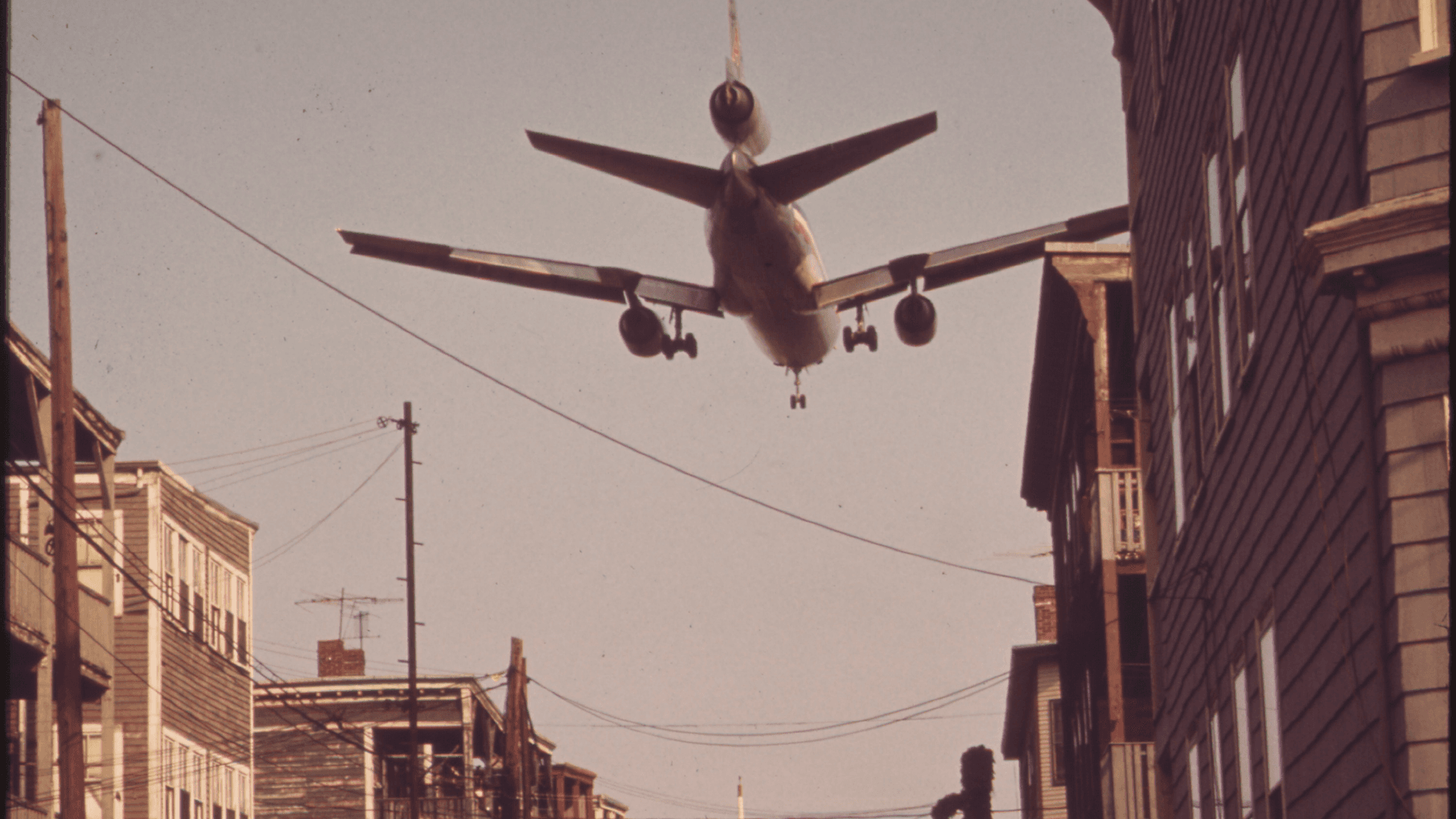
Hero image: Near Logan Airport, airplane coming in for a landing over Neptune Road homes (1973), by Michael Philip Manheim for the EPA Documerica project, public domain. Via the U.S. National Archives and Wikimedia Commons.
Take our professional IQ test
Want to know your IQ? Try the first ever professional online IQ test.