Blood Type and IQ: Is Your Blood Group Linked to Intelligence?
Blood type and IQ are not meaningfully linked. The few studies are small, old or confounded by social class, and no blood group has been shown to score higher.
Dr. Russell T. WarneChief Scientist
Share
Blood type and IQ have no meaningful link: no large or well-designed study has found that people with type A, B, AB or O blood differ in intelligence, and the claim that one group (often AB) has the highest IQ has no research behind it. The evidence is close to absent: the few studies are small, decades old, or explained by social class, and in the largest related dataset (on personality, in over 10,000 people) blood type explained less than 0.3% of the variance.
That near-silence is itself informative. This article covers the handful of studies that do exist, why genetics makes a large blood type effect very unlikely, where the idea comes from (largely the Japanese belief that blood type shapes personality), and the confounds that produced the occasional positive finding.
What the studies of blood type and IQ found
Only a few studies have looked directly at blood groups and test scores, and none was designed to settle the question.
• The 1973 Nature report: geneticists at Cambridge and Oxford (Gibson et al., 1973) reported an association between ABO blood groups and IQ, part of a research program that later examined other inherited markers in a group of Oxfordshire villages (Mascie-Taylor et al., 1985).
• The stratification reply: two years later, Thomson and Bodmer (1975) argued in the same journal that "population stratification" could explain the association. This means that if a population is made up of subgroups that differ in both blood group frequencies and average test scores (for example, because of social class or regional origin), blood type and IQ will correlate even though neither affects the other.
• Blood groups and social class: Beardmore and Karimi-Booshehri (1983) then showed that stratification of exactly this kind exists in England. In two large samples of blood donors, type A was more common, and type O less common, in professional and managerial classes, giving a type A person about 15% greater probability than chance of being in those classes. Rh-positive and Rh-negative types did not differ by class.
• A small Ecuadorian study: in 132 university students, type O was more common in participants from lower socioeconomic backgrounds, and higher socioeconomic status went with better scores on several tests. After adjusting for status and testing site, only one narrow skill, visual shape recognition, differed by blood group (Pluck, 2020). This was posted as a preprint and is not a peer-reviewed finding.
• Rh type and a parasite: a study of 502 soldiers found that the link between latent Toxoplasma infection and intelligence scores ran in opposite directions in Rh-positive and Rh-negative men (Flegr et al., 2013). That is an interaction in a single sample, and it says nothing about Rh type on its own.
None of these findings has been replicated in a large, representative sample with the kind of ancestry controls that modern genetics requires.
AB blood and cognitive decline
A larger, better-controlled study of blood type and cognition points the opposite way from the internet claim. In the US REGARDS cohort, researchers genotyped ABO in 495 adults who developed cognitive impairment over an average of 3.4 years and 587 who did not. People with type AB had higher odds of new cognitive impairment (odds ratio 1.82, 95% CI 1.15 to 2.90), possibly related to a clotting protein, factor VIII, though that did not significantly account for the link (Alexander et al., 2014). This concerns new memory and thinking problems in adults, which is a different question from IQ, and it is a single study.
Why one gene cannot carry much of IQ
Your ABO type is set by a single gene, ABO, whose variants determine which sugar molecules sit on the surface of red blood cells (Yamamoto et al., 1990). Intelligence works very differently.
The largest genetic study of intelligence in its era, by Savage and colleagues (2018), analysed 269,867 people and found 205 regions of the genome and 1,016 genes associated with test scores. All the common variants measured together captured an estimated 19% of the variation in intelligence (the "SNP heritability"), and a polygenic score built from the results explained up to 5.2% of the variance in independent samples. Each individual variant had a tiny effect.
When hundreds of genetic regions together predict about 5% of the differences between people, a single gene that sorts people into four blood groups would be expected to account for a sliver at most. Intelligence is moderately to highly heritable, as our article on whether IQ is genetic explains, but that heritability is spread across the genome rather than concentrated in a few visible traits.
A worked example shows how small any plausible effect would be. In the best data on blood type and personality (covered below), blood type explained less than 0.3% of the variance in any personality item. If blood type explained that much of IQ, the spread between blood group averages would be roughly the square root of .003 times 15, or under one IQ point, smaller than the typical measurement error of an IQ test. This is only an illustration; no study has measured such a difference.
Where the blood type idea comes from
In Japan, "ketsueki-gata" (blood type) is a popular way of describing personality, much as star signs are used elsewhere. Each blood type is said to come with its own temperament, and the online claim that AB is the "genius" blood type sits in this same tradition of reading character from blood, without any cited study behind it. The academic version dates back at least to 1927, when T. Furukawa published a study of temperament and blood groups in the Japanese Journal of Psychology, followed by an English-language paper in 1930.
The personality claim has been tested properly and fails. Nawata (2014) reanalysed random-sample surveys of more than 10,000 people in Japan and the United States. In 65 of 68 personality items, blood groups did not differ significantly, and blood type explained less than 0.3% of the variance in personality. If blood type cannot predict how people describe themselves, there is little reason to expect it to predict reasoning ability, and no study has shown that it does.
The blood type myth belongs to the same family as claims that eye color or hair color reveal intelligence. Our article on eye color and IQ explains why claims linking iris color to intelligence have no scientific support.
Confounds that can create a false link
When blood type and IQ appear to correlate, the usual explanations are these.
• Ancestry and region: blood group frequencies vary between populations and regions, and so do schooling, income and test familiarity. In the Ecuadorian preprint, blood type frequencies varied by testing site.
• Social class: the English blood donor data show ABO frequencies differing by occupational class, and class is strongly linked to test scores.
• Small samples and many comparisons: a study that compares four blood groups on several tests runs many statistical comparisons. With a sample of around a hundred people, one "significant" result by chance is to be expected.
• Publication and attention: an unusual positive finding is more likely to be noticed and shared than a null one, so the occasional association travels further than the larger body of nothing.
A convincing study would need a large, representative sample, full-scale IQ, careful control for ancestry and social background, and ideally a comparison of siblings with different blood types within the same family. That study has not been done, and given what is known about the genetics of intelligence, it would almost certainly find little.
Frequently asked questions
Which blood type has the highest IQ?
None has been shown to. The popular claim that type AB has the highest IQ has no peer-reviewed study behind it, and the one large cohort study of AB blood and cognition found higher odds of later cognitive impairment, the reverse of higher ability.
Is blood type AB a sign of genius?
No. The idea comes from Japanese blood type personality lore, which large surveys have not supported.
Does Rh-negative blood mean higher intelligence?
There is no evidence for this. Rh type did not differ by social class in English blood donors, and the only intelligence finding involving Rh concerned its interaction with a parasitic infection in one sample.
Is intelligence inherited through blood?
Intelligence is partly heritable, but through thousands of small genetic variants across the genome. Blood is not the carrier, and blood type is set by a single gene with no demonstrated effect on IQ.
Can a blood test measure IQ?
No. Intelligence is measured with standardized cognitive tests, and even DNA-based polygenic scores currently predict only a small share of the differences in test scores.
The takeaway
There is no real evidence that blood type is linked to intelligence. The few positive reports are small, old, or explained by blood group frequencies differing across social classes and regions, and genetics makes a large single-gene effect very unlikely. The "AB is the smartest" claim grew out of personality folklore that fails its own tests. If you want to know your IQ, a blood test will not tell you, but you can take the RIOT IQ test, which measures reasoning directly.
References
1. Alexander, K. S., Zakai, N. A., Gillett, S., McClure, L. A., Wadley, V., Unverzagt, F., & Cushman, M. (2014). ABO blood type, factor VIII, and incident cognitive impairment in the REGARDS cohort. Neurology, 83(14), 1271-1276. [doi.org/10.1212/WNL.0000000000000844](. doi.org
2. Beardmore, J. A., & Karimi-Booshehri, F. (1983). ABO genes are differentially distributed in socio-economic groups in England. Nature, 303(5917), 522-524. [doi.org/10.1038/303522a0](. doi.org
3. Flegr, J., Preiss, M., & Klose, J. (2013). Toxoplasmosis-associated difference in intelligence and personality in men depends on their Rhesus blood group but not ABO blood group. PLOS ONE, 8(4), e61272. [doi.org/10.1371/journal.pone.0061272](. doi.org
4. Furukawa, T. (1927). A study of temperament by means of human blood groups. The Japanese Journal of Psychology, 2(4), 612-634. [doi.org/10.4992/jjpsy.2.612](. doi.org
5. Furukawa, T. (1930). A study of temperament and blood-groups. The Journal of Social Psychology, 1(4), 494-509. [doi.org/10.1080/00224545.1930.9714153](. doi.org
6. Gibson, J. B., Harrison, G. A., Clarke, V. A., & Hiorns, R. W. (1973). IQ and ABO blood groups. Nature, 246, 498-500. [doi.org/10.1038/246498a0](. doi.org
7. Mascie-Taylor, C. G. N., Gibson, J. B., Hiorns, R. W., & Harrison, G. A. (1985). Associations between some polymorphic markers and variation in IQ and its components in Otmoor villagers. Behavior Genetics, 15(4), 371-383. [doi.org/10.1007/BF01070895](. doi.org
8. Nawata, K. (2014). No relationship between blood type and personality: Evidence from large-scale surveys in Japan and the US. The Japanese Journal of Psychology, 85(2), 148-156. [doi.org/10.4992/jjpsy.85.13016](. doi.org
9. Pluck, G. (2020). ABO blood group, socioeconomic status, and cognitive function: Evidence for better visual recognition associated with the type O phenotype [Preprint]. PsyArXiv. [doi.org/10.31234/osf.io/df3nj](. doi.org
10. Savage, J. E., Jansen, P. R., Stringer, S., Watanabe, K., Bryois, J., de Leeuw, C. A., et al. (2018). Genome-wide association meta-analysis in 269,867 individuals identifies new genetic and functional links to intelligence. Nature Genetics, 50(7), 912-919. [doi.org/10.1038/s41588-018-0152-6](. doi.org
11. Thomson, G., & Bodmer, W. F. (1975). Population stratification as an explanation of IQ and ABO association. Nature, 254(5498), 363. [doi.org/10.1038/254363a0](. doi.org
12. Yamamoto, F., Clausen, H., White, T., Marken, J., & Hakomori, S. (1990). Molecular genetic basis of the histo-blood group ABO system. Nature, 345(6272), 229-233. [doi.org/10.1038/345229a0](. doi.org
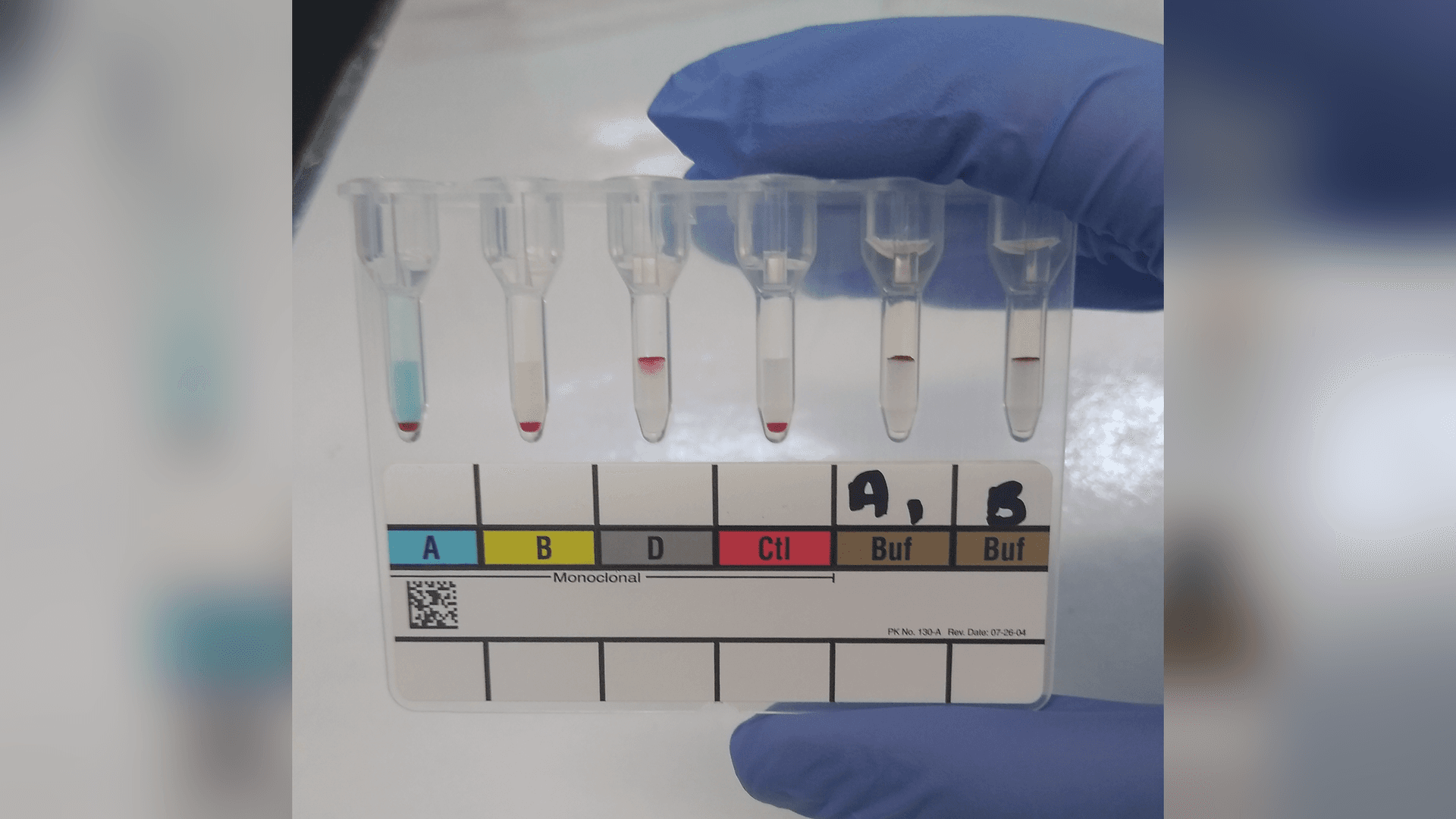
Hero image: Blood typing by gel card method (column agglutination or MTS gel) - type O positive, by SpicyMilkBoy, CC BY-SA 4.0. Via Wikimedia Commons.
Take our professional IQ test
Want to know your IQ? Try the first ever professional online IQ test.