Lead Exposure and IQ: How Much Childhood Lead Lowers Intelligence | Riot IQ
Oct 10, 2026·Advanced Topics & Research
Lead Exposure and IQ: How Much Childhood Lead Lowers Intelligence
Lead exposure lowers IQ: in a pooled study of 1,333 children, blood lead rising from 2.4 to 30 µg/dL cost about 6.7 points, most of it at low levels.
Dr. Russell T. WarneChief Scientist
Share
Lead exposure in early childhood lowers IQ: in a pooled analysis of 1,333 children, a rise in blood lead from 2.4 to 30 micrograms per deciliter (µg/dL) was linked to a loss of about 6.7 IQ points, and more than half of that loss occurred below 10 µg/dL. There is no known safe blood lead level, and the effect is among the best documented environmental influences on intelligence.
This page covers what the pooled analysis and the cohort studies behind it found, how the research led health agencies to lower their thresholds, whether childhood lead still matters in adulthood, what leaded gasoline did to the population as a whole, and how to separate lead's effect from the poverty it travels with.
What the pooled analysis found
The key study is a 2005 pooled analysis led by Bruce Lanphear that combined raw data from seven long-running cohort studies in the United States, Mexico, Australia and the former Yugoslavia. The children had their blood lead measured repeatedly from birth or infancy and took a full-scale IQ test between ages 5 and 10. The analysis adjusted for the quality of the home environment, birth weight, the mother's education and the mother's IQ.
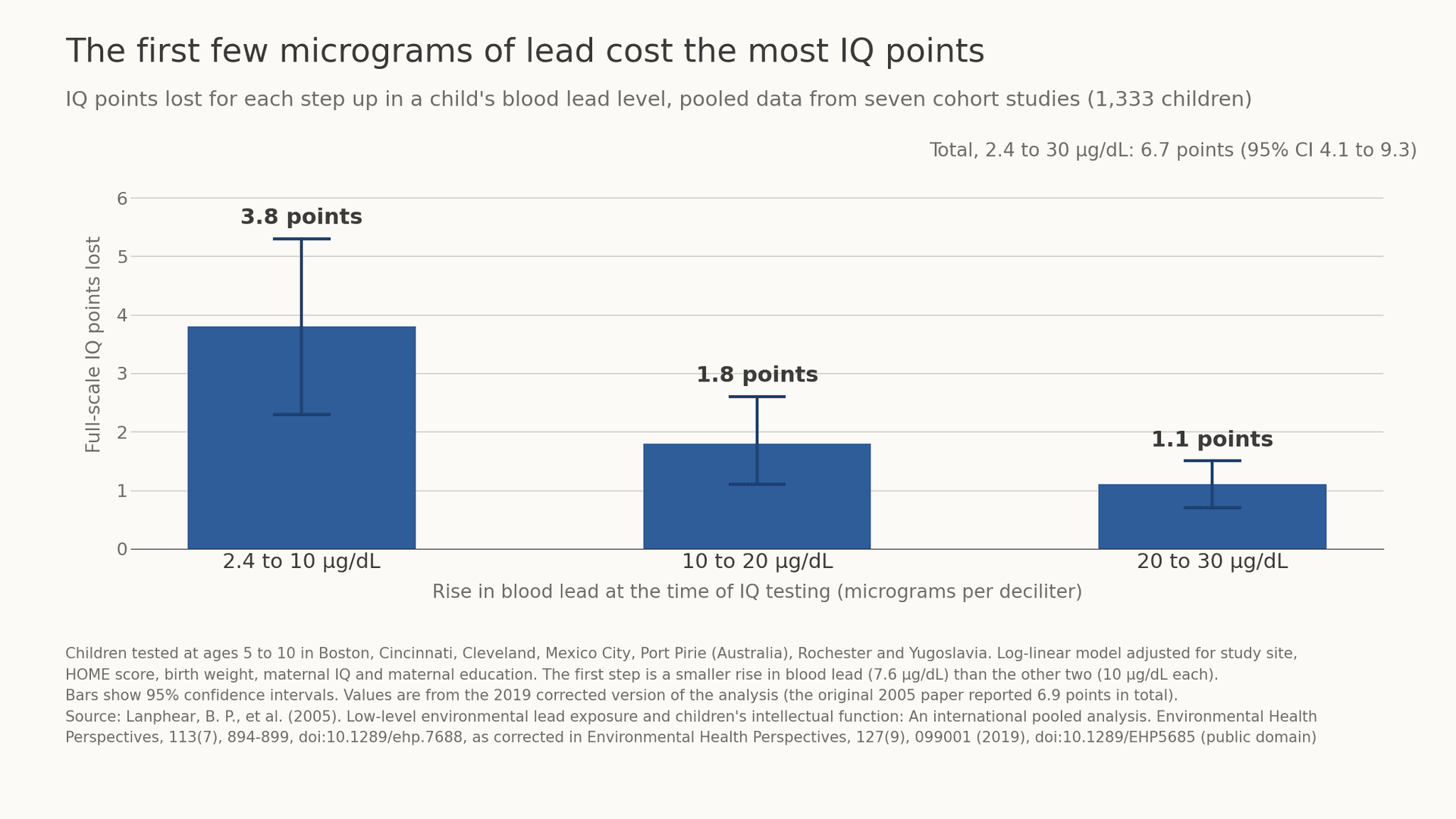
In 2019 the authors published a correction after finding two data errors in the Boston cohort, along with a fully reanalyzed version of the paper. The corrected numbers are slightly smaller than the originals and do not change the conclusions. In the corrected analysis, a rise in blood lead measured at the time of testing from 2.4 to 30 µg/dL was linked to 6.7 fewer IQ points (95% confidence interval 4.1 to 9.3).
The shape of the curve is the striking part. The first step, from 2.4 to 10 µg/dL, was linked to 3.8 points; the next, from 10 to 20, to 1.8 points; and the last, from 20 to 30, to 1.1 points. The chart above shows those three steps. Children whose blood lead never exceeded 7.5 µg/dL showed a significantly steeper decline per microgram than more heavily exposed children.
A single cohort in Rochester, New York, had found the same pattern two years earlier. Richard Canfield and colleagues followed 172 children and tested them on the Stanford-Binet at ages 3 and 5. Each 10 µg/dL increase in lifetime average blood lead was linked to 4.6 fewer points, and in a nonlinear model IQ fell 7.4 points as blood lead rose from 1 to 10 µg/dL.
How the research moved the thresholds
A landmark early study was Herbert Needleman's 1979 paper in the New England Journal of Medicine. Instead of blood, his team measured lead in the dentine of children's shed baby teeth, a record of earlier exposure. Children with high dentine lead scored significantly lower on the Wechsler Intelligence Scale for Children than those with low levels, a difference not explained by 39 other variables the team examined. Teachers also rated classroom behavior worse as tooth lead rose.
Studies like these drove the official definition of excessive exposure steadily downward. Before 1970 it was a blood lead level of 60 µg/dL, a level that could cause visible poisoning. It was cut to 40 in 1971, 30 in 1978, 25 in 1985 and 10 in 1991. In 2012 the Centers for Disease Control and Prevention (CDC) introduced a "blood lead reference value" set at the 97.5th percentile of US children aged 1 to 5, initially 5 µg/dL. In 2021 it lowered that value to 3.5 µg/dL and stated that "there is no known safe blood lead level."
Does childhood lead still matter in adulthood?
The Dunedin study in New Zealand followed a cohort born in 1972 and 1973, in which high blood lead was found among children from every socioeconomic level. Aaron Reuben and colleagues looked at 565 members who had been tested for lead at age 11, when their average blood lead was 10.99 µg/dL. At 38, after adjustment for the mother's IQ, the person's own childhood IQ and childhood socioeconomic status, each 5 µg/dL of childhood blood lead was linked to a 1.61-point lower adult IQ (-2.48 to -0.74). Higher childhood lead was also tied to a decline in IQ from childhood to adulthood and to downward social mobility.
Lead exposure in adulthood is a separate question with a thinner evidence base. A 2007 review of 21 studies found that in adults with environmental exposure, cognitive function was more consistently linked to cumulative lead stored in bone than to current blood lead. In workers currently exposed on the job, associations showed up more clearly with blood lead.
Leaded gasoline and a nation's IQ
Lead was blended into gasoline, mainly to boost octane, from the early 1920s. The US Environmental Protection Agency began phasing it down in 1973, and a ban on leaded fuel for on-road vehicles took effect on January 1, 1996. Children's blood lead fell over the same decades. Among US children aged 1 to 5, the geometric mean fell from 15.2 µg/dL in 1976 to 1980 to 0.83 µg/dL in 2011 to 2016, a decline of about 94.5%.
A 2022 study by Michael McFarland, Mathew Hauer and Aaron Reuben estimated what the leaded gasoline era cost. Combining national blood lead surveys with gasoline lead data, they estimated that more than 170 million Americans alive in 2015 had blood lead above 5 µg/dL in early childhood. They calculated a total of about 824 million IQ points lost to childhood lead exposure, an average of 2.6 points per person, rising to 5.9 points for people born from 1966 to 1970. These are model-based estimates that apply dose-response findings to whole populations, so they carry more uncertainty than the cohort studies.
Drinking water can also carry lead. After Flint, Michigan, switched to a more corrosive water source without adequate corrosion control, the share of young children with elevated blood lead rose from 2.4% to 4.9%, with the largest increases in disadvantaged neighborhoods, according to an analysis by pediatrician Mona Hanna-Attisha and colleagues. The authors described water as a growing source of childhood lead exposure because of aging infrastructure. Their study measured blood lead, not IQ, so it cannot say how many points were lost. Lead's case is far stronger than that for fluoride, the other drinking-water exposure often debated for its effect on IQ.
Separating lead from poverty
Lead exposure is not randomly distributed. Higher blood lead in US children has been consistently associated with lower family income and older housing, and the same factors affect children's IQ through many other routes. Lead is one item on a long list of environmental factors that influence IQ, and many of the others cluster in the same neighborhoods.
The strongest studies handle this by measuring the confounders directly. The pooled analysis adjusted for maternal IQ and the home environment, both powerful predictors of a child's score, and the lead effect remained. The Dunedin study adjusted for each participant's own childhood IQ. Lanphear's team opened their paper by calling lead "a confirmed neurotoxin"; the open question they set out to answer was how large the effect is at low levels, and their answer was that the loss per microgram is steepest at the lowest levels. The broader relationship between family background and scores is covered in our page on IQ and socioeconomic status.
For families, the practical route is testing. The CDC recommends that screening focus on children at higher risk, based on the age of their housing and other factors, and Medicaid requires blood lead tests for enrolled children at 12 and 24 months. A pediatrician or the local health department can arrange a test and advise on next steps.
Frequently asked questions
How many IQ points does lead exposure lower?
In the pooled analysis of 1,333 children, a rise in blood lead from 2.4 to 30 µg/dL was linked to about 6.7 fewer IQ points. Over half of that loss, 3.8 points, came from the rise between 2.4 and 10 µg/dL.
Is there a safe level of lead?
The CDC states there is no known safe blood lead level. Its reference value of 3.5 µg/dL marks children with more lead than 97.5% of US children aged 1 to 5, and it is not a safety threshold.
Should I get my child tested for lead?
A pediatrician or the local health department can advise on and arrange a blood lead test. The CDC recommends screening focused on higher-risk children, such as those living in older housing, and Medicaid requires tests at 12 and 24 months.
Does lead exposure affect adult IQ?
Childhood exposure is linked to lower adult IQ decades later. For exposure that begins in adulthood, studies link cumulative lead stored in bone to poorer cognitive function, though the evidence is thinner than for children.
Did leaded gasoline lower IQ scores?
A 2022 model estimated that childhood lead exposure, largely from the leaded gasoline era, cost Americans alive in 2015 an average of 2.6 IQ points each. The estimate was highest, 5.9 points, for people born from 1966 to 1970.
The takeaway
Lead is one of the clearest cases of an environmental exposure that lowers intelligence. The best pooled evidence puts the loss at about 6.7 IQ points across the range from 2.4 to 30 µg/dL, with the steepest losses at the low end, and the effect survives adjustment for maternal IQ and home environment. Children's average blood lead in the United States has fallen by about 95% since the late 1970s, over the decades when lead was taken out of gasoline. If you want a careful measure of your own reasoning abilities, you can take the RIOT IQ test.
References
1. Lanphear, B. P., Hornung, R., Khoury, J., Yolton, K., Baghurst, P., Bellinger, D. C., Canfield, R. L., Dietrich, K. N., Bornschein, R., Greene, T., Rothenberg, S. J., Needleman, H. L., Schnaas, L., Wasserman, G., Graziano, J., & Roberts, R. (2005). Low-level environmental lead exposure and children's intellectual function: An international pooled analysis. Environmental Health Perspectives, 113(7), 894-899. [doi.org/10.1289/ehp.7688](. doi.org
2. Lanphear, B. P., Hornung, R., Khoury, J., Yolton, K., Baghurst, P., Bellinger, D. C., Canfield, R. L., Dietrich, K. N., Bornschein, R., Greene, T., Rothenberg, S. J., Needleman, H. L., Schnaas, L., Wasserman, G., Graziano, J., & Roberts, R. (2019). Erratum: "Low-level environmental lead exposure and children's intellectual function: An international pooled analysis". Environmental Health Perspectives, 127(9), 099001. [doi.org/10.1289/EHP5685](. doi.org
3. Canfield, R. L., Henderson, C. R., Jr., Cory-Slechta, D. A., Cox, C., Jusko, T. A., & Lanphear, B. P. (2003). Intellectual impairment in children with blood lead concentrations below 10 µg per deciliter. New England Journal of Medicine, 348(16), 1517-1526. [doi.org/10.1056/NEJMoa022848](. doi.org
4. Needleman, H. L., Gunnoe, C., Leviton, A., Reed, R., Peresie, H., Maher, C., & Barrett, P. (1979). Deficits in psychologic and classroom performance of children with elevated dentine lead levels. New England Journal of Medicine, 300(13), 689-695. [doi.org/10.1056/NEJM197903293001301](. doi.org
5. Ruckart, P. Z., Jones, R. L., Courtney, J. G., LeBlanc, T. T., Jackson, W., Karwowski, M. P., Cheng, P.-Y., Allwood, P., Svendsen, E. R., & Breysse, P. N. (2021). Update of the blood lead reference value: United States, 2021. MMWR. Morbidity and Mortality Weekly Report, 70(43), 1509-1512. [doi.org/10.15585/mmwr.mm7043a4](. doi.org
6. Reuben, A., Caspi, A., Belsky, D. W., Broadbent, J., Harrington, H., Sugden, K., Houts, R. M., Ramrakha, S., Poulton, R., & Moffitt, T. E. (2017). Association of childhood blood lead levels with cognitive function and socioeconomic status at age 38 years and with IQ change and socioeconomic mobility between childhood and adulthood. JAMA, 317(12), 1244-1251. [doi.org/10.1001/jama.2017.1712](. doi.org
7. Shih, R. A., Hu, H., Weisskopf, M. G., & Schwartz, B. S. (2007). Cumulative lead dose and cognitive function in adults: A review of studies that measured both blood lead and bone lead. Environmental Health Perspectives, 115(3), 483-492. [doi.org/10.1289/ehp.9786](. doi.org
8. U.S. Environmental Protection Agency. (1996, January 29). EPA takes final step in phaseout of leaded gasoline [Press release]. [epa.gov](. epa.gov
9. Egan, K. B., Cornwell, C. R., Courtney, J. G., & Ettinger, A. S. (2021). Blood lead levels in U.S. children ages 1-11 years, 1976-2016. Environmental Health Perspectives, 129(3), 037003. [doi.org/10.1289/EHP7932](. doi.org
10. McFarland, M. J., Hauer, M. E., & Reuben, A. (2022). Half of US population exposed to adverse lead levels in early childhood. Proceedings of the National Academy of Sciences, 119(11), e2118631119. [doi.org/10.1073/pnas.2118631119](. doi.org
11. Hanna-Attisha, M., LaChance, J., Sadler, R. C., & Champney Schnepp, A. (2016). Elevated blood lead levels in children associated with the Flint drinking water crisis: A spatial analysis of risk and public health response. American Journal of Public Health, 106(2), 283-290. [doi.org/10.2105/AJPH.2015.303003](. doi.org
Figure by RIOT IQ. Data from Lanphear et al. (2005), Environmental Health Perspectives 113(7), 894-899, as corrected in 2019 (doi.org/10.1289/EHP5685), public domain.
Take our professional IQ test
Want to know your IQ? Try the first ever professional online IQ test.