Myopia and IQ are linked, but weakly: nearsighted people score a few points higher on average, and most of that link runs through years of schooling.
Dr. Russell T. WarneChief Scientist
Share
Nearsighted people do score a little higher on intelligence tests on average, but the gap is small: in a German study of 3,452 adults myopic adults outscored non-myopic adults by roughly 4 IQ-style points, and the correlation between cognitive score and degree of myopia was about r = .15. Most of that link runs through education, because large genetic studies show that more years in school cause myopia, while there is little sign that myopia itself changes intelligence.
The idea that people with glasses are smarter is one of the oldest stereotypes about intelligence. This page covers what the large conscript and cohort studies found, why schooling is the main explanation, what genetic studies add, and why the association says almost nothing about any one person. It describes research and does not give medical advice. Anyone with blurry distance vision, or a child who squints at the board, should see an optometrist or ophthalmologist for an eye examination.
How strong is the link between myopia and IQ?
Myopia, or nearsightedness, means the eye focuses light from distant objects in front of the retina, usually because the eyeball has grown too long. Close objects stay sharp and far ones blur. Eye care professionals measure it in dioptres (D), with more negative numbers meaning stronger myopia.
The association with intelligence has been found in very large samples:
• Israeli conscripts: Rosner and Belkin studied 157,748 men aged 17 to 19 and found that myopia was significantly more common in the more intelligent and more educated groups. In their models, years of schooling and intelligence weighed about equally.
• Danish conscripts: Teasdale, Fuchs and Goldschmidt compared 5,943 myopic and 9,891 non-myopic 18-year-old men. Myopes of every degree had higher test scores and more education than non-myopes. The relationship was not linear: among men with myopia between -2.0 and -7.75 D, there were no significant differences in scores.
• Singapore children: Saw and colleagues tested 1,204 Chinese schoolchildren aged 10 to 12 with Raven's Standard Progressive Matrices, a nonverbal reasoning test. After adjusting for parental myopia, father's education and books read per week, children in the top IQ quartile had 2.4 times the odds of myopia of children in the bottom quartile.
• German adults: In the Gutenberg Health Study, Mirshahi and colleagues gave 3,452 adults aged 40 to 79 the Tower of London planning test. Myopes averaged 14.0 points and non-myopes 12.9, with standard deviations of about 4. That gap is about 0.28 standard deviations, which I converted to roughly 4 points on the familiar IQ scale (0.28 × 15).
A Danish finding is worth stressing. Once someone was myopic at all, how myopic they were barely tracked their score. That pattern fits a trigger such as schooling better than a direct biological tie between eye length and brain function.
Education is the main path
The best evidence on cause and effect comes from Mendelian randomisation, a method that uses genetic variants as natural experiments because they are assigned at conception and are not changed by later life choices. Mountjoy and colleagues applied it to 67,798 adults in the UK Biobank and tested both directions:
• Education to myopia: Each extra year of education was associated with -0.18 D of refractive error in ordinary regression. The genetic analysis suggested the causal effect was larger, -0.27 D per year.
• Myopia to education: There was little evidence that myopia affected how long people stayed in school (-0.008 years per dioptre, not significant).
The authors calculated that a UK university graduate with 17 years of education would, on average, be at least 1 dioptre more myopic than someone who left school at 16. That is enough to need glasses for driving.
Studies of young children point the same way. Ding and colleagues followed 706 first-graders in Guangzhou, China, and compared children who differed by only four months in age but sat in different school grades. Within a grade, a full year of age made no significant difference to refraction. Across the grade boundary, the youngest second-graders were 0.36 D more myopic than the oldest first-graders, and the gap grew in later grades. Time in school, rather than age, drove the change.
The German study tied these threads together. When education and cognitive score were entered into the same model, years of education predicted myopia and cognitive performance no longer did. The authors concluded that cognitive ability may be associated with myopia mainly through its effect on how much education a person gets. Higher-scoring students tend to stay in school longer, a pattern covered in our article on what IQ predicts, and longer schooling then lengthens the eye.
What genetic studies add
Genetics adds a twist. In a genome-wide study of 300,486 people, Davies and colleagues found a positive genetic correlation between general cognitive function and short-sightedness (rg = 0.32) and a negative one with long-sightedness (rg = -0.21). Some of the same genetic variants, in other words, nudge people toward both higher test scores and myopia.
A genetic correlation does not by itself show a shared biological mechanism in the eye and brain. Variants linked to cognitive ability also predict staying in education, so part of that correlation may simply be the education pathway seen at the genetic level. The Singapore and New Zealand child studies leave a small amount unexplained. Saw's team found that nonverbal IQ predicted myopia more strongly than books read per week. In the Dunedin cohort, Williams and colleagues found that children with myopia at age 11 had higher verbal and performance IQ scores, while children with farsightedness (hyperopia) scored slightly lower, and these differences were not fully explained by family background or earlier ability. Whether a direct link exists beyond education is still an open question, and any such effect looks small.
Why "glasses mean smart" is a weak signal
Myopia is now so common that wearing glasses tells you little about anyone's intelligence. A meta-analysis by Holden and colleagues, covering 145 studies and 2.1 million people, estimated that 22.9% of the world's population was myopic in 2000 and projected 49.8% by 2050. When half the world is nearsighted, the group includes people at every level of ability.
The environmental causes are well studied. Close work such as reading is one suspect, and time outdoors appears to protect. In a cluster randomised trial in Guangzhou, adding a 40-minute outdoor class to each school day cut the three-year rate of new myopia from 39.5% to 30.4%. Neither factor has anything to do with how intelligent a child is.
There are also several reasons the stereotype outlives the data:
• Visibility: Glasses are easy to see, and the bookish child with glasses is a familiar figure in fiction.
• Selection: Students in demanding academic programs have spent more years in school, so they are more likely to be myopic.
• Size: An association of r = .15 means myopia accounts for about 2% of the variation in test scores. Plenty of very able people have perfect distance vision, and plenty of people with strong myopia score below average.
Getting glasses does not change anyone's IQ, and myopia is not a sign of giftedness. Family income and parental education also shape both schooling and test scores, a topic covered in our article on whether IQ reflects socioeconomic status.
Frequently asked questions
Do people who wear glasses have higher IQs?
On average, slightly. Studies of conscripts and schoolchildren find that myopic people score a few points higher, but most of the difference reflects more years of schooling.
Does reading or studying cause myopia?
More years of education cause myopia according to Mendelian randomisation studies, at about -0.27 dioptres per year in the UK Biobank. Researchers still debate how much of that comes from close work and how much from less time outdoors.
Does myopia make you smarter?
There is no evidence that it does. Genetic analyses found little effect of myopia on years of education, and the IQ link runs mainly from schooling to the eye.
Is high myopia linked to even higher IQ?
Not clearly. In the Danish conscript study, scores did not differ significantly among men with myopia from -2.0 to -7.75 dioptres.
Who should I see about nearsightedness?
An optometrist can measure refractive error and prescribe correction, and an ophthalmologist (a medical eye doctor) handles eye disease and high myopia. Children should have their eyes checked if they squint, sit close to screens or struggle to see the board.
The takeaway
The myopia IQ link is real but small, about a 4-point average gap in adults, and the best causal evidence shows that schooling explains most of it. A shared genetic contribution may account for a little more, but it does not make glasses a marker of intelligence. If you want an actual measure of your reasoning ability, you can take a full-length online IQ test built on a modern norm sample.
References
1. Rosner, M., & Belkin, M. (1987). Intelligence, education, and myopia in males. Archives of Ophthalmology, 105(11), 1508-1511. [doi.org/10.1001/archopht.1987.01060110054030](. doi.org
2. Teasdale, T. W., Fuchs, J., & Goldschmidt, E. (1988). Degree of myopia in relation to intelligence and educational level. The Lancet, 2(8624), 1351-1354. [doi.org/10.1016/s0140-6736(88)90880-x](. doi.org
3. Saw, S. M., Tan, S. B., Fung, D., Chia, K. S., Koh, D., Tan, D. T., & Stone, R. A. (2004). IQ and the association with myopia in children. Investigative Ophthalmology & Visual Science, 45(9), 2943-2948. [doi.org/10.1167/iovs.03-1296](. doi.org
4. Mirshahi, A., Ponto, K. A., Laubert-Reh, D., Rahm, B., Lackner, K. J., Binder, H., Pfeiffer, N., & Unterrainer, J. M. (2016). Myopia and cognitive performance: Results from the Gutenberg Health Study. Investigative Ophthalmology & Visual Science, 57(13), 5230-5236. [doi.org/10.1167/iovs.16-19507](. doi.org
5. Mountjoy, E., Davies, N. M., Plotnikov, D., Smith, G. D., Rodriguez, S., Williams, C. E., Guggenheim, J. A., & Atan, D. (2018). Education and myopia: Assessing the direction of causality by mendelian randomisation. BMJ, 361, k2022. [doi.org/10.1136/bmj.k2022](. doi.org
6. Ding, X., Morgan, I. G., Hu, Y., Yuan, Z., & He, M. (2022). Exposure to the life of a school child rather than age determines myopic shifts in refraction in school children. Investigative Ophthalmology & Visual Science, 63(3), 15. [doi.org/10.1167/iovs.63.3.15](. doi.org
7. Davies, G., Lam, M., Harris, S. E., Trampush, J. W., Luciano, M., Hill, W. D., ... Deary, I. J. (2018). Study of 300,486 individuals identifies 148 independent genetic loci influencing general cognitive function. Nature Communications, 9, 2098. [doi.org/10.1038/s41467-018-04362-x](. doi.org
8. Williams, S. M., Sanderson, G. F., Share, D. L., & Silva, P. A. (1988). Refractive error, IQ and reading ability: A longitudinal study from age seven to 11. Developmental Medicine & Child Neurology, 30(6), 735-742. [doi.org/10.1111/j.1469-8749.1988.tb14635.x](. doi.org
9. Holden, B. A., Fricke, T. R., Wilson, D. A., Jong, M., Naidoo, K. S., Sankaridurg, P., Wong, T. Y., Naduvilath, T. J., & Resnikoff, S. (2016). Global prevalence of myopia and high myopia and temporal trends from 2000 through 2050. Ophthalmology, 123(5), 1036-1042. [doi.org/10.1016/j.ophtha.2016.01.006](. doi.org
10. He, M., Xiang, F., Zeng, Y., Mai, J., Chen, Q., Zhang, J., Smith, W., Rose, K., & Morgan, I. G. (2015). Effect of time spent outdoors at school on the development of myopia among children in China: A randomized clinical trial. JAMA, 314(11), 1142-1148. [doi.org/10.1001/jama.2015.10803](. doi.org
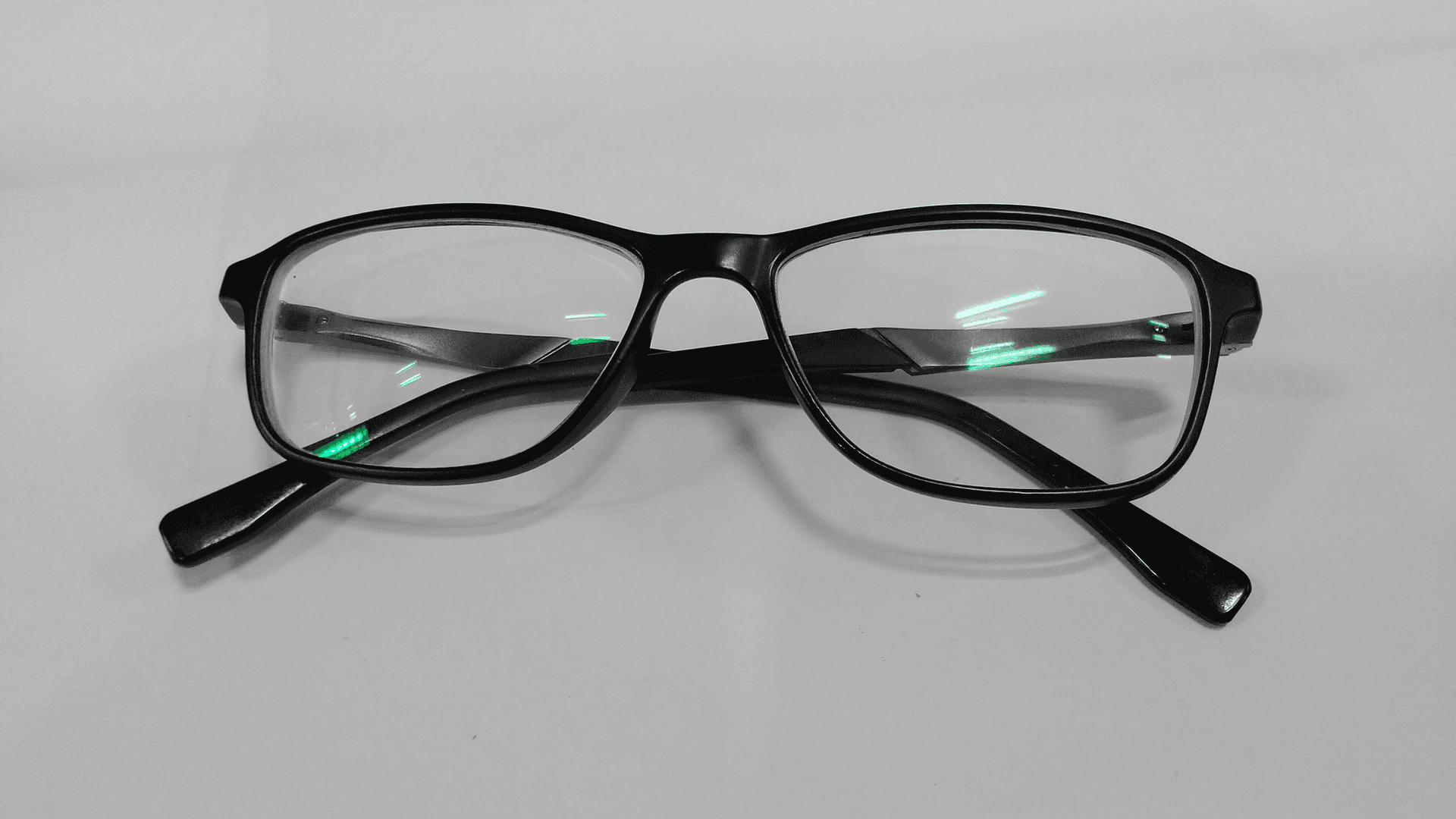
Hero image: Spectacles, by Maheshshinde, CC0. Via Wikimedia Commons.
Take our professional IQ test
Want to know your IQ? Try the first ever professional online IQ test.