Does Stress Lower IQ? What Acute and Chronic Stress Do to Test Scores | Riot IQ
Oct 16, 2026·Advanced Topics & Research
Does Stress Lower IQ? What Acute and Chronic Stress Do to Test Scores
Does stress lower IQ? Short-term stress barely moves IQ scores in lab tests, though it dents working memory; severe early deprivation can cost about 9 points.
Dr. Russell T. WarneChief Scientist
Share
Short-term stress does not measurably lower IQ scores in the best direct test: in a 2025 experiment, young men who went through a stressful ice-water task right before an IQ test scored 114.5 on average, against 113.2 after a calm control task, a difference too small to matter. Stress does chip away at some of the mental skills an IQ test draws on, especially working memory, and severe, prolonged stress early in life is a different story, with children rescued from deprived orphanages scoring about 9 points higher as young adults than those left behind.
This article covers what acute stress does to thinking, the experiment that tested stress and IQ head-on, what long-term stress and early adversity do, and how much test-day nerves and "stereotype threat" really matter.
What acute stress does to thinking
When something stressful happens, the body releases adrenaline and noradrenaline within seconds and the hormone "cortisol" (the main stress hormone, released by the adrenal glands) over the following minutes. In a widely cited review, Amy Arnsten described the prefrontal cortex, the brain region behind planning and holding information in mind, as the region most sensitive to stress. Even quite mild stress that feels uncontrollable can cause a rapid loss of prefrontal abilities, and longer exposure changes the structure of nerve cells there.
The best summary of the human experiments is a meta-analysis by Grant Shields, Matthew Sazma and Andrew Yonelinas, which pooled 51 studies and 2,486 participants who were stressed in the laboratory (for example by giving a speech to a panel or holding a hand in ice water) and then tested on "executive functions," the control skills that steer thinking. The pooled effects were:
• Working memory: an effect size of -0.20 (95% confidence interval -0.33 to -0.06) across 34 studies, a small but consistent impairment.
• Cognitive flexibility: -0.30 (-0.58 to -0.02) across only 6 studies, so this estimate is less certain.
• Inhibition: -0.08 overall, which was not significantly different from zero. Stress actually improved the ability to hold back a physical response (0.30) while it impaired the ability to block out distracting thoughts (-0.21).
To put the working-memory figure on a familiar scale, an IQ score has a "standard deviation" (a measure of how spread out scores are) of 15 points, so -0.20 SD is about 3 points. That conversion is only illustrative. These studies measured single laboratory tasks, such as the n-back (tracking items in a changing sequence), shortly after a stressor, and working memory is one part of a full IQ test. You can read more about that ability in our article on what working memory is.
The direct test: stress right before an IQ test
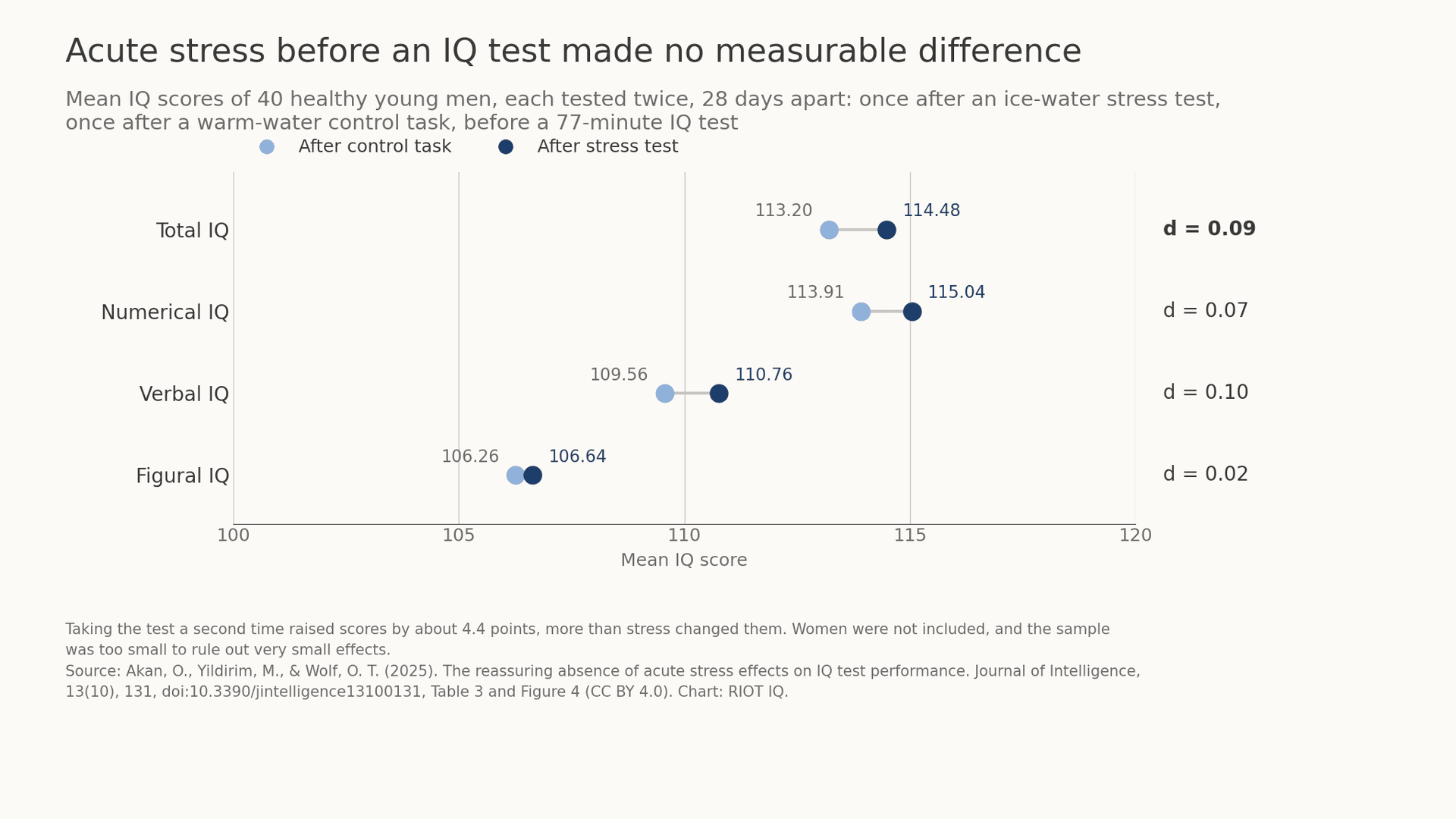
Because working memory and reasoning are closely related, researchers expected stress to drag down IQ scores too. Osman Akan, Mustafa Yildirim and Oliver Wolf at Ruhr University Bochum tested this directly. Forty healthy men aged 18 to 34 each came to the lab twice, 28 days apart. On one day they did the "socially evaluated cold-pressor test," holding a hand in ice-cold water for up to three minutes while being filmed and watched by a stranger. On the other day they put a hand in warm water with nobody watching. Then they took the short form of a German IQ test, the I-S-T 2000 R, which lasts 77 minutes and gives verbal, numerical and figural scores.
The stress task worked. Participants rated it far more stressful than the control, and their saliva cortisol stayed higher after the stress task than after the control task. Their IQ scores did not fall:
• Total IQ: 114.48 after stress against 113.20 after the control task (Cohen's d of 0.09).
• Subscores: numerical, verbal and figural IQ also showed no meaningful difference, with effect sizes of 0.02 to 0.10.
• Test anxiety: men who described themselves as more anxious about tests did not score lower, and anxiety did not make the stress effect any worse.
A Bayesian analysis, which weighs the evidence for an effect against the evidence for none, gave very strong support for the absence of a stress effect (a Bayes factor of 0.015). The biggest influence on scores was practice. Whatever the condition, men scored about 4.4 points higher on their second visit (95% credible interval 1.8 to 6.8), a reminder that taking a test twice changes scores more than a stressful morning did.
This is one small study of young men in a low-stakes research setting, and the authors note it could not detect very small effects. Real-world stress may be stronger and longer-lasting. Still, it is the most direct evidence available, and it suggests that the stress hormones flowing on a tense day do not knock several points off a well-built IQ test.
Chronic stress and early adversity
Long-term stress is different from a few minutes of pressure. In a major review, Sonia Lupien, Bruce McEwen, Megan Gunnar and Christine Heim concluded that chronic exposure to stress hormones affects brain structures involved in thinking at every stage of life, with effects that depend on when the stress happens and how long it lasts. Most of this evidence comes from animal studies and from correlations in people, where stress travels with poverty, illness, poor sleep and family history, so it is hard to isolate stress itself.
The strongest causal evidence comes from the Bucharest Early Intervention Project, a randomized trial in Romanian orphanages. Young children living in institutions were randomly assigned either to stay in institutional care or to move into specially created foster families. Charles Nelson and colleagues reported in 2007 that by 42 and 54 months, the foster care children had better cognitive outcomes than those who stayed, and the children placed youngest, before about 24 months, did best.
The gains lasted. When Kathryn Humphreys and colleagues retested 95 of the original participants at age 18, those randomized to foster care had a full-scale IQ about 9 points higher (73.5 against 64.7), roughly 0.6 standard deviations. Even so, both groups remained far below the never-institutionalized comparison group, who averaged about 95. Institutional deprivation in that era meant severe neglect with very few caregivers per child, so it should not be read as a measure of what everyday adult stress does. It does show that a severely harsh early environment can lower measured IQ by a large amount, and that a better environment can recover part of it.
Money worries are a related question. The idea that financial stress temporarily costs people IQ points, known as the scarcity hypothesis, is covered in our article on poverty and IQ.
Test-day nerves and stereotype threat
Feeling nervous during an exam is common, and people who score low on a test often blame stress. Some of that blame is fair. A 30-year meta-analysis of 238 studies by Nathaniel von der Embse and colleagues found that test anxiety was negatively related to a wide range of educational outcomes, including standardized tests and grade point average, with effects in the small to moderate range, and that anxiety ran higher when tests were seen as high-stakes. Correlations like these cannot show direction, though. Students who struggle with the material have good reason to feel anxious about tests, and the Akan experiment found no causal effect of trait test anxiety on IQ. Anxiety as a long-term trait is a separate topic, discussed in our article on anxiety and IQ.
"Stereotype threat" is the idea that worrying about confirming a negative stereotype about your group lowers your score. Early studies were influential, but the evidence has weakened. A meta-analysis of studies on girls and math by Paulette Flore and Jelte Wicherts found an average effect of -0.22 along with several signs of publication bias, meaning that studies with null results may have gone unpublished. The same team then ran a preregistered experiment with 2,064 Dutch high school students and found no overall effect of stereotype threat on girls' math scores. It may operate in some settings, but it cannot be relied on to explain group differences in test scores.
If stress is lasting for weeks, disrupting sleep or making daily tasks hard, it is worth talking to a family doctor or a licensed psychologist, who can check for an anxiety disorder, depression or a medical cause.
Frequently asked questions
Can stress make you score lower on an IQ test?
In the most direct experiment, a strong laboratory stressor right before an IQ test made no meaningful difference to scores. Stress does slightly impair working memory, so very severe distress could still affect performance on some tasks.
Does chronic stress lower intelligence?
Prolonged stress affects brain regions involved in memory and planning, but in adults it is hard to separate stress from the problems that cause it. The clearest evidence of lasting IQ loss comes from severe early deprivation in childhood.
Does cortisol make you less intelligent?
Cortisol rises during stress and is linked with changes in how the prefrontal cortex works. Raised cortisol on test day has not been shown to lower IQ scores, and there is no evidence that it lowers intelligence itself.
Is stereotype threat real?
Early studies reported sizable effects, but a meta-analysis found signs of publication bias and a large preregistered study in the Netherlands found no effect. Its influence on real test scores appears to be small at most.
Should I take an IQ test when I am stressed?
A stressful day is unlikely to change your score much. Being rested and free of distractions matters more, and being ill or acutely distressed is a good reason to reschedule.
The takeaway
Short bursts of stress take a small bite out of working memory and mental flexibility, yet the one experiment that tested stress before a full IQ test found no drop in scores, while practice raised them by more than 4 points. Severe and prolonged adversity in early childhood is another matter, and the Bucharest trial shows it can cost children a large number of IQ points, part of which a stable family can restore. If you want an accurate picture of your reasoning ability, test on an ordinary day when you are rested and take a full-length online IQ test.
References
1. Akan, O., Yildirim, M., & Wolf, O. T. (2025). The reassuring absence of acute stress effects on IQ test performance. Journal of Intelligence, 13(10), 131. [doi.org/10.3390/jintelligence13100131](. doi.org
2. Arnsten, A. F. T. (2009). Stress signalling pathways that impair prefrontal cortex structure and function. Nature Reviews Neuroscience, 10(6), 410-422. [doi.org/10.1038/nrn2648](. doi.org
3. Shields, G. S., Sazma, M. A., & Yonelinas, A. P. (2016). The effects of acute stress on core executive functions: A meta-analysis and comparison with cortisol. Neuroscience & Biobehavioral Reviews, 68, 651-668. [doi.org/10.1016/j.neubiorev.2016.06.038](. doi.org
4. Lupien, S. J., McEwen, B. S., Gunnar, M. R., & Heim, C. (2009). Effects of stress throughout the lifespan on the brain, behaviour and cognition. Nature Reviews Neuroscience, 10(6), 434-445. [doi.org/10.1038/nrn2639](. doi.org
5. Nelson, C. A., Zeanah, C. H., Fox, N. A., Marshall, P. J., Smyke, A. T., & Guthrie, D. (2007). Cognitive recovery in socially deprived young children: The Bucharest Early Intervention Project. Science, 318(5858), 1937-1940. [doi.org/10.1126/science.1143921](. doi.org
6. Humphreys, K. L., King, L. S., Guyon-Harris, K. L., Sheridan, M. A., McLaughlin, K. A., Radulescu, A., Nelson, C. A., Fox, N. A., & Zeanah, C. H. (2022). Foster care leads to sustained cognitive gains following severe early deprivation. Proceedings of the National Academy of Sciences, 119(38), e2119318119. [doi.org/10.1073/pnas.2119318119](. doi.org
7. von der Embse, N., Jester, D., Roy, D., & Post, J. (2018). Test anxiety effects, predictors, and correlates: A 30-year meta-analytic review. Journal of Affective Disorders, 227, 483-493. [doi.org/10.1016/j.jad.2017.11.048](. doi.org
8. Flore, P. C., & Wicherts, J. M. (2015). Does stereotype threat influence performance of girls in stereotyped domains? A meta-analysis. Journal of School Psychology, 53(1), 25-44. [doi.org/10.1016/j.jsp.2014.10.002](. doi.org
9. Flore, P. C., Mulder, J., & Wicherts, J. M. (2018). The influence of gender stereotype threat on mathematics test scores of Dutch high school students: A registered report. Comprehensive Results in Social Psychology, 3(2), 140-174. [doi.org/10.1080/23743603.2018.1559647](. doi.org
Figure by RIOT IQ. Data from Akan, Yildirim & Wolf (2025), Journal of Intelligence 13(10), 131 (doi.org/10.3390/jintelligence13100131), Table 3 and Figure 4, CC BY 4.0.
Take our professional IQ test
Want to know your IQ? Try the first ever professional online IQ test.