Is Overthinking a Sign of Intelligence? What Research on Rumination Shows
Is overthinking a sign of intelligence? Mostly no: brooding shows no link with IQ, while reflective thinking correlates weakly (about r = .1 to .25).
Dr. Russell T. WarneChief Scientist
Share
Overthinking is mostly not a sign of intelligence. In the kind of overthinking people usually mean, dwelling on problems and replaying what went wrong, the best study finds essentially no link with IQ (correlations close to zero), while a calmer, reflective habit of turning ideas over shows a small positive link of about r = .1 to .25, or roughly 1.5 to 4 IQ points per standard deviation of reflection.
This article explains what psychologists mean by overthinking, what the best study of rumination and IQ found, how repetitive negative thinking relates to mental control, why smart people sometimes take longer on hard problems, and where the popular claim comes from.
What researchers mean by overthinking
"Overthinking" is not a clinical term, so research on it uses related concepts. The closest is "rumination," the habit of thinking repeatedly about one's distress and its causes and consequences. Susan Nolen-Hoeksema, who developed the main theory of rumination, reviewed decades of work with Blair Wisco and Sonja Lyubomirsky. They concluded that rumination worsens low mood and impairs problem solving, and that it is linked to depression, anxiety, binge eating, binge drinking and self-harm. "Worry" is a close cousin that looks forward instead of back, at what might go wrong.
Researchers now split rumination, as measured by the widely used Ruminative Response Scale, into two parts:
• Brooding: a tendency to dwell on negative feelings and what went wrong. This is the part most closely tied to depression.
• Reflective pondering: analyzing your thoughts and emotions in order to understand them. Some studies suggest it is neutral or even helpful over time.
The difference matters, because the two parts relate to intelligence in different ways.
What the best study of rumination and IQ found
The most informative study comes from Alta du Pont and colleagues at the University of Colorado, who used 751 young adults from the Colorado Longitudinal Twin Study. Participants had verbal and performance IQ measured at about age 16 and took Raven's Advanced Progressive Matrices, a nonverbal reasoning test, at about age 23, when they also completed the rumination scale and a depression questionnaire. The zero-order correlations, before any statistical adjustment, were:
• Brooding: essentially zero with every IQ measure, from -.05 to .07 in men and women.
• Reflective pondering: small and positive, from .06 to .18 in men and .13 to .25 in women, with the largest link for verbal IQ.
• Depressive symptoms: small and negative, from about -.04 to -.16.
After adjusting for depressive symptoms, reflection still predicted higher scores on all three IQ measures, while the small negative relation that brooding showed once reflection was held constant was no longer significant. The authors concluded that the negative links between rumination and IQ seen elsewhere are explained by depression, and that the positive link belongs to reflection.
On the IQ scale, a correlation of .20 means that someone one standard deviation above average in reflection would be expected to score about 3 points higher (0.20 x 15). That is small. Knowing how much someone ponders tells you very little about their IQ, and the verbal IQ scores were measured years before the rumination questionnaire, so the study cannot show which came first.
An earlier and much smaller study of 126 undergraduates by Alexander Penney and colleagues found that higher verbal intelligence predicted more worry and rumination. It is the source of many headlines about worriers being smarter, and it is discussed alongside the other anxiety studies in our article on anxiety and IQ.
Overthinking and mental control
If brooding is unrelated to IQ, it might still interfere with thinking in the moment. A meta-analysis by Yingkai Yang and colleagues pooled 34 studies and 3,066 participants on rumination and "executive functions," the control skills that direct attention and thought. More rumination went with weaker "inhibition" (the ability to block out irrelevant information), r = -.23, and weaker "set-shifting" (switching flexibly between tasks or rules), r = -.19. There was no significant link with working memory.
These are correlations, so they could run either way. Ruminating may use up attention, or people who find it harder to let go of a thought may be more likely to get stuck in loops. Either way, it points in the opposite direction from the popular claim. Getting stuck on a thought looks more like a small cost to mental control than a sign of extra reasoning power.
Do smart people take longer to decide?
One finding that does fit the "deep thinker" image is about time. In a study of 650 participants from the Human Connectome Project, Michael Schirner, Gustavo Deco and Petra Ritter found that people with higher intelligence scores answered simple questions faster, yet took more time on the hardest items of a matrix reasoning test. Their brain models suggested that slower, better-integrated processing helped avoid jumping to conclusions on difficult problems.
Frank Goldhammer, Johannes Naumann and Samuel Greiff found a similar pattern in 230 people taking a computerized Raven's test. Overall, faster responses went with correct answers, especially for easy items and able test takers. For harder items with more rules to work out, taking longer was less of a disadvantage or even helped.
This is careful thinking applied to a problem that requires it, which is different from going round in circles about a decision that is already made. "Analysis paralysis," stalling because every option seems to need more thought, has not been shown to be a marker of high IQ.
Enjoying thinking is also modestly linked to intelligence. A 2025 meta-analysis by Felix Schweitzer and colleagues found that "need for cognition," a questionnaire measure of how much people like effortful thinking, correlated r = .23 with general intelligence. That trait is covered in our article on curiosity and intelligence.
Why the claim is so popular
The idea that overthinkers are smarter spreads through listicles and social media posts, often citing the Penney study without its small sample or its null results for many symptoms. It is also flattering, which helps any claim travel.
Selection plays a part too. People who spend their working lives with ideas, such as students and academics, may both think a lot and score above average, while the confounds that matter most are rarely mentioned. Brooding goes with depression and with "neuroticism," a personality trait reflecting a tendency toward negative emotions. In a meta-analysis of more than 160,000 people, Jeromy Anglim and colleagues found that neuroticism correlated slightly negatively with intelligence (about -.09). Related habits such as perfectionism raise similar questions, discussed in our article on perfectionism and IQ.
If repetitive thinking is taking up hours of the day, disrupting sleep or coming with persistent low mood, a family doctor or a licensed psychologist can assess whether depression or an anxiety disorder is involved.
Frequently asked questions
Are overthinkers smarter?
Not on average. Brooding over problems shows essentially no correlation with IQ, while reflective, problem-focused thinking shows a small positive link of roughly 1.5 to 4 IQ points per standard deviation.
Is rumination linked to high IQ?
It depends on the type. In a study of 751 young adults, reflective pondering was modestly linked to higher IQ, while brooding was not, and the negative links seen elsewhere were explained by depression.
Do intelligent people take longer to make decisions?
On hard problems, sometimes. Higher scorers answered easy reasoning items faster but spent longer on the hardest items, which seemed to help them avoid mistakes.
Does overthinking lower your IQ?
There is no evidence that it lowers intelligence itself. Rumination is linked with weaker inhibition and mental flexibility, which may make it harder to concentrate while it is happening.
Is worrying a sign of high intelligence?
One study of 126 students found verbal intelligence predicted more worry, but larger studies of anxiety and neuroticism find small negative links with IQ. Worry is better understood as a habit of mind than as a measure of ability.
The takeaway
The overthinking that most people complain about, brooding over what went wrong, has no measurable connection to intelligence and goes with slightly weaker mental control. Reflective thinking and a taste for effortful thought are linked to IQ, but only modestly, and higher scorers seem to slow down when problems are hard, not when they are worried. If you want a measure of your reasoning ability instead of a guess based on how much you think, take the RIOT IQ test.
References
1. Nolen-Hoeksema, S., Wisco, B. E., & Lyubomirsky, S. (2008). Rethinking rumination. Perspectives on Psychological Science, 3(5), 400-424. [doi.org/10.1111/j.1745-6924.2008.00088.x](. doi.org
2. du Pont, A., Karbin, Z., Rhee, S. H., Corley, R. P., Hewitt, J. K., & Friedman, N. P. (2020). Differential associations between rumination and intelligence subtypes. Intelligence, 78, 101420. [doi.org/10.1016/j.intell.2019.101420](. doi.org
3. Penney, A. M., Miedema, V. C., & Mazmanian, D. (2015). Intelligence and emotional disorders: Is the worrying and ruminating mind a more intelligent mind? Personality and Individual Differences, 74, 90-93. [doi.org/10.1016/j.paid.2014.10.005](. doi.org
4. Yang, Y., Cao, S., Shields, G. S., Teng, Z., & Liu, Y. (2017). The relationships between rumination and core executive functions: A meta-analysis. Depression and Anxiety, 34(1), 37-50. [doi.org/10.1002/da.22539](. doi.org
5. Schirner, M., Deco, G., & Ritter, P. (2023). Learning how network structure shapes decision-making for bio-inspired computing. Nature Communications, 14, 2963. [doi.org/10.1038/s41467-023-38626-y](. doi.org
6. Goldhammer, F., Naumann, J., & Greiff, S. (2015). More is not always better: The relation between item response and item response time in Raven's matrices. Journal of Intelligence, 3(1), 21-40. [doi.org/10.3390/jintelligence3010021](. doi.org
7. Schweitzer, F. M., Lindenberg, N. M., Fleischhauer, M., & Enge, S. (2025). The relationship of need for cognition and typical intellectual engagement with intelligence and executive functions: A multi-level meta-analysis. Journal of Intelligence, 13(11), 142. [doi.org/10.3390/jintelligence13110142](. doi.org
8. Anglim, J., Dunlop, P. D., Wee, S., Horwood, S., Wood, J. K., & Marty, A. (2022). Personality and intelligence: A meta-analysis. Psychological Bulletin, 148(5-6), 301-336. [doi.org/10.1037/bul0000373](. doi.org
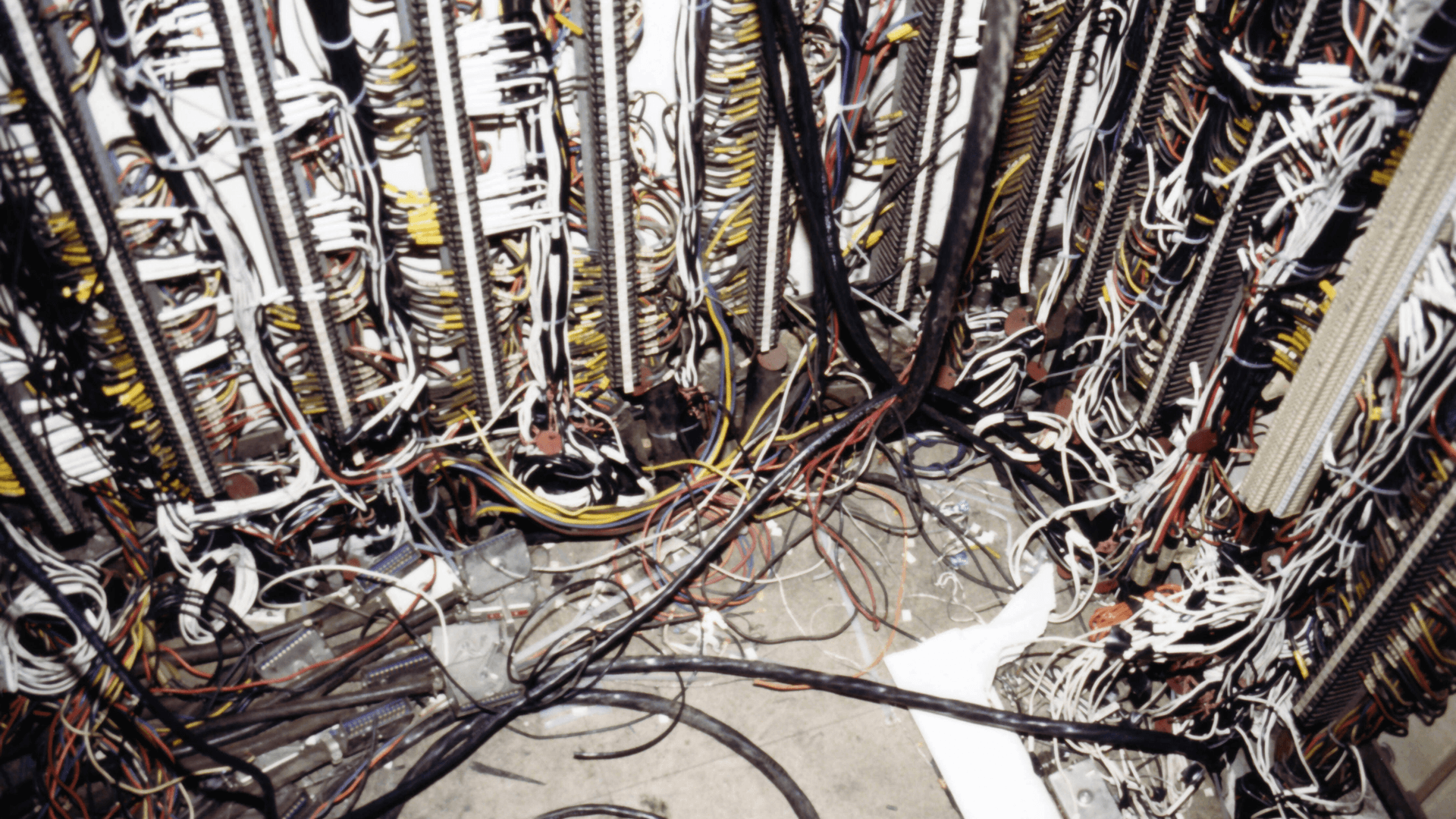
Hero image: Cable salad, by Achim Hering, CC BY 3.0. Via Wikimedia Commons.
Take our professional IQ test
Want to know your IQ? Try the first ever professional online IQ test.