Typing Speed and IQ: Do Fast Typists Have Higher IQs?
Typing speed and IQ are only weakly linked: in 10,613 US adults, faster typists scored a bit higher on reasoning tests (r = 0.24, about 3.6 IQ points per SD).
Dr. Russell T. WarneChief Scientist
Share
Typing speed and IQ are only weakly related. In the largest study so far, 10,613 American adults, people who typed faster on a computer scored a little higher on reasoning and vocabulary tests, a correlation of r = 0.24, which works out to roughly 3.6 IQ points for every standard deviation of extra typing speed.
That link is real but small, and most of what separates a 30-word-per-minute typist from a 90-word-per-minute typist is practice, age and typing technique. The evidence on this question is thin: one large survey study, a handful of small laboratory studies of typists, and a growing medical literature on keystroke timing. This article covers what those studies show, why typing is better described as a skill than as an ability, how it relates to processing speed, and what keystroke patterns can reveal about cognitive decline.
What the largest study found
The best evidence comes from Raymond Hernandez and colleagues at the University of Southern California, who added a one-sentence typing test to the Understanding America Study, a nationally representative online panel. Participants typed "The quick brown fox jumps over the lazy dog" as fast as they could, and the researchers scored "adjusted words per minute" (speed multiplied by accuracy). The same people had also taken a battery of cognitive tests. The median computer typist managed about 38 adjusted words per minute; the middle half fell between 24 and 56.
For people who typed on a computer, the correlations with typing speed were:
• General cognitive ability composite (number series, verbal analogies, vocabulary): r = 0.24.
• Perceptual speed composite (fast visual matching and choice reaction tasks): r = 0.52.
• Memory composite (immediate and delayed word recall): r = 0.28.
• Picture vocabulary on its own: r = -0.03, essentially zero.
A "correlation" runs from -1 to 1, and r = 0.24 means typing speed accounts for about 6% of the differences between people in general cognitive ability. To translate it into IQ points: someone who types one standard deviation faster than average would be expected, on average, to score about 0.24 standard deviations higher on that composite, which is 0.24 × 15 = 3.6 points on the IQ scale. That is a group-level trend. Plenty of slow typists will outscore fast ones.
The vocabulary result is a useful clue. Vocabulary keeps growing through middle age, while typing speed fell steadily with age in this sample (r = -0.52 between age and computer typing speed). Older adults know more words and type more slowly, which cancels out any raw link. When the researchers adjusted for age, sex, race, ethnicity, education, income, employment and language, the correlation with vocabulary rose to 0.16 and the correlation with perceptual speed halved to 0.26. The correlation with the general ability composite stayed at 0.24 for computer typists. On smartphones it was weaker, 0.14 before adjustment and 0.15 after.
The authors' own reading is careful. Without adjustment, they wrote, typing speed largely reflects perceptual speed. After controlling for demographics, it seems to capture "some combination of general cognition and technology skill." Faster typists also rated their own computer skills higher (r = 0.44), a reminder that practice is mixed into every number above.
Typing speed is mostly a practised skill
Most of the variation in typing speed comes from how much and how people have practised. In a study of 168,960 volunteers who completed an online typing test, Vivek Dhakal and colleagues at Aalto University found an average of 51.56 words per minute with a standard deviation of 20.2, and some typists exceeded 120. Faster typists tended to use more fingers and to press the next key before releasing the previous one ("rollover"), habits that come from technique and experience.
Nina Keith and K. Anders Ericsson studied 60 university students who had typed for years. The amount of typing they had done since first using a keyboard predicted their speed, and the fastest students were those who had once taken a typing class and still tried to type quickly in daily life. A perceptual speed test (digit-symbol substitution) and a finger-tapping test were not significantly related to their typing performance.
Timothy Salthouse's classic study of typists aged 19 to 72, whose speeds ranged from 17 to 104 net words per minute, adds a twist. The older typists were slower at tapping and at choice reaction time, yet they typed just as fast. They compensated by looking further ahead in the text, a strategy built through years of practice.
This pattern fits Phillip Ackerman's theory of skill acquisition. When people first learn a task, general intelligence predicts who picks it up fastest. As the task becomes routine, the influence of general ability fades, and perceptual speed and then motor speed take over. Typing, once learned, sits at the far end of that curve. Similar logic applies to IQ and handwriting, another everyday motor skill that people sometimes read too much into.
Motor speed versus processing speed
Typing speed is partly a motor skill (how quickly your fingers move) and partly a perceptual one (how quickly you read and chunk the text ahead). Intelligence researchers care about a different kind of speed: how fast the brain takes in and compares simple information. Across 172 studies, Leah Sheppard and Philip Vernon found an average correlation of about -0.24 between reaction times on simple and choice tasks and intelligence, meaning brighter people respond slightly faster. The literature on IQ and reaction time covers this in more detail.
Clinical IQ tests measure speed deliberately and under controlled conditions. The Wechsler scales, for example, combine short timed tasks such as symbol coding into a Processing Speed Index and score them against age norms. A typing test rewards a skill you can train for hours a day. That is why an online words-per-minute score is not a measure of intelligence, even though it correlates with one, and why a good IQ test samples several different abilities rather than one speeded task.
Why do people assume fast typists are smart? Typing tests look like tests: they produce a number, a percentile and a leaderboard. Fast typing is also common among people who write or program for a living, jobs that tend to require more education. The Hernandez study found that faster typists had more years of education and higher incomes, so a raw link between typing speed and IQ partly reflects who spends their working day at a keyboard.
Keystrokes and cognitive decline
The most active research on typing and cognition is medical. Researchers record "keystroke dynamics," the timing of each press and release during ordinary typing, to look for early signs of neurological disease. A 2022 meta-analysis by Hessa Alfalahi and colleagues reviewed 41 studies of keystroke timing as a diagnostic tool and pooled 25 of them. In the studies of mild cognitive impairment and early Alzheimer's disease, keystroke measures identified patients with a pooled sensitivity of 0.85 and specificity of 0.82. Those figures rest on only 254 patients with mild cognitive impairment across the included studies, so they are promising but early.
Keystroke changes are not specific to one condition. Slowing can reflect arthritis, poor eyesight, Parkinson's disease, medication effects or simple unfamiliarity with a device. Anyone who notices that a parent or partner has become much slower or more error-prone at typing, along with memory or word-finding problems, should raise it with a family doctor, who can arrange cognitive screening or a referral to a neurologist or memory clinic.
Frequently asked questions
Does typing fast mean you have a high IQ?
No. In the largest study, the correlation between computer typing speed and general cognitive ability was 0.24, so typing speed tells you very little about any one person's IQ.
What is an average typing speed?
In an online study of almost 169,000 volunteers, the average was about 52 words per minute. In a nationally representative US sample using a one-sentence test, the median computer typist managed about 38 adjusted words per minute.
Can learning to type faster raise your IQ?
There is no evidence that it can. Typing speed improves with practice and good technique, but that practice does not transfer to reasoning ability.
Is typing speed a measure of processing speed?
Partly. Typing speed correlates strongly with perceptual speed tests (r = 0.52 in one large study), but it also depends heavily on motor practice, which processing speed tests are designed to minimise.
Can typing patterns detect dementia?
Research suggests keystroke timing can help flag mild cognitive impairment, but the studies are small and the method is not a diagnosis. A doctor is the right person to assess any worrying change.
The takeaway
Typing speed has a small, genuine link with intelligence, about 0.24 in the best study, worth roughly 3.6 IQ points per standard deviation of speed. Most of the difference between slow and fast typists comes from practice, technique, age and how much time someone spends at a keyboard. A words-per-minute score is a useful measure of a skill and, in older adults, may one day help flag cognitive change. For a picture of your reasoning ability itself, take the RIOT IQ test, which measures several cognitive abilities rather than one practised skill.
References
1. Hernandez, R., Schneider, S., Gatz, M., Finkel, D., Minns, S., Orriens, B., Liu, Y., & Kapteyn, A. (2026). Functional and cognitive correlates of typing speed in a large U.S. panel study. Scientific Reports, 16, 5900. [doi.org/10.1038/s41598-026-36500-7](. doi.org
2. Dhakal, V., Feit, A. M., Kristensson, P. O., & Oulasvirta, A. (2018). Observations on typing from 136 million keystrokes. Proceedings of the 2018 CHI Conference on Human Factors in Computing Systems, 1-12. [doi.org/10.1145/3173574.3174220](. doi.org
3. Keith, N., & Ericsson, K. A. (2007). A deliberate practice account of typing proficiency in everyday typists. Journal of Experimental Psychology: Applied, 13(3), 135-145. [doi.org/10.1037/1076-898X.13.3.135](. doi.org
4. Salthouse, T. A. (1984). Effects of age and skill in typing. Journal of Experimental Psychology: General, 113(3), 345-371. [doi.org/10.1037/0096-3445.113.3.345](. doi.org
5. Ackerman, P. L. (1988). Determinants of individual differences during skill acquisition: Cognitive abilities and information processing. Journal of Experimental Psychology: General, 117(3), 288-318. [doi.org/10.1037/0096-3445.117.3.288](. doi.org
6. Sheppard, L. D., & Vernon, P. A. (2008). Intelligence and speed of information-processing: A review of 50 years of research. Personality and Individual Differences, 44(3), 535-551. [doi.org/10.1016/j.paid.2007.09.015](. doi.org
7. Alfalahi, H., Khandoker, A. H., Chowdhury, N., Iakovakis, D., Dias, S. B., Chaudhuri, K. R., & Hadjileontiadis, L. J. (2022). Diagnostic accuracy of keystroke dynamics as digital biomarkers for fine motor decline in neuropsychiatric disorders: A systematic review and meta-analysis. Scientific Reports, 12, 7690. [doi.org/10.1038/s41598-022-11865-7](. doi.org
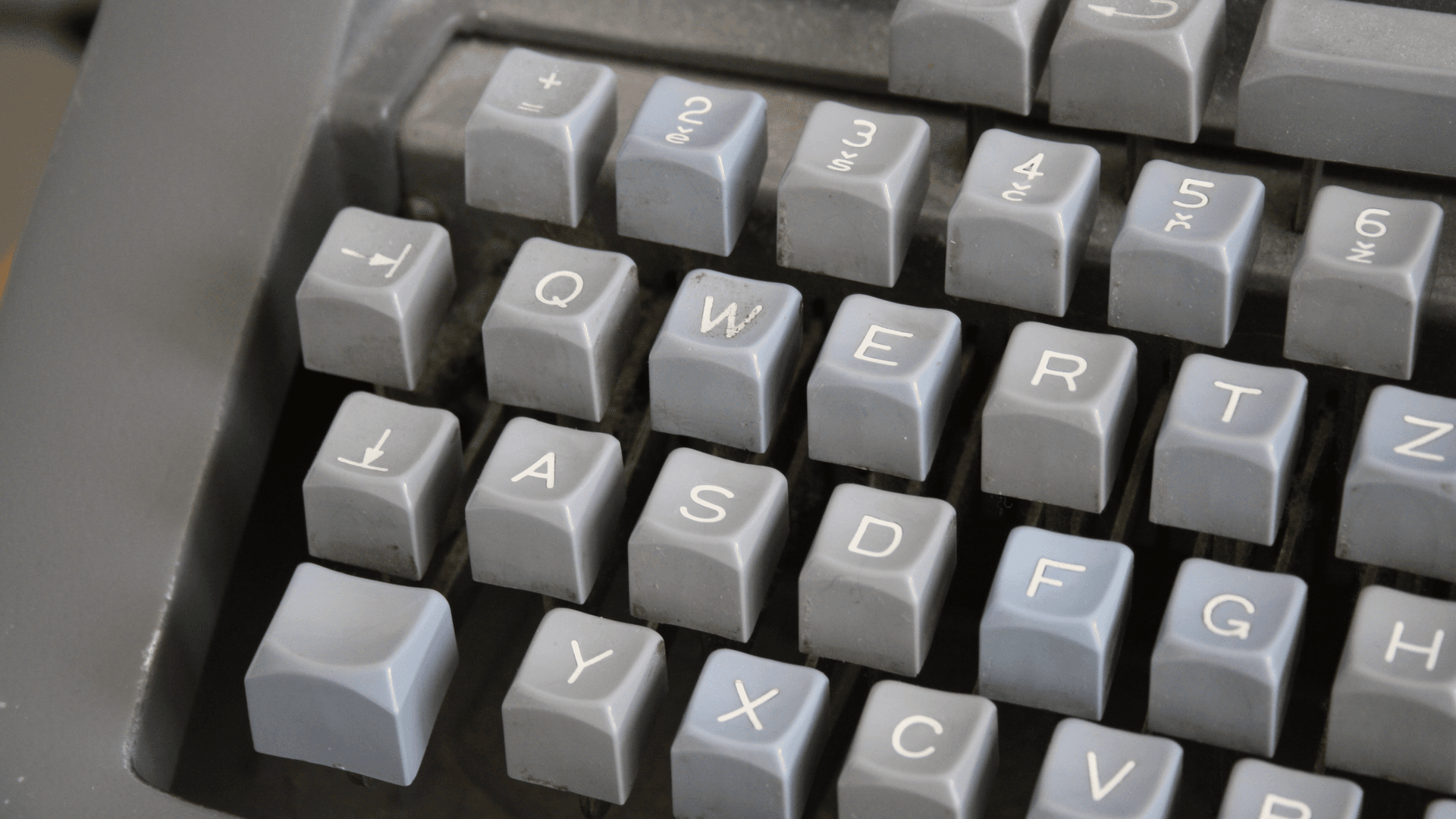
Hero image: Keys of Consul typewriter, by Jiří Sedláček (Frettie), CC BY 3.0. Via Wikimedia Commons.
Take our professional IQ test
Want to know your IQ? Try the first ever professional online IQ test.