Poverty and IQ: How Much Does Growing Up Poor Lower Intelligence?
Poverty and IQ are linked: low-SES children score about 6 points lower at age 2 and 15 to 17 points lower by 16, but how much poverty itself causes is unclear.
Dr. Russell T. WarneChief Scientist
Share
Poverty and IQ are clearly linked: in a UK study of nearly 15,000 children, those from low socioeconomic status (SES) families scored about 6 IQ points lower than children from high-SES families at age 2, and 15 to 17 points lower by age 16. How much of that gap poverty itself causes is much less certain, because family income travels with parental education, parental IQ and shared genes, and the best experiments give mixed answers.
This page covers how big the poverty gap is and how it grows, what adoption studies and a large cash-transfer experiment show about cause and effect, the "scarcity" claim that money worries cost 13 IQ points, and the debate over whether genes matter less for children raised in poverty.
How big is the gap between poor and better-off children?
The clearest picture of the gap comes from the Twins Early Development Study (TEDS) in England and Wales. Sophie von Stumm and Robert Plomin followed 14,853 children who were tested on IQ nine times between ages 2 and 16. Family SES combined parental education, parental occupation and family income. Children from low-SES homes (at least one "standard deviation," a measure of spread, below the average) scored about 6 points lower at age 2 than children from high-SES homes. By 16, the gap was 15 points for boys and about 17 points for girls.
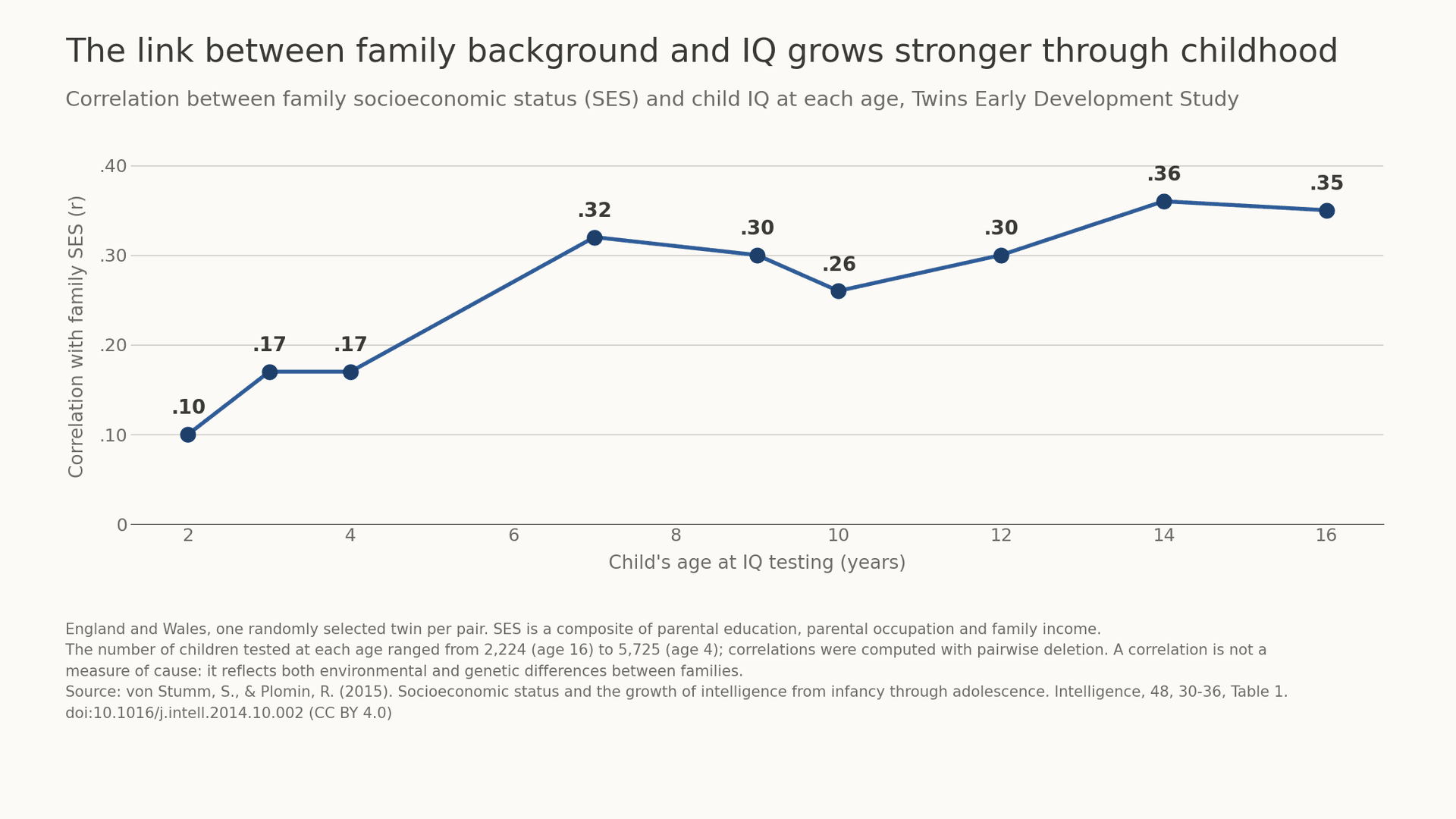
The correlation tells the same story in a different unit. As the chart above shows, the correlation between family SES and IQ was .10 at age 2 and .17 at ages 3 and 4, then settled around .30 from age 7 onward, reaching .35 at age 16. A correlation of .30 to .35 is moderate: family background accounts for roughly a tenth of the differences in children's scores, and children from every kind of home are spread across the whole IQ range.
Brain imaging studies report similar patterns. Nicole Hair and colleagues analyzed 823 MRI scans from 389 US children and adolescents. Children below the federal poverty line had regional gray matter volumes 8 to 10 percentage points below the developmental norm, and children from low-income households scored 4 to 7 points lower on standardized achievement tests. These are correlations, so they describe the gap without settling its cause.
Does poverty cause lower IQ?
Separating poverty from everything that comes with it requires changing a child's circumstances while holding the family's genes constant. Two kinds of study come close.
Adoption studies
Michel Duyme and colleagues searched 5,003 French adoption files for children who had been abused or neglected, were adopted between ages 4 and 6, and had an IQ below 86 before adoption (average 77). When the 65 children were retested at about 13.5 years old, those adopted into high-SES families had gained an average of 19.5 points, compared with 7.7 points for those placed in low-SES families. The sample was small, and children who start with very low scores tend to score higher on retesting even without any change, which is part of why both groups gained.
A larger Swedish study by Kenneth Kendler, Eric Turkheimer and colleagues compared brothers from the same biological family, one raised by his birth parents and one adopted away. In 436 such sibships, the adopted brothers scored 4.41 IQ points higher at military conscription (ages 18 to 20), and each step up a 5-point scale of adoptive parents' education was linked to 1.71 more points. A replication in 2,341 half-sibships found a 3.18-point gain. Adoptive homes tend to be more advantaged, so this is good evidence that rearing environment matters, though education and income cannot be fully separated.
The Baby's First Years cash-transfer trial
The most direct test is Baby's First Years, which recruited 1,000 low-income US mothers shortly after giving birth and randomly assigned them to receive either $333 or $20 a month. In 2022, Sonya Troller-Renfree and colleagues reported that at about age 1, infants in the high-cash group showed more power in high-frequency brain activity on EEG (n = 435), a pattern the authors linked to later cognitive skills. They noted that the significance of the estimates varied with how the data were analyzed.
The later results have been null. In a 2025 working paper covering 891 families after four years of payments, the research team found no statistically significant effects on any of four preregistered primary outcomes (language, executive function, social-emotional problems and high-frequency brain activity) or on pre-literacy and visual-spatial skills. A 2026 report on the age-4 EEG found no effect on the main preregistered brain measures, with only an exploratory difference in one frequency band. Payments continue, so later waves may still show effects, but the trial so far does not show that extra cash raises young children's cognitive skills.
Does money worry lower IQ? The scarcity hypothesis
A separate claim holds that poverty lowers IQ in the moment, by consuming attention. In a widely covered 2013 Science paper, Anandi Mani, Sendhil Mullainathan, Eldar Shafir and Jiaying Zhao reported that prompting thoughts about a costly car repair lowered test performance among poorer shoppers at a New Jersey mall but not richer ones, and that Indian sugarcane farmers performed worse before harvest, when money was tight, than after. Princeton's press release described the drop as similar to a 13-point dip in IQ, which is where the popular number comes from.
The findings have been contested. Jelte Wicherts and Annemarie Zand Scholten reanalyzed the laboratory data without splitting income into two groups and found that the interaction with income did not hold up, which they attributed to short, easy tests that richer participants nearly maxed out. A study of low-income US households randomly surveyed before or after payday found no difference in cognitive test performance. A large 2021 replication project on scarcity research found strong successes for some studies and clear failures for others. The 13-point figure is best read as an illustration from a single paper whose central result is disputed.
Genes, parents and the SES-heritability debate
Much of the poverty and IQ correlation may run through parents. Parents' own cognitive ability affects both the income they earn and the genes and home environment they pass on, and higher IQ itself predicts later education and income, a direction covered in our page on IQ and socioeconomic status. Using DNA from about 3,000 unrelated TEDS children, Maciej Trzaskowski and colleagues estimated that 94% of the correlation between family SES and IQ at age 7 was genetically mediated, falling to 56% for IQ at age 12. The standard errors were large, and the authors stressed that heritability does not mean a trait cannot change.
Poverty may also change how much genes matter. In 2003, Eric Turkheimer and colleagues studied 7-year-old twins from the US National Collaborative Perinatal Project and found that in impoverished families about 60% of IQ variance was explained by the shared environment and the genetic contribution was close to zero, with almost exactly the reverse in affluent families. A 2016 meta-analysis by Elliot Tucker-Drob and Timothy Bates found moderate support for this gene-by-SES interaction in US studies, but zero or reversed effects in Western Europe and Australia. The pattern seems to depend on how unequal access to schooling and health care is in a given country. Our page on whether IQ is genetic covers heritability itself, and specific poverty-linked hazards such as poor nutrition appear in our list of environmental factors that influence IQ.
Frequently asked questions
How many IQ points lower do children from poor families score?
In a large UK twin study, children from low-SES homes scored about 6 points lower than high-SES children at age 2 and 15 to 17 points lower at age 16. The comparison was between families at least one standard deviation below and above average SES.
Does poverty cause low IQ?
Adoption studies show that moving children into more advantaged homes raises IQ by several points, so environment matters. The largest US cash-transfer trial, however, found no effect on children's cognitive skills after four years, and part of the correlation reflects parents' genes and education.
Is it true that poverty lowers IQ by 13 points?
That number comes from a press release about a 2013 experiment on money worries and test performance. Reanalyses and replication attempts have questioned the result, so it is not an established effect.
Do genes matter less for children raised in poverty?
Some US twin studies found lower heritability of IQ at low SES. A meta-analysis found the pattern in the United States but not in Western Europe or Australia.
Can a child from a poor family have a high IQ?
Yes. The correlation between family background and IQ is moderate, around .30 to .35 in adolescence, so children from low-income homes are found across the whole range of scores.
The takeaway
Children who grow up poor score lower on IQ tests on average, and the gap widens from about 6 points in toddlerhood to 15 to 17 points by age 16. Adoption studies show that a more advantaged rearing environment can raise IQ by several points, but a randomized trial of monthly cash payments has not yet shown cognitive gains, and genetic studies suggest that a large share of the correlation runs through parents. Poverty and IQ are best understood as entangled with many other family influences. If you want a careful measure of your own reasoning, you can take a full-length online IQ test.
References
1. von Stumm, S., & Plomin, R. (2015). Socioeconomic status and the growth of intelligence from infancy through adolescence. Intelligence, 48, 30-36. [doi.org/10.1016/j.intell.2014.10.002](. doi.org
2. Hair, N. L., Hanson, J. L., Wolfe, B. L., & Pollak, S. D. (2015). Association of child poverty, brain development, and academic achievement. JAMA Pediatrics, 169(9), 822-829. [doi.org/10.1001/jamapediatrics.2015.1475](. doi.org
3. Duyme, M., Dumaret, A.-C., & Tomkiewicz, S. (1999). How can we boost IQs of "dull children"? A late adoption study. Proceedings of the National Academy of Sciences, 96(15), 8790-8794. [doi.org/10.1073/pnas.96.15.8790](. doi.org
4. Kendler, K. S., Turkheimer, E., Ohlsson, H., Sundquist, J., & Sundquist, K. (2015). Family environment and the malleability of cognitive ability: A Swedish national home-reared and adopted-away cosibling control study. Proceedings of the National Academy of Sciences, 112(15), 4612-4617. [doi.org/10.1073/pnas.1417106112](. doi.org
5. Troller-Renfree, S. V., Costanzo, M. A., Duncan, G. J., Magnuson, K., Gennetian, L. A., Yoshikawa, H., Halpern-Meekin, S., Fox, N. A., & Noble, K. G. (2022). The impact of a poverty reduction intervention on infant brain activity. Proceedings of the National Academy of Sciences, 119(5), e2115649119. [doi.org/10.1073/pnas.2115649119](. doi.org
6. Noble, K., Magnuson, K., Duncan, G., Gennetian, L. A., Yoshikawa, H., Fox, N. A., Halpern-Meekin, S., Troller-Renfree, S., Han, S., Egan-Dailey, S., Nelson, T. D., Nelson, J. M., Black, S., Georgieff, M., & Karhson, D. (2025). The effect of a monthly unconditional cash transfer on children's development at four years of age: A randomized controlled trial in the U.S. (NBER Working Paper No. 33844). National Bureau of Economic Research. [doi.org/10.3386/w33844](. doi.org
7. Troller-Renfree, S. V., Costanzo, M. A., Duncan, G. J., Magnuson, K., Gennetian, L. A., Yoshikawa, H., Black, S. R., Karhson, D. S., Georgieff, M. K., Nelson, J. M., Nelson, T. D., Fox, N. A., & Noble, K. G. (2026). The impact of a monthly unconditional cash transfer on child brain activity: A 4-year follow-up. Developmental Cognitive Neuroscience, 78, 101673. [doi.org/10.1016/j.dcn.2026.101673](. doi.org
8. Mani, A., Mullainathan, S., Shafir, E., & Zhao, J. (2013). Poverty impedes cognitive function. Science, 341(6149), 976-980. [doi.org/10.1126/science.1238041](. doi.org
9. Princeton University. (2013, August 30). Poor concentration: Poverty reduces brainpower needed for navigating other areas of life [Press release, via ScienceDaily]. [sciencedaily.com](. sciencedaily.com
10. Wicherts, J. M., & Scholten, A. Z. (2013). Comment on "Poverty impedes cognitive function". Science, 342(6163), 1169. [doi.org/10.1126/science.1246680](. doi.org
11. Carvalho, L. S., Meier, S., & Wang, S. W. (2016). Poverty and economic decision-making: Evidence from changes in financial resources at payday. American Economic Review, 106(2), 260-284. [doi.org/10.1257/aer.20140481](. doi.org
12. O'Donnell, M., Dev, A. S., Antonoplis, S., Baum, S. M., Benedetti, A. H., Brown, N. D., Carrillo, B., Choi, A. L., Connor, P., Donnelly, K., Ellwood-Lowe, M. E., Foushee, R., Jansen, R., Jarvis, S. N., Lundell-Creagh, R., Ocampo, J. M., Okafor, G. N., Azad, Z. R., Rosenblum, M., Schatz, D., Stein, D. H., Wang, Y., Moore, D. A., & Nelson, L. D. (2021). Empirical audit and review and an assessment of evidentiary value in research on the psychological consequences of scarcity. Proceedings of the National Academy of Sciences, 118(44), e2103313118. [doi.org/10.1073/pnas.2103313118](. doi.org
13. Trzaskowski, M., Harlaar, N., Arden, R., Krapohl, E., Rimfeld, K., McMillan, A., Dale, P. S., & Plomin, R. (2014). Genetic influence on family socioeconomic status and children's intelligence. Intelligence, 42, 83-88. [doi.org/10.1016/j.intell.2013.11.002](. doi.org
14. Turkheimer, E., Haley, A., Waldron, M., D'Onofrio, B., & Gottesman, I. I. (2003). Socioeconomic status modifies heritability of IQ in young children. Psychological Science, 14(6), 623-628. [doi.org/10.1046/j.0956-7976.2003.psci_1475.x](. doi.org
15. Tucker-Drob, E. M., & Bates, T. C. (2016). Large cross-national differences in gene × socioeconomic status interaction on intelligence. Psychological Science, 27(2), 138-149. [doi.org/10.1177/0956797615612727](. doi.org
Figure by RIOT IQ. Data from von Stumm & Plomin (2015), Intelligence 48, 30-36, Table 1 (doi.org/10.1016/j.intell.2014.10.002), CC BY 4.0.
Take our professional IQ test
Want to know your IQ? Try the first ever professional online IQ test.