Birth Order and IQ: Are Firstborns Really Smarter?
Birth order IQ research finds firstborns score about 1.5 points higher per birth position on average, a real but small gap that says little about one family.
Dr. Russell T. WarneChief Scientist
Share
Yes, but only by a little. Large birth order IQ studies find that firstborns score about 1.5 IQ points higher than secondborns on average, with a similar small step down for each later position, a difference of about one tenth of a standard deviation.
That gap is one of the most replicated findings in family research, and it is also one of the most overinterpreted. It shows up in national samples from Norway, Denmark, Britain, Germany and the United States. It is too small to tell you which of two siblings will score higher, and the best evidence traces it to family life after birth rather than to biology. This page covers what the largest studies show, why the design of a study changes the answer, what is thought to cause the effect, and where only children fit.
What the largest studies show
The modern evidence comes from very large samples, often military conscripts tested at around age 18 or 19.
• Three national panels: Julia Rohrer, Boris Egloff and Stefan Schmukle analyzed panel data from the United States, Great Britain and Germany and found the expected decline in IQ from firstborns to later-borns. They put the effect at about 1.5 IQ points, or 10% of a standard deviation, for each step in birth position. In families with two children, the older sibling had the higher IQ in 6 of 10 cases.
• Norwegian conscripts: Petter Kristensen and Tor Bjerkedal studied nearly 250,000 Norwegian conscripts and found that scores declined from firstborns to later-borns. A companion analysis of more than a quarter of a million test scores compared brothers directly: the elder brother averaged 5.18 on the military's nine-point (stanine) scale against 4.93 for the younger one. If one stanine is taken as about half a standard deviation, as it is by design, that gap works out to roughly 2 IQ points. That conversion is ours.
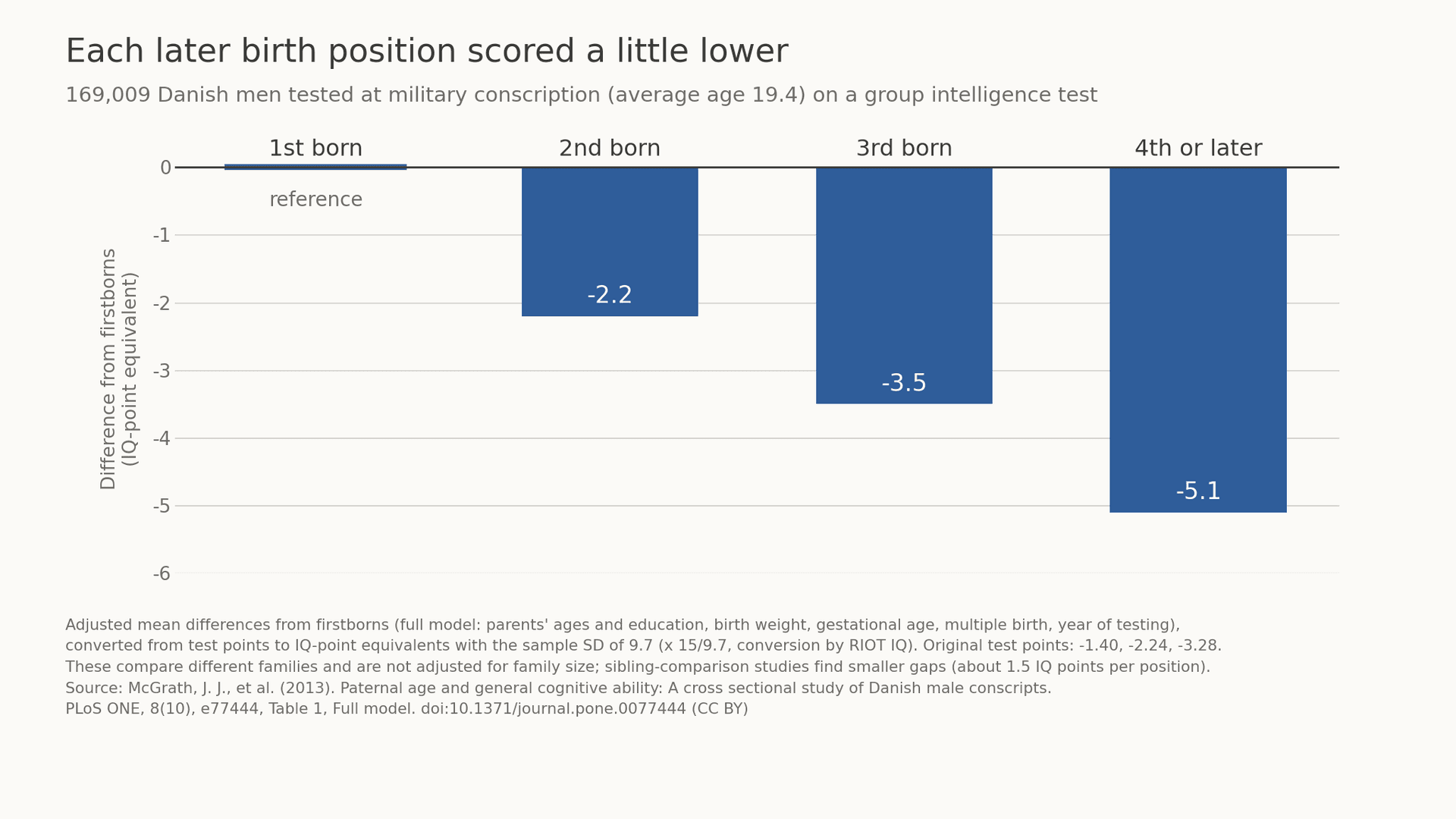
• Danish conscripts: The chart above uses a 2013 study by John McGrath and colleagues of 169,009 Danish men. After adjustment for parents' ages and education and birth weight, secondborns scored about 2 IQ-point equivalents below firstborns, thirdborns about 3.5 below, and fourth or later borns about 5 below.
• American high school students: Rodica Damian and Brent Roberts analyzed Project Talent, a representative sample of about 377,000 U.S. high school students. The correlation between birth order and intelligence was .04, after controls for age, sex, family size, parents' socioeconomic status and family structure.
A correlation of .04 sounds like nothing, and for an individual it nearly is. Rohrer's team put it another way: when a randomly chosen firstborn from a two-child family was compared with a randomly chosen secondborn from a different family, the firstborn had the higher IQ only 52% of the time. A coin flip would get you 50%.
Why within-family and between-family studies disagree
The most important method point in this literature is the difference between comparing siblings and comparing strangers.
A between-family study compares firstborns from some families with later-borns from other families. That design has a built-in problem. Fourth-borns only exist in families with at least four children, and in many countries larger families have, on average, parents with less education and less money. Those same parents tend to have children with lower average scores, whatever their birth order. So a between-family study can show a birth order effect that is really a family size effect. The general link between IQ and socioeconomic status is the reason that matters.
A within-family study compares siblings in the same household, so the parents, the home and the family's income are the same for both. That design removes most of the confounding.
For years the two designs gave different answers. Using the U.S. National Longitudinal Survey of Youth, Joseph Rodgers and colleagues argued that lower-scoring parents tend to have larger families, but that large families do not make lower-scoring children, and called the apparent birth order effect "a methodological illusion." A 2006 multilevel analysis by Aaron Wichman, Rodgers and Robert MacCallum of children aged 7 to 8 and 13 to 14 concluded that birth order had no significant influence once between-family differences were removed.
The larger datasets that followed changed the picture. The Norwegian brother comparisons and the within-family analyses in Rohrer's three-country study both found the firstborn advantage inside families. My reading of the evidence is that the debate settled on a small real effect within families plus some extra between-family confounding in older studies. The Danish chart is a between-family comparison and does not adjust for family size, which is one reason its later-born gaps are larger than Rohrer's within-family estimate. Sex and age matter for how far the results generalize, too. The Norwegian and Danish samples are men tested at around 18 or 19, while Rohrer's panels and Project Talent included both sexes at a range of ages, and the effect looks similar in size across them.
What causes the firstborn advantage
The cleanest test of biology versus upbringing came from the Norwegian conscripts. Some secondborns had an older sibling who died in infancy, so they were raised as the eldest child in the home. Kristensen and Bjerkedal found that IQ depended on social rank in the family, not on birth order as such: these boys scored like firstborns. Their conclusion supported a family interaction explanation.
Genetic data point the same way. In a 2022 study of the Norwegian Mother, Father and Child Cohort, Martin Arstad Isungset and colleagues found no differences in polygenic scores for educational attainment by birth order. Earlier-born children actually had lower birth weight than their younger siblings, so a worse start in the womb cannot explain their advantage. The authors concluded that birth order differences arise after birth, while noting that the specific causes remain hard to pin down.
The candidate explanations include:
• Diluted parental attention: A firstborn has the parents to themselves until a sibling arrives, and later-borns always share.
• The confluence model: Robert Zajonc and Gregory Markus proposed in 1975 that a child's intellectual environment is roughly the average intellectual level of everyone at home, so each new baby lowers that average, while older children may gain from teaching younger ones.
• Expectations and roles: Parents may give eldest children more responsibility and different expectations, which could shape how they engage with schoolwork.
None of these has been nailed down as the main cause, and they are not mutually exclusive.
Where only children fit
Only children are a separate question, because they are both firstborns and children from the smallest possible family. A quantitative review by Denise Polit and Toni Falbo found that only children were never at a disadvantage in intellectual achievement compared with any group, and did not differ significantly from firstborns or from children in two-child families. They did hold an advantage over later-born children and children from large families.
Personality is a different story from IQ. Rohrer's team found no birth order effects on extraversion, emotional stability, agreeableness, conscientiousness or imagination, and Damian and Roberts put the average association with personality at .02. The one exception in Rohrer's data was self-reported intellect, which declined by about a tenth of a standard deviation with birth position even after controlling for measured intelligence. Firstborns, in other words, also see themselves as slightly brighter.
Frequently asked questions
Are firstborns smarter than their siblings?
On average, by a small margin of about 1.5 IQ points per birth position. In two-child families the older sibling has the higher score only about 6 times in 10, so many younger siblings outscore their elder.
Do middle children have lower IQs?
Middle children fall between firstborns and lastborns, in line with the small step down for each position. Studies that report every position show a steady decline rather than a special middle-child penalty.
Is the birth order effect caused by genes or the womb?
The best evidence says no. Secondborns raised as the eldest after an older sibling died scored like firstborns, and polygenic scores do not differ by birth order.
Are only children smarter?
Only children score about the same as firstborns and children from two-child families, and a little higher on average than later-borns and children from large families.
Should parents worry about birth order?
No. A difference of one or two points is far smaller than the ordinary spread of scores among siblings and says nothing useful about any one child.
The takeaway
Birth order IQ differences are real, replicated and small: about 1.5 points per step, rooted in family life after birth rather than in genes or pregnancy. Comparing siblings within the same family gives a cleaner estimate than comparing strangers, and even the cleanest estimate is far too small to predict which child will score higher. If you want to see where your own reasoning stands, regardless of where you fall in the family, you can take a full-length online IQ test built on modern norms.
References
1. Rohrer, J. M., Egloff, B., & Schmukle, S. C. (2015). Examining the effects of birth order on personality. Proceedings of the National Academy of Sciences, 112(46), 14224-14229. [doi.org/10.1073/pnas.1506451112](. doi.org
2. Kristensen, P., & Bjerkedal, T. (2007). Explaining the relation between birth order and intelligence. Science, 316(5832), 1717. [doi.org/10.1126/science.1141493](. doi.org
3. Bjerkedal, T., Kristensen, P., Skjeret, G. A., & Brevik, J. I. (2007). Intelligence test scores and birth order among young Norwegian men (conscripts) analyzed within and between families. Intelligence, 35(5), 503-514. [doi.org/10.1016/j.intell.2007.01.004](. doi.org
4. McGrath, J. J., Mortensen, P. B., Pedersen, C. B., Ehrenstein, V., & Petersen, L. (2013). Paternal age and general cognitive ability: A cross sectional study of Danish male conscripts. PLoS ONE, 8(10), e77444. [doi.org/10.1371/journal.pone.0077444](. doi.org
5. Damian, R. I., & Roberts, B. W. (2015). The associations of birth order with personality and intelligence in a representative sample of U.S. high school students. Journal of Research in Personality, 58, 96-105. [doi.org/10.1016/j.jrp.2015.05.005](. doi.org
6. Rodgers, J. L., Cleveland, H. H., van den Oord, E., & Rowe, D. C. (2000). Resolving the debate over birth order, family size, and intelligence. American Psychologist, 55(6), 599-612. [doi.org/10.1037/0003-066X.55.6.599](. doi.org
7. Wichman, A. L., Rodgers, J. L., & MacCallum, R. C. (2006). A multilevel approach to the relationship between birth order and intelligence. Personality and Social Psychology Bulletin, 32(1), 117-127. [doi.org/10.1177/0146167205279581](. doi.org
8. Isungset, M. A., Freese, J., Andreassen, O. A., & Lyngstad, T. H. (2022). Birth order differences in education originate in postnatal environments. PNAS Nexus, 1(2), pgac051. [doi.org/10.1093/pnasnexus/pgac051](. doi.org
9. Zajonc, R. B., & Markus, G. B. (1975). Birth order and intellectual development. Psychological Review, 82(1), 74-88. [doi.org/10.1037/h0076229](. doi.org
10. Polit, D. F., & Falbo, T. (1988). The intellectual achievement of only children. Journal of Biosocial Science, 20(3), 275-286. [doi.org/10.1017/S0021932000006611](. doi.org
Figure by RIOT IQ. Data from McGrath et al. (2013), PLoS ONE 8(10), e77444, Table 1 (doi.org/10.1371/journal.pone.0077444), CC BY 4.0.
Take our professional IQ test
Want to know your IQ? Try the first ever professional online IQ test.