Does Turmeric Make You Smarter? What the Curcumin Trials Show | Riot IQ
Oct 29, 2026·Advanced Topics & Research
Does Turmeric Make You Smarter? What the Curcumin Trials Show
Does turmeric make you smarter? No study has shown it. Small curcumin trials report mixed effects on memory tests in older adults, and none measured IQ.
Dr. Russell T. WarneChief Scientist
Share
Turmeric has not been shown to make anyone smarter: no study has measured its effect on IQ, and the roughly ten small trials of curcumin, its main active compound, give mixed results on memory and attention tests in older adults. Two meta-analyses published in 2025 pooled almost the same trials and reached opposite conclusions, one finding no overall effect on cognition (0.14 standard deviations, not statistically significant) and the other a large one (0.82 standard deviations) that held only in longer trials of older, mostly Asian participants.
This page covers where the brain claim comes from, what the main trials found, why a curry habit and a capsule are different things, and what is known about safety. It describes research and is not medical advice.
Why turmeric is sold as a brain spice
Turmeric is the dried, ground root of Curcuma longa, a plant in the ginger family, and it gives curry its yellow colour. Its best-known compound, curcumin, acts as an antioxidant and reduces inflammation in laboratory studies. A 2025 meta-analysis of 25 studies in mice bred to develop Alzheimer's-like brain changes found that curcumin produced large improvements on memory tasks.
The human story started with population data. In 2006, researchers in Singapore compared 1,010 older adults without dementia and found that people who ate curry "occasionally" or "often" scored better on the Mini-Mental State Examination (MMSE), a 30-point dementia screen, than people who never or rarely ate it. A 4.5-year follow-up of 2,734 adults in the same research program linked curry eating with better scores on several short tests, with effect sizes between 0.13 and 0.19 standard deviations. Both studies adjusted for education and health, but curry eaters may differ from non-eaters in ways no survey fully captures, and the authors called the first result "tentative".
The second source is a statistic about India. A 2001 study in rural Ballabgarh reported an Alzheimer's incidence of 4.7 cases per 1,000 person-years in people over 65, against 17.5 in a Pennsylvania comparison town, and the gap was quickly credited to turmeric. The authors themselves warned that the short follow-up, cultural factors and other confounders called for caution. A 2023 nationally representative study estimated that 7.4% of Indians aged 60 and over, about 8.8 million people, are living with dementia, which leaves little support for the idea that turmeric protects a whole country. Our page on IQ and dementia covers why education and childhood ability affect dementia risk.
What the curcumin trials found
The randomized trials are small, and most test branded formulations designed to get more curcumin into the blood.
• Healthy adults aged 60 to 85 (Cox et al., 2015): Sixty people took 400 mg of Longvida, a solid lipid curcumin product, or placebo. One hour after a single dose, the curcumin group did better on sustained attention and working memory tasks, and working memory was better again after four weeks.
• A partial replication (Cox et al., 2020): Eighty adults aged 50 to 80 took the same product (80 mg of curcumin a day) or placebo for 12 weeks. The curcumin group did better on three working memory measures at 12 weeks and reported less fatigue. It also had significantly higher blood glucose, and three of the five authors had received funding from the supplement industry.
• Older adults over 12 months (Rainey-Smith et al., 2016): Ninety-six community-dwelling adults took 1,500 mg a day of a curcumin product or placebo. The only difference was on the Montreal Cognitive Assessment, another dementia screen, and it came from a dip in the placebo group at six months. No other clinical or cognitive measure differed.
• Adults aged 51 to 84 over 18 months (Small et al., 2018): Forty people without dementia took Theracurmin, 90 mg of curcumin twice a day, or placebo. Curcumin improved verbal memory, visual memory and attention, with between-group effect sizes of about 0.7 standard deviations for long-term verbal recall and for attention, both sitting right at the p = 0.05 line. With 21 people on curcumin, an effect that size has a very wide margin of error.
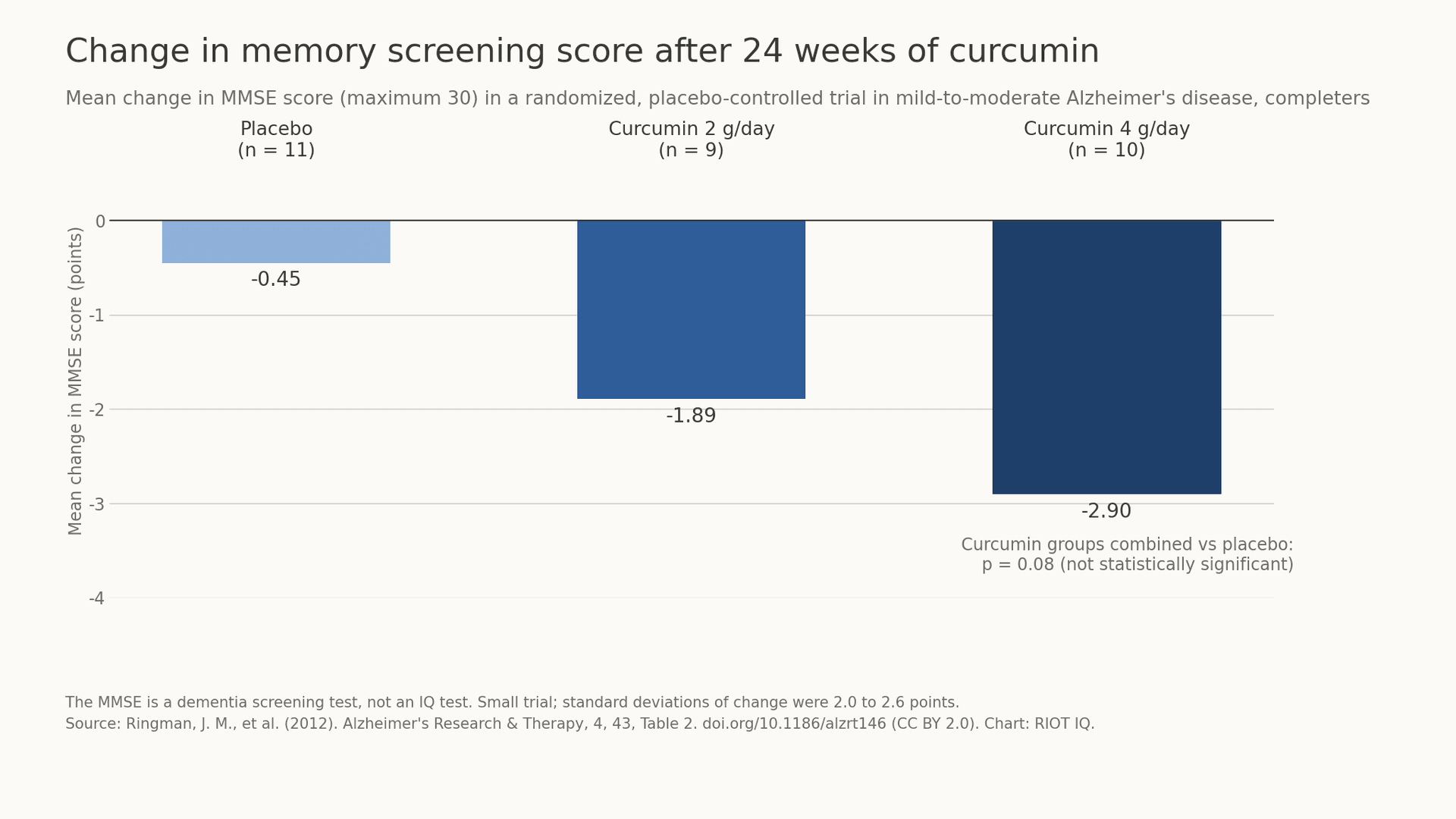
• People with Alzheimer's disease (Ringman et al., 2012): Thirty-six patients took placebo, 2 grams or 4 grams a day of curcumin for 24 weeks. There were no differences in cognition or in brain-related blood and spinal-fluid markers. If anything, the curcumin groups fell further on the MMSE, a trend that did not reach significance, and blood levels of curcumin itself were very low.
The two 2025 meta-analyses show how fragile this evidence base is. One pooled nine trials with 501 people and found a global cognition effect of 0.82 standard deviations, but the effect was no longer significant in trials shorter than 24 weeks, in people under 60 or outside Asia. The other pooled ten human studies with 531 people and found no overall effect (0.14, with a confidence interval running from -0.78 to 1.07), with smaller positive results for working memory and processing speed and more adverse events with curcumin than with placebo.
Do these results mean anything for IQ?
None of these trials used an IQ test. The MMSE and the Montreal Cognitive Assessment are brief screens built to flag dementia, and healthy adults score at or near the top. The memory and attention tasks in the Cox and Small trials are closer to what an IQ test samples, but each one measures a narrow skill, and a full-scale IQ combines many such tasks.
It is tempting to convert the effect sizes into IQ points by multiplying by 15, the IQ standard deviation. The 0.13 to 0.19 range from the Singapore cohort would come to about 2 or 3 points, and the 0.82 pooled effect would be about 12. Those conversions would mislead. The cohort figures are correlations between diet and single short tests, the 0.82 estimate rests on a few small trials and disagrees with a second meta-analysis of the same literature, and no trial measured general intelligence. A supplement that raised IQ by 12 points would be one of the largest effects in the history of intelligence research, and it would not hide in samples of 40 people.
Selection also matters outside the trials. People who buy brain supplements tend to be more health-conscious and better educated than average, so a survey showing that turmeric users score well on tests would mostly reflect who chooses to take it. Our page on nootropics and IQ covers the wider category of products sold to sharpen the mind.
Black pepper, absorption and safety
Curcumin is poorly absorbed. In a 1998 study, healthy volunteers who swallowed 2 grams of curcumin alone had blood levels that were undetectable or very low. Adding 20 mg of piperine, the compound that makes black pepper hot, raised curcumin's bioavailability by about 2,000% over the following hour. That is why many supplements combine the two, and why trial results for one formulation do not transfer to another product, or to turmeric in food.
Better absorption may carry a cost. The U.S. Drug-Induced Liver Injury Network described ten cases of liver injury linked to turmeric products, all since 2011; five patients were hospitalized and one died. Three of the seven products tested also contained piperine, and the authors suggested that rising use and the black pepper combination may explain the increase. The National Center for Complementary and Integrative Health notes that ordinary turmeric is likely safe in recommended amounts for two to three months, but that liver damage has been reported with high-bioavailability products.
Spice purity is a separate issue. Researchers in Bangladesh found that lead chromate, a bright yellow pigment, was being added to turmeric roots during polishing in seven of the nine main producing districts. Lead is a neurotoxin, and our page on lead exposure and IQ covers what it does to children's intelligence. Anyone taking other medicines or living with a liver condition should speak with a doctor or pharmacist before using turmeric supplements.
Frequently asked questions
Does turmeric make you smarter?
No study shows that it does. Small trials in older adults report some gains on memory and attention tasks, others find nothing, and none measured IQ.
Does eating curry protect your brain?
Studies in Singapore link regular curry eating with slightly better scores on short cognitive tests in later life. These are observational findings, so they cannot show that curry caused the difference.
Is curcumin the same as turmeric?
Curcumin is the main active compound in turmeric and makes up only a small part of the spice. Most trials used concentrated curcumin products, so their results say little about turmeric in cooking.
Why is black pepper added to turmeric supplements?
Piperine from black pepper slows the breakdown of curcumin, and one study found it raised bioavailability by about 2,000%. Liver injury cases have been reported with products that combine the two.
Can turmeric help with Alzheimer's disease?
A 24-week trial in people with Alzheimer's disease found no benefit on cognition or brain markers. Anyone worried about memory should see a doctor, ideally one who specializes in memory disorders.
The takeaway
Turmeric is a useful spice with interesting laboratory chemistry, but it has not been shown to raise intelligence. The human trials are small, mostly in older adults, use short memory tasks or dementia screens, and two careful meta-analyses of the same studies disagree about whether there is any overall effect at all. If you want a trustworthy measure of your reasoning ability, take a professionally developed IQ test.
References
1. Ng, T. P., Chiam, P. C., Lee, T., Chua, H. C., Lim, L., & Kua, E. H. (2006). Curry consumption and cognitive function in the elderly. American Journal of Epidemiology, 164(9), 898-906. [doi.org/10.1093/aje/kwj267](. doi.org
2. Ng, T. P., Nyunt, M. S. Z., Gao, Q., Gwee, X., Chua, D. Q. L., & Yap, K. B. (2022). Curcumin-rich curry consumption and neurocognitive function from 4.5-year follow-up of community-dwelling older adults (Singapore Longitudinal Ageing Study). Nutrients, 14(6), 1189. [doi.org/10.3390/nu14061189](. doi.org
3. Chandra, V., Pandav, R., Dodge, H. H., Johnston, J. M., Belle, S. H., DeKosky, S. T., & Ganguli, M. (2001). Incidence of Alzheimer's disease in a rural community in India: The Indo-US study. Neurology, 57(6), 985-989. [doi.org/10.1212/wnl.57.6.985](. doi.org
4. Lee, J., Meijer, E., Langa, K. M., Ganguli, M., Varghese, M., Banerjee, J., ... Dey, A. B. (2023). Prevalence of dementia in India: National and state estimates from a nationwide study. Alzheimer's & Dementia, 19(7), 2898-2912. [doi.org/10.1002/alz.12928](. doi.org
5. Cox, K. H., Pipingas, A., & Scholey, A. B. (2015). Investigation of the effects of solid lipid curcumin on cognition and mood in a healthy older population. Journal of Psychopharmacology, 29(5), 642-651. [doi.org/10.1177/0269881114552744](. doi.org
6. Cox, K. H. M., White, D. J., Pipingas, A., Poorun, K., & Scholey, A. (2020). Further evidence of benefits to mood and working memory from lipidated curcumin in healthy older people: A 12-week, double-blind, placebo-controlled, partial replication study. Nutrients, 12(6), 1678. [doi.org/10.3390/nu12061678](. doi.org
7. Rainey-Smith, S. R., Brown, B. M., Sohrabi, H. R., Shah, T., Goozee, K. G., Gupta, V. B., & Martins, R. N. (2016). Curcumin and cognition: A randomised, placebo-controlled, double-blind study of community-dwelling older adults. British Journal of Nutrition, 115(12), 2106-2113. [doi.org/10.1017/S0007114516001203](. doi.org
8. Small, G. W., Siddarth, P., Li, Z., Miller, K. J., Ercoli, L., Emerson, N. D., ... Barrio, J. R. (2018). Memory and brain amyloid and tau effects of a bioavailable form of curcumin in non-demented adults: A double-blind, placebo-controlled 18-month trial. American Journal of Geriatric Psychiatry, 26(3), 266-277. [doi.org/10.1016/j.jagp.2017.10.010](. doi.org
9. Ringman, J. M., Frautschy, S. A., Teng, E., Begum, A. N., Bardens, J., Beigi, M., ... Cole, G. M. (2012). Oral curcumin for Alzheimer's disease: Tolerability and efficacy in a 24-week randomized, double blind, placebo-controlled study. Alzheimer's Research & Therapy, 4(5), 43. [doi.org/10.1186/alzrt146](. doi.org
10. Wang, W., Zhao, R., Liu, B., & Li, K. (2025). The effect of curcumin supplementation on cognitive function: An updated systematic review and meta-analysis. Frontiers in Nutrition, 12, 1549509. [doi.org/10.3389/fnut.2025.1549509](. doi.org
11. Yu, L., Li, N., Li, B., Ye, K. X., Guo, J., Shan, J., ... Feng, L. (2025). Targeting cognitive aging with curcumin supplementation: A systematic review and meta-analysis. Journal of Prevention of Alzheimer's Disease, 12(8), 100248. [doi.org/10.1016/j.tjpad.2025.100248](. doi.org
12. Shoba, G., Joy, D., Joseph, T., Majeed, M., Rajendran, R., & Srinivas, P. S. (1998). Influence of piperine on the pharmacokinetics of curcumin in animals and human volunteers. Planta Medica, 64(4), 353-356. [doi.org/10.1055/s-2006-957450](. doi.org
13. Halegoua-DeMarzio, D., Navarro, V., Ahmad, J., Avula, B., Barnhart, H., Barritt, A. S., ... Vuppalanchi, R. (2023). Liver injury associated with turmeric: A growing problem. Ten cases from the Drug-Induced Liver Injury Network [DILIN]. American Journal of Medicine, 136(2), 200-206. [doi.org/10.1016/j.amjmed.2022.09.026](. doi.org
14. Forsyth, J. E., Nurunnahar, S., Islam, S. S., Baker, M., Yeasmin, D., Islam, M. S., ... Luby, S. P. (2019). Turmeric means "yellow" in Bengali: Lead chromate pigments added to turmeric threaten public health across Bangladesh. Environmental Research, 179, 108722. [doi.org/10.1016/j.envres.2019.108722](. doi.org
15. National Center for Complementary and Integrative Health. (2026). Turmeric. [nccih.nih.gov](. nccih.nih.gov
Figure by RIOT IQ. Data from Ringman et al. (2012), Alzheimer's Research & Therapy 4, 43 (doi.org/10.1186/alzrt146), Table 2, CC BY 2.0.
Take our professional IQ test
Want to know your IQ? Try the first ever professional online IQ test.