Microplastics and IQ: Do Microplastics Lower Intelligence?
No study has linked microplastics to IQ in people. Microplastics IQ fears rest on brain-tissue and mouse studies; plastic chemicals have mixed child IQ data.
Dr. Russell T. WarneChief Scientist
Share
No study has measured microplastics and IQ in the same people, so there is no evidence yet that microplastics lower intelligence. The concern comes from three other kinds of research: autopsy studies finding plastic particles in human brains, mouse experiments, and cohorts linking plastic-associated chemicals called phthalates to child IQ, where one study found 6.7 to 7.6 points lower IQ at the highest exposures but a later meta-analysis judged the overall evidence slight or indeterminate.
That is a long way from a demonstrated effect. This article explains what has been found in human tissue, what animal studies can and cannot tell us, how the chemical evidence differs from the particle evidence, and why the microplastics-and-IQ story spreads faster than the data.
Microplastics in the human brain: what has been found
"Microplastics" are plastic particles smaller than 5 millimetres, and "nanoplastics" are far smaller fragments, below a micrometre. The study behind most recent headlines is by Alexander Nihart, Matthew Campen and colleagues, published in Nature Medicine in 2025. They measured plastic in liver, kidney and frontal-cortex samples from people who died in New Mexico in 2016 and 2024.
• Concentrations: Brain samples held far more plastic than liver or kidney. The median in brain tissue was 3,345 micrograms per gram in 2016 and 4,917 micrograms per gram in 2024, compared with 433 and 404 micrograms per gram in 2024 liver and kidney.
• Type and size: Most of the plastic was polyethylene, and electron microscopy showed it mainly as nanoscale shards and flakes, largely 100 to 200 nanometres long.
• Dementia: Twelve brains from people with a dementia diagnosis had a median of 26,076 micrograms per gram, higher than any comparison group.
The authors were explicit that the dementia finding does not show cause. Brain atrophy, a weaker blood-brain barrier and poorer clearance are features of dementia that would be expected to raise plastic concentrations, so the disease may be causing the buildup rather than the other way round. They described the data as associative and called for better analytical methods and much larger samples.
Plastic particles have also turned up in arteries. Raffaele Marfella and colleagues analysed carotid plaque removed from 257 patients and followed them for about 34 months. Patients whose plaque contained microplastics and nanoplastics had a higher risk of heart attack, stroke or death (hazard ratio 4.53). That is a cardiovascular finding in an observational study, and it says nothing about intelligence.
What animal studies show
Mouse studies show that plastic particles can reach the brain and change behaviour, at least at high doses. In one widely covered experiment, Haipeng Huang and colleagues injected fluorescent polystyrene microplastics directly into the bloodstream of mice. Immune cells that had swallowed the particles became lodged in small blood vessels of the brain cortex, reducing local blood flow. The treated mice moved less and did worse on a maze test of spatial working memory.
Two details limit what this means for people. The particles were injected into the blood rather than eaten or inhaled, and the behavioural deficits had returned to baseline by four weeks. More broadly, a 2026 review of nanoplastic studies by Ahmet Ali Berber and colleagues noted that most experiments use pristine polystyrene beads at doses three to six orders of magnitude above plausible human exposure, so their results generate hypotheses rather than establish human harm.
Plastic chemicals and child IQ: the phthalate evidence
The only human IQ data near this topic concern chemicals used in plastics, which are a separate question from the particles themselves. "Phthalates" are compounds that make plastics flexible and are found in many consumer products.
• The most cited cohort: Pam Factor-Litvak and colleagues measured phthalate metabolites in late-pregnancy urine samples from 328 inner-city New York mothers and gave their children the Wechsler Intelligence Scale for Children at age 7. Children of mothers in the highest quartile for two phthalates (DnBP and DiBP) scored 6.7 and 7.6 IQ points lower than children of mothers in the lowest quartile. Each log-unit increase went with about 2.7 points lower full-scale IQ.
• An early systematic review: Maede Ejaredar and colleagues reviewed 11 studies in 2015 and concluded that prenatal phthalate exposure was associated with poorer cognitive and behavioural outcomes, including lower IQ.
• The larger meta-analysis: Elizabeth Radke of the US Environmental Protection Agency and colleagues reviewed 14 studies of cognition and found only slight or indeterminate evidence of an association for each phthalate. They concluded there was no clear pattern, and cautioned that this should not be read as proof of no effect, because of exposure misclassification, possible sensitive periods, sex-specific effects and mixtures of chemicals.
Bisphenol A (BPA), another plastic chemical, has mainly been studied against behaviour. Joseph Braun and colleagues followed 244 mother-child pairs in Cincinnati and found that higher BPA during pregnancy went with more anxious behaviour and poorer emotional control at age 3, mainly in girls. IQ was not the outcome.
Why the microplastics and IQ story spreads
Microplastics are everywhere, they are visible, and the numbers sound alarming. A 2021 analysis by Kala Senathirajah and colleagues estimated that people may ingest between 0.1 and 5 grams of microplastics a week, a range so wide that it mainly shows how uncertain exposure estimates still are. Add a brain-tissue study and a mouse maze, and a headline about falling intelligence almost writes itself.
The contrast with lead is instructive. Our article on IQ and lead exposure covers decades of cohort studies, dose-response data and policy changes that point to a causal effect on children's IQ. Microplastics have none of that yet. There are no birth cohorts measuring particle exposure and later IQ, no dose-response data in humans and no natural experiments.
Confounds that any future study must handle
When human studies do arrive, they will face familiar problems.
• Socioeconomic status: Diet, housing, packaging use and occupation all shape exposure, and they also relate to children's test scores. The phthalate cohorts adjust for these factors, but residual confounding is always possible.
• Co-exposures: People with high plastic exposure may also have more exposure to traffic pollution and other chemicals. Our page on IQ and air pollution discusses how researchers try to separate those effects.
• Measurement: Particle counts and polymer mass are measured with different methods, and the Nihart team themselves called for refinements to analytical techniques before drawing health conclusions.
• Reverse causation: As the dementia finding shows, illness can change how much plastic tissue retains, so a correlation in sick people cannot be read as a cause.
Frequently asked questions
Do microplastics lower IQ?
There is no direct evidence either way, because no study has measured microplastic exposure and IQ in the same people. Current concern rests on tissue, animal and chemical studies.
Are there microplastics in the human brain?
An autopsy study found plastic in frontal-cortex samples at a median of 4,917 micrograms per gram in 2024, higher than in liver or kidney. The methods are new and the results need replication.
Do microplastics cause dementia?
That has not been shown. Brains from people with dementia held more plastic, but the authors noted that dementia itself could cause more plastic to accumulate.
Do phthalates lower children's IQ?
One New York cohort found children in the highest prenatal exposure group scored 6.7 to 7.6 points lower at age 7, but a meta-analysis of 14 studies found only slight or indeterminate evidence overall.
Should I worry about microplastics during pregnancy?
The evidence does not show a specific risk to a child's IQ from microplastic particles. Questions about chemical exposures in pregnancy are best discussed with an obstetrician or midwife.
The takeaway
Microplastics have not been shown to lower IQ. Plastic particles have been found in human brain tissue and can impair mice at high doses, and one phthalate cohort reported a 6.7 to 7.6 point gap at the highest exposures, but the wider phthalate evidence is mixed and the human particle evidence is almost entirely missing. If you want a measure of where your reasoning skills stand today, take the RIOT IQ test.
References
1. Nihart, A. J., Garcia, M. A., El Hayek, E., Liu, R., Olewine, M., Kingston, J. D., Castillo, E. F., Gullapalli, R. R., et al. (2025). Bioaccumulation of microplastics in decedent human brains. Nature Medicine, 31(4), 1114-1119. [doi.org/10.1038/s41591-024-03453-1](. doi.org
2. Marfella, R., Prattichizzo, F., Sardu, C., Fulgenzi, G., Graciotti, L., Spadoni, T., D'Onofrio, N., Scisciola, L., et al. (2024). Microplastics and nanoplastics in atheromas and cardiovascular events. The New England Journal of Medicine, 390(10), 900-910. [doi.org/10.1056/NEJMoa2309822](. doi.org
3. Huang, H., Hou, J., Li, M., Wei, F., Liao, Y., & Xi, B. (2025). Microplastics in the bloodstream can induce cerebral thrombosis by causing cell obstruction and lead to neurobehavioral abnormalities. Science Advances, 11(4), eadr8243. [doi.org/10.1126/sciadv.adr8243](. doi.org
4. Berber, A. A., Yıldız, E., Berber, N., Kurnaz, M., & Kenanoğlu, N. A. (2026). Nanoplastic translocation across biological barriers (blood-brain, placental, intestinal): Transport mechanisms, tissue-specific vulnerabilities, and a corona-driven barrier selectivity framework. Biology, 15(14), 1133. [doi.org/10.3390/biology15141133](. doi.org
5. Factor-Litvak, P., Insel, B., Calafat, A. M., Liu, X., Perera, F., Rauh, V. A., & Whyatt, R. M. (2014). Persistent associations between maternal prenatal exposure to phthalates on child IQ at age 7 years. PLOS ONE, 9(12), e114003. [doi.org/10.1371/journal.pone.0114003](. doi.org
6. Ejaredar, M., Nyanza, E. C., Ten Eycke, K., & Dewey, D. (2015). Phthalate exposure and children's neurodevelopment: A systematic review. Environmental Research, 142, 51-60. [doi.org/10.1016/j.envres.2015.06.014](. doi.org
7. Radke, E. G., Braun, J. M., Nachman, R. M., & Cooper, G. S. (2020). Phthalate exposure and neurodevelopment: A systematic review and meta-analysis of human epidemiological evidence. Environment International, 137, 105408. [doi.org/10.1016/j.envint.2019.105408](. doi.org
8. Braun, J. M., Kalkbrenner, A. E., Calafat, A. M., Yolton, K., Ye, X., Dietrich, K. N., & Lanphear, B. P. (2011). Impact of early-life bisphenol A exposure on behavior and executive function in children. Pediatrics, 128(5), 873-882. [doi.org/10.1542/peds.2011-1335](. doi.org
9. Senathirajah, K., Attwood, S., Bhagwat, G., Carbery, M., Wilson, S., & Palanisami, T. (2021). Estimation of the mass of microplastics ingested: A pivotal first step towards human health risk assessment. Journal of Hazardous Materials, 404, 124004. [doi.org/10.1016/j.jhazmat.2020.124004](. doi.org
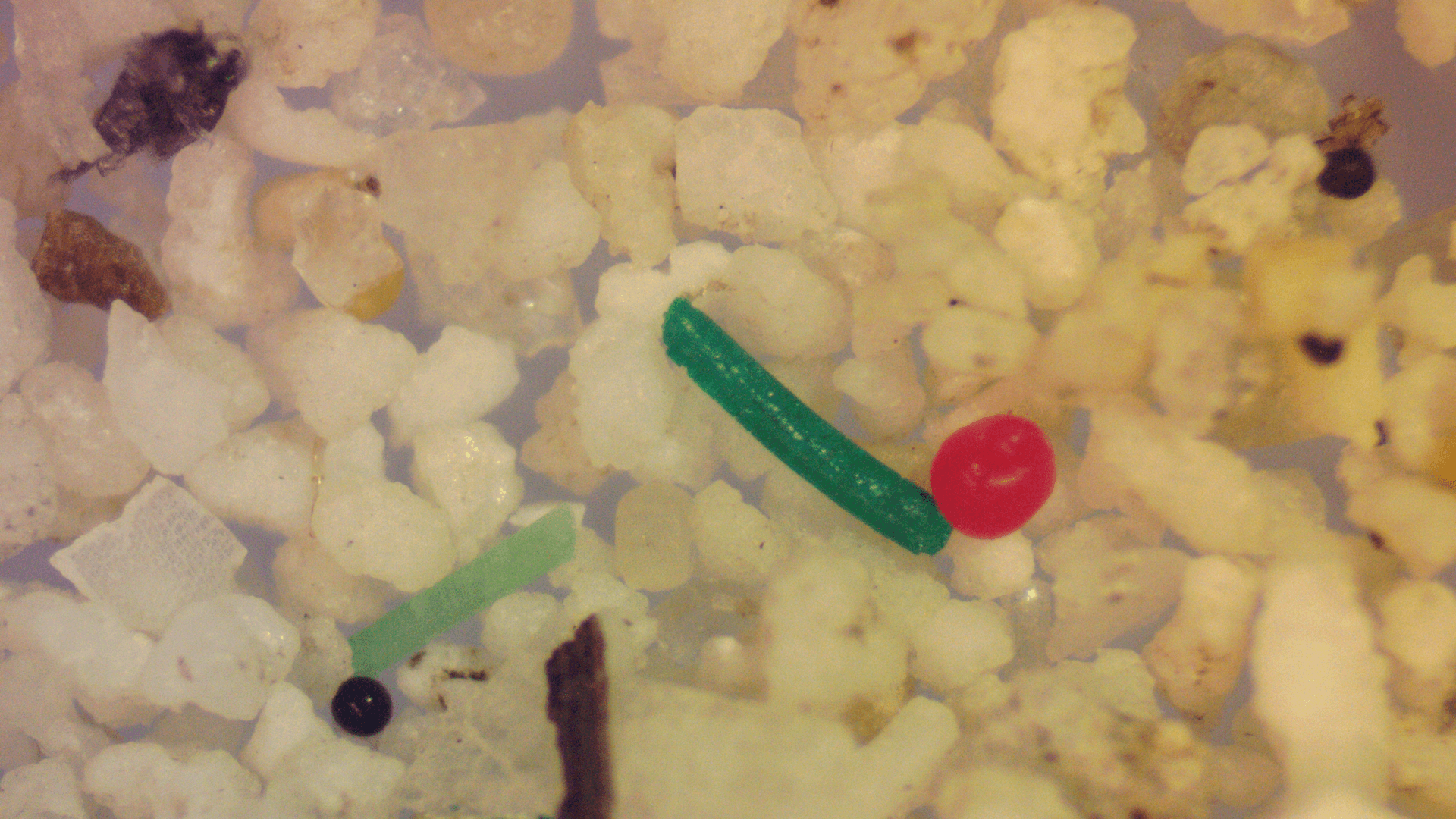
Hero image: Microplastics from the environment, by Oof.cc, CC BY-SA 4.0. Via Wikimedia Commons.
Take our professional IQ test
Want to know your IQ? Try the first ever professional online IQ test.