Swearing and IQ: Is Swearing a Sign of Intelligence?
Swearing IQ claims rest on one fluency study: people who list more swear words also list more ordinary words, but no study shows swearers have higher IQ.
Dr. Russell T. WarneChief Scientist
Share
There is no good evidence that people who swear have a higher IQ, and no evidence that they have a lower one. The claim comes from a 2015 study showing that people who can list more swear words in a minute also list more ordinary words, which is a finding about verbal fluency, measured without any IQ test.
Headlines such as "people who swear are smarter" circulated widely after that study, and later ones added that swearers are more honest and handle pain better. Each of those findings is real in a narrow sense, and each is about something other than intelligence. This page covers what the fluency research actually measured, what personality research says about who swears, the honesty and pain studies, and why the "sign of intelligence" reading goes too far.
What the swearing fluency study found
The study behind most swearing IQ headlines is by Kristin and Timothy Jay, published in Language Sciences in 2015. Its target was the "poverty-of-vocabulary" idea, the folk belief that people swear because they lack better words.
The researchers ran three studies with US college students. In the first, a few dozen participants had one minute each to say aloud as many words as they could from several categories:
• Letter fluency: words beginning with a given letter, the standard Controlled Oral Word Association Test (COWAT) used in neuropsychology.
• Category fluency: animal names.
• Taboo fluency: swear words and other taboo words.
A second study repeated the tasks in writing with a new group of students, and a third, with more than a hundred students, added questions about personality and how often people swear. Across the studies, scores on the three tasks were positively correlated. Students who produced many ordinary words also tended to produce many taboo words. The authors summed it up as "fluency is fluency": a large swearing vocabulary goes with a large vocabulary in general and is no sign of a gap. Vocabulary size itself is something IQ tests do measure, in a more controlled way, as our article on what vocabulary tests measure describes.
That is a fair rebuttal of the poverty-of-vocabulary myth. It does not show what the headlines claimed, for three reasons.
• No IQ test: the study measured how many words people could produce on demand. It did not give an intelligence test, so it cannot tell us whether swearers score higher on one.
• Knowledge versus habit: being able to list swear words is different from swearing often. A person who rarely swears can still know plenty of taboo words.
• A narrow sample: college students are already filtered on verbal and academic ability, which limits how far the results generalise.
Verbal fluency is one narrow ability
Fluency tasks tap what psychologists call retrieval fluency, the speed of pulling words or ideas from long-term memory. It is one of many narrow abilities in modern models of intelligence. In Stanek and Ones's large synthesis of personality and ability research, retrieval fluency is treated as its own cluster, separate from fluid reasoning and from acquired knowledge.
General intelligence shows up across all of these abilities, so it is reasonable to expect that someone with a strong vocabulary in one domain has a strong vocabulary in others. That is what Jay and Jay found. But a positive link between two fluency tasks says more about fluency than about overall reasoning ability. Verbal comprehension and word meaning are measured differently on an IQ test, as our article on what verbal reasoning is explains. Being fast at listing swear words is a long way from that.
Who swears more: the personality evidence
If swearing were a marker of intelligence, it should track IQ more closely than it tracks personality. The evidence points the other way.
In a review of taboo-word research, Timothy Jay reported that a set of 10 words accounts for 80% of public swearing, and that swearing is positively correlated with extraversion and hostility and negatively correlated with agreeableness, conscientiousness and religiosity. A study of 694 bloggers by Tal Yarkoni found the same pattern in written language. Use of swear words correlated -.21 with agreeableness and -.14 with conscientiousness, with a small positive correlation (.11) with neuroticism.
Those personality traits barely relate to intelligence. In Anglim and colleagues' 2022 meta-analysis of more than 100,000 people, agreeableness correlated .00 with general intelligence and conscientiousness -.02. Swearing, in other words, is mostly tied to traits that have almost nothing to do with IQ. How much a person swears also depends heavily on context, culture, age and the company they keep, none of which are measures of ability.
Honesty, pain and other swearing headlines
Two other findings are often bundled into the "swearing is smart" story. Neither measured intelligence.
Honesty. Gilad Feldman and colleagues reported in 2017 that profanity was associated with honesty. In a lab study of 276 online participants, people who reported swearing more scored lower on a lie scale (r = .34 between self-reported profanity and honesty). They found similar patterns in a linguistic analysis of 73,789 Facebook users and at the level of US states. A comment by Reinout de Vries and colleagues challenged the first study. They argued that the lie scale used, the Eysenck Lie subscale, is an impression-management measure and that high scores in low-stakes settings tend to reflect honesty, the opposite of how Feldman's team read them. In two other datasets, de Vries and colleagues found that profanity was negatively related to other people's ratings of the respondent's honesty-humility and positively related to actual cheating. The honesty question is contested, and it is separate from IQ either way.
Pain. Richard Stephens and colleagues found that repeating a swear word let volunteers keep a hand in ice water longer than repeating a neutral word, an effect on pain tolerance that has nothing to do with intelligence.
Why the "sign of intelligence" claim spread
Part of the appeal is that the finding flatters a common habit, and being told that swearing signals intelligence is a pleasant surprise. Part is a slide in wording from paper to press. "A large taboo vocabulary is no sign of a poor vocabulary" became "swearing means you have a large vocabulary", which then became "swearing means you are smart". Each step adds a claim the study never tested.
The fair summary is narrower:
• Supported: people who know many swear words tend to know many other words too, at least among college students.
• Not supported: that swearing more often is linked to higher IQ, or that it is linked to lower IQ.
• Mostly personality: how much people swear relates to agreeableness and conscientiousness, traits that have little or no correlation with intelligence.
Context matters for how swearing is received, and a word that is fine among friends can land badly at work. A strong vocabulary gives a speaker more choices, including the choice of when a taboo word fits and when it does not.
Frequently asked questions
Is swearing a sign of intelligence?
No study has shown that. The best-known research found that people who can list many swear words also list many ordinary words, which reflects verbal fluency and was measured without an IQ test.
Do people who swear have a higher IQ?
There is no direct evidence either way. The studies behind the headline did not measure IQ, and swearing frequency is linked mostly to personality traits that barely correlate with intelligence.
Does swearing mean you have a bigger vocabulary?
Knowing more swear words goes with knowing more words in general, according to Jay and Jay's fluency studies. That does not mean that swearing often builds or reveals a bigger vocabulary.
Are people who swear more honest?
One 2017 study reported this, but a published critique argued that its lie-scale measure was misread, and other data linked profanity to lower rated honesty and more cheating. The question is unsettled.
Is it true that swearing reduces pain?
Experiments have found that repeating a swear word can increase how long people tolerate cold-water pain compared with a neutral word. That finding concerns pain tolerance and says nothing about intelligence.
The takeaway
Swearing IQ headlines over-read a sound but narrow study. People with large vocabularies tend to know plenty of taboo words too, but that tells us about verbal fluency, and no research has shown that swearing more is tied to a higher or lower IQ. Who swears, and how often, is mostly a matter of personality and setting. If you want an actual measure of your reasoning ability, take a full-length online IQ test instead of counting your curse words.
References
1. Jay, K. L., & Jay, T. B. (2015). Taboo word fluency and knowledge of slurs and general pejoratives: Deconstructing the poverty-of-vocabulary myth. Language Sciences, 52, 251-259. [doi.org/10.1016/j.langsci.2014.12.003](. doi.org
2. Stanek, K. C., & Ones, D. S. (2023). Meta-analytic relations between personality and cognitive ability. Proceedings of the National Academy of Sciences, 120(23), e2212794120. [doi.org/10.1073/pnas.2212794120](. doi.org
3. Jay, T. (2009). The utility and ubiquity of taboo words. Perspectives on Psychological Science, 4(2), 153-161. [doi.org/10.1111/j.1745-6924.2009.01115.x](. doi.org
4. Yarkoni, T. (2010). Personality in 100,000 words: A large-scale analysis of personality and word use among bloggers. Journal of Research in Personality, 44(3), 363-373. [doi.org/10.1016/j.jrp.2010.04.001](. doi.org
5. Anglim, J., Dunlop, P. D., Wee, S., Horwood, S., Wood, J. K., & Marty, A. (2022). Personality and intelligence: A meta-analysis. Psychological Bulletin, 148(5-6), 301-336. [doi.org/10.1037/bul0000373](. doi.org
6. Feldman, G., Lian, H., Kosinski, M., & Stillwell, D. (2017). Frankly, we do give a damn: The relationship between profanity and honesty. Social Psychological and Personality Science, 8(7), 816-826. [doi.org/10.1177/1948550616681055](. doi.org
7. de Vries, R. E., Hilbig, B. E., Zettler, I., Dunlop, P. D., Holtrop, D., Lee, K., & Ashton, M. C. (2018). Honest people tend to use less—not more—profanity: Comment on Feldman et al.'s (2017) Study 1. Social Psychological and Personality Science, 9(5), 516-520. [doi.org/10.1177/1948550617714586](. doi.org
8. Stephens, R., Atkins, J., & Kingston, A. (2009). Swearing as a response to pain. NeuroReport, 20(12), 1056-1060. [doi.org/10.1097/WNR.0b013e32832e64b1](. doi.org
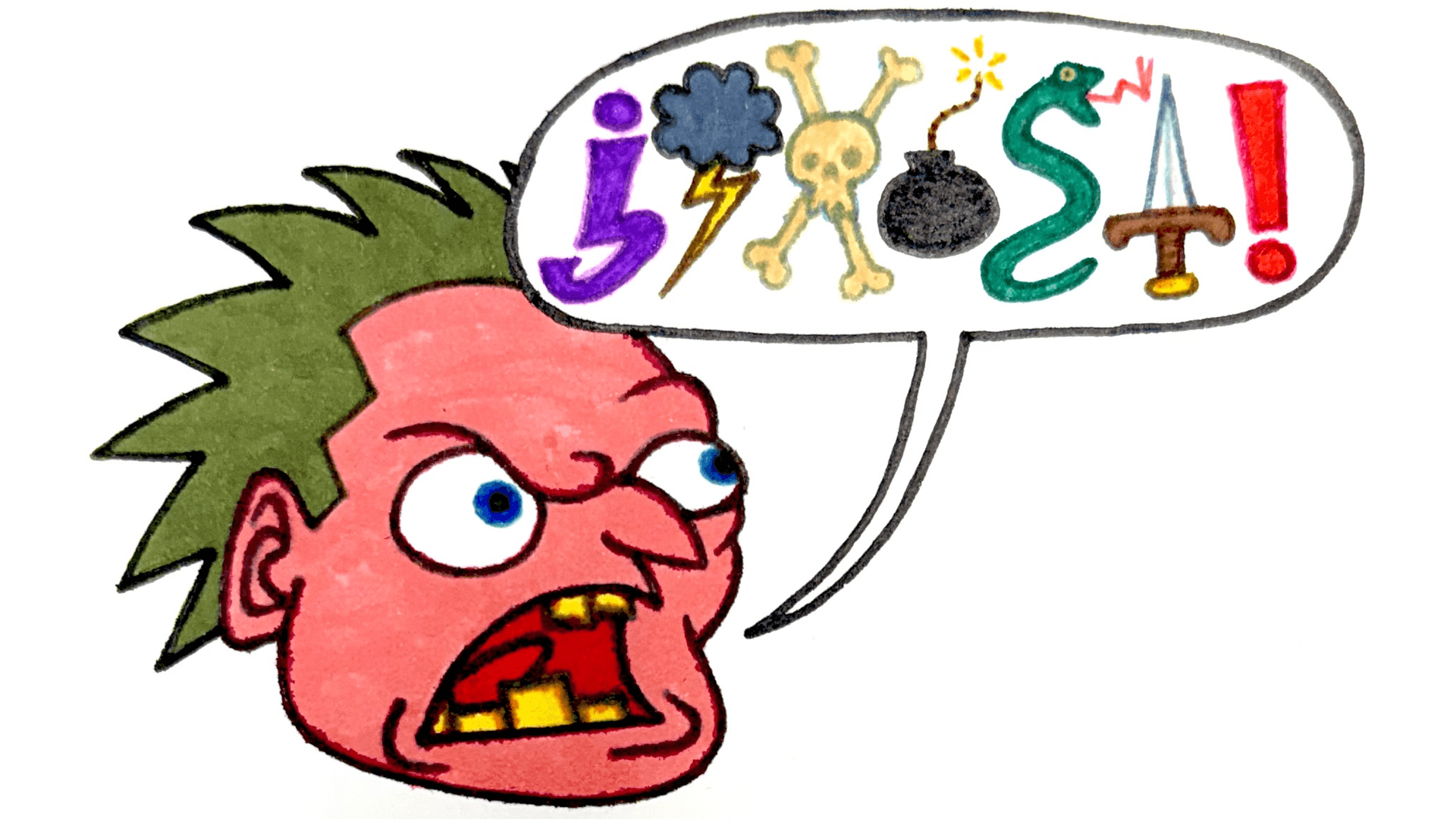
Hero image: Grawlix cartoon head, by RGBLionGam3r17, CC0. Via Wikimedia Commons.
Take our professional IQ test
Want to know your IQ? Try the first ever professional online IQ test.