Eye color IQ claims have no scientific support: no credible study links iris color to intelligence, and the reaction-time studies cited never measured IQ.
Dr. Russell T. WarneChief Scientist
Share
There is no credible evidence that eye color is linked to IQ. No peer-reviewed study we could find has compared measured intelligence across eye colors in a large, representative sample, and the small reaction-time studies usually cited for the idea never measured IQ at all.
That makes this a short answer, but the question is worth unpacking, because it shows how a claim can spread with almost no data behind it. This page covers what research on eye color and the brain does exist, what actually determines eye color, why the "eye color IQ" idea circulates, and which eye-related trait does have a small, real association with intelligence.
What research on eye color and the mind exists?
The closest thing to evidence is a cluster of reaction-time studies from the 1970s to the 1990s. W. H. Tedford and colleagues timed 126 adults responding to a visual signal and found that people with dark eyes had significantly faster simple reaction times. On a harder four-choice task the difference pointed the same way but was not significant, and in a further sample of 206 men tested on a single unpracticed trial it was not significant either.
Bruce Hale, Daniel Landers and colleagues then split reaction time into its components with electromyography. Dark-eyed participants were faster on average, but the only difference that came close to statistical significance was in the "premotor" part of the response, the time before the muscle starts to act (p < 0.07), and reflex times showed no eye-color difference at all. Anthony Fallone and Bahman Baluch later reported faster choice reaction times in dark-eyed participants. None of these studies tested intelligence, and their samples were small.
Reaction time does correlate with IQ, which is why these studies get pulled into the conversation. In a Scottish community sample of 1,350 adults aged about 56, Geoff Der and Ian Deary found that scores on a standard IQ-type test correlated 0.50 with average choice reaction time and 0.33 with simple reaction time (faster responses going with higher scores). Our article on whether IQ and reaction time are correlated covers that link in detail. Even so, a small and inconsistent eye-color difference in reaction speed cannot be converted into an IQ difference; that would require measuring IQ directly, and nobody has done it in a credible sample.
One more study often turns up in searches. Mats Larsson, Nancy Pedersen and Håkan Stattin rated the irises of 428 university students for crypts (small pits in the iris) and contraction furrows, then compared them with personality scores. Crypts were associated with traits such as warmth and trust, and furrows with impulsiveness. That study looked at iris texture, not color, and at personality, not intelligence, and it was a single sample.
What determines eye color?
Eye color depends mainly on how much melanin pigment the iris contains, along with the iris's physical structure. Hans Eiberg and colleagues traced blue eyes to a variant in a regulatory region of the HERC2 gene that reduces the activity of the neighboring OCA2 gene. They found one shared genetic background in 155 blue-eyed people from Denmark and in blue-eyed individuals from Turkey and Jordan, which pointed to a single founder mutation.
The full picture is more complicated. The largest genome-wide study of eye color, by Mark Simcoe and colleagues, analyzed up to 192,986 people of European ancestry and found 124 independent associations in 61 regions of the genome. Together, common genetic variants explained 53.2% of the variation in eye color, and the genes involved related to melanin production and iris structure.
Intelligence has a very different genetic profile. A genome-wide study of 269,867 people by Jeanne Savage and colleagues identified 205 regions and 1,016 genes associated with intelligence, and those genes were strongly expressed in the brain, particularly in two types of neuron in the striatum and hippocampus. The two lines of research map largely separate biology: one centers on pigment and structure in the iris, the other on genes active in the brain.
A within-family comparison would settle the question most cleanly, because brothers and sisters often differ in eye color while sharing parents and upbringing. We could not find any published study that has made that comparison.
Why the "eye color IQ" idea circulates
Searches such as "eye color with highest IQ" suggest people expect a ranking to exist. Online lists and quizzes often oblige, usually without citing any data.
Some versions of the claim lean on maps that set national average test scores beside the regional frequency of light or dark eyes. That reasoning commits what statisticians call the "ecological fallacy": treating a correlation between group averages as if it described individuals. In a classic 1950 paper, the sociologist W. S. Robinson showed that correlations computed across geographic areas can differ sharply from the correlations among the people living in them, so area-level patterns cannot be used to draw conclusions about individuals.
Group averages also reflect conditions that vary from place to place. A meta-analysis by Stuart Ritchie and Elliot Tucker-Drob, covering more than 600,000 participants, found that each additional year of education raised cognitive test scores by about 1 to 5 IQ points. Schooling, health and test familiarity differ between regions and generations, and average scores have risen substantially within single countries over the 20th century, a pattern known as the Flynn effect. Any map that lines up eye color with average scores is also lining up dozens of those environmental differences. Such maps say nothing about whether eye color, or anyone's ancestry, causes differences in intelligence, and we do not endorse claims that they do.
Beyond that, the idea draws on familiar cultural associations with light and dark eyes, which are easy to mistake for patterns in data, much as people read character and brains into messy handwriting.
An eye trait that is linked to IQ
If there is an eye-related trait with a real connection to intelligence, it is nearsightedness. Large studies find that people with myopia score slightly higher on cognitive tests on average, and most of that link appears to run through education, because more years in school raise the risk of myopia. Our article on myopia and IQ sets out the numbers. It is a useful contrast: myopia has a measurable and explained association with IQ, while eye color has none that anyone has demonstrated.
Frequently asked questions
Which eye color has the highest IQ?
None. No credible study has found that people with any eye color score higher on IQ tests than people with another.
Are people with blue eyes smarter?
There is no evidence that they are. Blue eyes come from a pigment gene variant that reduces melanin in the iris, and research has not linked it to intelligence.
Do people with dark eyes have faster reactions?
A few small studies from the 1970s to the 1990s reported slightly faster reaction times in dark-eyed people, but the results were inconsistent, and none of those studies measured IQ.
Is eye color genetic?
Yes. Variants near the HERC2 and OCA2 genes have the largest effects, and a study of nearly 193,000 people found 61 genomic regions involved, explaining about half of the variation in eye color.
Can you tell how intelligent someone is from their eyes?
No. No credible research shows that eye color carries information about IQ; the only way to know a person's IQ is to measure it with a well-built test.
The takeaway
Eye color and IQ are not linked in any credible research. The handful of studies on eye color and reaction time were small and never measured intelligence, and arguments built on maps of group averages confuse geography with individual ability. Eye color is set by pigment genes acting on the iris; intelligence is shaped by many genes active in the brain and by environment. If you want to know where your reasoning ability stands, take the RIOT IQ test rather than looking in the mirror.
References
1. Tedford, W. H., Hill, W., & Hensley, L. (1978). Human eye color and reaction time. Perceptual and Motor Skills, 47(2), 503-506. doi.org
2. Hale, B. D., Landers, D. M., Snyder Bauer, R., & Goggin, N. L. (1980). Iris pigmentation and fractionated reaction and reflex time. Biological Psychology, 10(1), 57-67. doi.org
3. Fallone, A. R., & Baluch, B. (1993). Eye colour: An unconsidered variable in cognitive research? Perceptual and Motor Skills, 77(3, Pt 2), 1123-1127. doi.org
4. Der, G., & Deary, I. J. (2018). Reaction times match IQ for major causes of mortality: Evidence from a population based prospective cohort study. Intelligence, 69, 134-145. doi.org
5. Larsson, M., Pedersen, N. L., & Stattin, H. (2007). Associations between iris characteristics and personality in adulthood. Biological Psychology, 75(2), 165-175. doi.org
6. Eiberg, H., Troelsen, J., Nielsen, M., Mikkelsen, A., Mengel-From, J., Kjaer, K. W., & Hansen, L. (2008). Blue eye color in humans may be caused by a perfectly associated founder mutation in a regulatory element located within the HERC2 gene inhibiting OCA2 expression. Human Genetics, 123(2), 177-187. doi.org
7. Simcoe, M., Valdes, A., Liu, F., Furlotte, N. A., Evans, D. M., Hemani, G., ... Hysi, P. G. (2021). Genome-wide association study in almost 195,000 individuals identifies 50 previously unidentified genetic loci for eye color. Science Advances, 7(11), eabd1239. doi.org
8. Savage, J. E., Jansen, P. R., Stringer, S., Watanabe, K., Bryois, J., de Leeuw, C. A., ... Posthuma, D. (2018). Genome-wide association meta-analysis in 269,867 individuals identifies new genetic and functional links to intelligence. Nature Genetics, 50(7), 912-919. doi.org
9. Robinson, W. S. (1950). Ecological correlations and the behavior of individuals. American Sociological Review, 15(3), 351-357. doi.org
10. Ritchie, S. J., & Tucker-Drob, E. M. (2018). How much does education improve intelligence? A meta-analysis. Psychological Science, 29(8), 1358-1369. doi.org
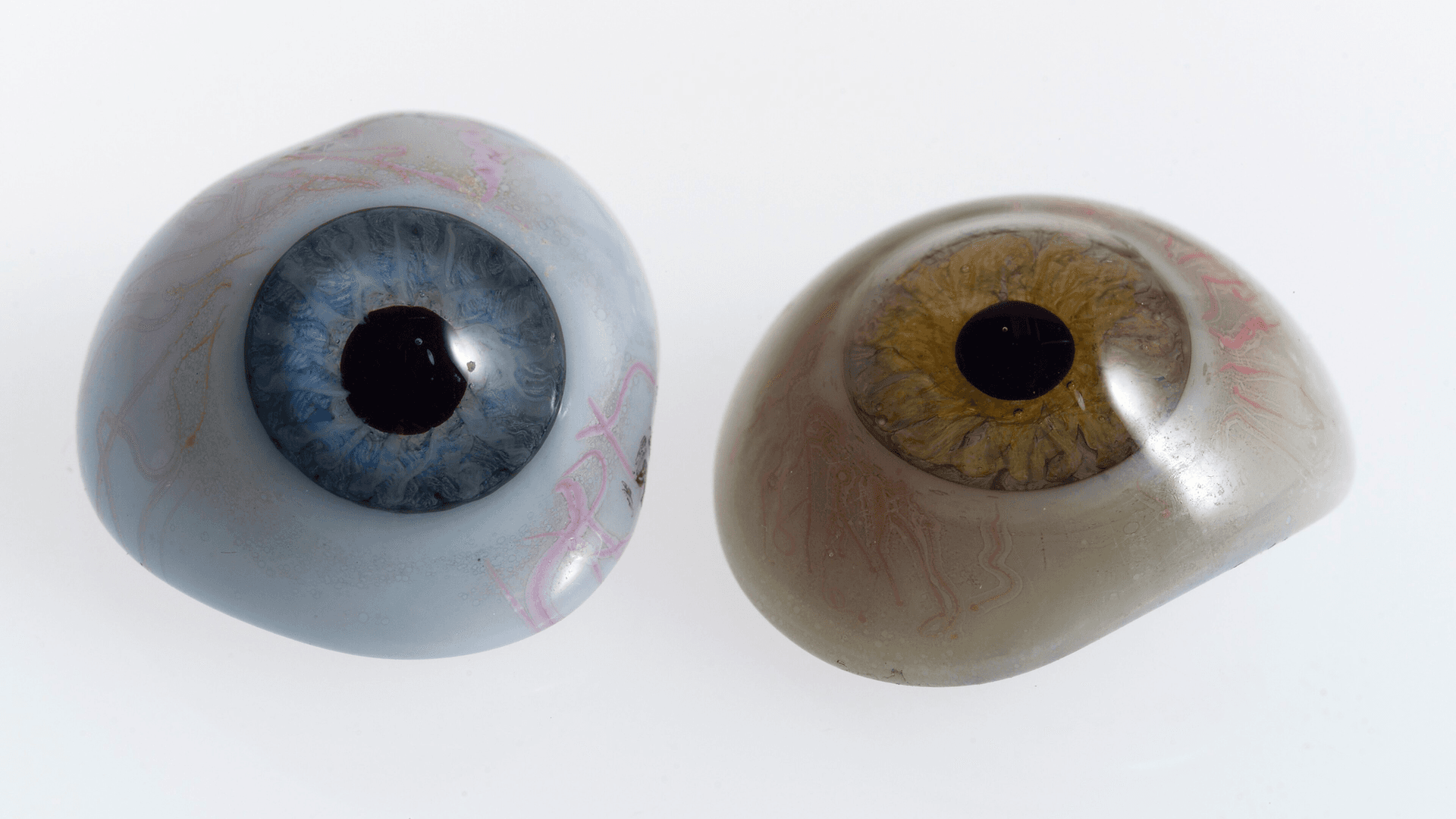
Hero image: A selection of glass eyes from an optician's glass eye case, Wellcome Collection, CC BY 4.0. Via Wikimedia Commons.
Take our professional IQ test
Want to know your IQ? Try the first ever professional online IQ test.