Birth Month and IQ: Does the Month You Were Born Affect Intelligence?
Birth month and IQ are barely linked. Children born just after the school cutoff do better on school tests, but the gap vanishes when tested at the same age.
Dr. Russell T. WarneChief Scientist
Share
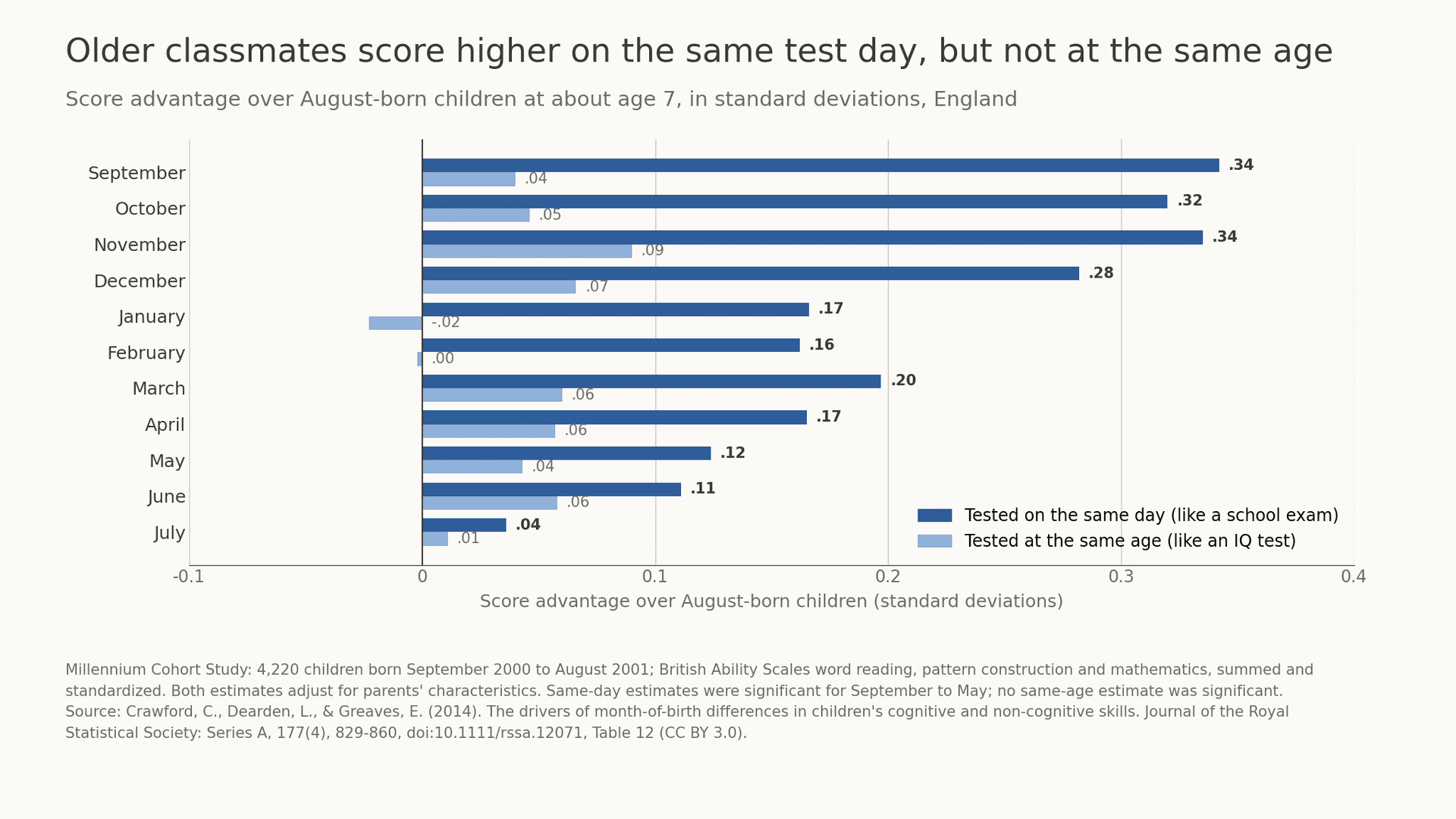
Birth month has almost no effect on IQ. In England, children born in September (the oldest in their school year) scored about 0.34 standard deviations higher than August-born classmates on cognitive tests taken on the same day, roughly 5 points on an IQ-style scale, but when children were tested at the same age the gap shrank to 0.04 standard deviations, less than 1 point and statistically indistinguishable from zero.
So the birth month effect is real, but it is an age effect. It shows up in school exams, where children who are nearly a year apart in age sit the same paper, and it largely vanishes on tests that compare children with others of the same age, which is how IQ tests are scored. This page covers the best evidence on birth month and test scores, why the youngest children in a class fall behind at school, how IQ norms handle birthdays, and what season-of-birth studies show once family background is taken into account.
Does birth month affect IQ?
The clearest test comes from economists Claire Crawford, Lorraine Dearden and Ellen Greaves, who used two large UK birth cohorts to separate the effect of being tested at a younger age from everything else that comes with a late birthday, such as starting school younger and being the youngest in the class.
In the Avon Longitudinal Study of Parents and Children, they compared children born just before and just after the September 1 school cutoff. On national achievement tests at age 7, which every child in a year group takes at about the same time, children born just after the cutoff (the oldest in their year) scored 0.84 "standard deviations" higher, a standard deviation being a measure of how spread out scores are. The same children also took the Wechsler Intelligence Scale for Children (WISC) at a clinic visit around their eighth birthday, so everyone was tested at the same age. On the WISC, the gap was 0.07 standard deviations, about 1 IQ point, and not statistically significant.
A second check used the Millennium Cohort Study, where the timing of cognitive testing at about age 7 varied by chance. As the chart above shows, when the analysis mimicked testing everyone on the same day, September-born children scored 0.34 standard deviations above August-born children, and the advantage shrank steadily month by month. When the analysis mimicked testing everyone at the same age, no month differed significantly from August. The authors concluded that age at test accounts for the vast majority of the birth month gap in cognitive scores, while the combined effect of starting school earlier, spending longer in school and being relatively older in class is close to zero.
To convert to IQ points, multiply a standard deviation by 15, the spread of the IQ scale. A 0.34 gap is about 5 points; a 0.04 gap is about half a point.
Why the oldest children in a class score higher at school
With a single cutoff date, the oldest children in a school year are almost a full year older than the youngest. Kelly Bedard and Elizabeth Dhuey pointed out that this makes the oldest children roughly 20% older than the youngest when they start school. Across OECD countries, they found that the youngest members of each cohort scored 4 to 12 percentile points lower than the oldest in fourth grade and 2 to 9 percentile points lower in eighth grade, and in Canada and the United States the youngest were even less likely to attend university.
The gap narrows with age. The Crawford team summarized their earlier analysis of national data for England: August-born children scored more than half a standard deviation below September-born children at age 7, and the gap was just over a tenth of a standard deviation at age 16. A year of development matters a lot to a 7-year-old and much less to a 16-year-old.
Norway offers a cleaner test of IQ itself, because young men took an IQ test at military enrolment around age 18, outside school. Sandra Black, Paul Devereux and Kjell Salvanes could separate school starting age from age at test. They found a small positive effect of starting school younger on IQ at 18, and a much larger positive effect of simply being older on the day of the test. Being relatively young in class does not seem to depress IQ. Being younger when tested does lower raw scores.
Classmates may matter in the other direction too. Using a US experiment in which children of the same age were randomly assigned to kindergarten classes, Elizabeth Cascio and Diane Whitmore Schanzenbach found that, holding a child's own age constant, having older classmates on average improved test scores up to eight years later. That result cuts against the idea that being the youngest in class is harmful in itself.
This is also a different question from birth order, the position among siblings, which our page on IQ and birth order covers.
How IQ tests take birthdays into account
IQ scores are "norm-referenced," meaning a person's raw score is compared with the scores of a large reference sample. For children, the comparison group is defined by age. Conventional norming, as Julian Urban and colleagues describe in a 2025 review, splits the reference sample into age intervals and computes norms within each one. An August-born child who is still 6 near the end of the school year is compared with other children of about the same age, while a September-born classmate who is nearly 8 is scored against an older group.
That is why IQ resists the school-entry effect that shows up in exam results. National exams in England are taken on the same day by everyone in a year group, so a child's score reflects both ability and up to a year's difference in age. An IQ score has that age difference built out of it.
Age-band norming has its own small quirk. Because each band is a block of months, a child's score can jump when they cross into the next band, even though they have not become more able overnight. Urban's review opens with the example of a child apparently "gaining six IQ points just by aging a month" and calls it a methodological artifact. Newer "continuous norming" methods model how scores change smoothly with age to reduce that kind of bias. Either way, the adjustment follows the child's exact age on the day of testing.
Season of birth, ADHD and other confounds
Older research looked for a seasonal effect on intelligence itself, through temperature, maternal nutrition or infections during pregnancy. In the Aberdeen Children of the 1950s study of 12,150 people, Debbie Lawlor and colleagues found that reading at age 9 and arithmetic at age 11 varied slightly by season of birth, but the differences were less than 0.1 standard deviations (under 1.5 IQ points) and were largely explained by age at school entry and age relative to classmates. Verbal reasoning at 11 did not vary by season, and temperature around conception, pregnancy or birth did not affect intelligence.
Family background is another confound. Kasey Buckles and Daniel Hungerman showed that the mothers who give birth in different seasons differ: winter births are disproportionately to teenage and unmarried mothers, and family background controls explained nearly half of the link between season of birth and adult outcomes. A raw comparison of winter-born and summer-born adults therefore mixes birth timing with differences in parents.
Relative age also affects who gets labelled. In a study of 937,943 children in British Columbia, where the school cutoff is December 31, Richard Morrow and colleagues found that boys born in December were 30% more likely than boys born in January to be diagnosed with ADHD, and girls born in December were 70% more likely. The youngest children in a class can look less attentive simply because they are younger. Our page on IQ and ADHD covers what ADHD does and does not mean for IQ. Parents with concerns about a young-for-grade child's attention or progress should talk with the child's teacher and pediatrician, and a psychologist if an assessment is needed.
The "bad" birth month also depends on the country. In England it is August; in British Columbia it is December. A real seasonal effect on the brain would not move with school admission rules.
Frequently asked questions
Which birth month has the highest IQ?
No birth month has a meaningfully higher IQ. When children are tested at the same age, differences between birth months are close to zero; school-test advantages go to whichever children are oldest under their country's cutoff date.
Are summer-born children less intelligent?
No. In England, summer-born children score lower on school exams taken on the same day as older classmates, but in the best UK study the gap on an IQ test given at the same age was about 1 point and not significant.
Should I delay my child's school start because of their birthday?
That is a decision to make with the school and your child's teacher, based on the individual child. Research shows that late-birthday gaps in school scores shrink with age and largely reflect age at testing.
Do IQ tests adjust for age?
Yes. Children's IQ scores compare a child with others of the same age in the norm sample, which is why a younger child is not penalized for being younger.
Does season of birth affect intelligence?
Any seasonal effect is very small. A Scottish cohort study found differences under 0.1 standard deviations that were mostly explained by school entry rules, and part of the remaining link reflects which families have babies in which seasons.
The takeaway
Birth month and IQ are essentially unrelated. The well-documented birth month effect in schools comes from comparing children of different ages on the same day: the oldest in a year group score higher, the gap fades through school, and when children are tested at the same age it all but disappears. IQ tests are designed to remove exactly that age difference. If you want a measure of reasoning ability that is scored against people of your own age, you can take a professionally developed IQ test.
References
1. Crawford, C., Dearden, L., & Greaves, E. (2014). The drivers of month-of-birth differences in children's cognitive and non-cognitive skills. Journal of the Royal Statistical Society: Series A (Statistics in Society), 177(4), 829-860. [doi.org/10.1111/rssa.12071](. doi.org
2. Bedard, K., & Dhuey, E. (2006). The persistence of early childhood maturity: International evidence of long-run age effects. The Quarterly Journal of Economics, 121(4), 1437-1472. [doi.org/10.1093/qje/121.4.1437](. doi.org
3. Black, S. E., Devereux, P. J., & Salvanes, K. G. (2011). Too young to leave the nest? The effects of school starting age. Review of Economics and Statistics, 93(2), 455-467. [doi.org/10.1162/REST_a_00081](. doi.org
4. Cascio, E. U., & Schanzenbach, D. W. (2016). First in the class? Age and the education production function. Education Finance and Policy, 11(3), 225-250. [doi.org/10.1162/EDFP_a_00191](. doi.org
5. Urban, J., Scherrer, V., Strobel, A., & Preckel, F. (2025). Continuous norming approaches: A systematic review and real data example. Assessment, 32(5), 654-674. [doi.org/10.1177/10731911241260545](. doi.org
6. Lawlor, D. A., Clark, H., Ronalds, G., & Leon, D. A. (2006). Season of birth and childhood intelligence: Findings from the Aberdeen Children of the 1950s cohort study. British Journal of Educational Psychology, 76(3), 481-499. [doi.org/10.1348/000709905X49700](. doi.org
7. Buckles, K. S., & Hungerman, D. M. (2013). Season of birth and later outcomes: Old questions, new answers. Review of Economics and Statistics, 95(3), 711-724. [doi.org/10.1162/REST_a_00314](. doi.org
8. Morrow, R. L., Garland, E. J., Wright, J. M., Maclure, M., Taylor, S., & Dormuth, C. R. (2012). Influence of relative age on diagnosis and treatment of attention-deficit/hyperactivity disorder in children. Canadian Medical Association Journal, 184(7), 755-762. [doi.org/10.1503/cmaj.111619](. doi.org
Figure by RIOT IQ. Data from Crawford, Dearden and Greaves (2014), Journal of the Royal Statistical Society: Series A 177(4), 829-860 (doi.org/10.1111/rssa.12071), Table 12, CC BY 3.0.
Take our professional IQ test
Want to know your IQ? Try the first ever professional online IQ test.