Jun 17, 2026·Advanced Topics & ResearchLogical Reasoning on an IQ Test: How It's Defined, Measured, and Why It Predicts So Much
Explore what logical reasoning on an IQ test truly measures. Learn its cognitive definitions, brain mechanics, and why it strongly predicts job performance.
Dr. Russell T. WarneChief Scientist
Ask most people what an IQ test measures, and "logical reasoning" is usually the first thing they name — often before they can describe any other component. That instinct isn't wrong, exactly, but it's incomplete. Logical reasoning isn't one task. It's a family of related cognitive operations, each with its own definition, its own brain basis, and its own track record of predicting outcomes outside the testing room. This article breaks down what logical reasoning actually is, how it's structured within the broader model of intelligence, what's happening in the brain when you solve a logic problem, how it's measured on a professional test, and why it turns out to be one of the more consequential predictors we have for real-world performance.
What Logical Reasoning Actually Means
In the Cattell-Horn-Carroll (CHC) framework — the dominant taxonomy used to organize human cognitive abilities — logical reasoning falls primarily under fluid intelligence (Gf), and within Gf it splits into two well-defined narrow abilities. Induction is the ability to discover underlying rules or patterns that govern a problem or set of materials. General sequential reasoning represents the ability to reason logically using known premises and principles.
These two operations are doing genuinely different cognitive work. Deductive reasoning involves drawing specific conclusions from general principles or premises. When the premises are true and the reasoning is valid, the conclusion must be true. This type of reasoning is characteristic of mathematical proofs and formal logic. Inductive reasoning runs in the opposite direction: rather than starting with a rule and applying it, you start with scattered examples and have to infer what rule could be generating them. Inductive reasoning is the ability to figure out an abstract rule from a limited set of data — it represents a person's capacity to acquire new knowledge without explicit instruction, allowing information and experiences to be abstracted and generalized to similar situations. A third narrow ability, quantitative reasoning, applies the same inductive and deductive operations specifically to numerical and mathematical content. Quantitative reasoning involves inductively and deductively reasoning with numbers, mathematical relations, and operators. It overlaps meaningfully with logical reasoning but is typically reported as its own distinct index, since number-based and non-numeric reasoning don't always move together in the same person's profile. It's also worth flagging that induction and deduction aren't confined to fluid intelligence. Whenever inductive and deductive reasoning tasks rely primarily on past experience and previous knowledge, they are classified as measures of crystallized intelligence instead. The distinguishing factor isn't the logical operation itself — it's whether the content being reasoned about is novel or familiar to the person doing the reasoning.
What the Brain Is Doing During a Logic Problem
The neuroscience of logical reasoning has become considerably more refined in recent years, partly because researchers have started separating inductive and deductive processing rather than treating "reasoning" as a single undifferentiated brain event.
Frontoparietal and cingulo-opercular brain networks control the cognitive functions needed in deductive and inductive reasoning, but they do so through different functional frameworks. The frontoparietal network operates as a fast, intuitive system, while the cingulo-opercular network is slower and more analytical. A 2024 fMRI study using Raven's matrices and formal logic tasks found that both networks activated during the matrix-reasoning task, suggesting reasoning recruits both rapid pattern-detection and slower deliberate verification processes simultaneously. More fine-grained lesion-mapping research has localized this further. A right frontal network appears to underpin performance on Raven's Advanced Progressive Matrices, one of the most well-established measures of fluid intelligence, and this network may be critical to making high-level inferences based on perceiving the progression of a pattern. A separate left frontal network appears to support the ability to formulate a mental program to guide multi-stage reasoning, distinct from the perceptual side of pattern recognition. This finding matters because it suggests that "logical reasoning" isn't generated by a single brain region acting alone, but by a coordinated, partially separable set of systems doing distinguishable jobs. More difficult non-verbal reasoning problems elicit greater activation in the prefrontal and parietal regions, suggesting these areas support the increasing computational demands of complex reasoning. Performance on tasks like Raven's matrices continues to improve into early adulthood, reflecting ongoing maturation of the prefrontal cortex and increasing efficiency of working memory processes.
How It's Measured on a Professional IQ Test
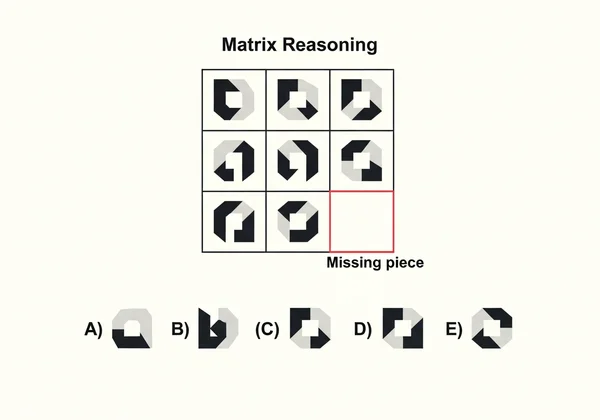
The most influential and longest-standing format for measuring inductive logical reasoning is Raven's Progressive Matrices, first developed in 1936. RPM is a non-verbal test used to measure general intelligence and abstract reasoning, regarded as a non-verbal estimate of fluid intelligence. It comprises a series of multiple-choice items listed in order of increasing difficulty, designed to measure the eductive — meaning-making — component of general intelligence. Each item presents a matrix of panels following an underlying generative rule across attributes like shape, size, color, and position, with one panel left blank; the task is to deduce the rule and select the option that completes the pattern. The enduring popularity of this format comes down to one design feature: it doesn't require language or specific cultural knowledge to solve. The Raven's Progressive Matrices test is a frequently used aptitude assessment used to determine the ability of logical reasoning, and is progressive in the sense that questions get harder as the test continues. Deductive reasoning is tested through a related but distinct format: conditional logic tasks, such as the Wason selection task, which require examinees to apply a stated rule correctly to determine which additional information would confirm or violate it. A well-constructed test battery measures both operations rather than only one, because — as the neuroscience suggests — they don't always recruit identical cognitive resources, and a test-taker can be considerably stronger at one than the other.
Why Logical Reasoning Predicts So Much Outside the Test
This is where the evidence becomes hard to dismiss as a psychometric curiosity. A landmark meta-analysis published in Psychological Bulletin found that structured assessments of general mental ability — a core component of which is logical reasoning — are among the strongest predictors of job performance. That finding, originally from Schmidt and Hunter's 1998 synthesis, has remained one of the most cited results in personnel psychology for over two decades. More recent analyses have refined rather than overturned that conclusion. A 2022 meta-analysis by Sackett and colleagues re-evaluated the predictive ranking of cognitive ability tests, taking into account broader job contexts and more rigorous definitions of performance. Cognitive ability remained an important predictor of job performance, though it ranked lower than some other previously underappreciated predictors once additional variables were accounted for. That's a useful corrective: logical reasoning is a strong predictor, not the only one, and it performs best in combination with job-relevant assessments rather than in isolation. The labor-market signal for this ability has also become more pronounced in recent years. A 2018 report from the Foundation for Young Australians, analyzing millions of job postings, found a 212% increase in the demand for critical thinking skills between 2015 and 2018. A 2023 Stack Overflow survey similarly found that problem-solving skills, closely tied to logical reasoning, were among the top qualities employers sought in developers. Both findings point in the same direction: as work has become more abstract and less procedural, the premium on the ability to reason through novel problems — rather than execute memorized steps — has grown.
What a Logical Reasoning Score Actually Tells You
A score on this index reflects something specific: how efficiently you can extract a governing rule from incomplete information, or apply a stated rule correctly to reach a valid conclusion, under timed conditions with unfamiliar material. It does not measure how much you know or how quickly you process simple information — those are captured by separate indices on a well-constructed cognitive profile.
What makes logical reasoning distinct from other reasoning-adjacent abilities is its emphasis on rule discovery and rule application as the core operations being tested, independent of content domain. A strong score here indicates a person who reasons well through structure itself — which, as the workplace evidence above suggests, transfers unusually well into environments where the specific problem at hand has never been encountered before.
If you want to see where your logical reasoning sits as part of a complete cognitive profile, the RIOT measures inductive and deductive reasoning using the same CHC-based design principles underlying professional clinical batteries.
References
Cogn-IQ.org. (2026). Analytical Reasoning: Intelligence Theory Guide. https://www.cogn-iq.org/learn/theory/analytical-reasoning/ Cogn-IQ.org. (2025). Non-Verbal Reasoning in Psychometrics — Definition & Examples. https://www.cogn-iq.org/learn/theory/non-verbal-reasoning/ PubMed. (2024). The Brain Networks Basis for Deductive and Inductive Reasoning: A Functional Magnetic Resonance Imaging Study. https://pubmed.ncbi.nlm.nih.gov/38050565/ Oxford Academic / Brain. (2025). A right frontal network for analogical and deductive reasoning. https://academic.oup.com/brain/article/148/5/1757/8104772 MyCulture.ai. (2025). Logical Reasoning Example: 8 Types to Sharpen Hiring Assessments. https://www.myculture.ai/blog/logical-reasoning-example
Take our professional IQ test
Want to know your IQ? Try the first ever professional online IQ test.
AuthorDr. Russell T. WarneChief Scientist