Jun 11, 2026·Advanced Topics & ResearchThe Future of IQ Testing: Trends and Innovations
How are AI and adaptive algorithms changing cognitive assessment? Discover the future of IQ testing. Read the article and try the RIOT IQ test today!
Dr. Russell T. WarneChief Scientist
Intelligence testing has always evolved in response to scientific advances, shifting social needs, and improvements in measurement technology. In the century since Alfred Binet and Theodore Simon published their first intelligence test in 1905, the field has moved from paper-and-pencil assessments administered in schoolrooms to sophisticated computer-based tools used in clinical, educational, employment, and research settings around the world. The question now is not whether IQ testing will continue to change, but how. I have spent over 15 years studying intelligence and developing psychometric assessments, including the Reasoning and Intelligence Online Test (RIOT). In that time, the pace of change in assessment technology has accelerated noticeably. Several developments are already reshaping how tests are built, administered, and interpreted — and a few more are on the horizon that will likely transform the field further. This article reviews the most significant trends in IQ testing, grounding them in current evidence and explaining what they mean for anyone interested in understanding human cognitive ability.
Is Traditional IQ Testing Being Left Behind?
Before exploring what is new, it is worth clarifying what is not changing. The fundamental measurement target — general cognitive ability, or g — remains as scientifically well-established as ever. Decades of research confirm that g is real, stable, and predictive of important life outcomes across health, income, occupational performance, and more. No innovation in how IQ is measured changes that underlying reality. What is changing — and rapidly — is the infrastructure surrounding measurement. Item selection algorithms, scoring models, delivery platforms, security protocols, and the relationship between neuroscience and behavioral testing are all in motion. The changes are real, but the scientific foundation supporting IQ as a meaningful construct is not being dismantled. It is being built upon.
The Expansion of Online Testing
One of the most visible shifts in psychological assessment over the past decade has been the move toward online and remote delivery. The online psychometric testing segment accounted for 71.5% of total market revenues in 2025 and is forecast to grow at a compound annual growth rate of 10.8% through 2034. By 2034, online delivery is expected to represent over 85% of total market revenues as digital assessment adoption reaches near-saturation among corporate and educational end-users.
This shift was accelerating before COVID-19, but the pandemic pushed it forward decisively. A 2024 randomized repeated-measures study found that adults who completed the WAIS-IV online scored virtually the same as those tested in person, with full-scale IQ correlations above .90. That is not a marginal finding. It confirms what careful psychometricians had argued for years: the online medium is not the problem. Poorly constructed tests are the problem, and that is a separate issue entirely.
The expansion of online testing raises the stakes for quality control. When the barrier to publishing an "IQ test" online is effectively zero, the internet fills up with tools created by people with no training in psychometrics and no obligation to report reliability, validity, or normative data. This is why understanding the difference between a professionally developed online test and an amateur one is more important than ever.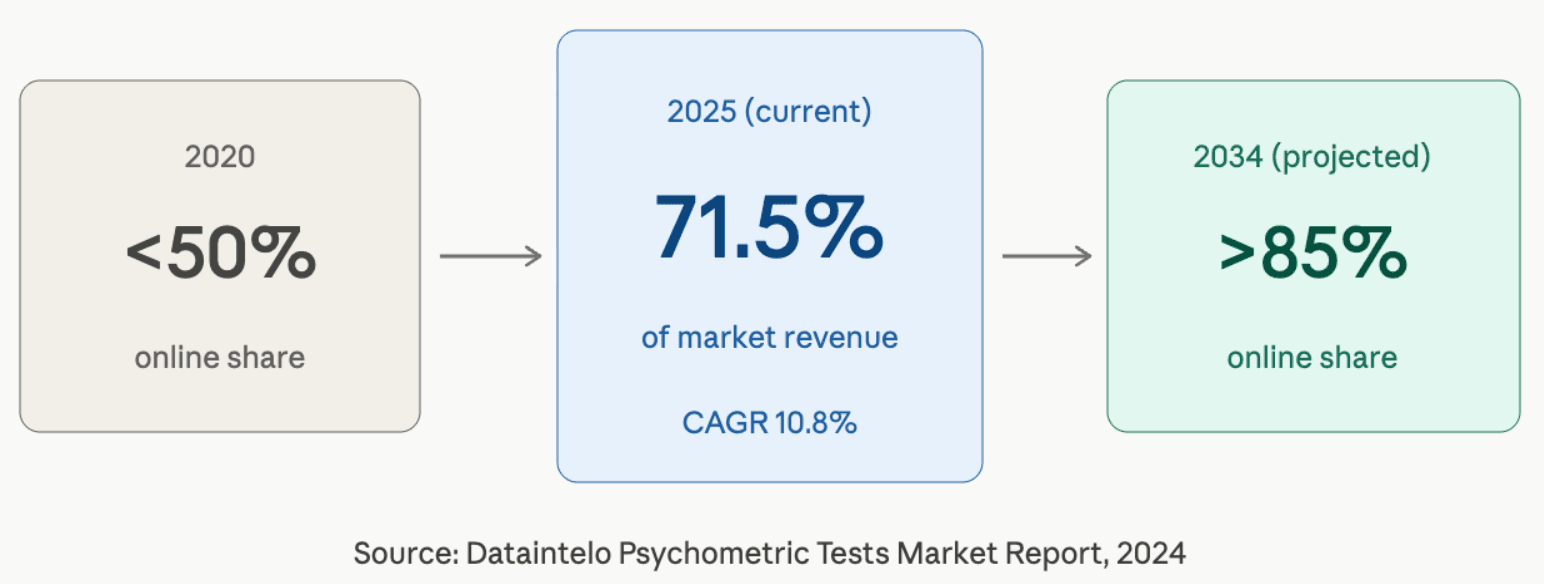
Computerized Adaptive Testing: Precision With Fewer Questions
One of the most technically significant trends in intelligence assessment is the growing adoption of computerized adaptive testing (CAT). The principle is straightforward: rather than giving every examinee the same fixed set of questions, the test selects items dynamically based on the examinee's responses in real time. If an examinee answers a question correctly, the algorithm presents a harder item. An incorrect answer triggers an easier one. The process continues until the algorithm converges on a precise estimate of the examinee's ability.
The practical effect is substantial. Research consistently demonstrates that CAT can reduce test length by 50% or more while maintaining equivalent or superior measurement precision compared to fixed-form tests. CAT is not a new idea — the GRE and GMAT have used versions of it for decades — but recent advances in item response theory modeling and machine learning have made adaptive algorithms substantially more sophisticated. A pivotal development was the integration of the Rasch model from Item Response Theory, which allowed CAT to adaptively match question difficulty to a test-taker's estimated proficiency level. Modern CAT systems also manage content balancing across domains, control for item exposure rates, and monitor response patterns for irregularities.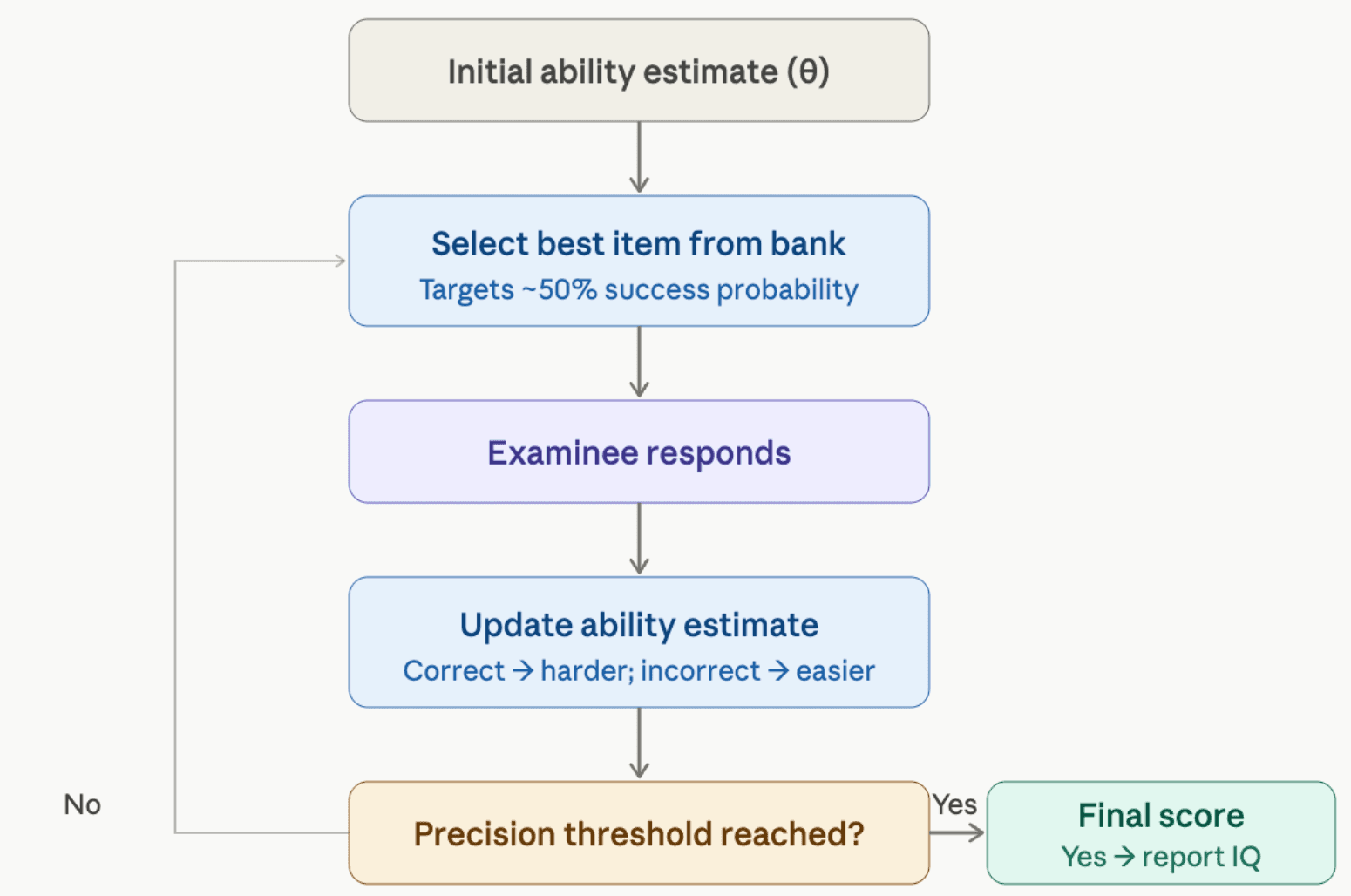 The RIOT uses IRT-based scoring throughout. While not currently a fully adaptive test in the classical CAT sense, it applies the psychometric precision of IRT to its scoring and item calibration — a foundation that positions it well for future development as the field continues in this direction.
Item Response Theory: The Engine Under the Hood
Most examinees who take an IQ test have never heard of item response theory. That is as it should be — IRT is a set of statistical models that operate invisibly behind the scenes, determining how individual questions are calibrated, how scores are calculated, and how measurement precision is quantified across different ability levels.
IRT represents a substantial improvement over classical test theory (CTT), the older framework that dominated psychometrics for most of the 20th century. The central limitation of CTT is that item statistics — difficulty, discrimination — are sample-dependent. The same item will appear to have different statistical properties when tested on different groups of examinees. IRT solves this by modeling the probability that a person at a given ability level will answer an item correctly, producing item parameters that are, in principle, sample-independent. Major opportunities this creates include the use of computerized adaptive tests to prevent conditional measurement error, multidimensional models to prevent misinterpretation of scores, and analyses of differential item functioning to prevent bias.
One important implication for examinees is that IQ scores derived from IRT-based tests carry more precise information than scores from older CTT-based instruments. Rather than a single reliability coefficient applied to everyone equally, IRT provides score-level information functions — a precision map showing where the test measures ability most and least accurately. Test creators and clinicians can therefore identify not just what someone scored, but how confident to be in that score at different points on the ability distribution.
AI's Role in Test Development and Scoring
Artificial intelligence is entering psychometrics in several places simultaneously, and the implications are worth understanding carefully.
The most straightforward application is automated item generation (AIG). Large language models and other AI tools can now produce candidate test items at a scale and speed that human item writers cannot. This is genuinely useful: a large item bank is a prerequisite for adaptive testing, and building one by hand is time-consuming and expensive. Template-based automated item generation using cognitive models has produced items with psychometric properties comparable to human-authored items in mathematics and certain verbal domains. The critical point is that generating items is not the hard part — validating them is. AI can produce thousands of candidate items quickly, but each item still requires psychometric calibration, content review, and bias review. The human bottleneck has shifted from item writing to item review.
AI-assisted item generation is a promising tool for speeding up test development pipelines, but it does not replace psychometric expertise. A test built entirely on AI-generated items that have not been properly calibrated is not a valid instrument, regardless of how polished the interface looks. Professional standards for psychological testing apply equally to AI-generated content as to any other item source.
AI is also being applied to test security. Deepfake attempts in testing have surged, with a 3,000 percent increase from 2022 to 2023. Document fraud has also skyrocketed, with digital forgeries doubling to 34.8 percent of all document fraud attempts in the last six months. AI-powered proctoring systems use multi-biometric analysis — face, voice, and keystroke recognition — to address these threats.
The Growing Accessibility of Professional Assessment
A related trend — one I find personally significant — is the democratization of high-quality cognitive assessment. For most of the 20th century, obtaining a professionally administered IQ test meant scheduling an appointment with a licensed psychologist, traveling to a clinic or school, and often paying several hundred dollars out of pocket. The access barriers were real and unevenly distributed: wealthier individuals and those in urban areas with access to trained professionals were far more likely to obtain formal assessments than those without those advantages.
Online testing, when done responsibly, has the potential to close that gap substantially. The RIOT was built precisely on that premise: that there is no reason a professional-grade IQ test must be administered in person by a licensed clinician. The measurement science is the same regardless of delivery medium. What matters is the rigor of the development process — the representativeness of the norm sample, the quality of the item bank, the transparency of psychometric documentation, and adherence to professional standards.
What Neuroscience Reveals — and Does Not Reveal — About Intelligence
Some of the most exciting long-term research in intelligence science is not happening in psychometrics laboratories at all. It is happening in neuroimaging facilities, where researchers are examining the biological substrates of cognitive ability.
The evidence that intelligence has a neurobiological basis is now substantial. Researchers from Caltech, Cedars-Sinai Medical Center, and the University of Salerno have shown that a computing tool can predict a person's intelligence from functional magnetic resonance imaging scans of resting-state brain activity — that is, brain activity recorded when the person is not doing or thinking about anything in particular. A meta-analysis of studies using structural, functional, and diffusion MRI confirmed that resting-state functional connectivity is the most studied predictor, and found a significant difference between the prediction accuracy for general versus fluid intelligence from fMRI data.
These findings have genuine implications for the future of intelligence assessment, but they need to be interpreted carefully. Brain-based measures of intelligence are not yet in a position to replace behavioral IQ tests. The predictive models are probabilistic, not deterministic; they capture group-level trends reasonably well but are less precise at the individual level than a well-validated behavioral test. Additionally, fMRI equipment is expensive, requires specialized training to operate, and is far from the kind of accessible format most people can practically access.
What neuroimaging research does contribute is a deepening of the theoretical basis for intelligence assessment. Every study demonstrating a biological correlate of g — whether brain volume, processing efficiency, resting-state connectivity, or white matter integrity — adds another layer of evidence that the construct being measured by IQ tests is real, not merely a statistical artifact. That matters for the long-term credibility of the field.
Improving Fairness and Bias Detection
Concerns about test fairness are not new — psychologists began systematically studying potential bias in IQ tests in the 1960s, and modern test development has included formal bias screening as a standard step since the 1980s. But recent advances in methodology are making bias detection more systematic and more sensitive.
The current state of the science is that IQ tests, when used with populations for whom they were designed, are not biased in the technical sense of the term. They do not produce systematically different predictions of criterion outcomes — like academic performance or job training success — for different demographic groups. The existence of group differences in average scores is not, by itself, evidence of bias, a point that bears repeating because it is frequently misunderstood.
Machine learning methods can now detect statistical patterns consistent with differential item functioning across demographic groups, processing more item features simultaneously than traditional methods. However, statistical detection is only the first step: understanding why an item is biased and revising it requires human judgment about content, language, and cultural context. The machine can flag candidate items that show statistical anomalies, but deciding whether a flagged item genuinely reflects group differences in the underlying ability being measured — or an irrelevant cultural advantage — is a judgment call requiring content expertise from reviewers with backgrounds representing the populations the test is designed for. This is the approach the RIOT used during development, and it reflects best practice in the field.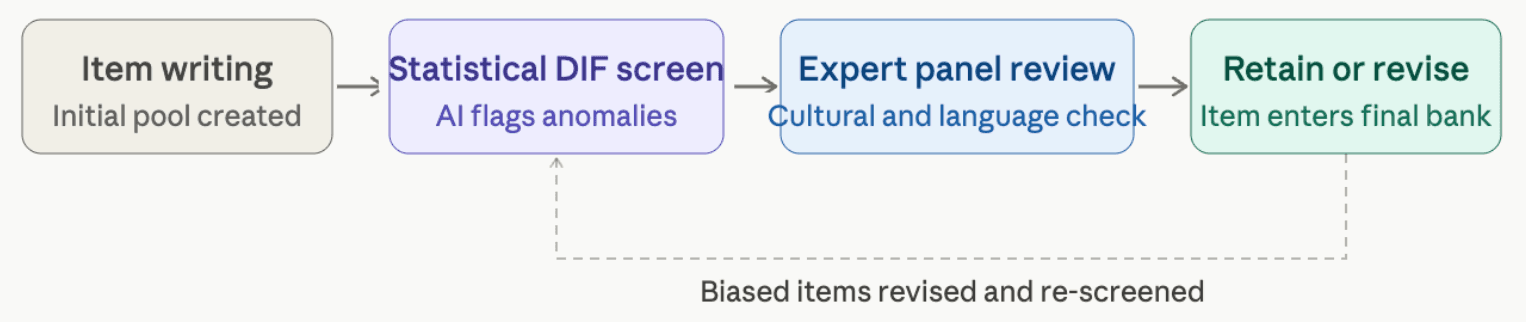
Process Data: Beyond the Score
One development that has attracted increasing research interest is the analysis of process data — the detailed behavioral information generated during test-taking that goes beyond the final answer to each item. Response latency, answer change patterns, and navigation behavior are all logged by modern computerized testing platforms, and they contain information that traditional scoring ignores.
Process data analysis allows AI to examine response time patterns, keystroke dynamics, and other behavioral data collected during testing. These data may provide information about test-taking strategies, engagement, and construct-relevant behaviors that supplement traditional score reports. Response time data correlates with processing speed — itself a component of some IQ batteries and a predictor of important outcomes independent of overall IQ. Pattern analysis of answer changes can help distinguish examinees who are working carefully and revising thoughtfully versus those answering carelessly or randomly. And anomalous response patterns can flag potential validity concerns — such as an examinee performing far below their apparent ability level, which might reflect fatigue, anxiety, or lack of effort.
None of this replaces the core score. A well-validated IQ score from a professionally developed test remains the primary output. But process data represents an additional layer of information that could make score reports more useful and interpretations more accurate.
The Limits of Innovation
It is easy, when surveying the pace of technological change, to assume that every development is an improvement. That is not always true in intelligence assessment.
Some innovations being marketed as advances are better understood as shortcuts. Tests that produce an IQ estimate in two minutes, tests that claim to measure intelligence through gamified tasks with no published validity data, and tests that generate impressive-looking score reports while concealing the absence of a legitimate norm sample — these are not innovations. They are familiar problems in new packaging. A test's credentials — who created it, how it was developed, whether its technical properties are documented and publicly available — remain the most reliable indicators of whether it will produce meaningful data. No amount of interface polish changes that.
Genuine innovation in IQ testing means improving accuracy, accessibility, efficiency, and fairness without sacrificing the scientific rigor that makes scores interpretable in the first place. That is a harder target to hit than building a sleek interface, and it is the distinction that separates professional instruments from everything else currently available online.
Where the Field Is Headed
The trajectory of intelligence testing over the next decade will likely be shaped by several converging forces. Adaptive testing algorithms will become more sophisticated, drawing on richer item banks and incorporating process data into ability estimation in real time. Bias detection methods will become more sensitive, producing instruments that are fairer across demographic groups. Neuroimaging research will continue to deepen the theoretical underpinnings of what IQ tests measure, even if brain-based assessment remains a research tool rather than a practical instrument for most purposes.
Perhaps most importantly, the access gap between clinical assessment and self-administered assessment will continue to narrow. The barriers that once made professional-grade cognitive evaluation available only to those with the resources to reach a trained clinician are eroding. That is a positive development — but only if the tests filling that gap are genuinely professional.
I built the RIOT because I believed the online medium could support rigorous, standards-compliant intelligence assessment. The trends described in this article suggest that belief was correct, and that the direction of the field is toward more accessible, more precise, and more fairly designed tools than existed when the first IQ tests were published over a century ago.
Take the First Professional Online IQ Test
The Reasoning and Intelligence Online Test (RIOT) is the first online IQ test built to meet professional standards for psychological assessment. It was developed through the same rigorous process used for traditional in-person assessments: pilot testing, item calibration, expert review for content and bias, and normative data collected from a representative U.S. adult sample. It meets all relevant standards from the Standards for Educational and Psychological Testing established by the American Educational Research Association, American Psychological Association, and National Council on Measurement in Education. Where most online IQ tests are created by anonymous individuals with no formal training in psychometrics, the RIOT's development is fully documented and its creator's credentials are public. A free sample version is available for anyone who wants to familiarize themselves with the format before taking the full test.
Sources
Gottfredson, L. S. (1997). Mainstream science on intelligence. Intelligence, 24(1), 13–23. https://doi.org/10.1016/S0160-2896(97)90014-3 Warne, R. T. (2025). Technical manual for the Reasoning and Intelligence Online Test, version 1.0. Riot IQ.
Thompson, N. A., & Weiss, D. J. (2011). A framework for the development of computerized adaptive tests. Practical Assessment, Research & Evaluation, 16(1), 1–9.
Embretson, S. E., & Reise, S. P. (2000). Item response theory for psychologists. Lawrence Erlbaum.
Bartholomaeus, V., et al. (2025). Equivalence of telehealth and face-to-face administration of the WAIS-IV. The Clinical Neuropsychologist, 39(5), 1073–1096. https://doi.org/10.1080/13854046.2024.2335117 Dubois, J., et al. (2018). A distributed brain network predicts general intelligence from resting-state human neuroimaging data. Philosophical Transactions of the Royal Society B.
Rao, H., et al. (2022). On the prediction of human intelligence from neuroimaging: A systematic review. Intelligence. https://www.sciencedirect.com/science/article/pii/S0160289622000356 Gierl, M. J., & Lai, H. (2018). Using automated processes to generate test items. Educational Measurement: Issues and Practice.
Chalmers, R. P. (2016). Generating adaptive and non-adaptive test interfaces for multidimensional IRT applications. Journal of Statistical Software.
American Educational Research Association, American Psychological Association, & National Council on Measurement in Education. (2014). Standards for educational and psychological testing. https://www.testingstandards.net Reeve, B. B., & Fayers, P. (2005). Applying IRT modeling for evaluating questionnaire item and scale properties. https://pmc.ncbi.nlm.nih.gov/articles/PMC6745011/ Deary, I. J., Penke, L., & Johnson, W. (2010). The neuroscience of human intelligence differences. Nature Reviews Neuroscience. https://www.larspenke.eu/pdfs/Deary_Penke_Johnson_2010_-_Neuroscience_of_intelligence_review.pdf Dataintelo. (2024). Psychometric tests market report: Global forecast. https://dataintelo.com/report/psychometric-tests-market Cogn-IQ. (2026). AI in cognitive assessment: Opportunities, risks, and what's next. https://www.cogn-iq.org/blog/ai-cognitive-assessment/ Zumbo, B. D., Maddox, B., & Ochieng, L. (2023). Process data in cognitive assessment. Psychometrika.
Take our professional IQ test
Want to know your IQ? Try the first ever professional online IQ test.
AuthorDr. Russell T. WarneChief Scientist
