🇺🇸The official website of Riot IQ
Log in
  • Home
  • About

Measure your
intelligence online.

Google

Assessments

  • All IQ Tests
  • Basic IQ Test
  • Full IQ Test
  • Custom IQ Test
  • Free IQ Test

Our Socials

  • X
  • YouTube
  • Facebook
  • LinkedIn

Other IQ Tests

  • WAIS-V
  • SB-5
  • Raven's 2
  • RIAS-2
  • CogAT 9
  • WISC-V

Community

  • Join Subreddit
  • Join Discord

Other Pages

  • Test Manual
  • Administer IQ Tests
  • About Us
  • Articles
  • Data
  • FAQ

Research

  • What do polygenic scores really predict?
  • Working speed and ability on the RIOT

Intelligence Journals & Organizations

  • Human Intelligence Research & Education (HIRE) Foundation
  • International Society for Intelligence Research (ISIR)
  • Intelligence & Cognitive Abilities Journal (ICA)
  • Intelligence Journal
  • Mensa Foundation

Contact

  • Email
  • Support

News & Press

  • International Society for Intelligence Research
  • American Thinker
  • Mensa Foundation (1/2)
  • Mensa Northern New Jersey
  • The University of Western Australia
  • Prolific
  • Quillette
  • Brainz

Our Articles

  • Gmatclub (1/2)
  • ApolloTechnical
  • LessWrong
  • Psychreg
  • Study in Switzerland
  • SuccessConsciousness
  • Creative Organizational Design (1/2)
  • ABNewsWire
  • Vanderbilt University

Our Articles

  • The Globe and Mail
  • Barchart
  • Journal
  • Mensa Foundation (2/2)
  • Psychologs
  • Creative Organizational Design (2/2)
  • AZBigMedia
  • Thoughts on Life and Love
  • Anxiety and Depression Association of America

Our Articles

  • Before It's News
  • Siglo XXI
  • TechBullion
  • Medium
  • Gmatclub (2/2)
  • MSN
  • National Review
  • Minding the Campus
  • Launching Next

Our Articles

  • Comparing Cronbach’s Alpha and McDonald’s Omega Reliability
  • Breaking the Intelligence & IQ Taboo
  • What is the Flynn Effect?
  • A Comprehensive History of IQ Tests
  • The 15 Subtests of the RIOT

Our Articles

  • How to Take an IQ Test
  • How to Calculate IQ
  • What is the RIOT IQ Test?
  • The Pro-Human Aspects of Intelligence Research
  • What is an IQ Test? A Beginner's Guide.

Our Articles

  • 5 Best IQ Tests in 2025
  • Cognitive Profiles on the RIOT IQ Test Results
  • 6 Cognitive Abilities of the RIOT
  • Are There Any Professional and Real Online IQ Tests?

Our Articles

  • Resources to Learn About IQ and Intelligence
  • Studying IQ Matters
  • The Search for Albert Einstein's IQ
  • Do Non-g Gains from the Flynn Effect Matter?

Riot IQ © 2026

  • Terms of Service
  • Privacy Policy
  • BAA Agreement
  • Test Administrator Terms
  • Terms of Service
  • •Privacy Policy
  • •BAA Agreement
  • •Test Administrator Terms

Table of Contents

  • What the largest study found
  • Do gamers score higher than non-gamers?
  • Can playing video games raise your IQ?
  • Why skill at some games tracks intelligence
  • Frequently asked questions
  • Do gamers have higher IQs?
  • Did a study show video games raise children's IQ by 2.5 points?
  • Which video games are best for your brain?
  • Can video games lower your IQ?
  • Are people who are good at strategy games smarter?
  • The takeaway
  • References
Oct 8, 2026·Advanced Topics & Research

Video Games and IQ: Do Gamers Have Higher IQs?

Video games and IQ are only weakly linked: across 310 effect sizes, gaming skill correlated with cognitive ability at just r = .07, and training barely transfers.

Dr. Russell T. WarneChief Scientist
Share
Video Games and IQ: Do Gamers Have Higher IQs?
Gamers do not have meaningfully higher IQs: across 310 effect sizes, a 2018 meta-analysis found that skill at video games correlated with general cognitive ability at only r = .07, and training people on video games raised their cognitive scores by a near-zero 0.07 standard deviations, about one IQ point. The most-cited positive result, a 2022 study of American children, found that kids who gamed more gained about 2.5 extra IQ points over two years, but that effect did not hold up in a within-family check.

That gap between the headlines and the averages is the story of video games IQ research. This page covers what the large children's study actually measured, how gamers compare with non-gamers, whether playing can raise intelligence, why skill at some games tracks IQ, and what confounds every study in this area has to deal with.


What the largest study found

The study behind most "video games boost IQ" headlines is Sauce, Liebherr, Judd and Klingberg's 2022 paper in Scientific Reports. They used the Adolescent Brain Cognitive Development (ABCD) study, which tested 9,855 American children at ages 9 and 10 and retested about half of them two years later. The children reported how much time they spent watching TV and videos, socializing online and gaming. The researchers built an intelligence factor from five tasks, including vocabulary, reading, memory and a spatial task, and controlled for family socioeconomic status and a polygenic score for cognitive ability.

The results were mixed in an informative way:

• At ages 9 to 10: Gaming time had no independent association with intelligence (β = 0.01). Children who spent more time watching videos (β = -0.12) or socializing (β = -0.10) scored slightly lower.

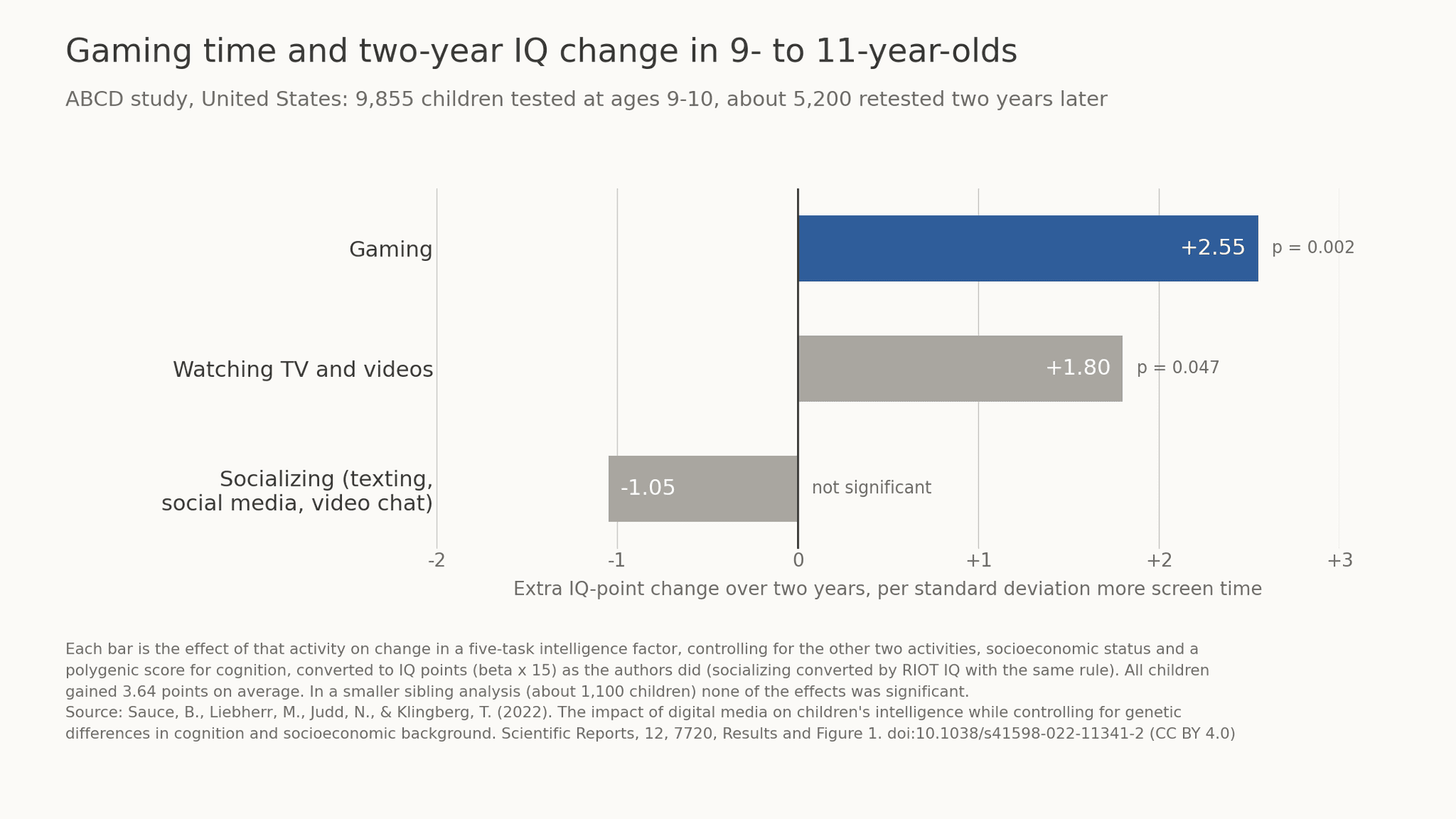
• Over two years: All children gained an average of 3.64 IQ points as they matured. Children who gamed more gained a little more, a standardized effect of 0.17 that the authors converted to 2.55 IQ points. Watching videos showed a smaller effect (1.8 points) that became non-significant when parental education replaced the broader socioeconomic measure.

• Within families: In a posthoc sibling analysis of about 1,100 children from roughly 400 families, none of the screen-time types had a significant effect on the change in intelligence. The authors attributed this to low statistical power and advised that the main results be interpreted with caution.

The study also had limits the authors named themselves. Screen time was self-reported, and all games were lumped into a single variable, from simple phone games to complex multiplayer titles. A 2.55-point effect is small, it is an association estimated within a statistical model, and the sibling result means it is not settled.


Do gamers score higher than non-gamers?

The broadest answer comes from Sala, Tatlidil and Gobet's 2018 meta-analyses in Psychological Bulletin, which pooled three kinds of evidence:

• Skill and ability: Across 310 effect sizes, the correlation between video game skill and cognitive ability averaged r = .07. The one notable exception was spatial ability, at r = .18.

• Players versus non-players: Across 315 effect sizes, regular players outperformed non-players by g = 0.33, about 5 IQ-style points (0.33 × 15). After correcting for publication bias, the estimate fell to g = 0.18, under 3 points.

• Training: Across 359 effect sizes, training people on video games produced g = 0.07, and the bias-corrected estimate was essentially zero (g = -0.01).

The player advantage is the hardest result to interpret, because these studies compare people who chose to game with people who did not. Habitual players differ in age, sex, interests and prior abilities, so the comparison cannot show that games produced the difference. Sala's team concluded that cognitive ability and video game skill are only weakly related, and that there was no evidence of a causal effect of gaming on overall cognitive ability.


Can playing video games raise your IQ?

Action games have the strongest case for specific benefits. In a 2003 Nature paper, Green and Bavelier showed that habitual action game players outperformed non-players on several visual attention tasks, and that non-players trained on an action game improved. A later meta-analysis by Bediou and colleagues, covering 2000 to 2015, found that action game players outperformed non-players by about half a standard deviation (g = 0.55) on perceptual, attentional and cognitive tasks, and that intervention studies produced a smaller effect of a third of a standard deviation (g = 0.34). The clearest gains were in top-down attention and spatial cognition. The authors also estimated that published effects were about 30% larger than effects across the full literature.

Those are gains on attention and spatial tasks, close cousins of what the games themselves demand. Psychologists call that near transfer. Far transfer, improvement on broad measures such as IQ, is what Sala's training meta-analysis failed to find. The same pattern turns up for brain-training apps and for chess: people get better at what they practise, and the benefit rarely spreads to general reasoning.


Why skill at some games tracks intelligence

If games do not raise IQ much, why do strong players of some games score well on IQ tests? Because complex games are, in effect, problem-solving tasks, and people who reason well tend to learn them faster.

• Puzzle and strategy games: Quiroga and colleagues had 134 adults play ten games of different genres under controlled conditions. The correlation between a latent general intelligence factor and a latent factor for overall game performance was 0.79, and earlier studies had reported latent correlations from 0.60 to 0.93.

• Competitive online games: Kokkinakis and colleagues found that rank in League of Legends correlated with fluid intelligence on the WASI-II at rho = .44 in 56 players.

These are correlations between ability and performance. They show that measured intelligence helps people play well, which is the reverse of the "games make you smart" claim. Spatial reasoning is the ability most often involved, a skill explained in our article on visual-spatial reasoning and why it shows up on an IQ test.

The "average IQ of players by game" rankings that circulate online are a different matter. They come from self-selected online quizzes or invented figures, with no defined sample or norm group, and they should not be read as data.


Frequently asked questions

Do gamers have higher IQs?

Not in any meaningful way. Gaming skill and cognitive ability correlate at about r = .07 on average, and the player versus non-player gap shrinks to under 3 IQ points after correcting for publication bias.

Did a study show video games raise children's IQ by 2.5 points?

The 2022 ABCD study linked more gaming time to a 2.55-point larger IQ gain over two years in a statistical model. A sibling analysis in the same paper found no significant effect, so the result is suggestive at best.

Which video games are best for your brain?

Action games show the clearest gains on attention and spatial tasks in experiments. No game genre has been shown to raise overall IQ.

Can video games lower your IQ?

The large meta-analyses found no evidence of a general cognitive cost from gaming. In the ABCD study, gaming time was unrelated to intelligence at ages 9 to 10.

Are people who are good at strategy games smarter?

Often, yes, because these games reward reasoning and fast learning. Performance on complex games correlates with intelligence, which is why some researchers have explored games as ability measures.


The takeaway

The video games IQ evidence points one way: intelligence helps people get good at complex games far more than games raise intelligence. Action games can sharpen attention and spatial skills, but training studies show almost no transfer to overall IQ, and the best-known positive cohort result is small and fragile. To see where your own reasoning ability stands, try an online IQ test built by psychometricians.


References

1. Sauce, B., Liebherr, M., Judd, N., & Klingberg, T. (2022). The impact of digital media on children's intelligence while controlling for genetic differences in cognition and socioeconomic background. Scientific Reports, 12, 7720. [doi.org/10.1038/s41598-022-11341-2](. doi.org

2. Sala, G., Tatlidil, K. S., & Gobet, F. (2018). Video game training does not enhance cognitive ability: A comprehensive meta-analytic investigation. Psychological Bulletin, 144(2), 111-139. [doi.org/10.1037/bul0000139](. doi.org

3. Green, C. S., & Bavelier, D. (2003). Action video game modifies visual selective attention. Nature, 423(6939), 534-537. [doi.org/10.1038/nature01647](. doi.org

4. Bediou, B., Adams, D. M., Mayer, R. E., Tipton, E., Green, C. S., & Bavelier, D. (2018). Meta-analysis of action video game impact on perceptual, attentional, and cognitive skills. Psychological Bulletin, 144(1), 77-110. [doi.org/10.1037/bul0000130](. doi.org

5. Quiroga, M. A., Diaz, A., Román, F. J., Privado, J., & Colom, R. (2019). Intelligence and video games: Beyond "brain-games". Intelligence, 75, 85-94. [doi.org/10.1016/j.intell.2019.05.001](. doi.org

6. Kokkinakis, A. V., Cowling, P. I., Drachen, A., & Wade, A. R. (2017). Exploring the relationship between video game expertise and fluid intelligence. PLOS ONE, 12(11), e0186621. [doi.org/10.1371/journal.pone.0186621](. doi.org

Figure by RIOT IQ. Data from Sauce et al. (2022), Scientific Reports 12, 7720, Results and Figure 1 (doi.org/10.1038/s41598-022-11341-2), CC BY 4.0.

Take our professional IQ test

Want to know your IQ? Try the first ever professional online IQ test.

Try our IQ test
Author
Dr. Russell T. WarneChief Scientist

Contact

Table of Contents

  • What the largest study found
  • Do gamers score higher than non-gamers?
  • Can playing video games raise your IQ?
  • Why skill at some games tracks intelligence
  • Frequently asked questions
  • Do gamers have higher IQs?
  • Did a study show video games raise children's IQ by 2.5 points?
  • Which video games are best for your brain?
  • Can video games lower your IQ?
  • Are people who are good at strategy games smarter?
  • The takeaway
  • References
Article Categories
All ArticlesUnderstanding IQ ScoresTaking an IQ TestRIOT-Specific InformationGeneral IQ & IntelligenceAdvanced Topics & ResearchIQ Scores & InterpretationMensa & High-IQ SocietiesOnline IQ Tests IQ Test Basics & FundamentalsAverage IQ & DemographicsFamous People & IQHistory & Origins Of IQ TestingAccuracy, Reliability & CriticismSpecial Population & Related ConditionsImproving IQ / PreparationSpecific IQ Tests & FormatsIQ Testing for HR & RecruitmentSkills Assessment
Related Articles
Daydreaming and IQ: Is Daydreaming a Sign of Intelligence?Twins and IQ: Do Twins Have Lower IQs Than Singletons?Talking to Yourself and IQ: Is Self-Talk a Sign of Intelligence?Swearing and IQ: Is Swearing a Sign of Intelligence?Video Games and IQ: Do Gamers Have Higher IQs?Myopia and IQ: Are Nearsighted People Smarter?Musicians and IQ: Do Musicians Have Higher IQs?Birth Order and IQ: Are Firstborns Really Smarter?Height and IQ: Are Taller People Smarter?Introvert IQ: Are Introverts Smarter Than Extraverts?Night Owl IQ: Are Night Owls Really More Intelligent?Left-Handed IQ: Are Left-Handed People Smarter?What are testing accommodations? Extra time, fairness, and what a score still meansWhat is Child Find? The IDEA duty to identify and evaluateWhat is an independent educational evaluation? The rules in 34 CFR §300.502Response to intervention: how schools decide a student needs more helpComputer adaptive testing: how a test that rebuilds itself as you go worksItem response theory: how a test models one item at a timeClassical test theory: the model behind most published test scoresConfirmatory factor analysis: testing a test's proposed structureFactor analysis: how the structure of an IQ test is discoveredPsychometrics: the science of building and evaluating mental testsWhat Is the Difference Between Intellectual Disability and Learning Disability? What Jobs Need High Spatial Ability?Is IQ Correlated With Dementia?Does High IQ Actually Correlate With Higher Salary After Age 30?High IQ vs. High EQ: Which One Predicts Long-Term Relationship Happiness?Are You Left-Brained or Right-Brained? What Neuroscience Actually SaysWhat Does Too Much Screen Time Do to Children's Brains?Types of IQ: The Quotients Explained (IQ, EQ, SQ, AQ, CQ)What Is the Dunning-Kruger Effect? What the Research Actually ShowsSame Test, Different Patterns: How ADHD and Autism Show Up Differently Across IQ SubtestsGeneral Intelligence vs. Multiple Intelligences: What Each Theory Gets RightNeuroplasticity in Your 30s and 40s: What the Science Actually SaysThe G-Factor vs. Gardner's Multiple Intelligences: What the Evidence Actually ShowsCan Hyperlexia Make You Seem Smarter Than You Actually Are?Is There a Correlation Between IQ and Reaction Time?Can Exercise Affect Your IQ Score?How Does IQ Change as a Person Ages?What Is the Flynn Effect and Why Are IQ Scores Rising?What Part of the Brain Controls IQ and Cognitive Function?Unlocking Your Potential: The Role of Online IQ TestingLogical Reasoning on an IQ Test: How It's Defined, Measured, and Why It Predicts So MuchThe Science Behind IQ Tests: Understanding Intelligence AssessmentExploring the Controversies Surrounding IQ TestsThe Future of IQ Testing: Trends and InnovationsVisual & Spatial Reasoning: What It Is and Why It Shows Up on an IQ TestFluid vs. Crystallized Intelligence: What the Difference Actually MeansIs Everyone About as Smart as I Am???Does Intelligence Research Undermine the Fight against Inequality?Does Intelligence Research Lead to Negative Social Policies?Do Past Controversies Taint Modern Research on Intelligence?Should Controversial or Unpopular Ideas Be Held to a Higher Standard of Evidence?Does Stereotype Threat Explain Score Gaps among Demographic Groups?Do Unique Influences Operate on One Group’s Intelligence Test Scores?Are Racial/Ethnic Group IQ Differences Completely Environmental in Origin?Do Males and Females Have the Same Distribution of IQ Scores?Is Emotional Intelligence a Real Ability that Is Helpful in Life?Is Very High Intelligence More Beneficial than Moderately High Intelligence?Are Intelligence Tests Designed to Create or Perpetuate a False Meritocracy?Is Intelligence Important in the Workplace?Do IQ Scores Just Measure How Good Someone is at Taking Tests?Are Admissions Tests A Barrier to College for Underrepresented Students? Do Non-Cognitive Variables Have Powerful Effects on Academic Achievement?Can Effective Schools Make Every Child Academically Proficient?Is Every Child Gifted?Does Improvability of IQ Mean Intelligence Can Be Equalized?Can Braining-Training Programs Raise IQ?Can Social Interventions Drastically Raise IQ?Are Genes Important for Determining Intelligence?Is Raising IQ Possible?Does IQ Reflect A Person’s Socioeconomic Status?Are Intelligence Tests Biased Against Diverse Populations?Is Practical Intelligence a Real Ability Separate from General Intelligence?Is Intelligence Just A Western Concept?Does IQ Correspond to Brain Anatomy or Functioning?Measuring Cognitive Aging with Memory and Processing Speed TasksComparing Cronbach’s Alpha and McDonald’s Omega ReliabilityWhat is the Flynn Effect? Is the World’s Collective IQ Increasing or Decreasing?How Do You Test Cognitive Functions?Does High IQ Correlate with Success?Creating an IQ TestIncreasing Your IQCulture-Fair Intelligence TestsFlynn EffectCognitive DevelopmentIQ Test QualityDo Non-g Gains from the Flynn Effect Matter?
Take our IQ tests

Basic IQ Test

5 subtests + 5 cognitive abilities

Take the IQ test

Features

  • ~13 Minutes
  • IQ score
  • Cognitive abilities breakdown
  • ±5.6 IQ margin of error

5/15 Subtests

Learn more
Vocabulary
Matrix Reasoning
SToVeS
Visual Reversal
Symbol Search
Most comprehensive

Full IQ Test

15 subtests + all cognitive abilities

Take the IQ test

Features

  • ~52 Minutes
  • IQ score
  • Cognitive abilities breakdown
  • ±3.7 IQ margin of error

15/15 Subtests

Learn more
Vocabulary, Information, Analogies
Matrix Reasoning, Visual Puzzles, Figure Weights
Object Rotation, SToVeS, Spatial Orientation
Computation Span, Exposure Memory, Visual Reversal
Symbol Search, Abstract Matching
Simple Reaction Time, Choice Reaction Time
Compare all tests