Does Philosophy Make You Smarter? Philosophy for Children, Philosophy Majors and IQ
Does philosophy make you smarter? No study shows it raises IQ. Philosophy majors gain a little in verbal reasoning, and school trials found small effects.
Dr. Russell T. WarneChief Scientist
Share
No study shows that studying philosophy raises IQ, but the best evidence suggests it modestly improves verbal reasoning. In data on about 650,000 American college students, philosophy majors scored 0.48 standard deviations higher on the verbal section of the GRE than other students with the same SAT scores, while two large school trials of "Philosophy for Children" found small effects in the first and none in the second.
Philosophy has a reputation as the discipline that teaches people how to think. This article covers what happened when schools taught philosophy to children, what the data on philosophy majors show, how much college improves critical thinking in general, and why people who study philosophy were already strong reasoners before they started.
Philosophy for Children: promising pilots, smaller effects at scale
"Philosophy for Children," often shortened to P4C, was developed by the American philosopher Matthew Lipman. A class reads a short story or looks at a picture, the children choose a question, such as what makes something fair, and the teacher guides a structured discussion in which pupils give reasons and respond to each other.
• The Scottish study: Keith Topping and Steve Trickey followed 105 children aged 10 who had one hour of philosophical enquiry a week for 16 months, compared with 72 children in other classes who followed the normal curriculum. The P4C children gained on the verbal, non-verbal and quantitative parts of the Cognitive Abilities Test, a group reasoning test, and the comparison children did not. A later summary by independent evaluators put the difference at an effect size of about 0.7. Two years later, after the children had moved to secondary school, 96 of the P4C pupils and 52 comparison pupils were retested, and the P4C pupils had kept their advantage.
• The first English trial: Stephen Gorard, Nadia Siddiqui and Beng Huat See evaluated P4C for the Education Endowment Foundation in 48 schools with 2,821 pupils, with schools assigned at random. After about a year, the P4C pupils had gained slightly more on national tests in reading (effect size 0.12) and maths (0.10), with no difference in writing (0.03). On the Cognitive Abilities Test the effect was 0.07, all of it on the verbal subscale. In raw terms, the P4C pupils gained 2.22 standard-score points and the comparison pupils 1.70, a difference of about half a point on a scale with a standard deviation of 15.
• The larger follow-up trial: A second trial run by the National Foundation for Educational Research compared 75 P4C schools with 123 control schools. It found no evidence that P4C improved Year 6 pupils' reading or maths, either for all pupils or for disadvantaged pupils. Teachers still liked the program and felt that pupils listened to each other better.
• The meta-analysis: A 2025 meta-analysis by Wei and Chen pooled 33 studies with 4,568 participants and reported a large average effect on reasoning, critical thinking and creativity (g = 0.59). It also found that smaller studies reported larger effects, a common warning sign that the published average overstates the true effect.
This is a familiar pattern in education research. Small studies run by enthusiasts find large gains, and the gains shrink when a program is tested in many schools by independent evaluators. Giovanni Sala and Fernand Gobet's reviews of cognitive training show the same pattern: once studies use proper controls, gains on distant abilities such as general intelligence are close to zero.
Do philosophy majors become better thinkers?
The strongest evidence about adults comes from a 2025 study by Michael Prinzing and Michael Vazquez in the Journal of the American Philosophical Association.
• The data: The authors used surveys from UCLA's Higher Education Research Institute that 649,511 students at 804 American colleges filled out as freshmen and again as seniors. Students reported their SAT scores when they entered college, and graduates from 1994 to 2004 also reported their GRE and LSAT scores.
• Selection first: Students with stronger verbal ability were more likely to choose philosophy. Each standard deviation of SAT Verbal score raised the odds of majoring in philosophy by 57%, and students who were more curious and open-minded as freshmen were also more likely to choose it.
• After adjusting for SAT scores: Philosophy majors averaged 573 on GRE Verbal compared with 540 for other majors, a difference of 0.48 standard deviations, and 157 compared with 155 on the LSAT, a difference of 0.35 standard deviations. There was no advantage on GRE Quantitative, where philosophy ranked 30th of 57 majors. On GRE Verbal and the LSAT it ranked first.
• Habits of mind: After adjusting for their answers as freshmen, philosophy seniors also rated themselves higher on self-report scales of curiosity, intellectual rigor and open-mindedness (effects of about 0.2 standard deviations).
If the GRE Verbal gap were converted to the IQ scale, 0.48 standard deviations would be about 7 points. That conversion is only illustrative, because the GRE is a test of developed academic skills and the graduates who take it are a selected group. The GRE's relationship to IQ is covered in the article on GRE scores and intelligence.
The study has real limits. It is observational, and the test scores were self-reported. The authors note that the SAT has no section dedicated to logical reasoning, so adjusting for it may not fully capture how logical students were before college. The result is consistent with philosophy teaching verbal and logical reasoning, but it cannot rule out that students who chose philosophy differed in ways the SAT did not measure.
How much does college teach critical thinking?
Philosophy courses are often sold as training in "critical thinking," the ability to analyze and evaluate arguments. Research on college in general gives a useful benchmark.
• College as a whole: Christopher Huber and Nathan Kuncel analyzed 71 studies and estimated that four years of college moves a student from the 50th to roughly the 72nd percentile in critical thinking skills, about 0.6 standard deviations. Curricula built specifically to teach critical thinking did not produce larger long-run gains than an ordinary college education.
• Teaching it directly: Philip Abrami and colleagues pooled 341 effect sizes from studies of critical thinking instruction and found an average effect of 0.30 standard deviations. Instruction that gave students opportunities for dialogue, which is the core of philosophy teaching, was among the approaches that helped.
• Education and IQ: Stuart Ritchie and Elliot Tucker-Drob's meta-analysis of more than 600,000 participants found that each additional year of education raises IQ scores by about 1 to 5 points. Any benefit of studying philosophy probably works partly through this general effect of more schooling, which applies to any subject.
The kind of reasoning philosophy trains is close to what IQ tests call verbal and logical reasoning, explained in the article on logical reasoning on an IQ test. It is plausible that years of analyzing arguments strengthen that skill a little. A small gain on one skill is still a long way from a rise in general intelligence. The same claim, that one subject teaches people to think in general, is made for learning to code.
Why philosophy students look so smart
Philosophers have pointed to their majors' test scores since the 1980s, and the selection behind those scores is strong.
• Reflective thinkers choose philosophy: Jonathan Livengood and colleagues gave the Cognitive Reflection Test, three short puzzles with tempting wrong answers, to 4,472 people online. Those with some philosophy training averaged 0.98 correct, compared with 0.44 for people with none, and those with graduate training in philosophy averaged 1.32. The gap held at each level of education. The authors could not tell whether training made people more reflective or reflective people chose philosophy.
• Verbal ability: As the Prinzing and Vazquez data show, students with high SAT Verbal scores are more likely to choose philosophy, and verbal ability is also what helps people read difficult texts. People who already read widely tend to score higher on verbal tests, a link discussed in the article on reading books and IQ.
• Who takes the GRE and LSAT: Philosophy majors are about three and a half times more likely than other students to take the LSAT. The study tested whether only the strongest philosophy students took these tests and found no evidence of it, but test-taking is still a choice that shapes who appears in the data.
The confounds that matter most are prior ability, family education and income, and the type of college a student attends. Comparisons of philosophers with everyone else that do not adjust for these will make philosophy look far more powerful than it is.
Frequently asked questions
Does philosophy make you smarter?
No study shows that philosophy raises IQ. Philosophy majors improve somewhat more in verbal reasoning than similar students in other majors, and school programs have had small or no effects.
Do philosophy majors have high IQs?
On average they score high on verbal tests, but much of that is selection. Students with strong verbal ability and curious, reflective personalities are more likely to choose philosophy.
Does Philosophy for Children work?
Small early studies found sizable gains on reasoning tests. Larger randomized trials in England found small gains in reading and maths in the first trial and no effect in the second.
Does studying philosophy help on the LSAT?
Philosophy majors scored about 2 LSAT points higher than other majors with the same SAT scores, a difference of 0.35 standard deviations. That is consistent with a modest benefit, though the study could not rule out other differences.
Is philosophy good for critical thinking?
Probably a little. College in general improves critical thinking by about 0.6 standard deviations, and instruction built around reasoned dialogue tends to help.
The takeaway
Philosophy does not make you smarter in the sense of raising IQ, and no study has tested whether it does. The best evidence suggests that studying philosophy modestly improves verbal and logical reasoning, while large school trials of Philosophy for Children found small effects or none. Much of philosophy's reputation comes from the strong students who choose it. If you want to see where your verbal and logical reasoning stand, take the RIOT IQ test.
References
1. Topping, K. J., & Trickey, S. (2007). Collaborative philosophical enquiry for school children: Cognitive effects at 10-12 years. British Journal of Educational Psychology, 77(2), 271-288. [doi.org/10.1348/000709906X105328](. doi.org
2. Topping, K. J., & Trickey, S. (2007). Collaborative philosophical inquiry for schoolchildren: Cognitive gains at 2-year follow-up. British Journal of Educational Psychology, 77(4), 787-796. [doi.org/10.1348/000709907X193032](. doi.org
3. Gorard, S., Siddiqui, N., & See, B. H. (2015). Philosophy for Children: Evaluation report and executive summary. Education Endowment Foundation. [dera.ioe.ac.uk](. dera.ioe.ac.uk
4. Lord, P., Dirie, A., Kettlewell, K., & Styles, B. (2021). Evaluation of Philosophy for Children: An effectiveness trial. Education Endowment Foundation and National Foundation for Educational Research. [nfer.ac.uk](. nfer.ac.uk
5. Wei, C., & Chen, L. (2025). The effects of Philosophy for Children on children's cognitive development: A three-level meta-analysis. Journal of Intelligence, 13(10), 130. [doi.org/10.3390/jintelligence13100130](. doi.org
6. Sala, G., & Gobet, F. (2017). Does far transfer exist? Negative evidence from chess, music, and working memory training. Current Directions in Psychological Science, 26(6), 515-520. [doi.org/10.1177/0963721417712760](. doi.org
7. Prinzing, M., & Vazquez, M. (2025). Studying philosophy does make people better thinkers. Journal of the American Philosophical Association, 11, 640-658. [doi.org/10.1017/apa.2025.10007](. doi.org
8. Huber, C. R., & Kuncel, N. R. (2016). Does college teach critical thinking? A meta-analysis. Review of Educational Research, 86(2), 431-468. [doi.org/10.3102/0034654315605917](. doi.org
9. Abrami, P. C., Bernard, R. M., Borokhovski, E., Waddington, D. I., Wade, C. A., & Persson, T. (2015). Strategies for teaching students to think critically: A meta-analysis. Review of Educational Research, 85(2), 275-314. [doi.org/10.3102/0034654314551063](. doi.org
10. Ritchie, S. J., & Tucker-Drob, E. M. (2018). How much does education improve intelligence? A meta-analysis. Psychological Science, 29(8), 1358-1369. [doi.org/10.1177/0956797618774253](. doi.org
11. Livengood, J., Sytsma, J., Feltz, A., Scheines, R., & Machery, E. (2010). Philosophical temperament. Philosophical Psychology, 23(3), 313-330. [doi.org/10.1080/09515089.2010.490941](. doi.org
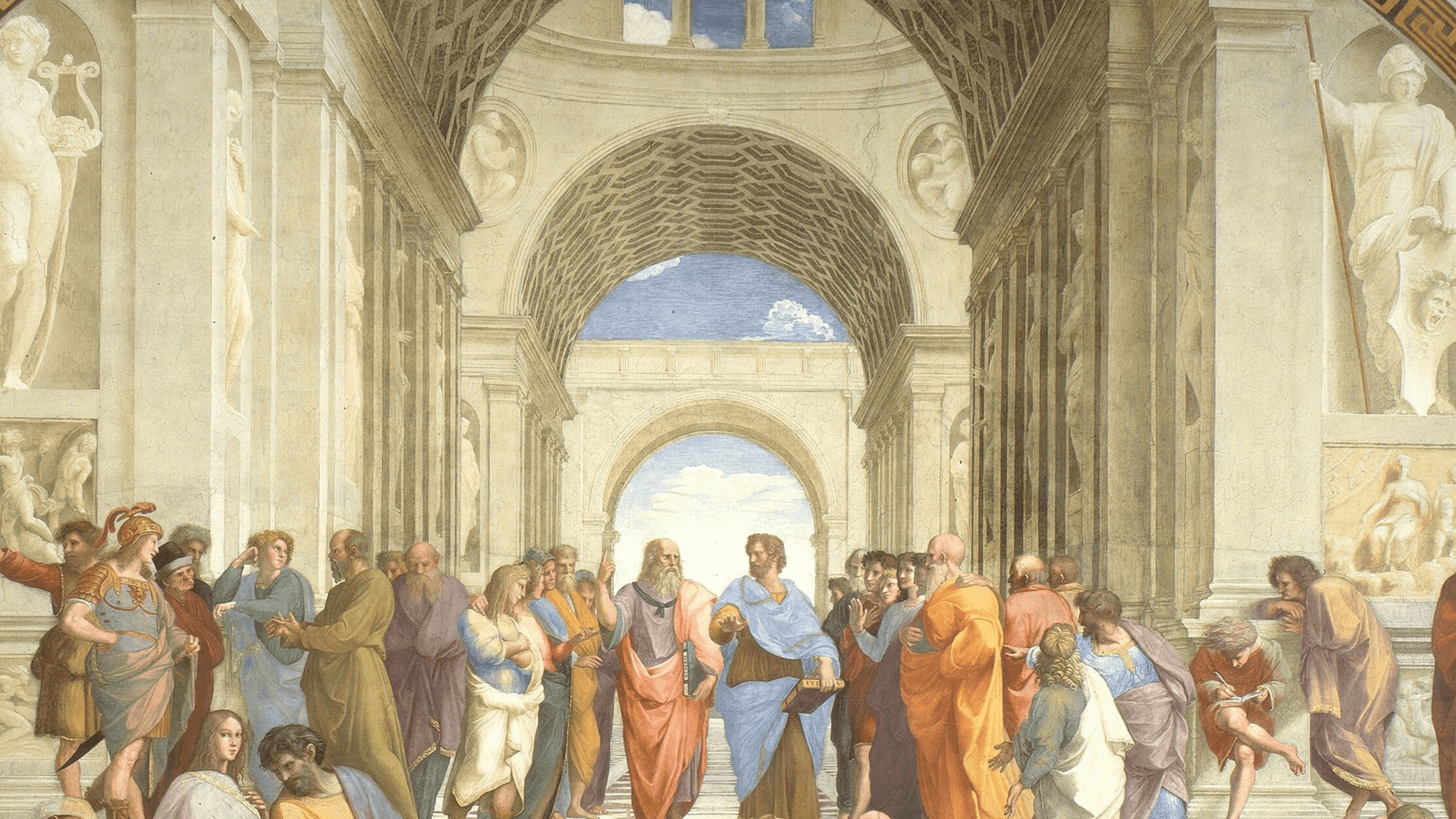
Hero image: The School of Athens, by Raphael (1509-1511), Public domain. Via Wikimedia Commons.
Take our professional IQ test
Want to know your IQ? Try the first ever professional online IQ test.