Does Boxing Lower IQ? What the Research on Boxers Shows
Does boxing lower IQ? No study gives an IQ-point loss, but pro fighters with more bouts process information more slowly, and boxers show signs of brain injury.
Dr. Russell T. WarneChief Scientist
Share
Boxing can lower cognitive performance, but no study has measured boxers' IQ before and after a career, so there is no reliable figure for IQ points lost. What the evidence does show is a dose effect: among professional fighters, each additional fight goes with slightly slower processing speed and smaller deep brain structures, and long careers carry a real risk of lasting brain disease, while small prospective studies of amateur boxers have found little measurable decline.
This page covers how doctors first described "punch drunk" boxers, what the largest study of active professional fighters found, why amateur boxing looks different but is not harmless, why IQ loss in boxers is hard to measure, and what people mean by "boxing IQ."
From "punch drunk" to chronic traumatic encephalopathy
In 1928 the New Jersey pathologist Harrison Martland published a short paper in the Journal of the American Medical Association called "Punch drunk." With help from a fight promoter, he listed 23 boxers; 15 were labelled punch drunk, and others were described with phrases such as "talks slow" and "thinks slow." The condition later became known as "dementia pugilistica," and today it is discussed under the heading of "chronic traumatic encephalopathy" (CTE), a brain disease linked to repeated head impacts.
The early evidence came from boxers with extreme exposure, often hundreds of bouts with little medical oversight. The best-known pathology series, published by Corsellis and colleagues in 1973, examined the brains of 15 former boxers. A 2025 review of 20th-century boxing cases coded 8 of those 15 men as having a complex course over decades, often alongside heavy drinking, vascular disease or head injuries sustained outside the ring, which makes it hard to attribute every symptom to boxing.
Professional fighters: more fights, slower processing
The largest study of active fighters is the Professional Fighters' Brain Health Study, run from the Cleveland Clinic's centre in Las Vegas. Bernick and colleagues tested 224 professional fighters (93 boxers and 131 mixed martial artists) and 22 controls with computerised cognitive tests and brain MRI.
• Brain volume: More professional fights, more years of fighting and a higher "fight exposure score" were all associated with smaller volumes of the thalamus and caudate, two deep structures involved in relaying signals and controlling movement and thought. For boxers, each professional fight was associated with roughly 0.3% to 0.4% less thalamic volume.
• Processing speed: Of the cognitive domains tested, only processing speed was related to exposure, falling by an estimated 0.19% per professional fight. Fighters in the highest exposure group scored 8.8% lower on processing speed than those in the lowest, after adjusting for age, race and education. Boxers were slower than mixed martial artists on average, and both groups were slower than the controls.
• Memory: The study found no differences between fighters and controls in verbal memory.
Processing speed is part of what full IQ batteries measure, but it is one part. A slower score on a computerised speed task is a warning sign, not proof of a lower overall IQ. The study was also cross-sectional, comparing fighters at one point in time, though the steady relationship between number of fights and the outcomes is what you would expect if the blows were doing the damage.
Not everyone with the same exposure is affected equally. In a small study of 30 professional boxers, Jordan and colleagues found that high-exposure boxers who carried the APOE e4 gene variant, a known risk factor for Alzheimer's disease, had worse scores on a brain-injury rating scale than high-exposure boxers without it.
Amateur boxing: few measurable deficits, clear biological signs
Amateur boxing uses shorter bouts and, for a long period, headguards, and its results look different. Loosemore and colleagues reviewed 36 observational studies in the BMJ and found the evidence generally poor in quality. The better studies, especially those using cohort designs and psychometric tests, mostly found nothing: only four of 17 detected any sign of chronic brain injury, and then only in a minority of boxers. They concluded that there was no strong evidence linking amateur boxing to chronic brain injury.
Two prospective studies illustrate this. Butler and colleagues tested 86 amateur boxers before a bout, immediately after it and again within two years, alongside water polo and rugby players, and found no neuropsychological decline. Porter followed 20 Irish amateur boxers and 20 controls matched on age and socioeconomic background for nine years and also found no deterioration; the boxers actually did better on the Trail Making Tests at every time point.
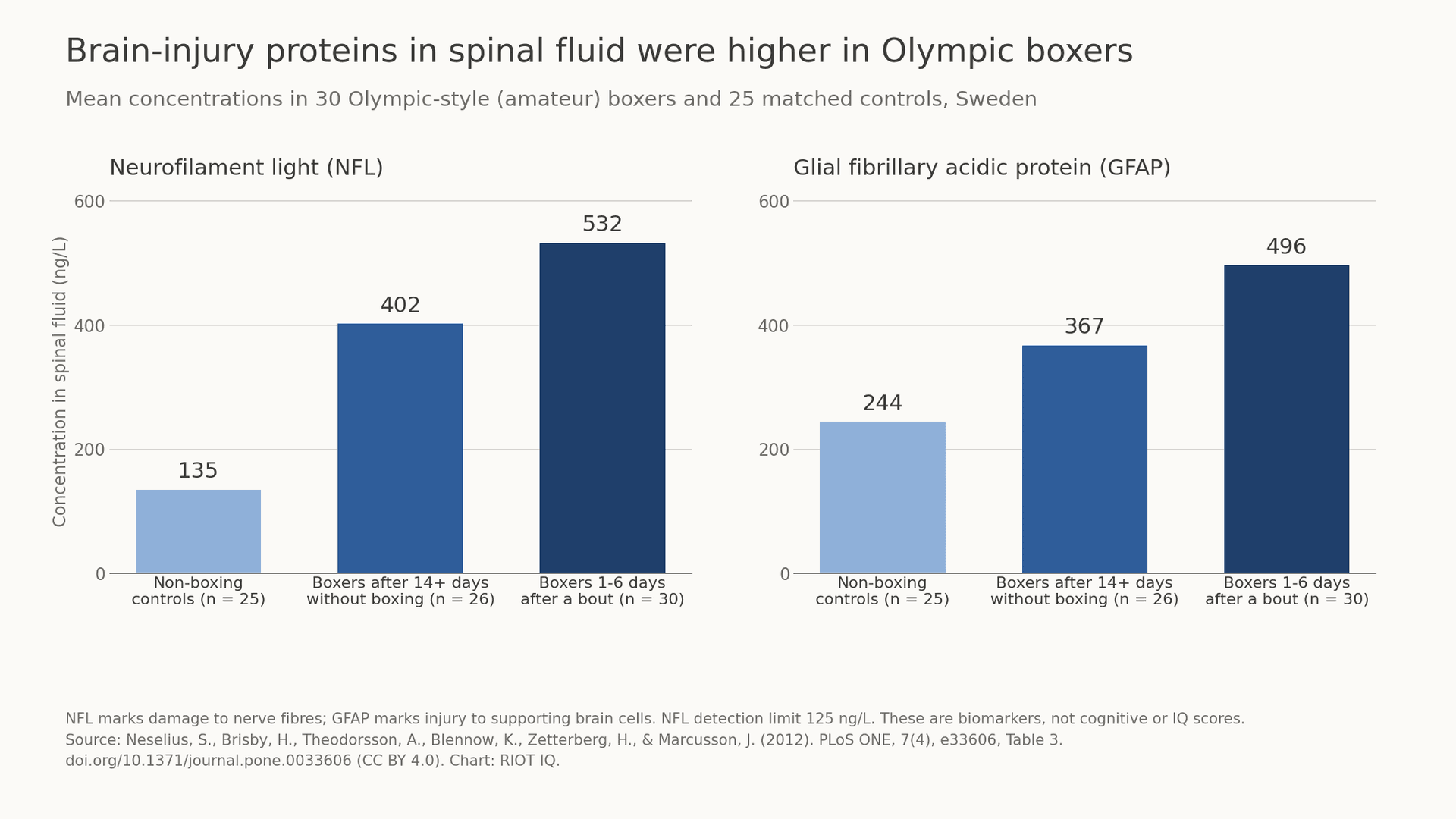
The biology tells a less reassuring story. In a Swedish study, Neselius and colleagues collected spinal fluid from 30 Olympic-style (amateur) boxers with at least 45 bouts each and from 25 matched controls. Shortly after a bout, the boxers had higher levels of proteins released by injured nerve fibres and support cells, and two of these markers were still raised after at least two weeks without boxing (see the chart above). Elevated markers show that the brain is being injured, even when standard tests do not pick up a change.
Long-term population data add to the concern. In the Caerphilly Prospective Study, which followed 1,123 Welsh men for 35 years, men who reported having boxed "seriously" when younger had about twice the odds of later cognitive impairment (odds ratio 2.27) and an earlier onset of dementia, by an estimated 4.8 years. Boxing history was self-reported, and the study was observational, so it cannot rule out other differences between men who boxed and men who did not. The site's page on whether IQ is correlated with dementia covers how cognitive ability and dementia risk relate more generally.
Why an IQ loss in boxers is hard to measure
To show that boxing lowers IQ, you would need a full IQ test before a boxer started and again years later, compared with similar people who never boxed. Nobody has done that study. Researchers instead compare boxers with controls, and that raises a selection problem: the people who take up boxing are not a random sample of the population.
In the professional fighters' study, 54% of participants had a high school education or less. Education and family background are linked to test scores for reasons that have nothing to do with punches. That is why the careful studies match controls on age and education, and why comparing exposure within fighters, such as number of fights, is more convincing than comparing fighters with the general public. In the Swedish study, boxers and controls had similar education levels.
For what a single concussion or a severe brain injury does to IQ, see the page on IQ and traumatic brain injury. Boxing training itself, like lifting weights or running, is good exercise. The risk comes from repeated blows to the head.
What people mean by "boxing IQ"
"Boxing IQ" or "ring IQ" is commentators' slang for ring craft: reading an opponent, managing distance, setting traps and adjusting between rounds. It describes a skill built through years of practice, and it is not what intelligence tests measure. A fighter can have outstanding boxing IQ in this sense and still be at risk from the cumulative effects of blows to the head.
Frequently asked questions
Does boxing make you dumber?
Heavy exposure is linked to slower processing speed and, in long careers, to lasting brain disease. Small studies of amateur boxers have found little measurable decline, though biomarkers show brain injury after bouts.
How many IQ points does boxing cost?
No study has measured that. The best data show about 0.19% slower processing speed per professional fight, which is not an IQ score.
Is amateur boxing safe for the brain?
It appears much less risky than professional boxing, but not risk-free. Spinal-fluid markers of brain injury rise after amateur bouts, and one long-term cohort linked serious boxing in youth with later cognitive impairment.
What is "punch drunk"?
It is the term Harrison Martland used in 1928 for boxers whose thinking, speech or movement had deteriorated. The condition is now discussed as chronic traumatic encephalopathy.
What does "boxing IQ" mean?
It is slang for ring intelligence, such as timing and reading an opponent. It is not a measured IQ score.
The takeaway
Boxing does not come with a known IQ cost, but the evidence points one way: the more blows to the head, the greater the risk. Professional fighters with long records show slower processing and smaller deep brain structures, while amateur boxing looks safer on standard tests yet still produces measurable signs of brain injury. Anyone worried about memory or thinking after years of boxing should see a doctor, ideally a neurologist. To see where your reasoning ability stands today, take the RIOT IQ test.
References
1. Martland, H. S. (1928). Punch drunk. Journal of the American Medical Association, 91(15), 1103-1107. [doi.org/10.1001/jama.1928.02700150029009](. doi.org
2. Castellani, R. J., Kostelecky, N., Ahrendsen, J. T., Nassan, M., Jamshidi, P., & Iverson, G. L. (2025). Neurological disorders and clinical progression in boxers from the 20th century: A narrative review. Brain Sciences, 15(7), 729. [doi.org/10.3390/brainsci15070729](. doi.org
3. Corsellis, J. A. N., Bruton, C. J., & Freeman-Browne, D. (1973). The aftermath of boxing. Psychological Medicine, 3(3), 270-303. [doi.org/10.1017/S0033291700049588](. doi.org
4. Bernick, C., Banks, S. J., Shin, W., Obuchowski, N., Butler, S., Noback, M., Phillips, M., Lowe, M., Jones, S., & Modic, M. (2015). Repeated head trauma is associated with smaller thalamic volumes and slower processing speed: The Professional Fighters' Brain Health Study. British Journal of Sports Medicine, 49(15), 1007-1011. [doi.org/10.1136/bjsports-2014-093877](. doi.org
5. Jordan, B. D., Relkin, N. R., Ravdin, L. D., Jacobs, A. R., Bennett, A., & Gandy, S. (1997). Apolipoprotein E epsilon4 associated with chronic traumatic brain injury in boxing. JAMA, 278(2), 136-140. [doi.org/10.1001/jama.1997.03550020068040](. doi.org
6. Loosemore, M., Knowles, C. H., & Whyte, G. P. (2007). Amateur boxing and risk of chronic traumatic brain injury: Systematic review of observational studies. BMJ, 335(7624), 809. [doi.org/10.1136/bmj.39342.690220.55](. doi.org
7. Butler, R. J., Forsythe, W. I., Beverly, D. W., & Adams, L. M. (1993). A prospective controlled investigation of the cognitive effects of amateur boxing. Journal of Neurology, Neurosurgery & Psychiatry, 56(10), 1055-1061. [doi.org/10.1136/jnnp.56.10.1055](. doi.org
8. Porter, M. D. (2003). A 9-year controlled prospective neuropsychologic assessment of amateur boxing. Clinical Journal of Sport Medicine, 13(6), 339-352. [doi.org/10.1097/00042752-200311000-00002](. doi.org
9. Neselius, S., Brisby, H., Theodorsson, A., Blennow, K., Zetterberg, H., & Marcusson, J. (2012). CSF-biomarkers in Olympic boxing: Diagnosis and effects of repetitive head trauma. PLoS ONE, 7(4), e33606. [doi.org/10.1371/journal.pone.0033606](. doi.org
10. Gallacher, J., Pickering, J., Bayer, A., Heslop, L., Morgan, G., Watkins, A., Martin, R., & Elwood, P. (2022). Amateur boxing and dementia: Cognitive impairment within the 35-year Caerphilly cohort study. Clinical Journal of Sport Medicine, 32(3), 329-333. [doi.org/10.1097/JSM.0000000000000976](. doi.org
Figure by RIOT IQ. Data from Neselius et al. (2012), PLoS ONE 7(4), e33606 (doi.org/10.1371/journal.pone.0033606), Table 3, CC BY 4.0.
Take our professional IQ test
Want to know your IQ? Try the first ever professional online IQ test.