Does Swimming Make You Smarter? What the Research Shows
Does swimming make you smarter? No trial shows it raises IQ. The swim-school study behind it had no non-swimmer control group, and adult trials are small.
Dr. Russell T. WarneChief Scientist
Share
Swimming does not make you smarter in the sense of raising your IQ: no randomized trial has tested swimming against an intelligence test. The popular claim that swimming children are months ahead of their peers comes from an Australian study, partly funded by the swim school industry, that compared swim-school children with test norms instead of with similar children who did not swim, and trials of water exercise in older adults are small, with modest effects on cognitive screening tests.
Swimming is excellent exercise, and it is easy to see why people hope it does more. This page covers where the "swimming makes kids smarter" headlines came from, why the families who choose swimming lessons are different from families who do not, what trials in older adults show, and whether being in water does anything special for the brain.
Where "swimming makes kids smarter" comes from
The claim traces to the Early Years Swimming project led by Professor Robyn Jorgensen at Griffith University in Australia. Griffith's 2013 press release said children who swam were "anywhere from six to 15 months ahead of the normal population" in cognitive skills, mathematical problem solving, counting, language and following instructions. The release also stated that the project "was funded by the swim school industry." The project's interim report described itself as an independent study and thanked "swim industry members who provided financial support."
The project had two parts.
• Parent surveys: Parents of about 7,000 children under five in Australia, New Zealand and the United States reported when their children reached developmental milestones. The interim report itself noted the main weakness: parents may overestimate their own children's achievements.
• Direct testing: To check the surveys, the team tested 177 children aged three to five who attended swim schools. Cognitive and language skills were measured with selected subtests of the Woodcock-Johnson III Tests of Achievement, which measure skills such as story recall, following directions and early maths. The press release reported the children as 11 months ahead in oral expression, six months ahead in maths reasoning, two months ahead in brief reading, 17 months ahead in story recall and 20 months ahead in understanding directions.
The key detail is the comparison group. The swimming children were compared with the test's published norms for the general population. There was no group of non-swimming children from similar families, and children were not randomly assigned to swimming lessons. The peer-reviewed paper from the project describes the 177 children as "often significantly better" than the normal populations and interprets this through the idea that swim lessons add "capital" to young children. That is a reasonable hypothesis, but the design cannot test it.
Achievement tests are also not IQ tests. They measure what a child has learned, which depends heavily on how much talking, reading and counting goes on at home.
There is a second reason for caution. Psychologists separate "near transfer," getting better at tasks like the one you practiced, from "far transfer," getting better at different tasks such as intelligence tests. Sala and Gobet's reviews of chess, music and working memory training found that far transfer rarely occurs, and that apparent gains shrink when studies use better control groups. Swimming lessons teach water skills and some listening to instructions. Large gains in story recall and maths would be an unusually far transfer.
Who learns to swim
The interim report raised the obvious objection itself: lessons cost money, so the families who use them may simply be better off. Its answer was that all four socioeconomic groups within the swimming sample scored above the norms. That does not settle the question. Families of any income who enroll a toddler in weekly lessons and then volunteer for research testing tend to be unusually involved parents, and that involvement is exactly what achievement tests at age four pick up.
Swimming ability itself tracks family background. In Malmö, Sweden, Pilgaard and colleagues compared about 1,700 ten-year-olds before and about 1,800 after the city introduced compulsory swimming lessons in second grade. Around 77% to 78% of children could swim in both groups. Children whose parents were manual workers, unemployed or born outside Europe, North America and Australia had markedly lower swimming ability, as did children in schools below the median on a socioeconomic index, and the gap had not narrowed after the program began.
Parental education and income also predict children's test scores. Our article on whether IQ reflects a person's socioeconomic status explains how strong that link is and why it makes comparisons between swimmers and non-swimmers hard to interpret.
Swimming and the ageing brain
Most experimental work on swimming and cognition is in older adults, and the trials are small.
• Water exercise trials: Song and colleagues pooled nine randomized trials with 324 adults aged 60 and over in a 2026 network meta-analysis. Aquatic aerobic exercise produced a "standardized mean difference" (the gap between groups in standard deviation units) of 0.51 against non-exercising controls, but the 95% confidence interval ran from -0.08 to 1.11, so the result was not statistically significant. Only aquatic "cognitive-motor" exercise, which combines movement with mental tasks, was significant, at 0.48 (0.02 to 0.95). If the outcome were an IQ test, 0.5 standard deviations would be about 7 points, but the outcomes were mostly screening tests and other cognitive measures, so that conversion only gives a rough sense of scale. With 324 participants spread across several kinds of exercise, the true effects could be much smaller.
• Swimmers against sedentary adults: In a French study by Abou-Dest and colleagues, 16 older adults who swam regularly performed better than 16 sedentary older adults on five of eight executive-function tasks, which involve updating working memory, switching between tasks and holding back automatic responses, but not on processing speed. All participants were volunteers compared at one point in time, so the study cannot show whether swimming caused the difference or whether healthier, sharper people keep swimming.
• Swimmers against land athletes: I could not find a well-designed study comparing the cognitive scores of swimmers with runners or cyclists of similar fitness and education. The claim that swimming is better for the brain than other sport rests on little data.
These results fit the broader exercise literature: physical activity seems mildly helpful for the ageing brain, and water exercise appears to be at least as helpful as land exercise, which matters for people with joint pain or balance problems. Our article on whether exercise can affect your IQ score covers that wider evidence, and how IQ changes as a person ages explains which abilities decline with age.
Does water do something special for the brain?
Two lines of research are often quoted to suggest that swimming has unique brain benefits.
• Blood flow during water exercise: Pugh and colleagues had 15 healthy young adults do 20 minutes of stepping exercise on land and in 30°C water up to chest level, at matched intensity. Blood flow velocity in the middle cerebral artery, a main artery feeding the brain, averaged 74 cm/s in water against 67 cm/s on land, roughly 10% higher. The study measured blood flow during a single session and did not test cognition.
• Cold water and dementia: Peretti and colleagues found that cooling mice raised levels of a "cold-shock" protein called RBM3 and that boosting RBM3 protected synapses in mouse models of prion disease and Alzheimer-type disease. That work was done in mice and used artificial cooling. I found no trial testing whether cold-water swimming slows cognitive decline in people.
Both findings are interesting physiology. Neither shows that swimming makes anyone smarter.
Frequently asked questions
Does swimming increase IQ?
No study has shown that it does. The best-known study of young swimmers used achievement tests and compared children with published norms, and adult trials measure memory and screening scores.
Are kids who take swimming lessons smarter?
Swim-school children in an Australian study scored above test norms on early language and maths skills. Without a comparison group of non-swimmers from similar families, that may reflect who takes lessons more than what lessons do.
Is swimming good for your brain?
For older adults, water exercise produces modest improvements on cognitive tests in small trials, about the same as land exercise. That is useful for people who find walking or running difficult.
Is swimming better for the brain than running?
There is no good evidence either way. Water exercise raises brain blood flow slightly compared with matched land exercise, but no study has shown this leads to better cognitive outcomes.
Does cold-water swimming prevent dementia?
That has not been shown. The cold-shock protein research behind the claim was done in mice.
The takeaway
Swimming is a valuable life skill and good exercise at any age, and water-based exercise is a gentle way for older adults to stay active. The evidence that it raises intelligence is weak: the famous children's study had no proper control group and was supported by the swim industry, and adult trials are small and measure screening tests. To see where your reasoning ability stands today, take a full-length online IQ test.
References
1. Griffith University. (2013, August 13). Swim study reveals a smart pool of talent [Press release]. Griffith News. [news.griffith.edu.au](. news.griffith.edu.au
2. Jorgensen, R. (2012). Early years swimming: Adding capital to young Australians. Interim report. Griffith Institute for Educational Research. [splash.online](. splash.online
3. Jorgensen, R. (2016). Early years swimming: A way of supporting school transitions? Early Child Development and Care, 186(9), 1429-1437. [doi.org/10.1080/03004430.2015.1096785](. doi.org
4. Sala, G., & Gobet, F. (2017). Does far transfer exist? Negative evidence from chess, music, and working memory training. Current Directions in Psychological Science, 26(6), 515-520. [doi.org/10.1177/0963721417712760](. doi.org
5. Pilgaard, F. I. H., Östergren, P.-O., Olin, A., Kling, S., Albin, M., & Björk, J. (2020). Socioeconomic differences in swimming ability among children in Malmö, southern Sweden: Initial results from a community-level intervention. Scandinavian Journal of Public Health, 48(5), 495-501. [doi.org/10.1177/1403494818821478](. doi.org
6. Song, J., Ma, Z., Luo, B., Liao, T., Wang, Y., Zhao, Z., & Zheng, X. (2026). Comparative efficacy of different aquatic exercise modalities on cognitive function in the elderly: A systematic review and network meta-analysis. Journal of Sports Science and Medicine, 25(2), 381-394. [doi.org/10.52082/jssm.2026.381](. doi.org
7. Abou-Dest, A., Albinet, C. T., Boucard, G., & Audiffren, M. (2012). Swimming as a positive moderator of cognitive aging: A cross-sectional study with a multitask approach. Journal of Aging Research, 2012, 273185. [doi.org/10.1155/2012/273185](. doi.org
8. Pugh, C. J. A., Sprung, V. S., Ono, K., Spence, A. L., Thijssen, D. H. J., Carter, H. H., & Green, D. J. (2015). The effect of water immersion during exercise on cerebral blood flow. Medicine & Science in Sports & Exercise, 47(2), 299-306. [doi.org/10.1249/MSS.0000000000000422](. doi.org
9. Peretti, D., Bastide, A., Radford, H., Verity, N., Molloy, C., Martin, M. G., Moreno, J. A., Steinert, J. R., Smith, T., Dinsdale, D., Willis, A. E., & Mallucci, G. R. (2015). RBM3 mediates structural plasticity and protective effects of cooling in neurodegeneration. Nature, 518(7538), 236-239. [doi.org/10.1038/nature14142](. doi.org
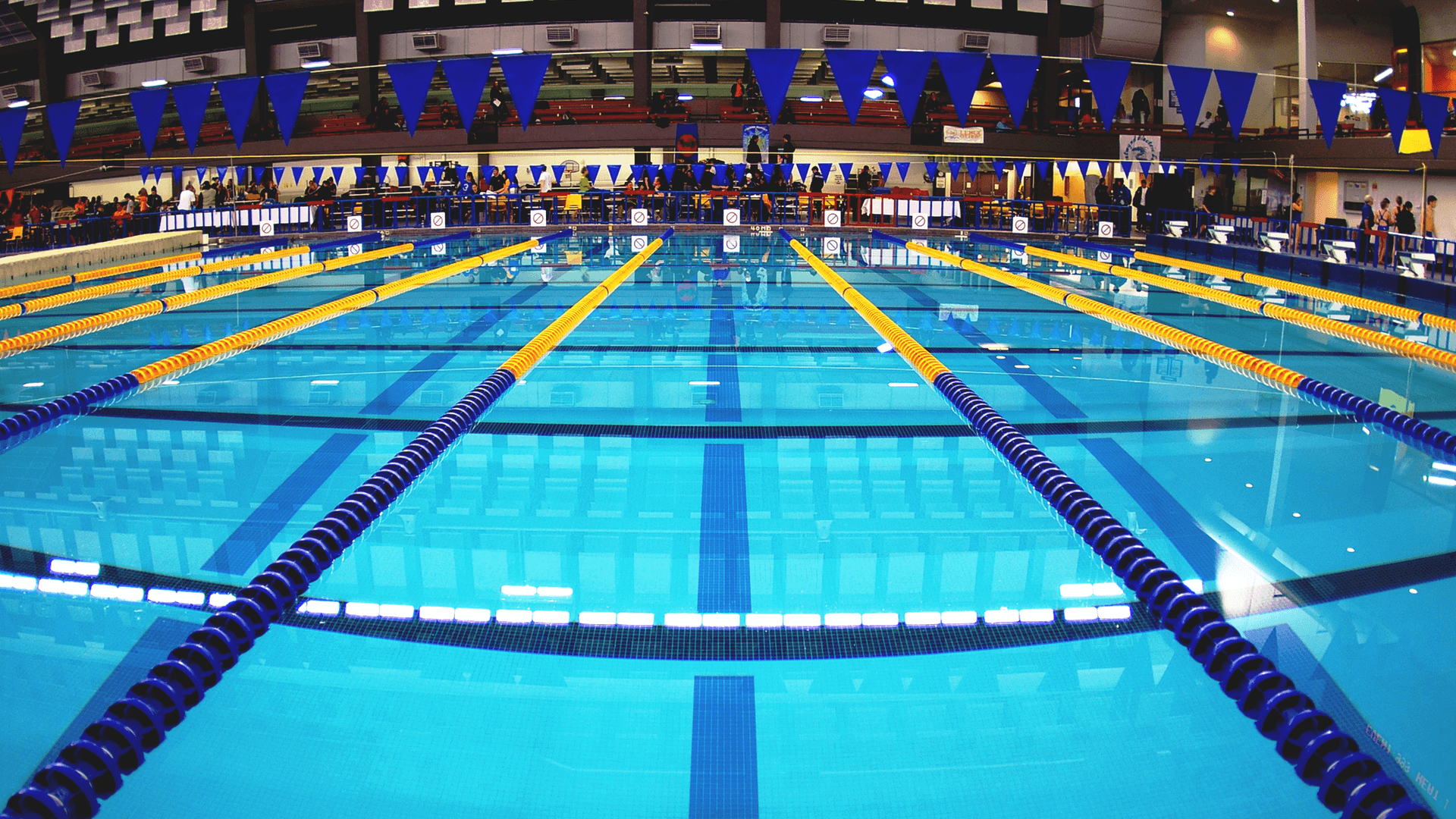
Hero image: Swimming pool with lane ropes in place, by Xander from Yellowknife, NT, Canada, CC BY 2.0. Via Wikimedia Commons.
Take our professional IQ test
Want to know your IQ? Try the first ever professional online IQ test.