Does Ashwagandha Make You Smarter? What the Trials Show for IQ
Does ashwagandha make you smarter? No study has tested it on IQ. Small trials show modest gains on memory tasks, and the evidence is rated low to moderate.
Dr. Russell T. WarneChief Scientist
Share
No study has tested whether ashwagandha raises IQ, so there is no evidence that it makes you smarter in that sense. The best summary, a 2026 meta-analysis of 20 small randomized trials, found that people taking ashwagandha did moderately better than people taking a placebo on memory tests (a standardized difference of 0.52), but the authors rated the certainty of the evidence as moderate at best.
Ashwagandha (Withania somnifera) is a shrub used in Ayurvedic medicine and now sold worldwide as a supplement for stress, sleep and focus. This page covers what the cognitive trials actually measured, why their results fall well short of an IQ gain, how the stress and cortisol story fits in, and what regulators have said about safety. It describes research and is not medical advice.
Why ashwagandha is sold as a brain supplement
Ashwagandha has a long history in traditional medicine as a tonic, and modern marketing draws on that history. The current wave of interest rests on two kinds of research. The first is a set of trials suggesting that ashwagandha lowers perceived stress and morning cortisol, a hormone involved in the stress response. The second is a smaller set of trials that gave people ashwagandha extract and then measured their memory, attention or reaction time.
Ashwagandha is often grouped with other "nootropics", the umbrella term for products sold to sharpen thinking. Our page on whether nootropics can increase IQ covers that category and how supplements are regulated. This page sticks to the trials of ashwagandha itself.
What the cognitive trials of ashwagandha show
Most of the human evidence comes from placebo-controlled trials that are small by medical standards. The ones most often cited ranged from 13 to 130 participants.
• Adults with mild cognitive impairment: Choudhary, Bhattacharyya and Bose randomized 50 adults with mild cognitive impairment to 300 mg of root extract twice a day or a placebo for eight weeks. The ashwagandha group improved more on several Wechsler Memory Scale subtests and on tests of attention and processing speed. The authors called it a pilot study.
• Bipolar disorder: Chengappa and colleagues added an extract (500 mg a day) to the usual medicines of people with bipolar disorder whose mood was stable. Of 60 enrolled, 53 completed eight weeks. The extract beat placebo on three tasks, including backward digit span (Cohen's d = 0.51), and none of the other cognitive tasks differed between groups.
• Healthy, stressed adults: Gopukumar and colleagues gave 130 stressed but otherwise healthy adults a sustained-release extract or a placebo for 90 days. The ashwagandha group did better on a computerized memory task and reported less stress. Four of the six authors were employees of private companies, including Inventia Healthcare and Laila Nutraceuticals.
• Healthy young adults, single doses: At Texas A&M, Xing and colleagues tested 13 volunteers for six hours after a single 400 mg dose, and Leonard and colleagues followed 59 young adults for 30 days on 225 mg a day. Both reported gains on selected working memory, attention and reaction-time measures, though not on every task. Two coauthors of each paper were affiliated with a private company, Increnovo; the 2024 paper states that they were not involved in data collection or analysis.
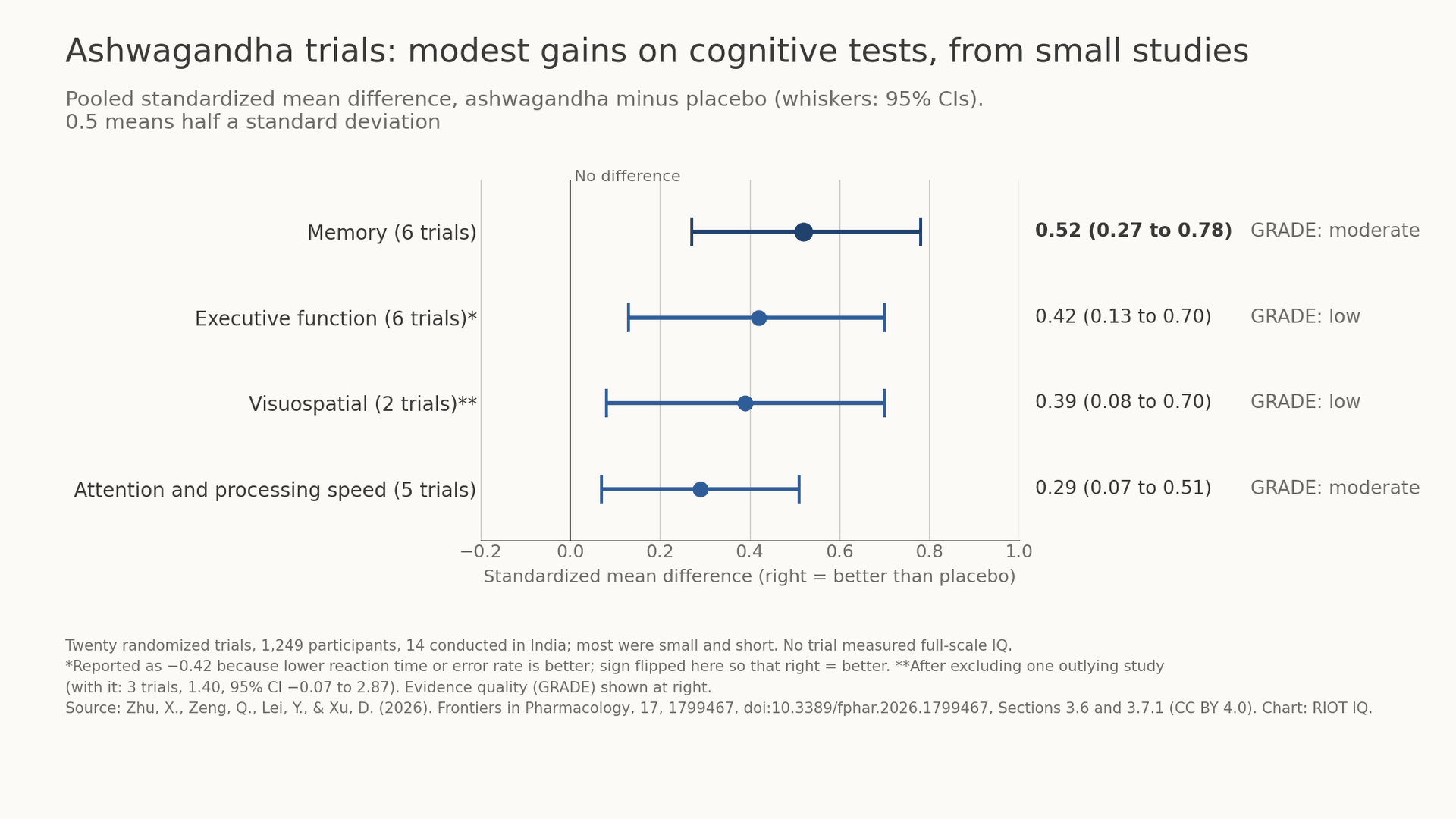
Zhu and colleagues pooled these and other trials in 2026. Their meta-analysis covered 20 trials with 1,249 participants in total, 14 of them run in India. Not every trial measured cognition. The memory analysis, for example, rested on six trials and 366 people. Pooled results favoured ashwagandha on memory (SMD = 0.52), executive function (0.42), and attention and processing speed (0.29). Visuospatial results were inconsistent across trials and became significant (0.39) only after the authors dropped one outlying study. Only one trial measured global cognition, so it could not be pooled. Using the GRADE system for rating evidence, the authors judged certainty as moderate for memory and attention and low for executive function and visuospatial ability.
An SMD (standardized mean difference) expresses a gap between groups in standard deviation units. Multiplying by 15 puts it on the familiar IQ-point scale, so 0.52 corresponds to roughly 8 points and 0.29 to roughly 4 points. Those figures describe scores on particular memory or reaction-time tasks. They are not IQ points.
Why these results do not add up to a higher IQ
It is tempting to read "better memory scores" as "smarter". The trials do not support that leap, for several reasons.
• No IQ outcome: None of the trials gave participants a full IQ test. An IQ score summarizes many abilities, including reasoning, vocabulary, spatial skill, memory and processing speed. A gain on one word-recall task or one reaction-time task is a much narrower claim.
• Small samples and many tests: Most trials had a few dozen people and gave each one many tasks. When a study checks many outcomes, a few will look significant by chance, and small trials that report positive results are more likely to be published. Zhu and colleagues noted that no domain had enough trials (10 or more) to test for publication bias.
• Who was studied: Several trials enrolled people with mild cognitive impairment, bipolar disorder or high stress. Improvement from a lowered baseline, for example when stress or poor sleep eases, is different from raising the ability of a healthy, well-rested person.
• Different products: The trials used different extracts, doses, plant parts (root, or root and leaf) and levels of the active compounds called withanolides. The meta-analysis authors warned that these preparations are not pharmacologically equivalent.
• Commercial ties: Several trials tested branded extracts and had authors employed by, or consulting for, the supplement industry. Industry involvement does not make a result wrong. It does make independent replication more important.
Ng and colleagues reached a similar verdict in an earlier systematic review of five clinical studies: there is some early evidence of cognitive benefit, drawn from a heterogeneous mix of patient groups.
Stress, cortisol and the indirect route
The most plausible way ashwagandha could affect test performance is indirect. Chronic stress and poor sleep can drag down concentration and memory on any given day, and our page on stress and IQ explains how stress affects test scores without changing underlying ability.
Lopresti and colleagues randomized 60 stressed adults to 240 mg of a standardized extract or a placebo for 60 days. The ashwagandha group showed a larger fall in an anxiety rating scale and in morning cortisol. Gopukumar's trial also reported lower stress scores and lower cortisol. If ashwagandha does ease stress for some people, small improvements on memory tasks would be an expected side effect. That would be a person performing closer to their usual level, which is a different thing from becoming more intelligent.
Safety and regulation of ashwagandha
Short trials have reported mostly mild side effects, such as stomach upset and drowsiness, and Zhu and colleagues found no serious adverse events in the trials they reviewed. Trials of a few weeks are poor at detecting rare harms, however, and case reports point to one in particular.
• Liver injury: Björnsson and colleagues described five people from Iceland and the US Drug-Induced Liver Injury Network who developed jaundice 2 to 12 weeks after starting ashwagandha supplements. Liver tests returned to normal within one to five months in four of them; the fifth was lost to follow-up. In India, Philips and colleagues reported eight patients with liver injury from single-ingredient ashwagandha products. Five had existing chronic liver disease, and three of those developed acute-on-chronic liver failure and died.
• Germany: In 2024 the German Federal Institute for Risk Assessment (BfR) advised that children, pregnant and breastfeeding women, and people with liver disease should not take ashwagandha supplements, and that others should be cautious. It noted that no safe intake level could be derived from the data available.
• Denmark: The Danish Veterinary and Food Administration states that products containing ashwagandha are illegal to sell in Denmark, citing a risk assessment by the Technical University of Denmark that raised concerns about effects on sex hormones and reproduction, metabolism, the immune system and the central nervous system.
Ashwagandha can also interact with medicines, according to the BfR, including drugs for diabetes, blood pressure and the immune system. Anyone thinking about it, especially with a liver, thyroid or hormone condition or during pregnancy, should talk to a doctor or pharmacist first.
Frequently asked questions
Does ashwagandha make you smarter?
There is no evidence that it raises IQ, because no trial has measured IQ. Small trials report modest gains on specific memory and attention tasks, mostly in stressed or cognitively impaired adults.
Does ashwagandha improve memory?
A 2026 meta-analysis found a moderate pooled improvement on memory tests (SMD = 0.52) across six small trials, with evidence rated moderate in certainty. Larger, independent trials are needed to confirm it.
How long do ashwagandha studies last?
The trials described here ran for 30 to 90 days, and a few tested single doses over a few hours. Long-term effects, good or bad, have not been studied well.
Is ashwagandha safe?
Most people in short trials reported only mild side effects, but rare cases of liver injury have been reported, and Denmark does not allow it to be sold. A doctor or pharmacist can advise on individual risks and drug interactions.
Can lowering stress improve test scores?
It can help people perform closer to their usual level, since stress and poor sleep impair concentration. That is different from raising underlying intelligence.
The takeaway
Ashwagandha has not been shown to make anyone smarter. The trials are small, varied and partly industry-linked, and none measured IQ. Pooled results suggest modest gains on memory and attention tasks, most plausibly linked to lower stress, with evidence rated moderate to low in certainty and real, if rare, safety concerns. If you want an accurate picture of your reasoning ability, take a full-length online IQ test.
References
1. Zhu, X., Zeng, Q., Lei, Y., & Xu, D. (2026). Effects of Withania somnifera (L.) Dunal (Ashwagandha) on cognitive and physical function in adults: A systematic review and meta-analysis. Frontiers in Pharmacology, 17, 1799467. [doi.org/10.3389/fphar.2026.1799467](. doi.org
2. Choudhary, D., Bhattacharyya, S., & Bose, S. (2017). Efficacy and safety of ashwagandha (Withania somnifera (L.) Dunal) root extract in improving memory and cognitive functions. Journal of Dietary Supplements, 14(6), 599-612. [doi.org/10.1080/19390211.2017.1284970](. doi.org
3. Chengappa, K. N. R., Bowie, C. R., Schlicht, P. J., Fleet, D., Brar, J. S., & Jindal, R. (2013). Randomized placebo-controlled adjunctive study of an extract of Withania somnifera for cognitive dysfunction in bipolar disorder. Journal of Clinical Psychiatry, 74(11), 1076-1083. [doi.org/10.4088/JCP.13m08413](. doi.org
4. Gopukumar, K., Thanawala, S., Somepalli, V., Rao, T. S. S., Thamatam, V. B., & Chauhan, S. (2021). Efficacy and safety of ashwagandha root extract on cognitive functions in healthy, stressed adults: A randomized, double-blind, placebo-controlled study. Evidence-Based Complementary and Alternative Medicine, 2021, 8254344. [doi.org/10.1155/2021/8254344](. doi.org
5. Xing, D., Yoo, C., Gonzalez, D., Jenkins, V., Nottingham, K., Dickerson, B., Leonard, M., Ko, J., Faries, M., Kephart, W., Purpura, M., Jäger, R., Sowinski, R., Rasmussen, C. J., & Kreider, R. B. (2022). Effects of acute ashwagandha ingestion on cognitive function. International Journal of Environmental Research and Public Health, 19(19), 11852. [doi.org/10.3390/ijerph191911852](. doi.org
6. Leonard, M., Dickerson, B., Estes, L., Gonzalez, D. E., Jenkins, V., Johnson, S., Xing, D., Yoo, C., Ko, J., Purpura, M., Jäger, R., Faries, M., Kephart, W., Sowinski, R., Rasmussen, C. J., & Kreider, R. B. (2024). Acute and repeated ashwagandha supplementation improves markers of cognitive function and mood. Nutrients, 16(12), 1813. [doi.org/10.3390/nu16121813](. doi.org
7. Ng, Q. X., Loke, W., Foo, N. X., Tan, W. J., Chan, H. W., Lim, D. Y., & Yeo, W. S. (2020). A systematic review of the clinical use of Withania somnifera (Ashwagandha) to ameliorate cognitive dysfunction. Phytotherapy Research, 34(3), 583-590. [doi.org/10.1002/ptr.6552](. doi.org
8. Lopresti, A. L., Smith, S. J., Malvi, H., & Kodgule, R. (2019). An investigation into the stress-relieving and pharmacological actions of an ashwagandha (Withania somnifera) extract: A randomized, double-blind, placebo-controlled study. Medicine, 98(37), e17186. [doi.org/10.1097/MD.0000000000017186](. doi.org
9. Björnsson, H. K., Björnsson, E. S., Avula, B., Khan, I. A., Jonasson, J. G., Ghabril, M., Hayashi, P. H., & Navarro, V. (2020). Ashwagandha-induced liver injury: A case series from Iceland and the US Drug-Induced Liver Injury Network. Liver International, 40(4), 825-829. [doi.org/10.1111/liv.14393](. doi.org
10. Philips, C. A., Valsan, A., Theruvath, A. H., Ravindran, R., Oommen, T. T., Rajesh, S., Bishnu, S., & Augustine, P. (2023). Ashwagandha-induced liver injury: A case series from India and literature review. Hepatology Communications, 7(10), e0270. [doi.org/10.1097/HC9.0000000000000270](. doi.org
11. German Federal Institute for Risk Assessment. (2024). Ashwagandha food supplements with potential health risks (BfR Communication No. 39/2024). [bfr.bund.de](. bfr.bund.de
12. Danish Veterinary and Food Administration. (n.d.). Ashwagandha i kosttilskud og drikkevarer [Ashwagandha in food supplements and drinks]. [foedevarestyrelsen.dk](. foedevarestyrelsen.dk
Figure by RIOT IQ. Data from Zhu, Zeng, Lei & Xu (2026), Frontiers in Pharmacology 17, 1799467 (doi.org/10.3389/fphar.2026.1799467), Sections 3.6 and 3.7.1, CC BY 4.0.
Take our professional IQ test
Want to know your IQ? Try the first ever professional online IQ test.