Does Lion's Mane Make You Smarter? What the Trials Show for IQ
Does lion's mane make you smarter? No trial has shown it. Six small studies found mixed results on memory screens and lab tasks, and none measured IQ.
Dr. Russell T. WarneChief Scientist
Share
Lion's mane has not been shown to make anyone smarter: no trial has measured IQ, and the three trials in healthy young adults produced two isolated faster scores on single tasks alongside slightly worse word recall. The more positive results come from three small trials of older adults, all scored on brief dementia screening tests, and in the largest of them the gap between lion's mane and placebo after 49 weeks (about 2.5 points on a 30-point scale) was not statistically significant.
Lion's mane (Hericium erinaceus) is an edible mushroom with a long history in East Asian cooking and medicine. This page covers why it is sold as a brain supplement, what each human trial found, and why the evidence falls short of a claim about intelligence. It describes research and is not medical advice.
Why lion's mane is sold as a brain supplement
The case starts in the laboratory. In 1994 Japanese chemists isolated compounds called "erinacines" from the mushroom's mycelium (the root-like threads that grow before the mushroom itself) and reported that they strongly stimulated the production of nerve growth factor, a protein that helps neurons survive, in cultured cells. A related family, the "hericenones", comes from the fruiting body, the part you would cook.
Animal studies followed. Mice bred to develop Alzheimer's-like brain changes had fewer amyloid plaques after 30 days of erinacine A-enriched mycelium, and a 2023 study from the University of Queensland reported that a purified mushroom compound improved memory in mice. That second study was funded by a Korean company, CNG-Bio, and its press coverage was widely shared by supplement sellers. Results in cells and mice are a reason to run human trials. They do not show what a capsule does to a person's reasoning ability. Our page on nootropics and IQ covers the wider category of brain supplements.
What the human trials of lion's mane found
Six placebo-controlled trials have tested lion's mane on thinking. All are small, and most were run or funded by companies that sell mushroom products.
• Older adults with mild cognitive impairment (Mori et al., 2009): Thirty Japanese adults aged 50 to 80 took tablets supplying about 3 grams a day of dried lion's mane powder, or a placebo, for 16 weeks. The lion's mane group scored higher on a scale based on the Revised Hasegawa Dementia Scale, a short dementia screen, at weeks 8, 12 and 16. Four weeks after stopping, their scores fell again. The lead author worked for Hokuto Corporation, a Japanese mushroom producer.
• Healthy adults over 50 (Saitsu et al., 2019): Thirty-one people took 3.2 grams a day of fruiting-body powder or placebo for 12 weeks. Final scores on the Mini-Mental State Examination (MMSE), a 30-point dementia screen, were 30.00 in the lion's mane group and 29.53 in the placebo group. Both groups started near the maximum, so the test had almost no room to show change. A visual memory test and a word-pair learning test showed no difference.
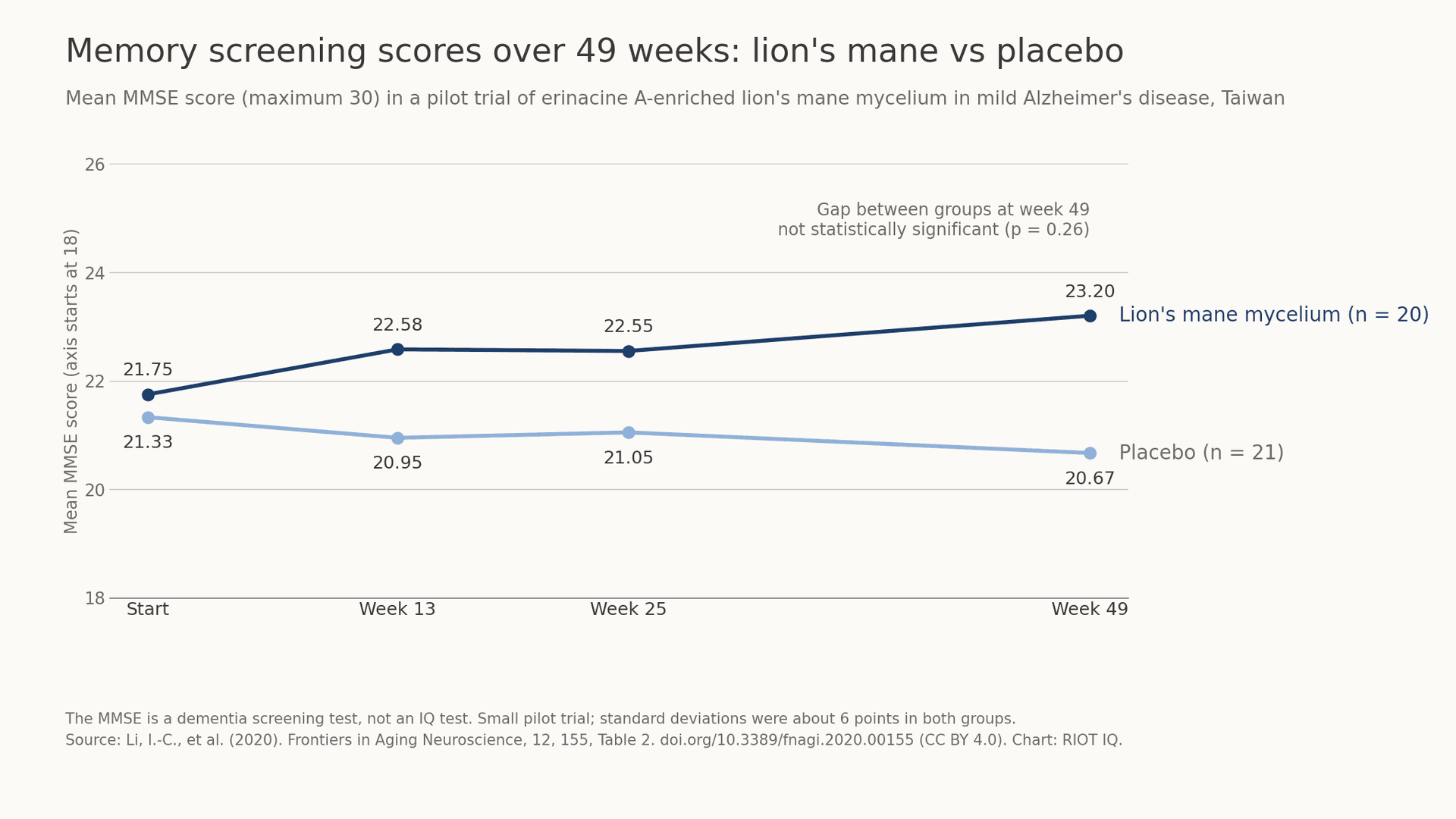
• Mild Alzheimer's disease (Li et al., 2020): Forty-nine patients in Taiwan were randomized to erinacine A-enriched mycelium capsules or placebo for 49 weeks, and 41 finished. MMSE scores rose from 21.75 to 23.20 with lion's mane and drifted from 21.33 to 20.67 with placebo. The rise was significant within the lion's mane group, but the difference between groups was not significant at any time point. One daily-living measure did differ at week 49. Grape King Bio supplied the capsules and paid the salaries of five of the ten authors.
• Healthy young adults (Docherty et al., 2023): Forty-one adults aged 18 to 45 took 1.8 grams a day or placebo for 28 days. An hour after the first dose, the lion's mane group got faster on the Stroop task (737.70 to 688.05 milliseconds), but the same group recalled fewer words immediately after dosing, and the placebo group improved more on delayed word recall over 28 days. Global accuracy and global speed scores did not differ.
• Other healthy young adults: A University of North Alabama trial gave 24 students 10 grams a day in muffins for four weeks and found no effect on any cognitive measure. A 2025 crossover study of 18 people found no effect of a single 3-gram extract dose on composite cognition or mood, with one faster result on a pegboard task. Two of its authors were employed by a drinks company that uses lion's mane.
A 2025 systematic review of 26 human studies concluded that lion's mane "shows limited effectiveness in clinical trials." That is a fair summary.
What these numbers mean for intelligence
None of these trials used an IQ test. The MMSE and the Hasegawa scale are brief screens built to flag dementia, with items such as naming the date and copying a drawing. A healthy adult scores at or near the top, which is why the 2019 trial in healthy older people found almost nothing to measure. Moving from 21 to 23 on the MMSE in Alzheimer's disease would matter for daily life, but it says nothing about reasoning in people without the disease.
It is tempting to convert the Alzheimer's trial into IQ points. The group spread in MMSE scores was about 6 points, so the week-49 gap of about 2.5 points looks like 0.4 standard deviations, or 6 IQ points if you multiply by 15. That conversion would mislead. The gap was not statistically significant, and the scale tracks impairment in people with a progressive brain disease, which is a different thing from intelligence.
The trials in healthy adults are the ones that bear on the "smarter" question. Across three trials and well over a dozen outcomes, they produced one faster Stroop score, one faster pegboard score, and two memory results that went the wrong way. With that many tests, a few chance findings in each direction are expected. The samples were small and often company-funded, and no result has been repeated by an independent group.
Supplement trials also face a selection problem in the real world. People who buy brain supplements tend to be more health-conscious and better educated than average, so any survey showing that lion's mane users score well on tests would mostly reflect who chooses to take it.
Which lion's mane, and how much?
The trials did not test the same thing. Some used dried mushroom or fruiting-body powder, one used mycelium grown to be rich in erinacine A, one used a proprietary "mushroom complex", and one used a concentrated 10:1 extract. Doses ranged from 1.8 to 10 grams a day. Fruiting bodies and mycelium contain different compounds, so a positive result for one product does not transfer to another.
In the United States, lion's mane is sold as a dietary supplement. The FDA does not have the authority to approve dietary supplements before they are marketed, and it generally does not approve their claims. The trials reported few side effects, though four patients in the Alzheimer's trial dropped out with abdominal discomfort, nausea or a skin rash. Anyone with memory concerns, or anyone taking other medicines, should speak with a doctor before adding a supplement. The pattern of promising lab work and small, mixed human trials is similar to the one our page on ashwagandha and IQ describes.
Frequently asked questions
Does lion's mane make you smarter?
No study has shown it. No trial has measured IQ, and the trials in healthy young adults found isolated faster scores on two tasks against many null or negative results.
Does lion's mane improve memory?
Two small trials in older adults with cognitive decline reported better scores on dementia screening tests, but in the larger one the difference from placebo was not statistically significant. In healthy young adults, lion's mane did not improve memory, and two word-recall results favoured placebo.
Does lion's mane grow new brain cells?
Compounds from lion's mane raise nerve growth factor in cultured cells and have improved brain markers and memory in mice. Those results have not been shown in human brains.
How long do lion's mane trials last?
They range from a single dose to 49 weeks. Most last between four and 16 weeks, and the benefit seen in the 2009 trial faded within four weeks of stopping.
Is lion's mane safe?
The trials reported few side effects, mainly stomach upset and rash in a small number of people. Supplements are not approved by the FDA before sale, so anyone considering one, especially with a medical condition, should ask a doctor or pharmacist.
The takeaway
Lion's mane is an interesting mushroom with real laboratory findings, but it has not been shown to make anyone smarter. The positive human results are small, come mostly from older adults with or near dementia, use screening tests in place of IQ tests, and are often funded by the companies that make the product. If you want a reliable measure of your reasoning ability, take a full-length online IQ test.
References
1. Kawagishi, H., Shimada, A., Shirai, R., Okamoto, K., Ojima, F., Sakamoto, H., Ishiguro, Y., & Furukawa, S. (1994). Erinacines A, B and C, strong stimulators of nerve growth factor (NGF)-synthesis, from the mycelia of Hericium erinaceum. Tetrahedron Letters, 35(10), 1569-1572. [doi.org/10.1016/S0040-4039(00)76760-8](. doi.org
2. Tsai-Teng, T., Chin-Chu, C., Li-Ya, L., Wan-Ping, C., Chung-Kuang, L., Chien-Chang, S., Chi-Ying, H. F., Chien-Chih, C., & Shiao, Y. J. (2016). Erinacine A-enriched Hericium erinaceus mycelium ameliorates Alzheimer's disease-related pathologies in APPswe/PS1dE9 transgenic mice. Journal of Biomedical Science, 23, 49. [doi.org/10.1186/s12929-016-0266-z](. doi.org
3. Martínez-Mármol, R., Chai, Y., Conroy, J. N., Khan, Z., Hong, S.-M., Kim, S. B., ... Meunier, F. A. (2023). Hericerin derivatives activates a pan-neurotrophic pathway in central hippocampal neurons converging to ERK1/2 signaling enhancing spatial memory. Journal of Neurochemistry, 165(6), 791-808. [doi.org/10.1111/jnc.15767](. doi.org
4. Mori, K., Inatomi, S., Ouchi, K., Azumi, Y., & Tuchida, T. (2009). Improving effects of the mushroom Yamabushitake (Hericium erinaceus) on mild cognitive impairment: A double-blind placebo-controlled clinical trial. Phytotherapy Research, 23(3), 367-372. [doi.org/10.1002/ptr.2634](. doi.org
5. Saitsu, Y., Nishide, A., Kikushima, K., Shimizu, K., & Ohnuki, K. (2019). Improvement of cognitive functions by oral intake of Hericium erinaceus. Biomedical Research, 40(4), 125-131. [doi.org/10.2220/biomedres.40.125](. doi.org
6. Li, I.-C., Chang, H.-H., Lin, C.-H., Chen, W.-P., Lu, T.-H., Lee, L.-Y., ... Lin, D. P.-C. (2020). Prevention of early Alzheimer's disease by erinacine A-enriched Hericium erinaceus mycelia pilot double-blind placebo-controlled study. Frontiers in Aging Neuroscience, 12, 155. [doi.org/10.3389/fnagi.2020.00155](. doi.org
7. Docherty, S., Doughty, F. L., & Smith, E. F. (2023). The acute and chronic effects of lion's mane mushroom supplementation on cognitive function, stress and mood in young adults: A double-blind, parallel groups, pilot study. Nutrients, 15(22), 4842. [doi.org/10.3390/nu15224842](. doi.org
8. Grozier, C. D., Alves, V. A., Killen, L. G., Simpson, J. D., O'Neal, E. K., & Waldman, H. S. (2022). Four weeks of Hericium erinaceus supplementation does not impact markers of metabolic flexibility or cognition. International Journal of Exercise Science, 15(2), 1366-1380. [doi.org/10.70252/XZKO8571](. doi.org
9. Surendran, G., Saye, J., Binti Mohd Jalil, S., Spreadborough, J., Duong, K., Shatwan, I. M., ... Surendran, S. (2025). Acute effects of a standardised extract of Hericium erinaceus (Lion's Mane mushroom) on cognition and mood in healthy younger adults: A double-blind randomised placebo-controlled study. Frontiers in Nutrition, 12, 1405796. [doi.org/10.3389/fnut.2025.1405796](. doi.org
10. Menon, A., Jalal, A., Arshad, Z., Nawaz, F. A., & Kashyap, R. (2025). Benefits, side effects, and uses of Hericium erinaceus as a supplement: A systematic review. Frontiers in Nutrition, 12, 1641246. [doi.org/10.3389/fnut.2025.1641246](. doi.org
11. U.S. Food and Drug Administration. (2026). Questions and answers on dietary supplements. [fda.gov](. fda.gov
Figure by RIOT IQ. Data from Li et al. (2020), Frontiers in Aging Neuroscience 12, 155 (doi.org/10.3389/fnagi.2020.00155), Table 2, CC BY 4.0.
Take our professional IQ test
Want to know your IQ? Try the first ever professional online IQ test.