Eye Contact and Intelligence: What the Research Shows | Riot IQ
Oct 17, 2026·Advanced Topics & Research
Eye Contact and Intelligence: What the Research Shows
Eye contact and intelligence are only loosely linked. Looking at people while speaking tracks IQ in small studies, and looking away helps hard thinking.
Dr. Russell T. WarneChief Scientist
Share
Eye contact is at best a weak, indirect clue to intelligence. No large study has measured how much eye contact people make in daily life against their IQ; the closest evidence comes from small video studies in which people who looked at their partner while speaking tended to score higher on an intelligence test and were judged smarter, while separate experiments show that looking away during a hard question helps everyone answer it.
This article covers why people look away when they think, what the studies of eye contact and perceived intelligence found, how culture and personal comfort shape gaze, and what research on babies' looking can and cannot tell us about later IQ.
Why people look away when they think
The most solid finding in this area is about "gaze aversion," the habit of looking away from someone's face while working out an answer. Glenberg and colleagues documented it in five experiments with adults. People looked away more often as questions got harder, the habit could not be explained only by embarrassment or by what participants thought the researchers wanted, and looking away improved performance. Their explanation is that a face is rich visual information, and shutting it out frees mental resources for the problem.
Children show the same pattern once they reach school age:
• Development: Gwyneth Doherty-Sneddon and colleagues found that 8-year-olds looked away more when answering difficult verbal reasoning and arithmetic questions than easy ones, while 5-year-olds responded less consistently. The adult pattern was in place by age 8.
• Social or mental load: in a study of 36 8-year-olds questioned either face to face or over a live video link, children looked away more in person, but question difficulty had a very strong effect in both conditions. The authors concluded that managing mental load is the main function.
• Teaching it: in a small experiment, ten 5-year-olds trained to look away while thinking did significantly better on challenging questions than ten untrained children.
A related experiment by Shogo Kajimura and Michio Nomura at Kyoto University showed the cost from the other side. Watching a video of a face with eyes directed at the viewer slowed people's ability to come up with a fitting verb for a spoken noun, compared with a face looking away, but only when the word task was hard. Holding eye contact and searching for words seem to draw on the same limited pool of mental control.
The practical reading is that looking away mid-thought is a sign someone is working hard on the question. It says nothing about whether the person is unusually bright, because nearly everyone does it once a problem gets difficult enough.
Does eye contact signal a higher IQ?
People do form impressions of intelligence from gaze, and those impressions are slightly better than chance. Murphy, Hall and Colvin filmed people in conversation, measured their intelligence, and asked judges to rate how intelligent each person seemed. Judges' guesses lined up with measured intelligence better than chance, and three behaviors helped explain why: responsiveness to the conversation partner, eye gaze, and looking at the partner while speaking. In other words, these behaviors were linked both to how smart people seemed and to how they actually scored.
In a follow-up, Murphy asked some participants to try to come across as intelligent during a videotaped conversation. Those participants seemed more intelligent to judges watching the video, though not to the partner they were talking with. "Looking while speaking" turned out to be the key behavior: it was correlated with measured IQ, people could deliberately increase it, and doing so raised their perceived intelligence.
A few cautions apply before anyone reads too much into this:
• Small, specific samples: these were laboratory studies in which judges rated strangers from short recorded conversations. They do not tell us how eye contact relates to IQ across the general population.
• The cue can be faked: if people can turn up their eye contact on request and look smarter for it, the behavior is a social signal as much as a trace of ability.
• Talking versus thinking: the cue that tracked IQ was looking at someone while speaking. One plausible reading, consistent with the Kyoto experiment, is that people who find it easier to put thoughts into words have more mental room left to hold eye contact while doing so. That is an interpretation, not something these studies tested directly.
Gaze is also only one channel in reading other people. Skill at inferring emotions from the eye region is a separate question, covered in our article on empathy and IQ.
Culture and comfort shape eye contact more than ability
How much eye contact feels normal varies between cultures, which is a strong reason not to read it as a measure of intelligence. Anjanie McCarthy and colleagues recorded the gaze of Canadian, Trinidadian and Japanese participants as they answered questions. When participants already knew the answer, Trinidadians held the most eye contact and Japanese participants the least. When they had to think, Canadians and Trinidadians tended to look up, while Japanese participants looked down. The authors concluded that gaze while thinking is at least partly set by cultural display rules.
Personal comfort matters too. Nicola Binetti and colleagues tested 498 visitors to the London Science Museum, from 56 nationalities and aged 11 to 79, by showing them videos of an actor looking straight at them for different lengths of time. On average, people preferred about 3.3 seconds of direct gaze. That preference did not depend on the viewer's gender or personality traits, or on how attractive they found the actor, but it was tracked by pupil dilation, a sign of physiological arousal that people do not control.
Reduced eye contact is also one of the early signs of autism listed by MedlinePlus Genetics, which describes difficulty using nonverbal social cues such as eye contact. That is a question about social communication and does not by itself say anything about reasoning ability; how autism and measured intelligence relate is covered in our article on autism and IQ. Anyone concerned about a child's eye contact or social development should raise it with a pediatrician or a developmental psychologist.
What babies' looking can tell us about later IQ
There is one area where looking behavior does predict later intelligence, though it involves looking at pictures, not eye contact. In "habituation" and "recognition memory" studies, a baby is shown an image until interest fades, then shown a new one. Babies who lose interest in the familiar picture faster, or who look longer at the new one, seem to be taking in information efficiently.
Robert McCall and Michael Carriger pooled these studies in a meta-analysis. Measures taken in the first year of life predicted IQ tested between ages 1 and 8, with a weighted average correlation of .36 (a raw median of .45). On the IQ scale, a correlation of .36 means a baby one standard deviation above average on these measures would be expected to score about 5 points higher later on (0.36 x 15). The authors also noted that for typical, low-risk samples, these infant measures did not consistently predict childhood IQ better than parental education and socioeconomic status did.
That finding is genuinely interesting, but it is easy to stretch. It concerns how infants process new visual information, measured in a lab. It does not mean that a baby, child or adult who makes a lot of eye contact is more intelligent.
Frequently asked questions
Do intelligent people avoid eye contact?
There is no evidence that they do as a group. Nearly everyone looks away while working through a hard question, because shutting out a face frees mental resources, and in small video studies people who looked at their partner while speaking actually scored slightly higher on intelligence tests.
Is looking away while thinking a sign of intelligence?
It is a sign of effort. Experiments with adults and children show that people look away more as questions get harder, and that doing so improves their answers.
Does eye contact make you look smarter?
It can. In one study, people asked to appear intelligent increased how much they looked at their partner while speaking, and observers watching the video rated them as more intelligent.
How long is normal eye contact?
In a study of 498 museum visitors from 56 nationalities, people preferred about 3.3 seconds of direct gaze on average, with wide individual differences that were unrelated to gender or personality.
Is poor eye contact a sign of low IQ?
No. Eye contact varies with culture, comfort, and conditions such as autism, none of which determine intelligence on their own. A pediatrician or psychologist can assess concerns about a child's social development.
The takeaway
Eye contact carries a faint signal about intelligence at most. People who look at their partner while speaking score a little higher in small lab studies and are judged smarter, but the cue is easy to fake and heavily shaped by culture and comfort, while looking away mid-thought is a normal, useful habit that helps people solve hard problems. A person's gaze is a poor substitute for an actual measurement. If you want to know where your reasoning ability stands, take the RIOT IQ test.
References
1. Glenberg, A. M., Schroeder, J. L., & Robertson, D. A. (1998). Averting the gaze disengages the environment and facilitates remembering. Memory & Cognition, 26(4), 651-658. [doi.org/10.3758/BF03211385](. doi.org
2. Doherty-Sneddon, G., Bruce, V., Bonner, L., Longbotham, S., & Doyle, C. (2002). Development of gaze aversion as disengagement from visual information. Developmental Psychology, 38(3), 438-445. [doi.org/10.1037/0012-1649.38.3.438](. doi.org
3. Doherty-Sneddon, G., & Phelps, F. G. (2005). Gaze aversion: A response to cognitive or social difficulty? Memory & Cognition, 33(4), 727-733. [doi.org/10.3758/BF03195338](. doi.org
4. Phelps, F. G., Doherty-Sneddon, G., & Warnock, H. (2006). Helping children think: Gaze aversion and teaching. British Journal of Developmental Psychology, 24(3), 577-588. [doi.org/10.1348/026151005X49872](. doi.org
5. Kajimura, S., & Nomura, M. (2016). When we cannot speak: Eye contact disrupts resources available to cognitive control processes during verb generation. Cognition, 157, 352-357. [doi.org/10.1016/j.cognition.2016.10.002](. doi.org
6. Murphy, N. A., Hall, J. A., & Colvin, C. R. (2003). Accurate intelligence assessments in social interactions: Mediators and gender effects. Journal of Personality, 71(3), 465-493. [doi.org/10.1111/1467-6494.7103008](. doi.org
7. Murphy, N. A. (2007). Appearing smart: The impression management of intelligence, person perception accuracy, and behavior in social interaction. Personality and Social Psychology Bulletin, 33(3), 325-339. [doi.org/10.1177/0146167206294871](. doi.org
8. McCarthy, A., Lee, K., Itakura, S., & Muir, D. W. (2006). Cultural display rules drive eye gaze during thinking. Journal of Cross-Cultural Psychology, 37(6), 717-722. [doi.org/10.1177/0022022106292079](. doi.org
9. Binetti, N., Harrison, C., Coutrot, A., Johnston, A., & Mareschal, I. (2016). Pupil dilation as an index of preferred mutual gaze duration. Royal Society Open Science, 3(7), 160086. [doi.org/10.1098/rsos.160086](. doi.org
10. MedlinePlus Genetics. (n.d.). Autism spectrum disorder. U.S. National Library of Medicine. [medlineplus.gov](. medlineplus.gov
11. McCall, R. B., & Carriger, M. S. (1993). A meta-analysis of infant habituation and recognition memory performance as predictors of later IQ. Child Development, 64(1), 57-79. [doi.org/10.2307/1131437](. doi.org
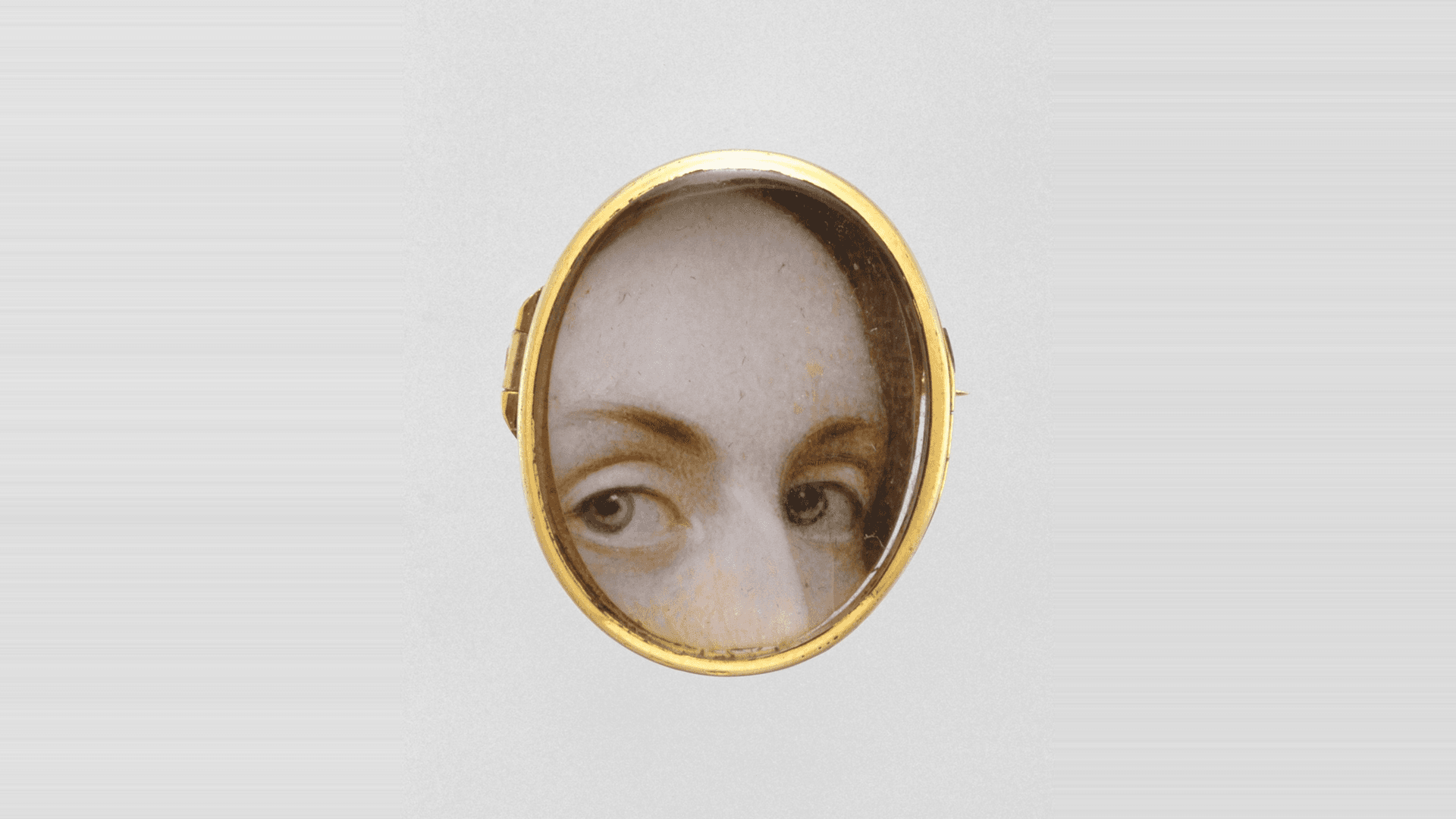
Hero image: Lover's Eye miniature, anonymous artist, The Metropolitan Museum of Art, CC0. Via Wikimedia Commons.
Take our professional IQ test
Want to know your IQ? Try the first ever professional online IQ test.