Does Eating Meat Make You Smarter? What the Research Shows | Riot IQ
Oct 19, 2026·Advanced Topics & Research
Does Eating Meat Make You Smarter? What the Research Shows
Does eating meat make you smarter? Not in well-fed people. Meat helped undernourished Kenyan kids on a reasoning test, and vegetarians tend to have higher IQs.
Dr. Russell T. WarneChief Scientist
Share
Eating meat does not make well-fed people smarter, and the best-known study points the other way: British children who scored 1 standard deviation (15 IQ points) higher at age 10 had 38% higher odds of being vegetarian at age 30. Meat does seem to help children who are short of food and nutrients; in a randomized school-feeding trial in rural Kenya, children given meat improved fastest on Raven's Progressive Matrices, a nonverbal reasoning test.
So the honest answer depends on who is eating. This page covers the vegetarian IQ research, the Kenyan trial, the nutrient gaps that can harm thinking on a strict vegan diet, and the evolutionary claim that meat built the human brain. Our page on whether diet or nutrition affects IQ covers food and intelligence more broadly. Nothing here is dietary or medical advice.
Do vegetarians have lower IQs?
No. In the largest study on the question, they had higher ones. Gale and colleagues followed 8,170 people in the 1970 British Cohort Study, who took mental ability tests at age 10 and reported their diets at 30. Of these, 366 (4.5%) said they were vegetarian, although about a third of them admitted eating fish or chicken.
Each 1 standard deviation (15 points) of childhood IQ went with 38% higher odds of being vegetarian as an adult. Vegetarians were also more likely to be women, to come from a higher social class and to hold more qualifications. After the researchers adjusted for social class, qualifications and sex, the link shrank to 20% higher odds per standard deviation but did not disappear. Dropping the people who ate fish or chicken made little difference.
The direction of this finding matters. IQ was measured 20 years before diet, so it cannot be that giving up meat raised these children's scores. The more likely reading is that brighter, better-educated people are more receptive to health and ethical arguments about diet. That is selection, and it is the same pattern seen with many "smart people do X" findings.
Studies that compare vegetarians and meat eaters directly find little difference in thinking ability:
• Older adults in the Adventist Health Study-2: Gatto and colleagues gave 132 healthy older adults a full neuropsychological battery. Processing speed, executive function and memory scores did not differ between vegetarians and non-vegetarians. The sample was small, and Seventh-day Adventists are an unusual, health-conscious group.
• Children of vegetarian mothers: In the Southampton Women's Survey, Crozier and colleagues compared children whose mothers were vegetarian or omnivorous during pregnancy. Vegetarian mothers had lower blood levels of vitamin B12 and some fatty acids, but after adjustment for confounders their children scored no worse on cognitive tests at ages 6 to 7. The vegetarian mothers were also better educated and tended to have higher IQs themselves.
The Kenyan school-feeding trial
The strongest causal evidence that meat can raise test scores comes from a single cluster-randomized trial in rural Embu District, Kenya, run by Charlotte Neumann and colleagues. Twelve schools with 555 first-grade children were randomly assigned to four groups. Three groups received a daily school snack of githeri, a local maize and bean stew, with meat, milk or extra oil added so that each snack had the same energy. The fourth group received no snack.
• Reasoning: Over 21 months, Whaley and colleagues found that the meat group outperformed all other groups on Raven's Progressive Matrices, a nonverbal reasoning test that is a good measure of fluid intelligence.
• Arithmetic and verbal skills: The meat and plain-githeri groups beat the control group on arithmetic. No group differed on verbal comprehension.
• School exams: In a later analysis of district-wide end-of-term exams, Hulett and colleagues found that the meat group improved more than every other group, with gains in arithmetic, English, Kiswahili, the local language Kiembu and geography. Intakes of iron, zinc, vitamin B12 and folate predicted the gains.
These children often ate too little and had diets short in iron, zinc and B12, nutrients that meat supplies in easily absorbed forms. The trial shows that adding meat to a poor diet can help children who are undernourished. It says nothing about adding more meat to an already adequate Western diet. Two caveats apply even in Kenya. Murphy and colleagues found that families cut back food at home for children given the milk or plain snacks, but less so for the meat group, so the meat children also ended up with more total energy. And because whole schools were randomized, the trial rests on just twelve units split four ways.
The wider evidence for animal-source foods in young children is weak. A Cochrane review by Eaton and colleagues found six trials in children aged 6 to 59 months, rated the evidence "very low" quality, and concluded that the effects on growth and development are uncertain.
When a meat-free diet can harm thinking
A well-planned vegetarian or vegan diet is not known to lower intelligence. The risk is a nutrient shortfall, and vitamin B12, which is found almost only in animal foods, is the main one. Our page on vitamin B12 and IQ covers deficiency in detail.
The clearest warning comes from the Netherlands. Louwman and colleagues studied 48 adolescents who had been raised on a strict macrobiotic (vegan-type) diet until about age 6 and 24 peers raised on ordinary diets. The omnivorous controls did better on most tests, and among the macrobiotic group, worse B12 status went with lower scores on a test of fluid intelligence (r = -0.38). The children had moved on to vegetarian or omnivorous diets years earlier, which suggests early deficiency can leave a lasting mark.
Creatine, which the body also gets from meat and fish, is a separate question covered on our page about creatine and IQ. Parents raising children on a vegan diet, and anyone worried about their own levels, should speak to a doctor or registered dietitian about B12 testing and supplements.
Did eating meat make humans smart?
The evolutionary version of the claim is popular. In 1995 Aiello and Wheeler proposed the "expensive-tissue hypothesis": the brain and the gut are both energy-hungry organs, so early humans could only afford a bigger brain by shrinking the gut, which in turn required richer food such as meat.
Later evidence has weakened this account. Navarrete and colleagues compared organ sizes in 100 mammal species, including 23 primates, and found no trade-off between brain size and gut size once body size was taken into account. Barr and colleagues reviewed the fossil record of eastern Africa from 2.6 to 1.2 million years ago and found that, after correcting for how intensively sites have been studied, there was no lasting rise in evidence of meat eating when Homo erectus appeared. Meat was probably part of the story, alongside other changes in diet and energy use. A rival idea, the cooking hypothesis, gives the credit to cooked food and control of fire.
Even if meat helped our ancestors evolve larger brains over hundreds of thousands of years, that would not mean that eating more meat today raises an individual's IQ.
Meat and the aging brain
Several large cohorts have tracked meat intake and later dementia. In the UK Biobank, Zhang and colleagues followed 493,888 adults for about 8 years. Each extra 25 grams a day of processed meat went with a 44% higher risk of dementia, while each extra 50 grams a day of unprocessed red meat went with a 19% lower risk. A 2026 study by Song and colleagues of older adults in China, Europe and the United States found that lacto-ovo vegetarians had 28% and vegans 33% higher odds of cognitive impairment than omnivores, with the link strongest in rural areas.
Both studies are observational. Meat intake tracks income, health, smoking and many other habits, and dementia is not a measure of IQ. They are useful mainly as a reminder that the type of meat and the rest of the diet probably matter more than whether meat is eaten at all.
Frequently asked questions
Does eating meat make you smarter?
Not in people who already eat enough. Meat improved reasoning test scores in undernourished Kenyan schoolchildren, but there is no evidence that it raises IQ in well-fed adults.
Are vegetarians smarter than meat eaters?
On average, people who became vegetarian had slightly higher IQs as children. That reflects who chooses the diet, since IQ was measured 20 years before diet in the main study.
Can a vegan diet lower IQ?
A well-planned vegan diet has not been shown to lower IQ. Untreated vitamin B12 deficiency, especially in young children, can harm thinking, so B12 intake matters.
Did meat make the human brain bigger?
It may have helped, but the expensive-tissue idea has been weakened by comparative data, and the fossil record shows no clear jump in meat eating when brains began to grow.
Is red meat bad for the brain?
In the UK Biobank, processed meat was linked to higher dementia risk and unprocessed red meat to slightly lower risk. These are associations, not proof of cause.
The takeaway
Eating meat is not a route to a higher IQ for people who already have enough to eat. Meat helped Kenyan children whose diets were short in energy and key nutrients, and people who go meat-free need to watch B12, but in well-fed populations the brighter children are the ones more likely to give meat up. If you want a reliable measure of your reasoning ability, take a full-length online IQ test.
References
1. Gale, C. R., Deary, I. J., Schoon, I., & Batty, G. D. (2007). IQ in childhood and vegetarianism in adulthood: 1970 British cohort study. BMJ, 334(7587), 245. [doi.org/10.1136/bmj.39030.675069.55](. doi.org
2. Gatto, N. M., Garcia-Cano, J., Irani, C., Jaceldo-Siegl, K., Liu, T., Chen, Z., Paul, J., Fraser, G., Wang, C., & Lee, G. J. (2021). Vegetarian dietary patterns and cognitive function among older adults: The Adventist Health Study-2. Journal of Nutrition in Gerontology and Geriatrics, 40(4), 197-214. [doi.org/10.1080/21551197.2021.1965939](. doi.org
3. Crozier, S. R., Godfrey, K. M., Calder, P. C., Robinson, S. M., Inskip, H. M., Baird, J., Gale, C. R., Cooper, C., Sibbons, C. M., Fisk, H. L., & Burdge, G. C. (2019). Vegetarian diet during pregnancy is not associated with poorer cognitive performance in children at age 6-7 years. Nutrients, 11(12), 3029. [doi.org/10.3390/nu11123029](. doi.org
4. Whaley, S. E., Sigman, M., Neumann, C., Bwibo, N., Guthrie, D., Weiss, R. E., Alber, S., & Murphy, S. P. (2003). The impact of dietary intervention on the cognitive development of Kenyan school children. The Journal of Nutrition, 133(11), 3965S-3971S. [doi.org/10.1093/jn/133.11.3965S](. doi.org
5. Neumann, C. G., Murphy, S. P., Gewa, C., Grillenberger, M., & Bwibo, N. O. (2007). Meat supplementation improves growth, cognitive, and behavioral outcomes in Kenyan children. The Journal of Nutrition, 137(4), 1119-1123. [doi.org/10.1093/jn/137.4.1119](. doi.org
6. Hulett, J. L., Weiss, R. E., Bwibo, N. O., Galal, O. M., Drorbaugh, N., & Neumann, C. G. (2014). Animal source foods have a positive impact on the primary school test scores of Kenyan schoolchildren in a cluster-randomised, controlled feeding intervention trial. British Journal of Nutrition, 111(5), 875-886. [doi.org/10.1017/S0007114513003310](. doi.org
7. Murphy, S. P., Gewa, C., Liang, L.-J., Grillenberger, M., Bwibo, N. O., & Neumann, C. G. (2003). School snacks containing animal source foods improve dietary quality for children in rural Kenya. The Journal of Nutrition, 133(11), 3950S-3956S. [doi.org/10.1093/jn/133.11.3950S](. doi.org
8. Eaton, J. C., Rothpletz-Puglia, P., Dreker, M. R., Iannotti, L., Lutter, C., Kaganda, J., & Rayco-Solon, P. (2019). Effectiveness of provision of animal-source foods for supporting optimal growth and development in children 6 to 59 months of age. Cochrane Database of Systematic Reviews, 2019(2), CD012818. [doi.org/10.1002/14651858.CD012818.pub2](. doi.org
9. Louwman, M. W., van Dusseldorp, M., van de Vijver, F. J., Thomas, C. M., Schneede, J., Ueland, P. M., Refsum, H., & van Staveren, W. A. (2000). Signs of impaired cognitive function in adolescents with marginal cobalamin status. The American Journal of Clinical Nutrition, 72(3), 762-769. [doi.org/10.1093/ajcn/72.3.762](. doi.org
10. Aiello, L. C., & Wheeler, P. (1995). The expensive-tissue hypothesis: The brain and the digestive system in human and primate evolution. Current Anthropology, 36(2), 199-221. [doi.org/10.1086/204350](. doi.org
11. Navarrete, A., van Schaik, C. P., & Isler, K. (2011). Energetics and the evolution of human brain size. Nature, 480(7375), 91-93. [doi.org/10.1038/nature10629](. doi.org
12. Barr, W. A., Pobiner, B., Rowan, J., Du, A., & Faith, J. T. (2022). No sustained increase in zooarchaeological evidence for carnivory after the appearance of Homo erectus. Proceedings of the National Academy of Sciences, 119(5), e2115540119. [doi.org/10.1073/pnas.2115540119](. doi.org
13. Zhang, H., Greenwood, D. C., Risch, H. A., Bunce, D., Hardie, L. J., & Cade, J. E. (2021). Meat consumption and risk of incident dementia: Cohort study of 493,888 UK Biobank participants. The American Journal of Clinical Nutrition, 114(1), 175-184. [doi.org/10.1093/ajcn/nqab028](. doi.org
14. Song, Z., He, Z., Wang, X., Lei, C., Ding, M., Sun, Z., Cao, J., Ren, G., & Di, Y. (2026). A gradient risk of cognitive impairment with vegetarian diets in older adults: Highest for vegan and potential benefit for pescatarian. Food Research International, 229, 118455. [doi.org/10.1016/j.foodres.2026.118455](. doi.org
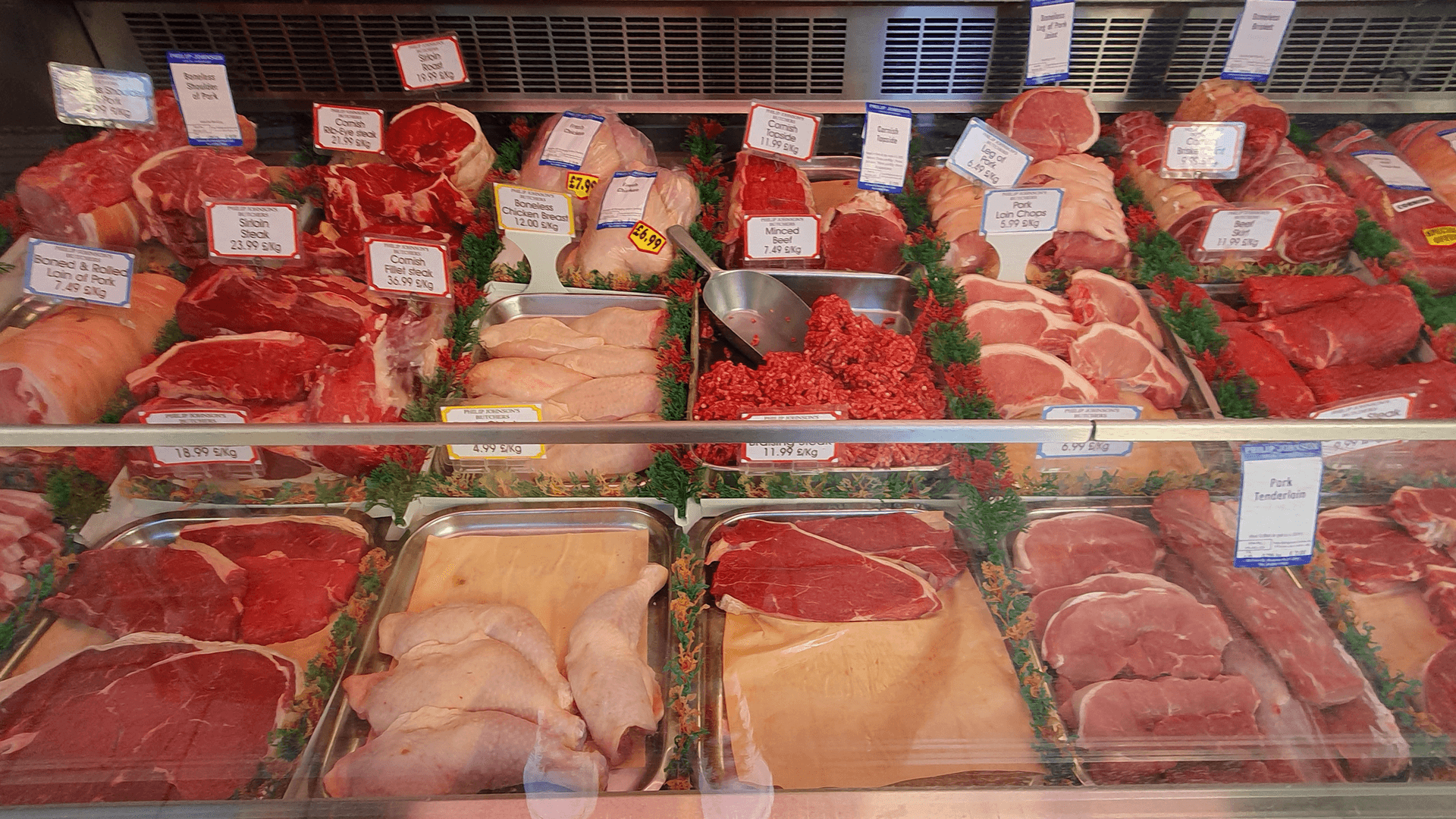
Hero image: Meat display in butcher's shop, Bodmin, Cornwall - January 2023, by Mutney, CC BY-SA 4.0. Via Wikimedia Commons.
Take our professional IQ test
Want to know your IQ? Try the first ever professional online IQ test.