Do Nuts Make You Smarter? What the Research Shows for IQ
Do nuts make you smarter? Not in any good trial. Walnut trials in 708 older adults and 771 teenagers found no overall gain on cognitive tests or IQ.
Dr. Russell T. WarneChief Scientist
Share
Nuts do not make you smarter in any way a well-run trial has detected. In the largest walnut trial, 708 healthy older adults ate 30 to 60 grams a day for two years, and their cognitive scores changed by almost exactly the same amount as those of people who ate none (a gap of about 0.01 standard deviations), while a six-month trial in 771 teenagers found no effect on any primary outcome, including a test of fluid intelligence.
Nuts are a reasonable food, and cohort studies link them to slightly better memory scores in old age. This page covers why walnuts got their reputation, what the randomized trials in older adults, college students and adolescents found, and why the observational links are hard to interpret. It describes research and is not medical or dietary advice.
Why walnuts look like a brain food
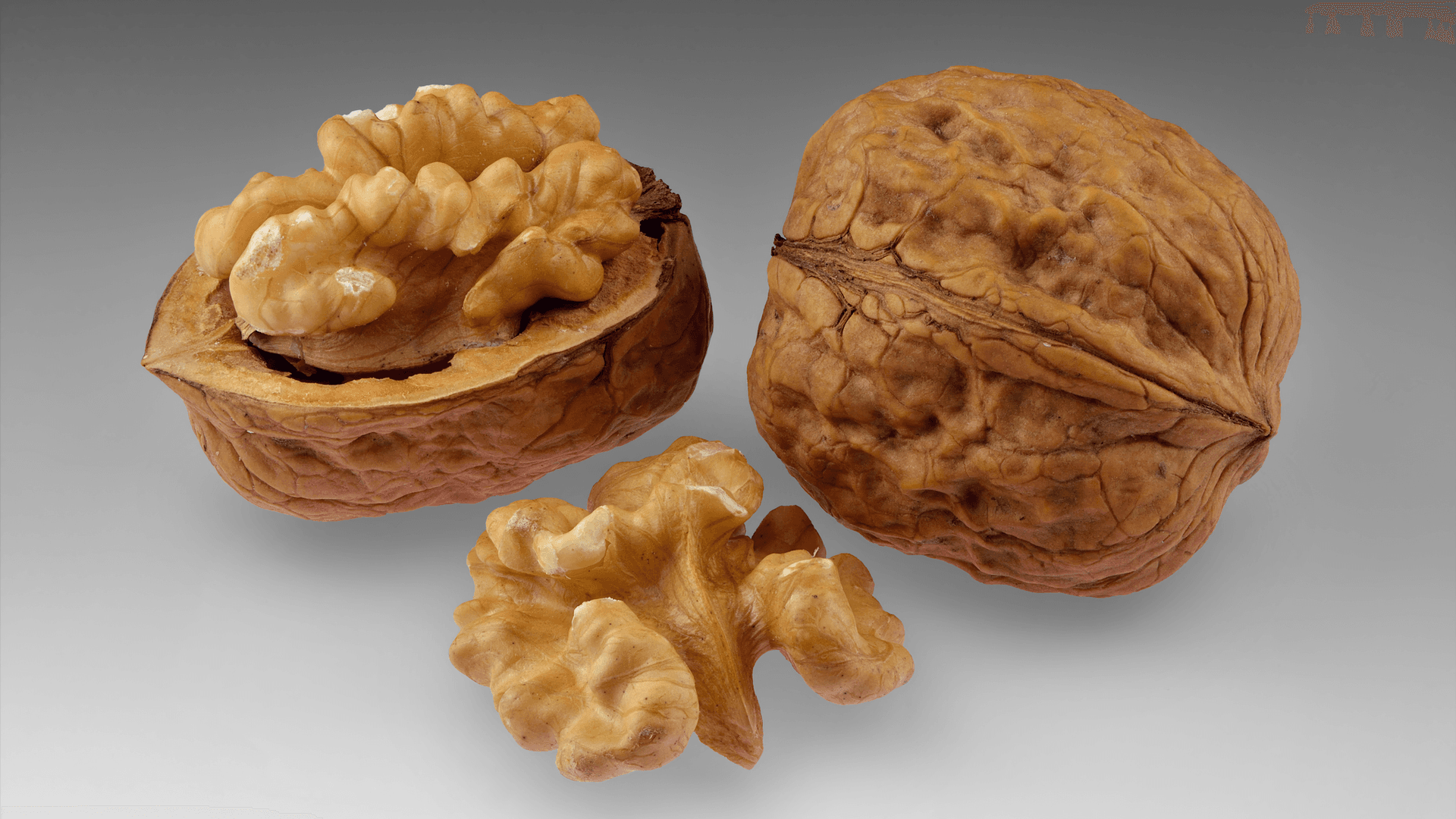
The idea is old. Under the "doctrine of signatures", a premodern belief that a plant's appearance reveals what it treats, the walnut was a natural candidate. In his 1657 herbal Adam in Eden, William Coles wrote that the kernel "hath the very figure of the Brain, and therefore it is very profitable for the Brain." A resemblance in shape is not evidence about what a food does, and modern nutrition science discarded the doctrine long ago, but the walnut's reputation survived.
The modern case is chemical. Walnuts contain vitamin E, folate, polyphenols and a good deal of alpha-linolenic acid ("ALA"), a plant omega-3 fat. ALA differs from the DHA and EPA in fish oil, and the fish-oil trials are a separate literature, which our page on fish oil and IQ covers. A plausible mechanism is a reason to run a trial. It does not tell you what the trial will find.
What the randomized trials found
Three walnut trials and one mixed-nut trial arm give the most direct evidence.
• Older adults (the WAHA trial): The Walnuts And Healthy Aging study randomly assigned 708 cognitively healthy people aged 63 to 79, in Barcelona and Loma Linda, California, to add walnuts at about 15% of their daily energy (30 to 60 grams) or to avoid walnuts for two years. In the main analysis of 657 participants, the global cognition score fell by 0.072 standard units in the walnut group and 0.086 in the control group, a difference too small to distinguish from zero. On the IQ scale that gap would be about 0.2 points, though the outcome was a battery of cognitive tests and not an IQ score. A post hoc analysis found a small advantage for walnuts at the Barcelona site, where participants were less educated and scored lower at baseline. The authors called this encouraging but inconclusive.
• Teenagers (the Walnuts Smart Snack trial): Pinar-Martí and colleagues randomized 771 healthy adolescents aged 11 to 16 in 12 Barcelona high schools to a group that ate 30 grams of raw walnuts a day for six months or to a control group. In the intention-to-treat analysis, which compares everyone as randomized, there were no significant differences on working memory, attention, executive function, behaviour or fluid intelligence (an inductive reasoning test). Only about a third of the walnut group (133 of 386) ate the walnuts for more than 100 of the 180 days. In an analysis weighted for adherence, the walnut group scored 1.78 more items correct on the reasoning test, roughly a third of a standard deviation given a baseline spread of about 5.5 items. That estimate depends on who chose to keep eating, so it lacks the protection of randomization. The California Walnut Commission supplied the walnuts free of charge.
• College students: Pribis and colleagues gave 64 students walnut-enriched banana bread or a placebo version for eight weeks each in a crossover design. Walnuts produced no gains in memory, mood or nonverbal reasoning. One verbal reasoning measure improved (d = 0.57), a single positive result among several outcomes in a small sample.
• Mixed nuts in PREDIMED: In the Barcelona cognition sub-study of the Spanish PREDIMED trial, a Mediterranean diet with 30 grams of mixed nuts a day was linked to a better memory composite than a low-fat control diet after about four years, in 334 older adults retested. The PREDIMED trial is mostly a story about olive oil and the Mediterranean diet, and its randomization problems (which led to a 2018 correction of this sub-study) are covered elsewhere on this site.
No trial in any age group has given nuts and then measured full-scale IQ. The closest thing, the reasoning test in the adolescent trial, showed no effect in the primary analysis.
What the cohort studies show
Most of the positive claims come from observational studies, which compare people who already eat nuts with people who do not.
The largest is from the Nurses' Health Study. O'Brien and colleagues followed 15,467 women aged 70 or older who reported their nut intake on questionnaires starting in 1980. On telephone cognitive tests given between 1995 and 2001, women who ate at least five servings of nuts a week scored 0.08 standard units higher on a global composite than women who ate none. The authors noted this equals the difference between women about two years apart in age. On the IQ scale it would be just over 1 point. Nut intake was not linked to how fast cognition declined over six years, which is the outcome that would matter most if nuts protected the brain.
A systematic review by Theodore and colleagues collected 22 studies with 43,793 adult participants. Because the studies differed in which nuts they examined and which cognitive tests they used, the authors described the evidence for mixed nuts as inconsistent. Studies of walnuts were more uniform: five of six found a positive association. Most of those were observational. Studies in groups at higher risk of cognitive decline tended to report more favourable results.
The reason caution is needed is selection. People who eat nuts several times a week tend to differ in education, income, overall diet, exercise and smoking from people who rarely eat them, and those factors predict cognitive scores on their own. Statistical adjustment reduces this problem but never removes it, which is why a small advantage in a cohort and a null result in a trial are compatible. For the broader picture of what food can and cannot do for intelligence, see our overview of whether diet or nutrition affects IQ.
How to read these numbers
It helps to put the effects on one scale. The cohort advantage in older women was about 1 IQ-point equivalent. The two-year trial difference was about 0.2 points. The adolescent per-protocol estimate was larger, about 5 points if converted (0.33 × 15), but it is the least protected by randomization and sits beside a null primary result.
These conversions are rough. The outcomes were cognitive test composites and, at best, a single reasoning subtest, neither of which is a full IQ battery, and IQ scores are among the most stable traits psychologists measure in adults. A food that raised them would have to show it repeatedly in randomized trials with proper tests.
Two narrower questions remain open. One is whether nuts slow decline in people at higher risk, as the Barcelona subgroup hinted. The other is whether diets rich in nuts reduce dementia risk over decades, a separate question from intelligence that our page on whether IQ is correlated with dementia touches on.
Frequently asked questions
Do nuts make you smarter?
No trial has shown it. A two-year walnut trial in older adults and a six-month trial in teenagers both found no overall effect on cognitive test scores, including a fluid reasoning test.
Are walnuts good for your brain because they look like one?
The resemblance is a leftover from the doctrine of signatures, a premodern idea that a plant's shape shows its medical use. Walnuts do contain ALA omega-3 fat and antioxidants, but trials have not found that eating them raises cognitive scores.
Can nuts help children or teenagers do better at school?
The best trial, in 771 adolescents, found no effect on attention, memory or reasoning when everyone assigned to walnuts was compared with controls. Teenagers who ate the walnuts consistently did better on some tests, but that comparison cannot rule out other differences between them.
Do nuts prevent dementia or memory loss?
Cohort studies link regular nut eating to slightly better memory scores in old age, but not to slower decline. Trials so far are inconclusive, and anyone worried about memory changes should speak with a doctor.
Which nuts are best for the brain?
Walnuts have been studied most, and even for walnuts the trial evidence is null overall. No study has shown that one kind of nut raises intelligence more than another.
The takeaway
Nuts are a reasonable part of a healthy diet, but they do not make you smarter. Large trials in older adults and teenagers found no overall effect on cognitive tests, and the small advantages in cohort studies, around 1 IQ-point equivalent, are the size that differences in education and lifestyle can produce. If you want an accurate measure of your reasoning ability, try an online IQ test built by psychometricians.
References
1. Sala-Vila, A., Valls-Pedret, C., Rajaram, S., Coll-Padrós, N., Cofán, M., Serra-Mir, M., ... Ros, E. (2020). Effect of a 2-year diet intervention with walnuts on cognitive decline. The Walnuts And Healthy Aging (WAHA) study: A randomized controlled trial. The American Journal of Clinical Nutrition, 111(3), 590-600. [doi.org/10.1093/ajcn/nqz328](. doi.org
2. Pinar-Martí, A., Gignac, F., Fernández-Barrés, S., Romaguera, D., Sala-Vila, A., Lázaro, I., ... Julvez, J. (2023). Effect of walnut consumption on neuropsychological development in healthy adolescents: A multi-school randomised controlled trial. eClinicalMedicine, 59, 101954. [doi.org/10.1016/j.eclinm.2023.101954](. doi.org
3. Pribis, P., Bailey, R. N., Russell, A. A., Kilsby, M. A., Hernandez, M., Craig, W. J., Grajales, T., Shavlik, D. J., & Sabaté, J. (2012). Effects of walnut consumption on cognitive performance in young adults. British Journal of Nutrition, 107(9), 1393-1401. [doi.org/10.1017/S0007114511004302](. doi.org
4. Valls-Pedret, C., Sala-Vila, A., Serra-Mir, M., Corella, D., de la Torre, R., Martínez-González, M. Á., ... Ros, E. (2015; corrected 2018). Mediterranean diet and age-related cognitive decline: A randomized clinical trial. JAMA Internal Medicine, 175(7), 1094-1103. [doi.org/10.1001/jamainternmed.2015.1668](. doi.org
5. O'Brien, J., Okereke, O., Devore, E., Rosner, B., Breteler, M., & Grodstein, F. (2014). Long-term intake of nuts in relation to cognitive function in older women. The Journal of Nutrition, Health & Aging, 18(5), 496-502. [doi.org/10.1007/s12603-014-0014-6](. doi.org
6. Theodore, L. E., Kellow, N. J., McNeil, E. A., Close, E. O., Coad, E. G., & Cardoso, B. R. (2021). Nut consumption for cognitive performance: A systematic review. Advances in Nutrition, 12(3), 777-792. [doi.org/10.1093/advances/nmaa153](. doi.org
7. Coles, W. (1657). Adam in Eden, or nature's paradise: The history of plants, fruits, herbs and flowers. London: Nathaniel Brooke. Digitized by the Wellcome Collection. [wellcomecollection.org](. wellcomecollection.org
Hero image: Walnuts, whole and open with halved kernel, by Ivar Leidus, CC BY-SA 4.0. Via Wikimedia Commons.
Take our professional IQ test
Want to know your IQ? Try the first ever professional online IQ test.