Do Energy Drinks Make You Smarter? What the Research Shows for IQ | Riot IQ
Oct 21, 2026·Advanced Topics & Research
Do Energy Drinks Make You Smarter? What the Research Shows for IQ
Do energy drinks make you smarter? No. Their caffeine can speed you up for an hour or two, but no study shows an IQ gain, and heavy use is linked to poor sleep.
Dr. Russell T. WarneChief Scientist
Share
Energy drinks do not make you smarter. A can can make you slightly quicker and more alert for an hour or two, almost entirely because of the 40 to 250 milligrams of caffeine it contains, but no study has found that energy drinks raise IQ, and heavy use in students goes along with shorter sleep and lower grades.
That short-term lift is a change in your state, much like the difference between taking a test tired and taking it rested. This page covers what is in an energy drink, what controlled trials of the drinks and their ingredients found, what the studies of teenagers and students show, and how much caffeine health agencies consider safe. It describes research and is not medical advice.
What is in an energy drink?
The active ingredient that matters is caffeine. A review by McLellan and Lieberman found that a typical 235-millilitre serving provides between 40 and 250 milligrams, which overlaps with the doses that improve attention and reaction time in laboratory studies. The rest of the label usually lists taurine (an amino acid), glucuronolactone, B vitamins, and plant extracts such as guaraná and ginseng. Full-sugar versions also carry a large dose of sugar.
McLellan and Lieberman searched for every study that tested these extra ingredients on physical or mental performance and found 32. Apart from some weak evidence for glucose and for guaraná extract, they concluded there was "an overwhelming lack of evidence" that anything other than caffeine contributes. In practical terms, an energy drink is a caffeinated soft drink. Our page on caffeine and IQ covers what caffeine itself does to thinking, including the problem of caffeine withdrawal in research.
What controlled trials of energy drinks found
The best direct evidence comes from small, double-blind laboratory studies that give people a drink or a placebo and test them shortly afterwards.
• The whole drink: Scholey and Kennedy gave 20 adults, who had fasted overnight and gone without caffeine, a 250-millilitre drink containing 75 milligrams of caffeine and 37.5 grams of glucose, its separate ingredients, or a placebo on five separate days. Thirty minutes after the whole drink, they scored better on a memory factor and a speed-of-attention factor. Other measures did not change.
• Ingredient by ingredient: Giles and colleagues gave 48 habitual caffeine users, deprived of caffeine for 24 hours, 200 milligrams of caffeine, 2,000 milligrams of taurine, both, or neither, each with or without 50 grams of glucose. Caffeine improved executive control and working memory and shortened reaction times. Taurine had mixed effects, slowing one reaction-time measure and speeding another, and glucose on its own slowed choice reaction time. The authors concluded that caffeine, and not taurine or glucose, is likely responsible for the cognitive changes people notice after an energy drink.
Two features of these studies matter for anyone hoping for a lasting gain. The outcomes were reaction times and memory tasks measured within an hour, and none was an intelligence test. The volunteers had also gone without caffeine beforehand, so part of the improvement is probably the relief of mild withdrawal, which brings a regular user back to their usual level. No trial has given people energy drinks and then measured full-scale IQ.
Sugar is the other ingredient people credit with a "boost". Blinded trials of sugar and thinking are covered in our page on sugar and IQ, and they do not support the idea of a meaningful sugar rush.
Energy drinks, sleep and school performance
The more worrying evidence concerns regular use, especially in young people. These studies are observational, which means they compare people who already drink energy drinks with people who do not.
• Sleep in university students: In a Norwegian survey of 53,266 students aged 18 to 35, about 4.7% of men and 3.3% of women drank energy drinks daily. Daily drinkers were roughly twice as likely to sleep too little (a risk ratio of 2.07 in men and 1.87 in women), and even small amounts were linked to taking longer to fall asleep and waking more in the night.
• Attention problems in middle school: In a Yale study of 1,649 middle school students in New Haven, those who reported drinking energy drinks were 66% more likely to be at risk for hyperactivity and inattention on a standard questionnaire, after adjusting for the number of sweetened drinks they consumed and other factors.
• A systematic review of children and young people: Ajibo and colleagues reviewed 57 studies published between 2016 and 2022. Energy drink use was associated with short and poor-quality sleep and with lower academic performance. It was also associated with smoking and alcohol use.
None of these studies shows that energy drinks cause lower grades. The direction can run both ways: a teenager who sleeps badly or struggles to concentrate may reach for an energy drink to get through the day. Energy drink use also tracks other differences. The UK government notes that children in more deprived areas are more likely to drink them, and family income and parental education predict school performance on their own. What is fairly clear is that a large dose of caffeine late in the day shortens sleep, and short sleep lowers performance on demanding mental tasks, a link our page on how sleep affects IQ and cognitive performance explains.
Do energy drinks lower IQ?
There is no evidence either way, because no study has measured IQ in energy drink users over time. Claims that energy drinks "lower IQ" go beyond the data, just as claims that they raise it do. IQ is one of the most stable traits psychologists measure in adults, and a drink that changed it would need to show that in long-term studies with proper tests.
What health agencies have done is set caffeine limits. The US Food and Drug Administration cites 400 milligrams a day as an amount not generally associated with negative effects in most healthy adults. The European Food Safety Authority reached the same daily figure for adults, considered single doses up to 200 milligrams safe, and found the evidence too limited to set a safe level for children and adolescents, suggesting about 3 milligrams per kilogram of body weight per day as a basis. In July 2026 the UK government confirmed that from April 2027 it will be illegal in England to sell drinks other than tea or coffee containing more than 150 milligrams of caffeine per litre to anyone under 16. Parents or students concerned about energy drink use, sleep or concentration can speak with a doctor or school nurse.
Frequently asked questions
Do energy drinks make you smarter?
No. Their caffeine can make you slightly faster and more alert for an hour or two, but no study has found a change in IQ.
Is an energy drink before an exam a good idea?
Caffeine can help a tired person stay alert, but it works the same way in coffee or tea. A high dose can also cause jitteriness and, taken late in the day, can cut into the sleep that matters more for exam performance.
Does taurine improve brain function?
Not in the human trials so far. A review of 32 studies found almost no evidence that taurine or other energy drink extras improve performance beyond the effect of caffeine.
Do energy drinks cause ADHD?
No study shows that they cause it. Surveys link energy drinks to more hyperactivity and inattention symptoms in teenagers, but those surveys cannot tell which came first, and anyone concerned about attention problems should speak with a doctor.
How much caffeine is in an energy drink?
A typical 235-millilitre serving contains 40 to 250 milligrams, and larger cans contain more. The FDA cites 400 milligrams a day as generally safe for most healthy adults, and European regulators suggest far lower amounts for children.
The takeaway
Energy drinks do not make you smarter. Their caffeine can sharpen alertness for a short time, and the other ingredients add little to that. Regular heavy use in young people goes along with poorer sleep and weaker school results, though those studies cannot prove cause and effect. If you want to know where your reasoning ability actually stands, take the RIOT IQ test when you are rested.
References
1. McLellan, T. M., & Lieberman, H. R. (2012). Do energy drinks contain active components other than caffeine? Nutrition Reviews, 70(12), 730-744. [doi.org/10.1111/j.1753-4887.2012.00525.x](. doi.org
2. Scholey, A. B., & Kennedy, D. O. (2004). Cognitive and physiological effects of an "energy drink": An evaluation of the whole drink and of glucose, caffeine and herbal flavouring fractions. Psychopharmacology, 176(3-4), 320-330. [doi.org/10.1007/s00213-004-1935-2](. doi.org
3. Giles, G. E., Mahoney, C. R., Brunyé, T. T., Gardony, A. L., Taylor, H. A., & Kanarek, R. B. (2012). Differential cognitive effects of energy drink ingredients: Caffeine, taurine, and glucose. Pharmacology Biochemistry and Behavior, 102(4), 569-577. [doi.org/10.1016/j.pbb.2012.07.004](. doi.org
4. Kaldenbach, S., Hysing, M., Strand, T. A., & Sivertsen, B. (2024). Energy drink consumption and sleep parameters in college and university students: A national cross-sectional study. BMJ Open, 14(2), e072951. [doi.org/10.1136/bmjopen-2023-072951](. doi.org
5. Schwartz, D. L., Gilstad-Hayden, K., Carroll-Scott, A., Grilo, S. A., McCaslin, C., Schwartz, M., & Ickovics, J. R. (2015). Energy drinks and youth self-reported hyperactivity/inattention symptoms. Academic Pediatrics, 15(3), 297-304. [doi.org/10.1016/j.acap.2014.11.006](. doi.org
6. Ajibo, C., Van Griethuysen, A., Visram, S., & Lake, A. A. (2024). Consumption of energy drinks by children and young people: A systematic review examining evidence of physical effects and consumer attitudes. Public Health, 227, 274-281. [doi.org/10.1016/j.puhe.2023.08.024](. doi.org
7. U.S. Food and Drug Administration. (2024). Spilling the beans: How much caffeine is too much? [fda.gov](. fda.gov
8. EFSA Panel on Dietetic Products, Nutrition and Allergies. (2015). Scientific opinion on the safety of caffeine. EFSA Journal, 13(5), 4102. [doi.org/10.2903/j.efsa.2015.4102](. doi.org
9. Department of Health and Social Care. (2026, July 16). Children's health further protected with energy drinks ban. GOV.UK. [gov.uk](. gov.uk
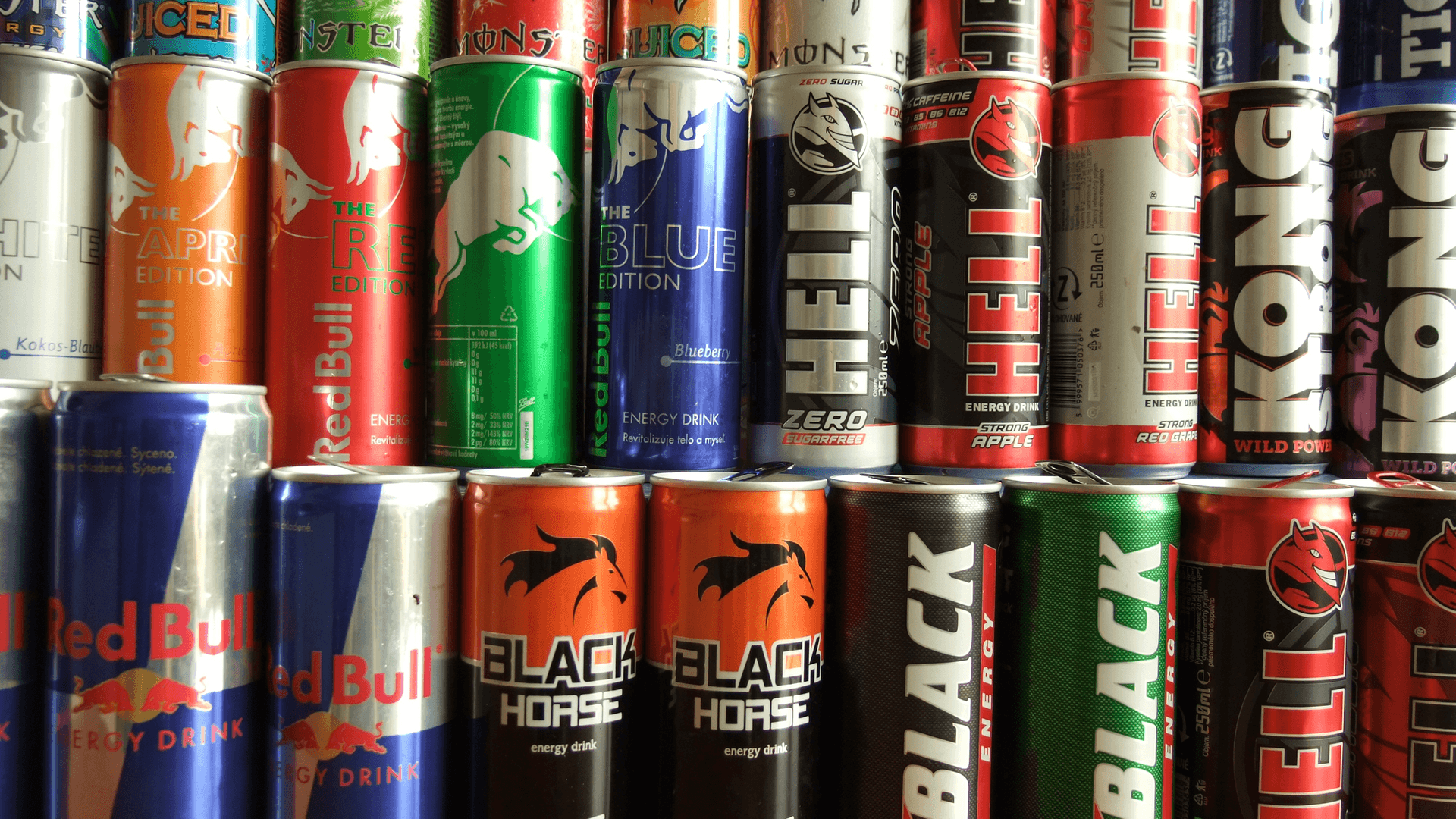
Hero image: Various energy drinks 01, by Oto Zapletal, CC BY-SA 4.0. Via Wikimedia Commons.
Take our professional IQ test
Want to know your IQ? Try the first ever professional online IQ test.