Does Honey Make You Smarter? What the Research Shows for IQ
Does honey make you smarter? No study shows it. Honey is about 82% sugar, and the best human trial found a short-term memory gain against no treatment at all.
Dr. Russell T. WarneChief Scientist
Share
Honey does not make you smarter, and no study has tested it on IQ. The best human evidence is a single 16-week Malaysian trial in 102 postmenopausal women, in which 20 grams of Tualang honey a day improved immediate word recall compared with women given nothing at all, with no gain in delayed recall.
Honey is about 82% sugar by weight, so any test of it as a brain food is partly a test of sugar. This page covers what honey contains, what the few human trials found, what the animal studies show, and the claims made for related bee products such as propolis and royal jelly. It describes research and is not medical or dietary advice.
What honey is made of
According to the US Department of Agriculture's FoodData Central database, 100 grams of honey contains about 82 grams of sugars, mostly fructose (about 41 grams) and glucose (about 36 grams), plus about 17 grams of water and less than half a gram of protein. A level tablespoon is roughly 21 grams, or about 17 grams of sugar.
The rest is a small mixture of enzymes, minerals, organic acids and plant compounds such as flavonoids and phenolic acids. These "polyphenols", compounds that act as antioxidants in the test tube, are the basis of most claims that honey protects the brain. Their amounts are small and vary with the flowers the bees visited. The polyphenol argument is the same one made for berries, and our page on blueberries and IQ looks at how that argument has held up in human trials.
Because honey is mostly sugar, the first question is whether sugar itself sharpens thinking. Blinded trials say it does not in any lasting way, a topic covered in detail on our page about sugar and IQ. Any benefit specific to honey would have to come from the small non-sugar fraction.
What the human trials found
Very few trials have given people honey and measured thinking, and none has measured IQ.
• Postmenopausal women (Tualang honey): Othman and colleagues at Universiti Sains Malaysia randomly assigned 102 healthy postmenopausal women to 20 grams a day of Tualang honey, a multifloral jungle honey from Malaysia, to estrogen-plus-progestin hormone therapy, or to no treatment. After 16 weeks, both the honey group and the hormone group did better than the untreated group on total learning and on immediate recall in a word-list memory test. Only the hormone group differed from controls on recall after interference and delayed recall. The control group received no honey, no sugar and no placebo, and the women knew what they were taking, so expectation and the extra sugar cannot be ruled out. The abstract reports no effect size that can be converted to an IQ scale. A 2015 review by the same group says the honey studies were funded by university research grants.
• Stroke patients (stingless-bee honey): In a 2025 Malaysian trial, 48 people with thinking problems after an ischaemic stroke were randomized to daily Trigona honey, made by stingless bees, or to no supplement for three months. On the Montreal Cognitive Assessment, a 30-point screening test for cognitive impairment, the honey group's average rose from about 20 to 24 points and the control group's from about 18 to 20. Again there was no placebo, the sample was small, and the outcome was a screening test for impairment, which is a different thing from an intelligence test.
• The dementia poster: A widely repeated claim comes from a 2009 conference poster abstract by Al-Himyari, which reported that among about 2,900 older adults given a daily tablespoon of honey or a placebo for five years, 95 in the honey group developed dementia compared with 394 in the placebo group. A poster abstract is not a peer-reviewed paper, and I could not find a full publication of the methods or data. Later papers nonetheless cite it as a randomized, placebo-controlled study.
None of these studies tested healthy young or middle-aged adults, and none compared honey with the same amount of ordinary sugar.
What the animal studies show
Most of the evidence for honey and memory comes from rats. A 2021 review of 28 papers on Tualang honey and the nervous system, written by researchers who work on it, noted that its memory effects "have been investigated in greater detail in animals than in human."
The animal designs are often more careful than the human ones on one point: they compare honey with sugar. In a New Zealand study, Chepulis and colleagues fed 45 young rats a diet containing 10% honey, an equivalent amount of sucrose, or no sugar for 52 weeks. The honey-fed rats showed less anxiety-like behaviour and did better on a maze test of spatial memory at 9 and 12 months, though not on an object recognition task. Other studies report that Tualang honey protected memory in rats whose ovaries had been removed (a model of menopause) or that had been stressed or deprived of oxygen.
Results in rats are a reason to run human trials. They do not show that a spoonful of honey changes human intelligence. The doses and memory tasks differ, and many nutritional effects seen in rodents shrink or disappear in people.
Propolis, royal jelly and a safety note
Honey sits within a larger market of bee products sold for the brain, notably propolis (a resin bees use to seal the hive) and royal jelly (the secretion fed to queen larvae). A 2026 review by Garbarek and colleagues of bee-derived products in neurodegenerative disease found the evidence to be mostly from cell and animal studies, with limited human data, and concluded that these products "should currently be regarded as investigational candidates rather than established treatments." The authors also warned that preparations sold under the same name can differ widely in chemical makeup, so a result from one extract may not apply to another.
One safety fact matters more than any of the cognitive claims. Honey can contain the bacteria that cause botulism, and the US Centers for Disease Control and Prevention says honey should not be given to a child younger than 1 year old. Parents with questions about feeding an infant should ask a pediatrician. For the wider question of whether any food or diet changes intelligence, see our overview of whether diet or nutrition affects IQ.
Frequently asked questions
Does honey make you smarter?
No study has shown that honey raises intelligence. The best human trial found better immediate word recall after 16 weeks of honey compared with no treatment, with no placebo and no sugar comparison.
Is honey better for the brain than sugar?
In one rat study, honey-fed rats did better on a maze test than sucrose-fed rats. No human trial has compared the two on thinking, and honey is itself about 82% sugar.
Does honey help you study or do better on exams?
There is no evidence that eating honey before studying or a test improves performance. Like other sugars, it provides energy, but blinded trials of sugar find no lasting boost to thinking.
Does honey prevent dementia?
The claim rests largely on a 2009 conference abstract that was never published as a full paper I could find. Anyone worried about memory changes should speak with a doctor.
Can babies have honey for brain development?
No. The CDC advises against giving honey to children under 1 year old because of the risk of infant botulism, and no evidence suggests honey helps brain development.
The takeaway
Honey is a pleasant sweetener, but it does not make you smarter. The human evidence consists of a few small trials without placebo groups, measuring memory or screening scores in postmenopausal women and stroke patients, and much of the enthusiasm traces back to rat studies and an unpublished conference abstract. Honey's main ingredient is sugar, which does not raise intelligence either. If you want an accurate measure of your reasoning ability, you can take a full-length online IQ test.
References
1. Othman, Z., Shafin, N., Zakaria, R., Hussain, N. H. N., & Mohammad, W. M. Z. W. (2011). Improvement in immediate memory after 16 weeks of tualang honey (Agro Mas) supplement in healthy postmenopausal women. Menopause, 18(11), 1219-1224. [doi.org/10.1097/gme.0b013e31821e2044](. doi.org
2. Othman, Z., Zakaria, R., Hussain, N. H. N., Hassan, A., Shafin, N., Al-Rahbi, B., & Ahmad, A. H. (2015). Potential role of honey in learning and memory. Medical Sciences, 3(2), 3-15. [doi.org/10.3390/medsci3020003](. doi.org
3. Zarim, M. H. A., Ghazali, A. K., Halim, S. A., Rahman, E. N. S. E. A., Abusalah, M. A. H. A., Chan, Y. Y., & Hashim, S. (2025). The potential of Trigona honey as a supplementary therapy for vascular cognitive impairment in patients with acute ischaemic stroke. Malaysian Journal of Medical Sciences, 32(5), 70-81. [doi.org/10.21315/mjms-05-2025-359](. doi.org
4. Al-Himyari, F. A. (2009). The use of honey as a natural preventive therapy of cognitive decline and dementia in the Middle East [Conference abstract P1-241]. Alzheimer's & Dementia, 5(4 Suppl.). [doi.org/10.1016/j.jalz.2009.04.248](. doi.org
5. Azman, K. F., Aziz, C. B. A., Zakaria, R., Ahmad, A. H., Shafin, N., & Ismail, C. A. N. (2021). Tualang honey: A decade of neurological research. Molecules, 26(17), 5424. [doi.org/10.3390/molecules26175424](. doi.org
6. Chepulis, L. M., Starkey, N. J., Waas, J. R., & Molan, P. C. (2009). The effects of long-term honey, sucrose or sugar-free diets on memory and anxiety in rats. Physiology & Behavior, 97(3-4), 359-368. [doi.org/10.1016/j.physbeh.2009.03.001](. doi.org
7. Garbarek, J., Hys, O., Woźniak, A., Szewczyk-Golec, K., & Nuszkiewicz, J. (2026). Bee-derived products in neurodegenerative diseases: Bioactive constituents, redox-modulating mechanisms, evidence, and translational perspectives. Molecules, 31(19), 3564. [doi.org/10.3390/molecules31193564](. doi.org
8. U.S. Department of Agriculture, Agricultural Research Service. (2019). Honey (SR Legacy, FDC ID 169640). FoodData Central. [fdc.nal.usda.gov](. fdc.nal.usda.gov
9. Centers for Disease Control and Prevention. (2026). Botulism prevention. [cdc.gov](. cdc.gov
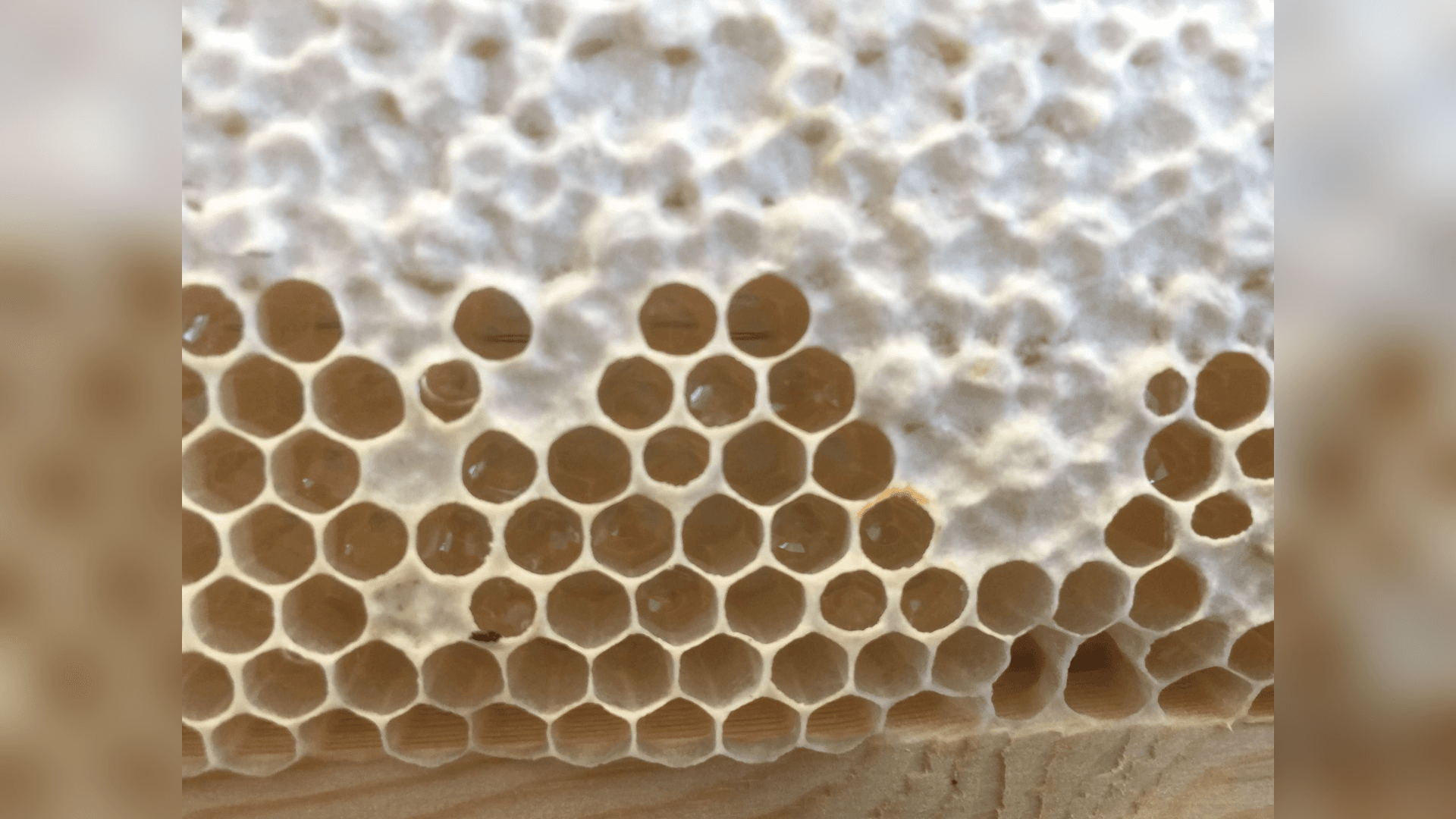
Hero image: Honey comb with capped honey, by Einebillion, CC BY 4.0. Via Wikimedia Commons.
Take our professional IQ test
Want to know your IQ? Try the first ever professional online IQ test.