Is Fidgeting a Sign of Intelligence? What the Research Shows
Is fidgeting a sign of intelligence? No study links it to IQ. Fidgeting rises with mental effort and mind wandering, and may help some people with ADHD.
Dr. Russell T. WarneChief Scientist
Share
Fidgeting is not a sign of intelligence, and no study has found that people who fidget more have higher IQs. There is no direct research on fidgeting and IQ at all; the nearest evidence shows that everyone tends to move more when a task gets mentally harder, that fidgeting in healthy adults goes with mind wandering and poorer memory for what they were taught, and that extra movement may help some children and adults with ADHD to concentrate.
This article covers what researchers mean by fidgeting, the experiments on movement and working memory, what fidget toys do in the classroom, where the "fidgeting means you're smart" idea comes from, and the confounds that make the claim hard to test.
What researchers mean by fidgeting
Fidgeting is small, repetitive movement that serves no obvious purpose: tapping a foot, bouncing a knee, clicking a pen, shifting in a chair. In ADHD research the same behaviour, measured more broadly, is called "gross motor activity" and is usually recorded with "actigraphs," small motion sensors worn on the wrist or ankle that count movement many times per second.
Ordinary fidgeting has been studied mainly as a sign of attention. Across four studies with adults, Jonathan Carriere, Paul Seli and Daniel Smilek found that people who described themselves as fidgety also reported being inattentive and having frequent spontaneous mind wandering, the kind that happens without meaning to. Deliberate mind wandering, attentional control and memory failures did not predict fidgeting once those were accounted for.
James Farley, Evan Risko and Alan Kingstone filmed 21 undergraduates while they watched a 40-minute lecture video. Attention and later memory for the lecture both declined as the lecture went on, and fidgeting rose. The link between more fidgeting and poorer retention held even after the students' own attention ratings were taken into account. In healthy adults, then, fidgeting looks more like a sign of a wandering mind than of a sharp one.
Movement and working memory: the experiments that started the debate
The research behind most popular claims comes from Mark Rapport's group at the University of Central Florida, and it concerns "working memory," the mental workspace that holds information while you use it.
In a 2009 study, Rapport and colleagues fitted 23 boys aged 8 to 12 with wrist and ankle actigraphs. Twelve had ADHD and 11 were typically developing. Every boy moved significantly more during working memory tasks than during control tasks, and the boys with ADHD moved more than the others in every condition. The extra movement was tied to the "central executive," the part of working memory that manages and updates information, and not to simple storage. The finding that matters most for the intelligence question is that all of the children moved more when the mental work got harder.
A 2015 follow-up led by Dustin Sarver studied 29 boys with ADHD and 23 typically developing boys on phonological (word and sound based) working memory tasks. In the ADHD group, higher activity during a task predicted significantly better working memory performance, though their scores did not reach the typical range. In the typically developing group, more movement predicted somewhat lower scores. Movement did not change attention in either group. The authors argued that hyperactivity may serve a compensatory role in ADHD, helping to keep the brain alert enough to work.
A 2024 study by Ha Min Son and colleagues points the same way in adults. Among 70 adults with ADHD wearing actigraphs during an attention task, fidgeting was higher on trials they answered correctly, and those with the most consistent reaction times fidgeted more later in the task. The study had no comparison group without ADHD.
These are small studies, and they show that movement and performance move together within a session, not that fidgeting makes anyone more intelligent. The research on ADHD and IQ scores is a separate question, covered in our article on ADHD and IQ.
What fidget toys do in the classroom
Whether fidget toys help focus has been tested directly. Paulo Graziano, Alexis Garcia and Taylor Landis studied 60 young children with ADHD (average age about 5) in a classroom treatment program. Using a design that alternated periods with and without spinners, they gave spinners to four randomly chosen children per classroom on three separate days, measured movement with accelerometers and coded attention from video.
• Movement: early in the program, spinners reduced how much children moved around, but that effect had disappeared by the final phase.
• Attention: in both phases, using a spinner was linked to poorer attention.
The authors concluded that fidget spinners hurt young children's attention, even within an evidence-based classroom program. The children were very young and the sample was specific (83% Hispanic), so the results may not apply to older students or adults, but they are the best direct test of fidget toys available. The difference from the Sarver findings is instructive: whole-body activity that the child produces on their own is not the same as a toy that pulls the eyes and hands away from the task.
Doodling is the other habit people often cite as helping concentration. It has its own small research literature, discussed in our article on doodling and IQ.
Where the "fidgeting means you're smart" idea comes from
The idea has three plausible sources, none of which is an IQ study.
The first is press coverage of the Rapport research. The University of Central Florida's release on the 2015 study ran under the headline "Kids with ADHD must squirm to learn." That is a reasonable summary for boys with ADHD on working memory tasks. Repeated across listicles, it turned into the claim that fidgeting helps everyone think, and then that fidgeters are smart.
The second is the observation, confirmed in the 2009 study, that people move more when they are thinking hard. Someone tapping a pen while working on a difficult problem looks like a person deep in thought, which is a fair description of the moment and says nothing about their ability. Other restless habits, such as nail biting, invite the same misreading.
The third is research on calories. James Levine and colleagues overfed 16 volunteers by 1,000 kilocalories a day for eight weeks and found that changes in "non-exercise activity thermogenesis" (NEAT), the energy used in fidgeting, posture and daily movement, explained much of the difference in how much fat people gained (r = .77). A later study found that fidgeting while seated raised energy use by about 54% above lying at rest. Those findings made fidgeting sound healthy, but they concern weight, not cognition.
Confounds that make the claim hard to test
The biggest confound is ADHD. Restlessness is one of its core features, so in any group of people, the most fidgety will include a larger share with ADHD, along with people who are anxious, tired or bored. Age matters too, because young children move far more than adults, and the setting matters, because people fidget more in long, dull sessions than in engaging ones.
A fair test of the claim would measure fidgeting objectively in a large, representative sample, give everyone a full IQ test and adjust for ADHD symptoms, age, sleep and education. No one has done that. Until someone does, the defensible conclusion is that fidgeting tells you about a person's state at a given moment and very little about their intelligence. If restlessness is disrupting school or work, a family doctor, a psychologist or a psychiatrist can assess whether ADHD or anxiety is involved.
Frequently asked questions
Are people who fidget smarter?
There is no evidence that they are. No study has compared IQ scores of frequent and infrequent fidgeters, and in healthy adults fidgeting goes with mind wandering and poorer recall of lecture material.
Does fidgeting help you concentrate?
It depends on who is fidgeting. In small studies, more movement went with better working memory in boys with ADHD and slightly worse working memory in typically developing boys.
Do fidget spinners help with ADHD?
The best classroom trial found the opposite. Among 60 young children with ADHD, using a fidget spinner was linked to poorer attention.
Why do I fidget when I am thinking hard?
Most people do. In one study, every child moved more during demanding working memory tasks than during easy control tasks, whether or not they had ADHD.
Does fidgeting burn calories?
Yes, a modest amount. In a small laboratory study, fidgeting while seated raised energy use by about 54% above lying at rest.
The takeaway
Fidgeting rises when the mind is working hard and when it is wandering, and in people with ADHD it may help hold attention on a demanding task. None of that makes it a marker of intelligence, and no study has linked it to IQ in either direction. If you want a real measure of your reasoning ability, take the RIOT IQ test, and feel free to tap your foot while you do.
References
1. Carriere, J. S. A., Seli, P., & Smilek, D. (2013). Wandering in both mind and body: Individual differences in mind wandering and inattention predict fidgeting. Canadian Journal of Experimental Psychology, 67(1), 19-31. [doi.org/10.1037/a0031438](. doi.org
2. Farley, J., Risko, E. F., & Kingstone, A. (2013). Everyday attention and lecture retention: The effects of time, fidgeting, and mind wandering. Frontiers in Psychology, 4, 619. [doi.org/10.3389/fpsyg.2013.00619](. doi.org
3. Rapport, M. D., Bolden, J., Kofler, M. J., Sarver, D. E., Raiker, J. S., & Alderson, R. M. (2009). Hyperactivity in boys with attention-deficit/hyperactivity disorder (ADHD): A ubiquitous core symptom or manifestation of working memory deficits? Journal of Abnormal Child Psychology, 37(4), 521-534. [doi.org/10.1007/s10802-008-9287-8](. doi.org
4. Sarver, D. E., Rapport, M. D., Kofler, M. J., Raiker, J. S., & Friedman, L. M. (2015). Hyperactivity in attention-deficit/hyperactivity disorder (ADHD): Impairing deficit or compensatory behavior? Journal of Abnormal Child Psychology, 43(7), 1219-1232. [doi.org/10.1007/s10802-015-0011-1](. doi.org
5. Son, H. M., Calub, C. A., Fan, B., Dixon, J. F., Rezaei, S., Borden, J., Schweitzer, J. B., & Liu, X. (2024). A quantitative analysis of fidgeting in ADHD and its relation to performance and sustained attention on a cognitive task. Frontiers in Psychiatry, 15, 1394096. [doi.org/10.3389/fpsyt.2024.1394096](. doi.org
6. Graziano, P. A., Garcia, A. M., & Landis, T. D. (2020). To fidget or not to fidget, that is the question: A systematic classroom evaluation of fidget spinners among young children with ADHD. Journal of Attention Disorders, 24(1), 163-171. [doi.org/10.1177/1087054718770009](. doi.org
7. University of Central Florida. (2015). Kids with ADHD must squirm to learn, UCF study says. UCF Today. [ucf.edu](. ucf.edu
8. Levine, J. A., Eberhardt, N. L., & Jensen, M. D. (1999). Role of nonexercise activity thermogenesis in resistance to fat gain in humans. Science, 283(5399), 212-214. [doi.org/10.1126/science.283.5399.212](. doi.org
9. Levine, J. A., Schleusner, S. J., & Jensen, M. D. (2000). Energy expenditure of nonexercise activity. American Journal of Clinical Nutrition, 72(6), 1451-1454. [doi.org/10.1093/ajcn/72.6.1451](. doi.org
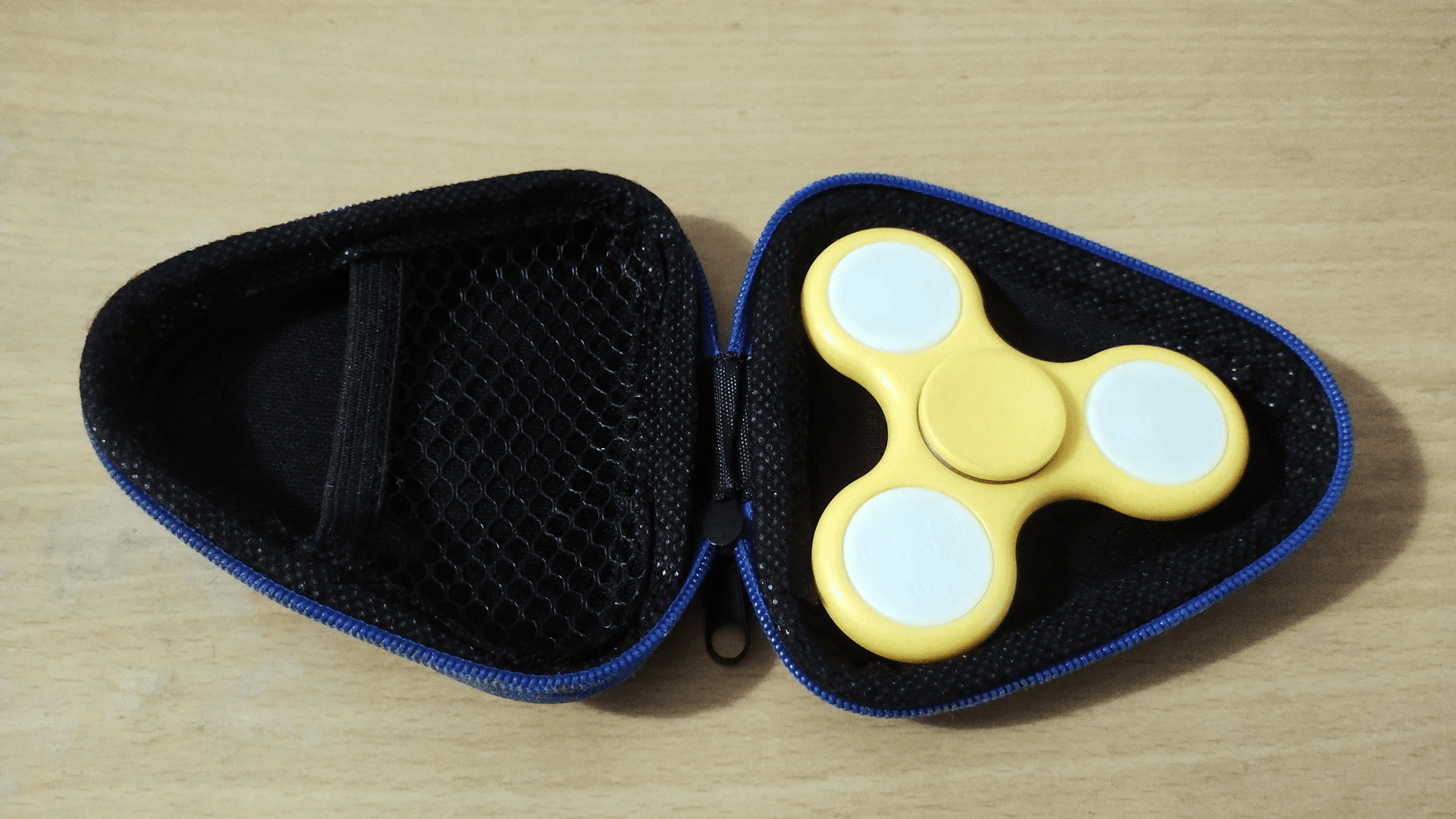
Hero image: Fidget spinner (Yellow) 2026 (02), by Gpkp, CC BY-SA 4.0. Via Wikimedia Commons.
Take our professional IQ test
Want to know your IQ? Try the first ever professional online IQ test.