Does Debating Make You Smarter? What School Debate Studies Show | Riot IQ
Oct 21, 2026·Advanced Topics & Research
Does Debating Make You Smarter? What School Debate Studies Show
Does debating make you smarter? No study shows debate raises IQ, but Boston debaters gained 0.13 SD in reading and were likelier to graduate and enter college.
Dr. Russell T. WarneChief Scientist
Share
No study has measured whether debating raises IQ, but the best evidence suggests that competitive debate modestly improves reading and argument skills. In a decade of data from Boston public schools, students' reading test scores rose by 0.13 standard deviations in the years they were on a debate team, and a 1999 meta-analysis found that debate and other communication training improved critical thinking test scores by about r = .18.
Debate has a reputation as a training ground for future lawyers and politicians. This article covers what the large school debate studies found, how debate affects critical thinking, why being good at arguing is not the same as reasoning well, and why debaters were often strong students before they joined a team.
What the school debate studies show
The largest studies come from "urban debate leagues," programs that bring competitive policy debate to public schools serving many low-income students. In policy debate, two-person teams research one topic for a whole school year and argue for or against a policy proposal in timed rounds that include cross-examination.
• Chicago: Briana Mezuk and colleagues studied the Chicago Urban Debate League using school records from 1997 to 2006 for 9,145 students. They used "propensity score matching," pairing debaters with non-debaters who had similar characteristics in their school records, and found that debaters were more likely to graduate, more likely to meet ACT college-readiness benchmarks and had larger gains in grade point average. A second analysis by Susannah Anderson and Mezuk, covering 1997 to 2007, reported that debaters were 3.1 times more likely to graduate, with stronger ACT results in English, reading and science.
• Boston: Beth Schueler and Katherine Larned linked ten years of Boston Debate League records to school and college enrollment data, including 3,515 students who debated. They compared each student with themselves in years with and without debate. Reading scores were 0.13 standard deviations higher in debate years, which the authors equate to about two-thirds of a typical year of ninth-grade learning. Math scores showed little change.
• Which skills improved: In Boston, gains were larger on test items about comprehension and analysis (0.10 standard deviations) than on grammar, vocabulary and punctuation items (0.06). Students who had been in the bottom quarter in elementary school reading gained 0.24 standard deviations, compared with 0.10 for those who had been in the top quarter.
• Graduation and college: In Boston, 80% of debaters graduated from high school within five years, compared with 68% of similar students at schools without debate, and 53% enrolled in college or another postsecondary institution within two years of their expected graduation, compared with 41%.
If the 0.13 reading gain were placed on the IQ scale, it would be about 2 points. That conversion is only illustrative, because a state reading test is a measure of school achievement, not an IQ test. Students also chose to join debate. The Boston authors note that they cannot fully rule out selection as an explanation for the graduation and college results, though the pattern of reading gains, with analytical items improving more than basic language items, makes them more confident about the reading effect.
Does debate improve critical thinking?
Debate coaches have long argued that the activity teaches "critical thinking," the ability to analyze and evaluate arguments, and there is some support for this.
• The forensics meta-analysis: Mike Allen, Sandra Berkowitz, Steve Hunt and Allan Louden pooled studies of competitive debate and speech (often called "forensics") and of public speaking and argumentation courses. Communication training improved scores on critical thinking tests, with average effects of about r = .18 in studies that followed students over time and r = .20 in studies that compared groups at one point. Competitive forensics showed the largest effect. Converted with the standard formula, an r of .18 corresponds to about 0.37 standard deviations. These studies are old, mostly small, and rarely randomized.
• Argument through dialogue: Deanna Kuhn and Amanda Crowell ran a multiyear program in which young adolescents argued about social issues with classmates, often in written electronic exchanges. On individual essays about new topics, these students wrote better arguments than a comparison group that spent the time on extensive essay-writing practice and class discussion, and they paid more attention to whether evidence supported a claim.
Both findings fit a near-transfer pattern: practice at building and judging arguments improves performance on tests of building and judging arguments. Logical reasoning is also part of what intelligence tests measure, as described in the article on logical reasoning on an IQ test. A small gain in a trained skill is still far from a rise in general intelligence. Giovanni Sala and Fernand Gobet's reviews of chess, music and working memory training found that once studies use proper control groups, gains on distant abilities such as general intelligence are close to zero. Older claims that memorizing poetry trains the mind have fared no better.
Arguing well is not the same as reasoning well
One influential theory suggests that winning arguments and finding the truth are different skills.
• The argumentative theory: Hugo Mercier and Dan Sperber proposed that human reasoning evolved mainly to produce and evaluate arguments meant to persuade others. On this view, people are skilled at finding arguments for what they already believe and poor at finding arguments against it, which explains the familiar "confirmation bias."
• Groups reason better: When people argue in a group, those strengths can combine. David Moshman and Molly Geil gave a well-known logic problem, the Wason selection task, to 143 college students. Only 9% of students working alone chose the correct answer, compared with 75% of groups who discussed it. The authors traced the groups' advantage to arguments the members built and tested together; imitation and peer pressure did not explain it.
• Myside bias and intelligence: Keith Stanovich, Richard West and Maggie Toplak reviewed studies of "myside bias," the tendency to evaluate evidence in favour of one's own views. Across many kinds of tasks, the size of this bias showed very little relation to intelligence. Bright people are no less biased toward their own side.
This research suggests a mixed picture for debate. Competitive debaters must often argue a side assigned to them, and they face an opponent whose job is to find the weaknesses in their case, which is close to the group setting where reasoning works best. Debate also rewards the persuasive skills that Mercier and Sperber argue can lead people astray when they reason alone. Nobody has tested whether years of debate reduce myside bias.
Why debaters look so smart
Debaters often have high grades and test scores, and much of that reflects who joins.
• Strong students join: In the Boston study, debaters were generally higher-achieving than students in the same schools who never debated. Debate demands a great deal of reading and fast speaking, which attracts students who are already verbally able. The verbal side of intelligence is described in the article on verbal reasoning.
• Motivation and support: Students who give up weekends to research a policy topic are unusually motivated, and they gain coaches, mentors and trips to tournaments on college campuses. Each of these could improve grades and college enrollment independently of the debating itself.
• The comparisons that matter: The Chicago and Boston studies adjusted for students' earlier test scores and backgrounds, and the Boston study compared students with themselves. That design is much stronger than comparing debaters with everyone else. It still falls short of a randomized trial, and no randomized trial of a debate program with an IQ outcome has been published.
Parental education, family income and the school a student attends are the main confounds. A comparison of debate champions with the general population that does not adjust for them will make debate look far more powerful than it is.
Frequently asked questions
Does debating make you smarter?
No study has tested whether debate raises IQ. The best studies show modest gains in reading and argument skills and higher rates of graduation and college enrollment among debaters.
Does debate improve critical thinking?
Probably a little. A meta-analysis of debate and communication training found average gains of about 0.37 standard deviations on critical thinking tests, though most of the studies were small and not randomized.
Are debaters more intelligent?
On average they tend to be strong students before they join, because debate attracts verbally able, motivated teenagers. Their later success reflects both that head start and any effect of the activity.
Does arguing make you smarter?
There is no IQ evidence for it. Arguing in a group can produce better answers to logic problems than reasoning alone, but research on myside bias shows that being bright does not stop people from favouring their own side.
Is debate good for struggling students?
In Boston, students who had the lowest reading scores in elementary school gained the most from debate, about 0.24 standard deviations in reading. They were also the most likely to see gains in graduation and four-year college enrollment.
The takeaway
Debating does not make you smarter in the sense of raising IQ, and no study has tested whether it does. The best evidence suggests that competitive debate modestly improves reading comprehension and argument skills, especially for students who start behind, and that debaters are more likely to finish school and go to college. Much of debate's reputation comes from the strong students who choose it. If you want to see where your verbal and logical reasoning stand, take a full-length online IQ test.
References
1. Mezuk, B., Bondarenko, I., Smith, S., & Tucker, E. (2011). Impact of participating in a policy debate program on academic achievement: Evidence from the Chicago Urban Debate League. Educational Research and Reviews, 6(9), 622-635. [eric.ed.gov](. eric.ed.gov
2. Anderson, S., & Mezuk, B. (2012). Participating in a policy debate program and academic achievement among at-risk adolescents in an urban public school district: 1997-2007. Journal of Adolescence, 35(5), 1225-1235. [doi.org/10.1016/j.adolescence.2012.04.005](. doi.org
3. Schueler, B. E., & Larned, K. E. (2025). Interscholastic policy debate promotes critical thinking and college-going: Evidence from Boston Public Schools. Educational Evaluation and Policy Analysis, 47(1), 108-134. [doi.org/10.3102/01623737231200234](. doi.org
4. Schueler, B. E., & Larned, K. E. (2024). Resolved: Debate programs boost literacy and college enrollment. Education Next, 24(3), 52-59. [educationnext.org](. educationnext.org
5. Allen, M., Berkowitz, S., Hunt, S., & Louden, A. (1999). A meta-analysis of the impact of forensics and communication education on critical thinking. Communication Education, 48(1), 18-30. [doi.org/10.1080/03634529909379149](. doi.org
6. Kuhn, D., & Crowell, A. (2011). Dialogic argumentation as a vehicle for developing young adolescents' thinking. Psychological Science, 22(4), 545-552. [doi.org/10.1177/0956797611402512](. doi.org
7. Sala, G., & Gobet, F. (2017). Does far transfer exist? Negative evidence from chess, music, and working memory training. Current Directions in Psychological Science, 26(6), 515-520. [doi.org/10.1177/0963721417712760](. doi.org
8. Mercier, H., & Sperber, D. (2011). Why do humans reason? Arguments for an argumentative theory. Behavioral and Brain Sciences, 34(2), 57-74. [doi.org/10.1017/S0140525X10000968](. doi.org
9. Moshman, D., & Geil, M. (1998). Collaborative reasoning: Evidence for collective rationality. Thinking & Reasoning, 4(3), 231-248. [doi.org/10.1080/135467898394148](. doi.org
10. Stanovich, K. E., West, R. F., & Toplak, M. E. (2013). Myside bias, rational thinking, and intelligence. Current Directions in Psychological Science, 22(4), 259-264. [doi.org/10.1177/0963721413480174](. doi.org
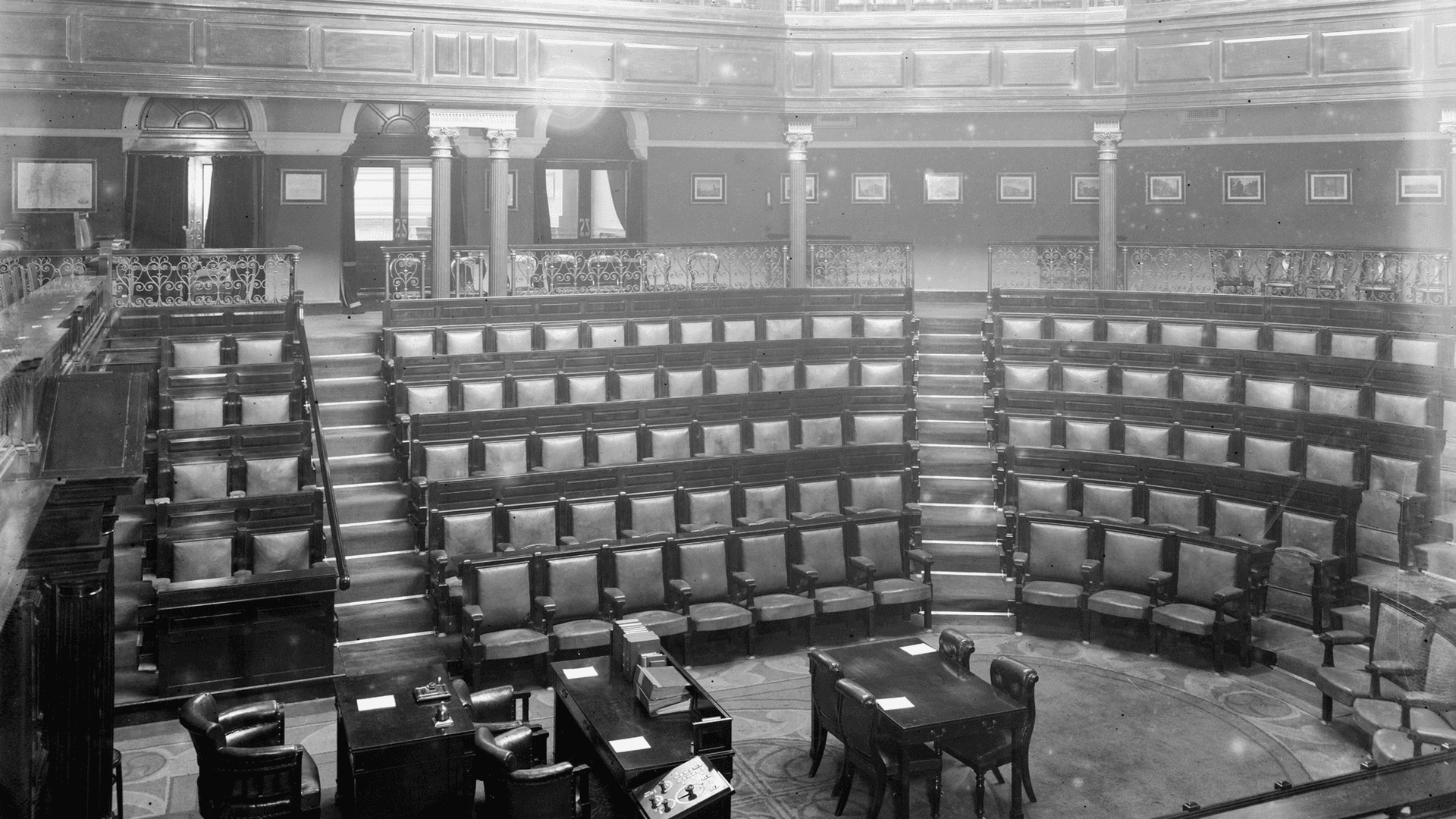
Hero image: Dáil Chamber silent and empty, National Library of Ireland, no known copyright restrictions. Via Wikimedia Commons.
Take our professional IQ test
Want to know your IQ? Try the first ever professional online IQ test.