Does Watching TV Make You Dumber? What the Research Shows
Does watching TV make you dumber? No study shows it lowers IQ. Heavy viewing in later life tracks slightly worse memory, but much of the gap is confounding.
Dr. Russell T. WarneChief Scientist
Share
Watching TV does not make you dumber in the sense of lowering your IQ: no study has shown that television reduces general intelligence, and the best natural experiment in children found a tiny gain, about 0.02 standard deviations per year of preschool exposure. In adults over 50, very heavy viewing (more than 3.5 hours a day) is linked to slightly worse verbal memory six years later, about half a word fewer on a word-list test after adjustment, and part of that link probably reflects who watches the most TV.
Television has been blamed for making people stupid since the 1950s. This page covers the large adult cohorts, why heavy viewers differ from light viewers in ways that matter, what natural experiments say about children, and where the "reality TV makes you dumb" headline came from.
What happens to adults who watch a lot of TV
The most-cited study is by Daisy Fancourt and Andrew Steptoe, who used the English Longitudinal Study of Ageing. They followed 3,590 adults aged 50 and over who did not have dementia, recorded how much TV they watched in 2008-09, and tested them again six years later. The memory test asked people to recall a list of 10 common words, once immediately and once after a delay.
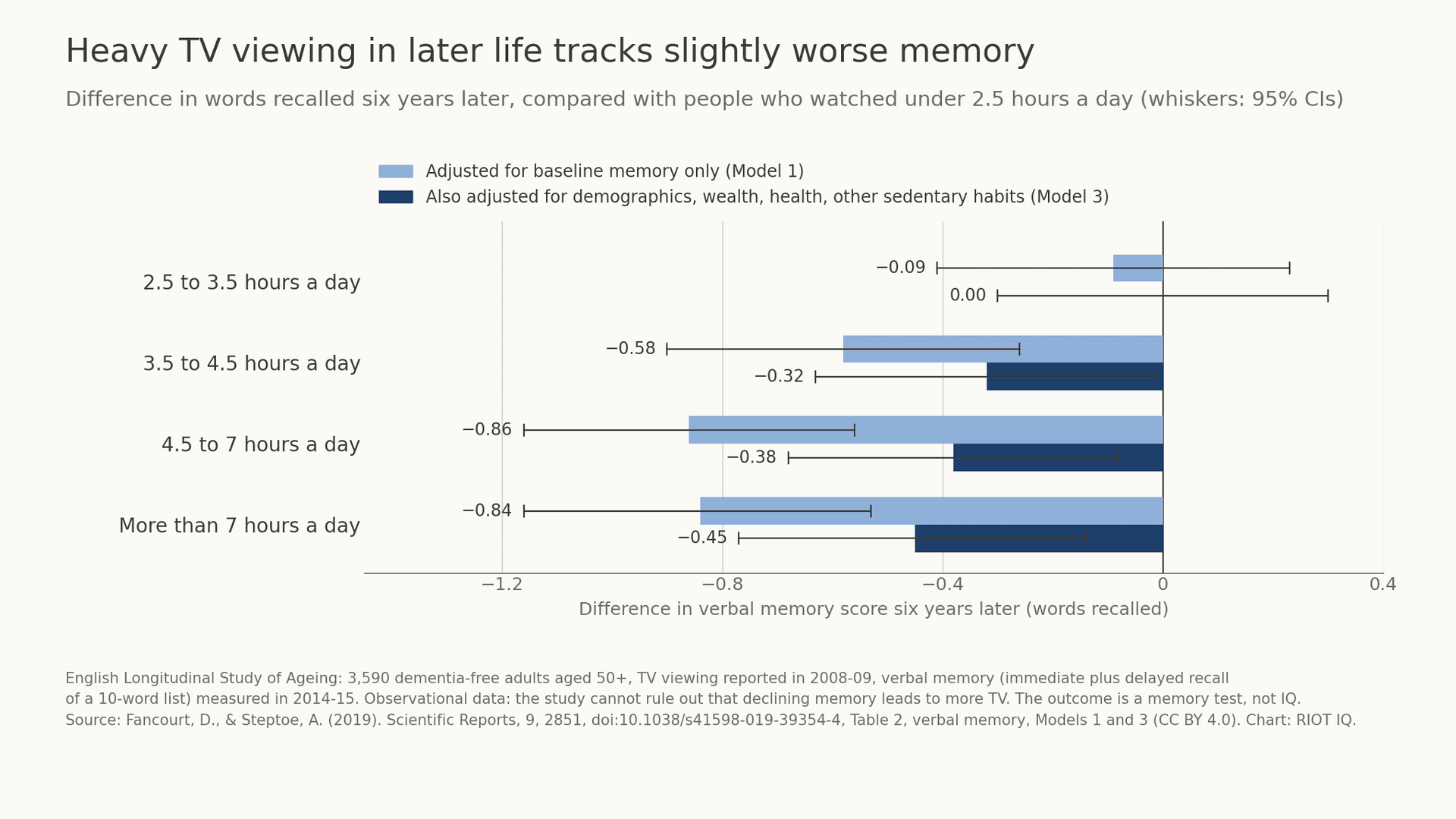
Compared with people who watched under 2.5 hours a day, those who watched 3.5 to 4.5 hours recalled about 0.32 fewer words at follow-up, and those who watched more than 7 hours recalled about 0.45 fewer, after adjusting for baseline memory, education, wealth, depression, health and other sedentary habits. Viewing of 2.5 to 3.5 hours showed no difference. A second test, naming as many animals as possible in a minute, showed no reliable link once the same factors were taken into account.
Two other large cohorts point the same way.
• Young adults followed for 25 years: Hoang and colleagues tracked 3,247 Americans in the CARDIA study from their mid-20s. The 10.9% who watched more than 3 hours a day at most visits were more likely to score more than 1 standard deviation below average in midlife on a processing-speed task (odds ratio 1.64) and a Stroop task (1.56), but not on a verbal learning test.
• Dementia in the UK Biobank: Raichlen and colleagues followed 146,651 adults aged 60 and over for about 12 years. People in the top third for TV time had a 21% higher risk of a dementia diagnosis than those in the bottom third after full adjustment (hazard ratio 1.21). Computer use showed the opposite pattern, with moderate users at about 30% lower risk.
None of these outcomes is an IQ score. The memory and speed tasks resemble parts of IQ batteries, but a decline on one task is a narrower finding than a fall in general intelligence. Our article on whether IQ is correlated with dementia covers how earlier ability relates to later decline.
How much of the link is television itself?
Heavy viewers are different people from light viewers before they ever switch on the set. In the English data, 41% of people who watched under 2.5 hours a day had a degree, compared with 8% of those who watched more than 7 hours. Lower wealth, chronic illness, mobility problems and low physical activity were all more common among heavy viewers.
Adjustment for these factors cuts the memory gap roughly in half. Before adjustment, people who watched more than 7 hours recalled 0.84 fewer words than light viewers; after full adjustment the gap was 0.45 words. That shrinkage is a warning sign. Any factor the researchers could not measure, such as lifelong reasoning ability or early, undiagnosed decline, could account for much of what remains.
• Reverse causation: People whose memory is starting to slip may give up demanding hobbies and watch more TV. Fancourt and Steptoe state plainly that they cannot rule this out, although results held when they excluded people diagnosed with dementia in the following two years.
• Displacement: Hours in front of the TV are hours not spent reading, knitting, socialising or moving. The authors list this as a possible explanation, and it would mean that the missing activities matter more than the television.
• Sitting still: Raichlen's team suggested that the very low muscle activity of TV viewing, compared with sitting at a computer, could play a part through cardiovascular health.
The contrast between TV and computer use is interesting, and it fits a story in which passive viewing is worse than active screen use. It also fits a story in which healthier, better-educated older adults are more likely to use computers. Observational data cannot separate the two.
Children, Sesame Street and the arrival of television
Children's screen time has its own article, what too much screen time does to children's brains, so this section stays short. The strongest evidence comes from natural experiments, which use accidents of history to compare similar children with different exposure.
Gentzkow and Shapiro used the staggered arrival of television across US cities in the 1940s and 1950s. Children who had more years of TV before starting school did not score worse on standardized tests as teenagers. Their best estimate was a gain of about 0.02 standard deviations per year of exposure, roughly 0.3 points if the scale were IQ, and they could rule out harms larger than about 0.03 standard deviations per year. These were school achievement tests, not IQ tests.
Kearney and Levine studied Sesame Street, using the fact that some areas received its 1969 broadcasts clearly while others did not because of UHF and VHF transmission. Children with better reception were more likely to be in the right grade for their age, especially boys. Effects on adult education and earnings were too imprecise to call.
Correlational cohorts are less reassuring. In the Dunedin study in New Zealand, each extra hour of weeknight viewing in childhood and adolescence was linked to a 43% higher risk of leaving school without qualifications, after adjustment for childhood IQ and sex. A Japanese brain-imaging study by Takeuchi and colleagues reported that children who watched more TV had lower verbal IQ scores, cross-sectionally and a few years later. Both designs share the confounding problems described above.
Does reality TV make you dumber?
The popular claim that shows like Jersey Shore "make you stupid" traces to a 2011 experiment by Markus Appel. Eighty-one participants read a story about a foolish soccer hooligan, and those who read the long version scored lower on a general knowledge quiz than a control group. Nobody in the study watched television; the participants read a text.
The idea behind it, that thinking about a stupid or clever person changes your test performance, has not held up well. Shanks and colleagues ran nine experiments with 475 participants using the original procedures and found no intelligence priming effect at all. The sound conclusion is that no reliable evidence shows reality TV lowers intelligence, and none shows that documentaries raise it either.
Frequently asked questions
Does watching TV lower your IQ?
No study has shown a drop in IQ caused by watching television. In the best natural experiment, children with more preschool TV exposure scored about the same or very slightly higher on later achievement tests.
How many hours of TV a day is too much for your brain?
In one English study of adults over 50, the link with poorer memory appeared above 3.5 hours a day. This is an observational threshold that marks where the association appeared; no trial has tested a safe limit.
Is watching TV worse than using a computer?
In the UK Biobank, TV time was linked to higher dementia risk and computer use to lower risk. Computer users also tend to be healthier and better educated, so the comparison does not prove that one activity harms and the other protects.
Can educational TV make children smarter?
Sesame Street improved school progress for children with better reception in the late 1960s. That is a gain in school readiness, which is not the same as a gain in IQ.
Does TV rot your brain?
The phrase overstates the evidence. Heavy viewing tracks slightly worse memory and speed in later life, but much of that link reflects education, health and the possibility that declining people watch more.
The takeaway
Watching TV has never been shown to lower IQ. In children, natural experiments find no harm and occasionally small benefits, especially from educational programming. In adults over 50, very heavy viewing is linked to slightly worse memory and a modestly higher dementia risk, but heavy viewers differ from light viewers in education, wealth and health, and declining memory may itself lead to more TV. Swapping a few hours of viewing for reading, socialising or a walk is reasonable, but nobody should expect it to change an IQ score. If you want an accurate picture of your reasoning ability, take a full-length online IQ test.
References
1. Fancourt, D., & Steptoe, A. (2019). Television viewing and cognitive decline in older age: Findings from the English Longitudinal Study of Ageing. Scientific Reports, 9, 2851. [doi.org/10.1038/s41598-019-39354-4](. doi.org
2. Hoang, T. D., Reis, J., Zhu, N., Jacobs, D. R., Launer, L. J., Whitmer, R. A., Sidney, S., & Yaffe, K. (2016). Effect of early adult patterns of physical activity and television viewing on midlife cognitive function. JAMA Psychiatry, 73(1), 73-79. [doi.org/10.1001/jamapsychiatry.2015.2468](. doi.org
3. Raichlen, D. A., Klimentidis, Y. C., Sayre, M. K., Bharadwaj, P. K., Lai, M. H. C., Wilcox, R. R., & Alexander, G. E. (2022). Leisure-time sedentary behaviors are differentially associated with all-cause dementia regardless of engagement in physical activity. Proceedings of the National Academy of Sciences, 119(35), e2206931119. [doi.org/10.1073/pnas.2206931119](. doi.org
4. Gentzkow, M., & Shapiro, J. M. (2008). Preschool television viewing and adolescent test scores: Historical evidence from the Coleman study. Quarterly Journal of Economics, 123(1), 279-323. [doi.org/10.1162/qjec.2008.123.1.279](. doi.org
5. Kearney, M. S., & Levine, P. B. (2019). Early childhood education by television: Lessons from Sesame Street. American Economic Journal: Applied Economics, 11(1), 318-350. [doi.org/10.1257/app.20170300](. doi.org
6. Hancox, R. J., Milne, B. J., & Poulton, R. (2005). Association of television viewing during childhood with poor educational achievement. Archives of Pediatrics & Adolescent Medicine, 159(7), 614-618. [doi.org/10.1001/archpedi.159.7.614](. doi.org
7. Takeuchi, H., Taki, Y., Hashizume, H., Asano, K., Asano, M., Sassa, Y., Yokota, S., Kotozaki, Y., Nouchi, R., & Kawashima, R. (2015). The impact of television viewing on brain structures: Cross-sectional and longitudinal analyses. Cerebral Cortex, 25(5), 1188-1197. [doi.org/10.1093/cercor/bht315](. doi.org
8. Appel, M. (2011). A story about a stupid person can make you act stupid (or smart): Behavioral assimilation (and contrast) as narrative impact. Media Psychology, 14(2), 144-167. [doi.org/10.1080/15213269.2011.573461](. doi.org
9. Shanks, D. R., Newell, B. R., Lee, E. H., Balakrishnan, D., Ekelund, L., Cenac, Z., Kavvadia, F., & Moore, C. (2013). Priming intelligent behavior: An elusive phenomenon. PLOS ONE, 8(4), e56515. [doi.org/10.1371/journal.pone.0056515](. doi.org
Figure by RIOT IQ. Data from Fancourt & Steptoe (2019), Scientific Reports 9, 2851 (doi.org/10.1038/s41598-019-39354-4), Table 2, verbal memory, Models 1 and 3, CC BY 4.0.
Take our professional IQ test
Want to know your IQ? Try the first ever professional online IQ test.