Do Podcasts Make You Smarter? Listening, Learning and IQ
Do podcasts make you smarter? No study shows they raise IQ. People learn about as much by listening as by reading, so podcasts add knowledge, not reasoning.
Dr. Russell T. WarneChief Scientist
Share
No study has tested whether listening to podcasts raises IQ, and there is no evidence that it does. What the research does show is that people understand and remember about as much from listening as from reading (a meta-analysis of 46 studies found a difference of only 0.07 standard deviations in favor of reading), so podcasts can add real knowledge, which is a different thing from raising reasoning ability.
Podcasts are often sold as a way to get smarter during a commute, and about half of American adults now listen to them. This article covers how listening compares with reading, what studies of podcast lectures and fast playback have found, why gaining knowledge is not the same as gaining IQ points, and why regular podcast listeners may already differ from people who do not listen.
Can you learn as much from listening as from reading?
The question behind most podcast claims is whether the ear is as good a route to knowledge as the eye. On average, it is close.
• The meta-analysis: Virginia Clinton-Lisell combined 46 studies with 4,687 participants that compared reading and listening comprehension of the same material. Overall, reading came out ahead by g = 0.07, a tiny difference that was not statistically reliable. In IQ-style units, where 1 standard deviation is 15 points, that is about 1 point on a comprehension test, and it is a comprehension score, not an IQ score.
• Where reading wins: Reading had a clearer advantage when readers could set their own pace (g = 0.13) and when questions required inference or general understanding (g = 0.36 for inferential questions), as opposed to recalling literal facts. Being able to slow down and reread seems to matter for harder material.
• An audiobook experiment: Beth Rogowsky, Barbara Calhoun and Paula Tallal randomly assigned 91 adults to receive a chapter of a nonfiction book as a digital audiobook, as e-text, or both at once. Comprehension did not differ between the groups, either immediately or two weeks later.
• Mind wandering: Trish Varao Sousa and colleagues found that people's minds wandered more when they listened to a passage than when they read it silently or aloud, and listening produced the poorest memory for the material. Their paper noted the implications for people relying on audiobooks and podcasts.
These results fit an older finding by Morton Ann Gernsbacher and colleagues: in adults, skill at understanding written language correlates highly with skill at understanding spoken language. Much of comprehension is a general ability that works across both channels. The separate question of whether reading itself raises IQ is covered in the article on reading books and IQ.
Learning from podcast lectures
Most controlled studies of podcasts come from universities and medical schools, where recorded lectures and audio teaching are now common.
• Podcast versus the lecture hall: In a frequently cited study by Dani McKinney, Jennifer Dyck and Elise Luber, 64 psychology students either attended a lecture or got a podcast of it. The podcast group scored higher on the exam (about 71% versus 62%), and podcast students who took notes did best. Students could pause and rewind, and it was a single lecture in one course.
• Audio versus written modules: Julie Roth and colleagues randomly assigned 60 medical residents and fellows to learn obstetrical neurology from narrative podcasts or from written reviews of the same cases. Both groups improved by similar amounts on the posttest, and the podcast was rated as more enjoyable.
• The scoping review: Jessica Kelly and colleagues reviewed 62 studies of audio podcasts in medical education. The 10 studies that tested knowledge retention found podcasts to be no worse than traditional teaching.
The pattern is consistent. A well-made podcast teaches its content about as well as other formats do. Learners who rehearse, take notes or quiz themselves on what they heard learn more, as they would with any other medium.
What about listening at double speed?
Many listeners speed up playback. Dillon Murphy and colleagues at UCLA randomly assigned 231 students to watch two lecture videos at normal speed or at 1.5x, 2x or 2.5x. At 2x the speakers were talking at more than 300 words per minute. Comprehension at 1.5x and 2x was close to normal speed, both immediately and a week later, and only the 2.5x group scored reliably lower than the normal-speed group. These were videos with slides, so pure audio may behave somewhat differently. The parallel question for text is covered in the article on speed reading and IQ.
Knowledge is not the same as a higher IQ
Learning facts from podcasts can make you more knowledgeable. Psychologists separate that kind of acquired knowledge, known as crystallized intelligence, from fluid reasoning, the ability to solve unfamiliar problems. Most IQ tests include vocabulary and general-information items, so a person who learns a great deal of general knowledge could score a little higher on those subtests. That would be a real gain in knowledge, with little reason to expect it to spread to reasoning or working memory tasks.
• Far transfer: Giovanni Sala and Fernand Gobet's reviews of chess, music and working memory training found that practice improves the trained skill while effects on general intelligence are close to zero in well-controlled studies. Listening to podcasts about history makes you better informed about history.
• The one strong exception is school: Stuart Ritchie and Elliot Tucker-Drob's meta-analysis of 42 data sets and more than 600,000 people found that each additional year of education raises IQ scores by about 1 to 5 points. Schooling involves years of structured instruction, practice and testing, and no study has tested whether informal listening produces anything similar.
Who listens to podcasts?
Much of the reason podcast listeners seem smart is about who chooses to listen.
• Education: In a 2022 Pew Research Center survey of 5,132 American adults, 49% had listened to a podcast in the past year. That included 62% of adults with a bachelor's degree, 49% of those with some college and 37% of those with a high school diploma or less. Among listeners, 88% said learning was a reason they listened.
• Curiosity: Sophie von Stumm and Phillip Ackerman's meta-analysis of 112 studies and about 60,000 people found that "investment traits," such as need for cognition and typical intellectual engagement, correlate on average about .30 with markers of adult intellect, including crystallized intelligence and knowledge. Curious people seek out information, and over years that habit and their existing ability both feed into what they know.
• Liking informative content is a weak signal: In Jason Rentfrow and colleagues' study of entertainment preferences, a taste for "cerebral" genres such as news and nonfiction books was essentially unrelated to scores on a short reasoning test (r = −.03).
Educated, curious people are more likely to listen to podcasts, so listeners would score higher on average even if the podcasts themselves did nothing for IQ.
Frequently asked questions
Do podcasts make you smarter?
No study shows that podcasts raise IQ. They can make you more knowledgeable about the topics you listen to, because people learn about as much from listening as from reading.
Is listening to a podcast as good as reading?
For most material the difference is very small: a meta-analysis of 46 studies found a gap of 0.07 standard deviations. Reading has an edge when you need to slow down, reread or draw inferences.
Are audiobooks as good as reading for comprehension?
In one randomized study, adults who listened to a nonfiction chapter remembered as much two weeks later as those who read it. Minds tend to wander more while listening, so attention matters.
Does listening at 2x speed hurt learning?
In a UCLA experiment with lecture videos, 2x speed produced comprehension close to normal speed, while 2.5x was clearly worse. Harder material may need slower playback.
Are people who listen to podcasts more intelligent?
Podcast listeners are more likely to have college degrees, and curious people seek out information. Any difference in average scores would mostly reflect who listens.
The takeaway
Podcasts do not make you smarter in the sense of raising IQ, and no study has tested whether they could. They are a reasonable way to learn: people understand and retain about as much by listening as by reading, and podcast lectures perform about as well as other teaching. What you gain is knowledge, which is valuable in its own right but is a different thing from reasoning ability. If you want to see how your reasoning and knowledge compare with the general population, try a professionally developed IQ test.
References
1. Clinton-Lisell, V. (2022). Listening ears or reading eyes: A meta-analysis of reading and listening comprehension comparisons. Review of Educational Research, 92(4), 543-582. [doi.org/10.3102/00346543211060871](. doi.org
2. Rogowsky, B. A., Calhoun, B. M., & Tallal, P. (2016). Does modality matter? The effects of reading, listening, and dual modality on comprehension. SAGE Open, 6(3). [doi.org/10.1177/2158244016669550](. doi.org
3. Varao Sousa, T. L., Carriere, J. S. A., & Smilek, D. (2013). The way we encounter reading material influences how frequently we mind wander. Frontiers in Psychology, 4, 892. [doi.org/10.3389/fpsyg.2013.00892](. doi.org
4. Gernsbacher, M. A., Varner, K. R., & Faust, M. E. (1990). Investigating differences in general comprehension skill. Journal of Experimental Psychology: Learning, Memory, and Cognition, 16(3), 430-445. [doi.org/10.1037/0278-7393.16.3.430](. doi.org
5. McKinney, D., Dyck, J. L., & Luber, E. S. (2009). iTunes University and the classroom: Can podcasts replace professors? Computers & Education, 52(3), 617-623. [doi.org/10.1016/j.compedu.2008.11.004](. doi.org
6. Roth, J. A., Chang, A., Ricci, B., Hall, M., & Mehta, N. (2020). Why not a podcast? Assessing narrative audio and written curricula in obstetrical neurology. Journal of Graduate Medical Education, 12(1), 86-91. [doi.org/10.4300/JGME-D-19-00505.1](. doi.org
7. Kelly, J. M., Perseghin, A., Dow, A. W., Trivedi, S. P., Rodman, A., & Berk, J. (2022). Learning through listening: A scoping review of podcast use in medical education. Academic Medicine, 97(7), 1079-1085. [doi.org/10.1097/ACM.0000000000004565](. doi.org
8. Murphy, D. H., Hoover, K. M., Agadzhanyan, K., Kuehn, J. C., & Castel, A. D. (2022). Learning in double time: The effect of lecture video speed on immediate and delayed comprehension. Applied Cognitive Psychology, 36(1), 69-82. [doi.org/10.1002/acp.3899](. doi.org
9. Sala, G., & Gobet, F. (2017). Does far transfer exist? Negative evidence from chess, music, and working memory training. Current Directions in Psychological Science, 26(6), 515-520. [doi.org/10.1177/0963721417712760](. doi.org
10. Ritchie, S. J., & Tucker-Drob, E. M. (2018). How much does education improve intelligence? A meta-analysis. Psychological Science, 29(8), 1358-1369. [doi.org/10.1177/0956797618774253](. doi.org
11. Shearer, E., Liedke, J., Matsa, K. E., Lipka, M., & Jurkowitz, M. (2023). Podcasts as a source of news and information. Pew Research Center. [pewresearch.org](. pewresearch.org
12. von Stumm, S., & Ackerman, P. L. (2013). Investment and intellect: A review and meta-analysis. Psychological Bulletin, 139(4), 841-869. [doi.org/10.1037/a0030746](. doi.org
13. Rentfrow, P. J., Goldberg, L. R., & Zilca, R. (2011). Listening, watching, and reading: The structure and correlates of entertainment preferences. Journal of Personality, 79(2), 223-258. [doi.org/10.1111/j.1467-6494.2010.00662.x](. doi.org
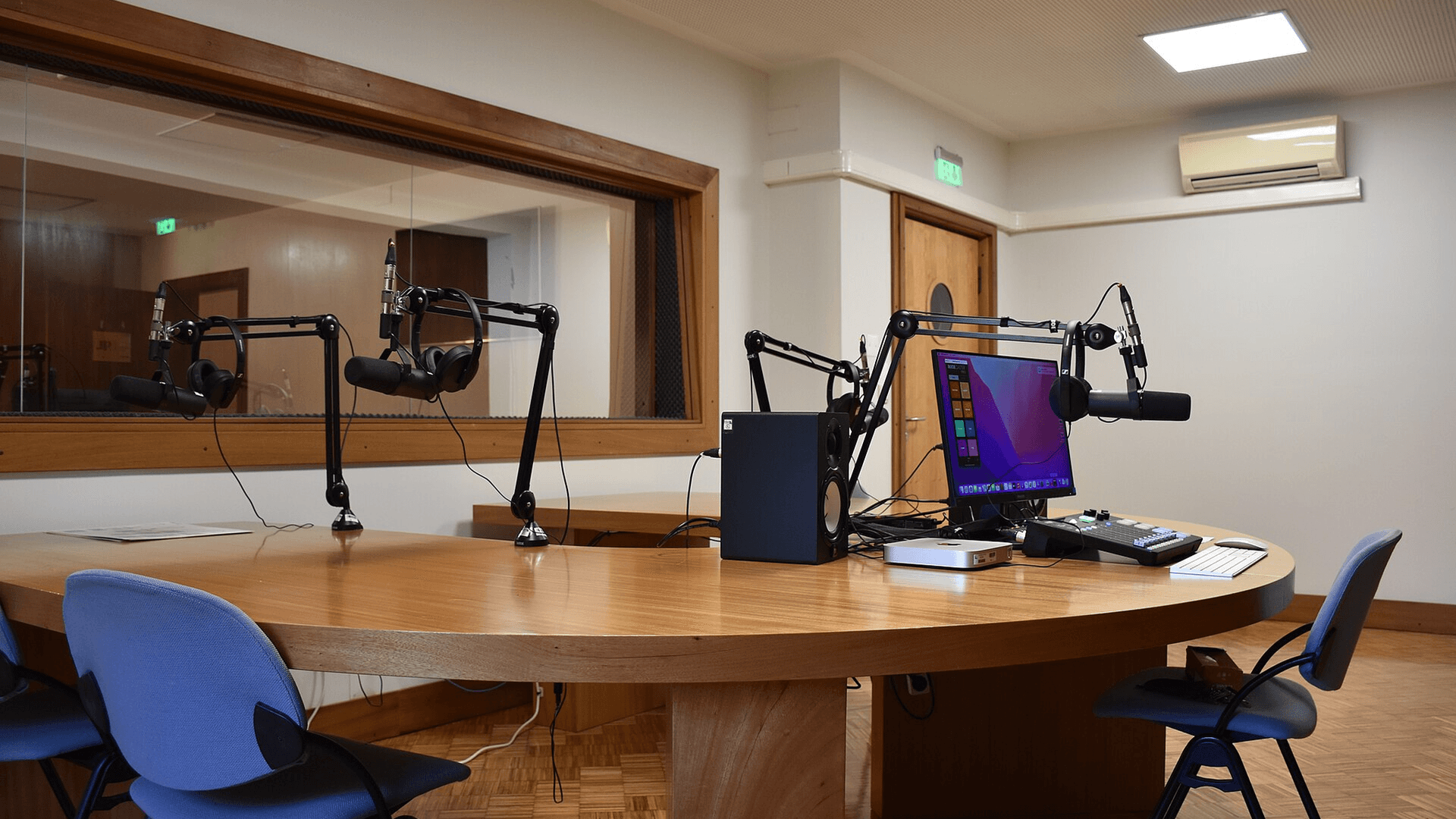
Hero image: Podcast Studio, by Ajcosta, CC BY-SA 4.0. Via Wikimedia Commons.
Take our professional IQ test
Want to know your IQ? Try the first ever professional online IQ test.