Do Board Games Make You Smarter? What the Research Shows | Riot IQ
Oct 30, 2026·Advanced Topics & Research
Do Board Games Make You Smarter? What the Research Shows
Do board games make you smarter? No trial shows an IQ gain. Older adults who play often decline slightly less, about 1 to 1.4 IQ-like points.
Dr. Russell T. WarneChief Scientist
Share
No study has shown that board games make people smarter in the sense of raising IQ. The strongest evidence comes from a preregistered study that followed 1,091 Scottish adults from age 11 to age 79: those who played games more often declined slightly less in later life, by about 1 to 1.4 IQ-like points for each standard deviation of extra play, and that is an association that the study could not prove was caused by the games.
Specific games can teach specific skills. A simple numbered race game improves young children's sense of how big numbers are, and expert Scrabble players recognize words in unusual ways. This page covers why board games have a brainy reputation, what the long-term studies of older adults found, what the training trials show, and why the people who play games may differ from those who do not.
Why board games have a reputation for building brains
Strategy games look like thinking made visible. Players plan several moves ahead, hold the board in mind, track other players' intentions and adjust when the dice go against them. Those demands overlap with "executive functions", the mental skills used to plan, hold information in mind and switch between tasks, so it seems natural that regular play would exercise them.
Health research has added to the impression. In the French PAQUID cohort, 3,675 older adults without dementia were followed for 20 years, and the 32.2% who reported playing board games regularly had a 15% lower risk of developing dementia after adjusting for age, sex, education and other factors (hazard ratio 0.85). Headlines rarely mentioned the next step in the analysis: once the authors also adjusted for baseline scores on a memory screening test and for depression, the difference shrank to a hazard ratio of 0.96 and was no longer statistically significant. Board game players did show slightly less decline on the screening test over time and less new depression.
Chess carries much of the reputation for the whole category. Our page on whether chess makes you smarter covers that evidence in full; the short version is that the better-controlled studies find little transfer from chess skill to general ability.
What the long-term studies of older adults show
The most informative study is Altschul and Deary's analysis of the Lothian Birth Cohort 1936. These participants took the same intelligence test, the Moray House Test, at age 11 and again at age 70, and a battery of 14 cognitive tests at 70, 73, 76 and 79. At age 70 they reported how often they played "games (like cards, chess, bingo, or crosswords)". About a third played every day or nearly every day, and about a fifth played less than once a year or never. Every analysis was preregistered, and the models controlled for childhood test scores, education, social class, sex, overall activity levels and health conditions.
• Age 11 to 70: People who played more games scored higher at 70 than their childhood scores predicted (standardized β = 0.094). The authors translated this into about 1.42 IQ-like points per standard deviation of game playing, roughly the difference between playing monthly and playing several times a week. After modelling the paths through education and social class, the figure was about 1.25 points.
• Age 70 to 79: More frequent players showed less decline in general cognitive ability over the decade, equivalent to about 1.02 IQ-like points per standard deviation of play, and less decline in memory, about 3.06 points. Differences on fluid reasoning, speed and crystallized knowledge pointed the same way but were not statistically significant.
These are real but small differences, measured on a scale where 15 points is one standard deviation. The study also had limits its authors spelled out: games playing was self-reported once or twice, the volunteers were better educated and healthier than average, and people whose thinking was starting to slip may simply have stopped playing. The game item also lumped together cards, bingo and crosswords, so it says nothing about board games in particular. Our article on whether puzzles make you smarter covers the crossword and sudoku research.
Do board-game interventions improve thinking?
Randomized trials are the better test, and they are mostly small.
• Number games for young children: In work by Ramani and Siegler, low-income preschoolers who played a simple linear board game with numbered squares for about an hour in total improved on four number tasks, including comparing magnitudes and placing numbers on a line, and the gains were still present nine weeks later. Children who played the same game with coloured squares instead of numbers did not improve. A follow-up found that a linear board worked better than a circular one for understanding number size, and Whyte and Bull found a similar benefit in children averaging 3.8 years of age after four 25-minute sessions. These are clear gains in early number sense, a narrow academic skill. None of these studies measured IQ.
• Executive functions across the lifespan: A 2026 meta-analysis by Estrada-Plana and colleagues screened more than 5,000 records and found only 24 eligible studies, 16 of which could be pooled. Kindergarten children who played board games improved more than controls on visuospatial short-term memory (Hedges' g = 0.26), and older adults improved on processing speed (g = 0.41). Effects on working memory, inhibition and mental flexibility were not significant, and several pooled results were highly inconsistent across studies. The authors concluded that the evidence is not yet strong enough to recommend board games for improving executive functions. One early study in their review included Raven's matrices, a classic reasoning test, and found that both groups improved, with no added benefit from the games.
• An earlier review: Noda and colleagues reviewed 27 pre-post studies of board-game programmes. Effect sizes for cognitive outcomes ranged from negative to very large, a spread that usually signals small samples and varied methods more than a dependable effect.
For scale, a g of 0.26 would be about 4 points if it were measured on an IQ scale (0.26 × 15), but these outcomes are memory-span and speed tasks, not IQ tests.
Expert players, transfer and who chooses to play
Psychologists distinguish "near transfer" (getting better at the trained skill and tasks very like it) from "far transfer" (gains in broad abilities such as general intelligence). Sala and Gobet's analyses of chess, music and working-memory training found that far-transfer effects shrink toward zero as studies get better controlled. Board-game experts fit the near-transfer pattern, much as skilled Tetris players rotate Tetris-shaped figures quickly but show no advantage on other spatial tests.
• Scrabble experts: Hargreaves and colleagues compared competitive Scrabble players with age-matched controls. On a series of cognitive assessments the two groups differed only in Scrabble-specific skills such as anagramming, although the experts recognized words presented vertically with unusual ease. A follow-up by van Hees and colleagues tested whether that advantage carried over to a similar task using symbols instead of letters. The experts were no faster and no more accurate than controls, despite years of intensive practice.
• Go (baduk) experts: Go is an even more complex game than chess. Southwick and colleagues found that baduk experts reported far more serious solo practice than amateurs, yet scored lower on a fluid reasoning test (d = -1.78, and -1.79 in a preregistered retest with a revised matrix task). The gap was no longer significant once education was taken into account, which the authors read as a trade-off between time spent in school and time spent practising. A 2025 review by Kim describes encouraging Go training studies in children and older adults, mostly small, and calls for longer follow-up.
Selection runs through all of this research. In the Lothian cohort, children who scored higher at age 11 went on to more education and higher social class, and also played more games at 70. The authors could adjust for those measured differences, but sociable, curious and healthy people are likely to keep playing games for reasons no questionnaire fully captures. Reverse causation is another problem: someone whose memory is starting to fade may give up bridge or Scrabble years before a diagnosis, which makes non-players look worse.
Frequently asked questions
Do board games make you smarter?
No study has shown that board games raise IQ. Older adults who play often tend to decline a little less, about 1 to 1.4 IQ-like points per standard deviation of extra play in the best study, and number games improve young children's number sense.
Which board game is best for your brain?
No trial has compared board games head to head on a general cognitive outcome. Each game mainly improves the skills it uses, so the best choice is one you enjoy enough to keep playing with other people.
Can board games prevent dementia?
Not on current evidence. In the PAQUID study the lower dementia risk among players was no longer significant after adjusting for baseline memory screening scores and depression, and observational studies cannot rule out early decline causing people to stop playing.
Do board games help children with maths?
Linear number games, where counters move along squares numbered in order, improve preschoolers' understanding of number size in several randomized studies. The benefit is specific to early number skills, and the studies did not measure IQ.
Are card games as good as board games?
The Lothian study counted cards, chess, bingo and crosswords as a single "playing games" item, so it cannot separate them. Our article on IQ and poker looks at one card game in detail.
The takeaway
Board games are a cheap, sociable way to practise planning, memory and number skills, and frequent players tend to keep their thinking a little sharper into old age. The evidence does not show that playing them makes anyone smarter in the sense of a higher IQ, and much of the gap between players and non-players reflects who chooses to play. If you want a reliable measure of your reasoning ability, try a professionally developed IQ test.
References
1. Altschul, D. M., & Deary, I. J. (2020). Playing analog games is associated with reduced declines in cognitive function: A 68-year longitudinal cohort study. The Journals of Gerontology: Series B, 75(3), 474-482. [doi.org/10.1093/geronb/gbz149](. doi.org
2. Dartigues, J.-F., Foubert-Samier, A., Le Goff, M., Viltard, M., Amieva, H., Orgogozo, J.-M., Barberger-Gateau, P., & Helmer, C. (2013). Playing board games, cognitive decline and dementia: A French population-based cohort study. BMJ Open, 3(8), e002998. [doi.org/10.1136/bmjopen-2013-002998](. doi.org
3. Ramani, G. B., & Siegler, R. S. (2008). Promoting broad and stable improvements in low-income children's numerical knowledge through playing number board games. Child Development, 79(2), 375-394. [doi.org/10.1111/j.1467-8624.2007.01131.x](. doi.org
4. Siegler, R. S., & Ramani, G. B. (2009). Playing linear number board games, but not circular ones, improves low-income preschoolers' numerical understanding. Journal of Educational Psychology, 101(3), 545-560. [doi.org/10.1037/a0014239](. doi.org
5. Whyte, J. C., & Bull, R. (2008). Number games, magnitude representation, and basic number skills in preschoolers. Developmental Psychology, 44(2), 588-596. [doi.org/10.1037/0012-1649.44.2.588](. doi.org
6. Estrada-Plana, V., Vita-Barrull, N., March-Llanes, J., Bafalluy, A. B., Ayesa-Arriola, R., & Moya-Higueras, J. (2026). Can executive functions be improved by playing board games across the lifespan? A systematic review and meta-analysis. Applied Psychology: Health and Well-Being, 18(4), e70194. [doi.org/10.1111/aphw.70194](. doi.org
7. Noda, S., Shirotsuki, K., & Nakao, M. (2019). The effectiveness of intervention with board games: A systematic review. BioPsychoSocial Medicine, 13, 22. [doi.org/10.1186/s13030-019-0164-1](. doi.org
8. Sala, G., & Gobet, F. (2017). Does far transfer exist? Negative evidence from chess, music, and working memory training. Current Directions in Psychological Science, 26(6), 515-520. [doi.org/10.1177/0963721417712760](. doi.org
9. Hargreaves, I. S., Pexman, P. M., Zdrazilova, L., & Sargious, P. (2012). How a hobby can shape cognition: Visual word recognition in competitive Scrabble players. Memory & Cognition, 40(1), 1-7. [doi.org/10.3758/s13421-011-0137-5](. doi.org
10. van Hees, S., Pexman, P. M., Hargreaves, I. S., Zdrazilova, L., Hart, J. M., Myers-Stewart, K., Cortese, F., & Protzner, A. B. (2016). Testing the limits of skill transfer for Scrabble experts in behavior and brain. Frontiers in Human Neuroscience, 10, 564. [doi.org/10.3389/fnhum.2016.00564](. doi.org
11. Southwick, D. A., Baldwin, C., Harwell, K. W., Agler, E., & Yoon, J. S. (2026). What predicts expertise in Baduk? Intelligence, practice, and a natural test of the range restriction hypothesis. Journal of Experimental Psychology: General, 155(11), 2765-2774. [doi.org/10.1037/xge0001983](. doi.org
12. Kim, K. W. (2025). Go and the brain: Cognitive and neural impacts of training. Psychiatry Investigation, 22(4), 357-364. [doi.org/10.30773/pi.2024.0387](. doi.org
13. Sims, V. K., & Mayer, R. E. (2002). Domain specificity of spatial expertise: The case of video game players. Applied Cognitive Psychology, 16(1), 97-115. [doi.org/10.1002/acp.759](. doi.org
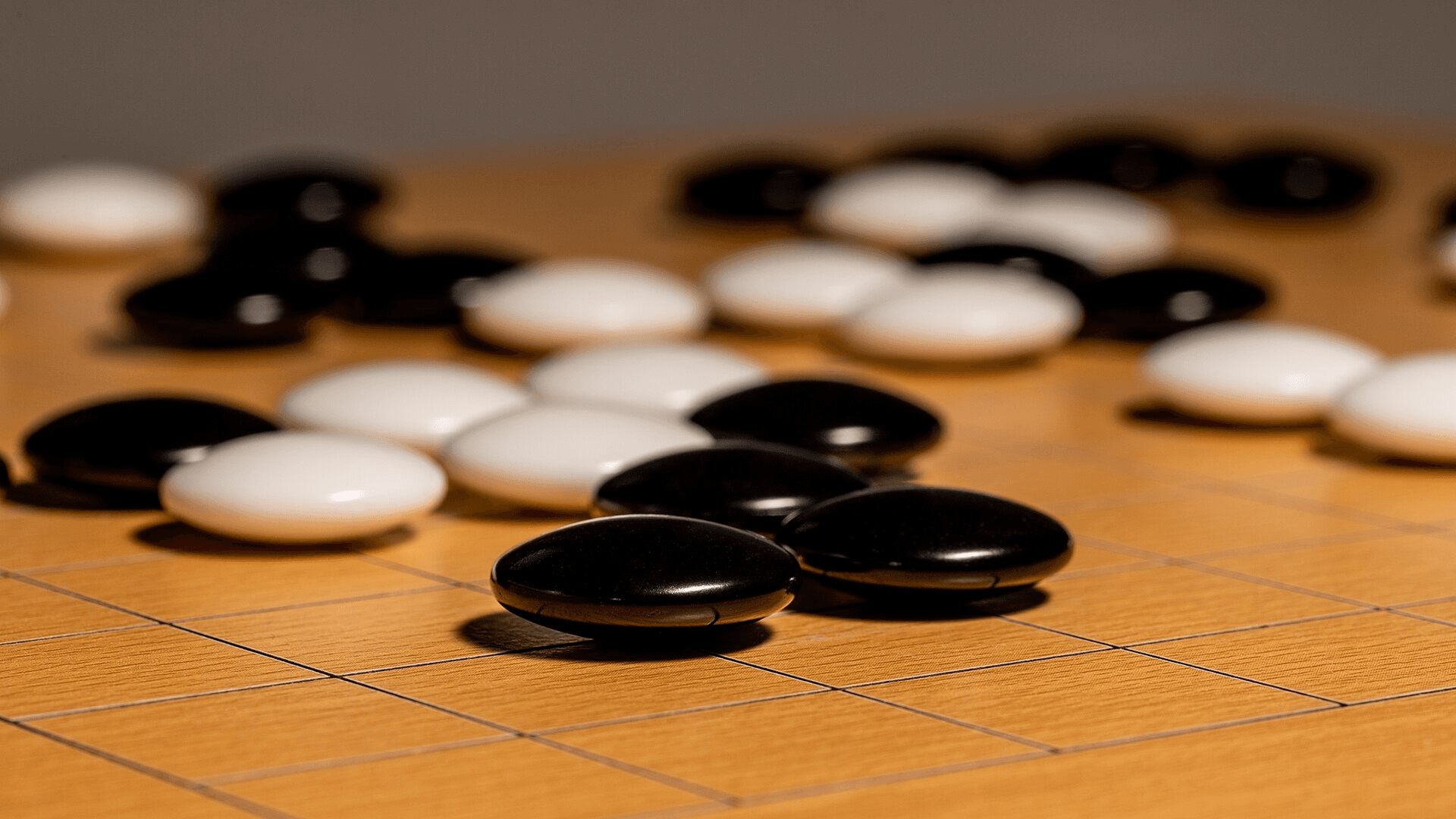
Hero image: Go, by Dietmar Rabich, CC BY-SA 4.0. Via Wikimedia Commons.
Take our professional IQ test
Want to know your IQ? Try the first ever professional online IQ test.