Does Learning Sign Language Make You Smarter? What the Research Shows | Riot IQ
Oct 30, 2026·Advanced Topics & Research
Does Learning Sign Language Make You Smarter? What the Research Shows
Does learning sign language make you smarter? No study shows an IQ gain. Signers do better on some visual-spatial tasks; the baby-sign IQ claim is unpublished.
Dr. Russell T. WarneChief Scientist
Share
No study has shown that learning sign language raises IQ. Signers do outperform non-signers on a few specific visual-spatial tasks, such as generating complex mental images, but the popular claim that babies taught signs gain 12 IQ points by age 8 was never published in a peer-reviewed journal that I could find, and the only randomized trial of baby signing found no effect even on language.
Sign language is a full human language, and learning one is worthwhile for its own sake. This page covers where the IQ claim came from, what the research on signers' visual and spatial skills actually shows, whether sign language produces the "bilingual advantage" sometimes claimed for spoken languages, and why the people who learn to sign may differ from those who do not.
Where the 12-point baby-sign claim comes from
The idea that signing makes children smarter rests mainly on the work of Linda Acredolo and Susan Goodwyn at the University of California, Davis, who developed and popularised "baby signs", simple gestures that parents teach infants before they can talk.
• The language study: Their peer-reviewed paper, published in 2000, followed infants whose mothers were trained to model symbolic gestures and compared them with control groups at several ages up to 36 months. The signing infants scored higher on selected measures of expressive and receptive language, and the authors concluded that gesturing did not hamper speech and might help it.
• The IQ follow-up: A UC Davis news release from March 1999 described a "preliminary" follow-up in which children who had signed as babies did better on standard IQ tests at ages 7 and 8. Later secondary sources give the figures as a mean IQ of 114 for the signing group against 102 for controls. That 12-point gap is often cited as if it came from the 2000 journal paper, but the release describes findings presented at meetings, and I could not find the IQ data in any peer-reviewed article. Sample sizes and test details are not given in the release.
• The randomized trial: Elizabeth Kirk and colleagues ran what they described as the first randomized controlled trial of baby signing, following 40 infants from 8 to 20 months. Infants whose mothers were trained to use gestures did not differ from controls on language outcomes. The mothers who signed did become more responsive to their babies' nonverbal cues.
Two systematic reviews reach the same conclusion. Johnston and colleagues evaluated 17 reports in 2005 and found that the evidence failed to support claims that signing speeds language development, citing weak methods and equivocal results. Fitzpatrick and colleagues reviewed 10 reports in 2014 and found the benefits still unclear, while also finding no evidence that baby sign interferes with typical development. Baby signing appears to be harmless. There is no good evidence that it raises intelligence.
What signers are better at
The stronger research concerns adults and children who are fluent signers. Signed languages use space grammatically: signers place people and objects at locations in front of them and refer back to those locations, and they routinely have to understand a scene described from the signer's point of view, which is the mirror image of their own.
• Mental imagery: Karen Emmorey, Stephen Kosslyn and Ursula Bellugi compared deaf signers of American Sign Language (ASL), hearing signers who grew up with deaf parents, and hearing non-signers. Both signing groups were better at generating complex mental images and at detecting mirror-image reversals. There were no group differences in holding an image in mind for a short time or in imagining an object rotating. Because the hearing signers showed the same advantage, the authors linked it to the language itself.
• Adults who learned later: Madeleine Keehner and Susan Gathercole tested hearing people who learned a sign language in early adulthood. They performed better than matched non-signers on a spatial memory task that required a 180-degree rotation, the standard viewpoint shift in sign conversation, and they did not show the usual cost of processing rotated stimuli.
• Proficiency, not just exposure: A 2026 study by Schwenk and Quandt of 40 deaf, hard-of-hearing and hearing ASL users found that ASL comprehension scores predicted performance on Block Design, a spatial subtest of the Wechsler adult intelligence scale (b = 0.19), while age of first exposure did not. The study was correlational and small.
The advantage is narrow and inconsistent. Marschark and colleagues ran three experiments with deaf and hearing participants who varied in signing skill, and found no general visual-spatial advantage for deaf individuals; hearing participants did better on several tasks regardless of sign language skill. Daphne Bavelier and colleagues have also shown that the enhanced peripheral attention seen in deaf people does not appear in hearing signers, which points to deafness itself as the cause. Our explainer on visual-spatial reasoning and why it shows up on an IQ test covers how these skills relate to overall IQ.
Hearing children learning sign at school
The closest thing to a test of IQ-type gains is a small Italian study. Olga Capirci and colleagues taught Italian Sign Language (LIS) to classes of hearing children in the first years of primary school and gave them Raven's Coloured Progressive Matrices, a nonverbal reasoning test often used as a measure of children's intelligence. In both of their studies the LIS group did better than comparison groups, including a class that studied English instead, and the second study added a spatial memory task.
This is encouraging but weak evidence. The children were compared by class within one school, the abstract does not report sample sizes, and I found no large randomized replication. Gains on a single reasoning test after a school year are also hard to separate from differences in teachers and classes, and from children becoming familiar with the test.
Is there a sign-language bilingual advantage?
Many people expect sign language to bring the same benefits claimed for speaking two languages. The evidence for a general bilingual advantage in self-control and attention is itself contested, and our page on IQ and bilingualism covers that debate.
Sign language offers a useful test of where any advantage would come from. Emmorey, Luk, Pyers and Bialystok compared 15 English monolinguals, 15 "bimodal" bilinguals who knew ASL and English, and 15 bilinguals who spoke two languages, on flanker tasks that measure the ability to ignore distracting information. The spoken-language bilinguals were faster than the other groups, and the ASL-English bilinguals did not differ from the monolinguals. Because sign and speech use different channels and can be produced at the same time, bimodal bilinguals face weaker pressure to suppress one language while using the other. So even if a bilingual advantage exists, sign language may not produce it.
This fits the broader pattern described by "near transfer" and "far transfer". Near transfer means getting better at the trained skill and closely related tasks; far transfer means gains in broad abilities such as general intelligence. Giovanni Sala and Fernand Gobet's meta-analyses of chess, music and working-memory training found that far-transfer effects fade as study quality improves. The signing research fits near transfer: the clearest gains are on tasks that mirror what signing itself demands.
Who learns sign language?
Selection is a real problem for any comparison between signers and non-signers.
• Parents who choose baby signs: Families who buy baby-sign courses and practise them daily tend to be highly engaged with their children's development, and parental education and engagement both predict children's later test scores. Without random assignment, a later IQ difference could come from the families rather than the signs.
• Adult learners: Hearing adults who take up ASL or BSL by choice may already enjoy visual and spatial tasks, and professional interpreters are a highly selected group.
• Deaf children: Deaf children's IQ results depend heavily on how they are tested and in what language, as explained in our guide to how deaf children are assessed for IQ. Comparisons between deaf and hearing groups mix the effects of deafness itself with differences in early access to language.
Frequently asked questions
Does learning sign language make you smarter?
No study has shown that learning sign language raises IQ. Fluent signers are better at a few specific visual-spatial tasks, such as generating mental images and handling 180-degree viewpoint shifts.
Does baby sign language increase IQ?
The widely quoted 12-point gain at age 8 comes from preliminary findings described in a 1999 university news release and was not, as far as I could find, published in a peer-reviewed journal. The only randomized trial found no benefit even for language.
Is sign language good for your brain?
Learning any complex skill engages the brain, and signers show some changes in visual imagery and spatial processing. There is no evidence that these changes raise general intelligence.
Do sign language interpreters have higher IQs?
There is no published study of interpreters' IQ scores. Interpreting is demanding work, and anyone who reaches that level of skill has been selected by long training.
Is ASL easier to learn than a spoken language?
No study cited here measured that. For most hearing adults ASL is a new language in a new modality, and it takes years of practice to reach fluency.
The takeaway
Learning sign language opens communication with Deaf communities and is valuable for that reason alone. The research shows that fluent signers gain some specific visual-spatial skills, and it does not show that signing raises IQ; the famous baby-sign IQ gain remains unpublished and unreplicated. If you want an accurate measure of your reasoning ability, try a professionally developed IQ test.
References
1. Goodwyn, S. W., Acredolo, L. P., & Brown, C. A. (2000). Impact of symbolic gesturing on early language development. Journal of Nonverbal Behavior, 24(2), 81-103. [doi.org/10.1023/A:1006653828895](. doi.org
2. University of California, Davis. (1999, March 31). 'Baby signs' favor kids' intellectual growth in school [News release]. [ucdavis.edu](. ucdavis.edu
3. Kirk, E., Howlett, N., Pine, K. J., & Fletcher, B. C. (2013). To sign or not to sign? The impact of encouraging infants to gesture on infant language and maternal mind-mindedness. Child Development, 84(2), 574-590. [doi.org/10.1111/j.1467-8624.2012.01874.x](. doi.org
4. Johnston, J. C., Durieux-Smith, A., & Bloom, K. (2005). Teaching gestural signs to infants to advance child development: A review of the evidence. First Language, 25(2), 235-251. [doi.org/10.1177/0142723705050340](. doi.org
5. Fitzpatrick, E. M., Thibert, J., Grandpierre, V., & Johnston, J. C. (2014). How HANDy are baby signs? A systematic review of the impact of gestural communication on typically developing, hearing infants under the age of 36 months. First Language, 34(6), 486-509. [doi.org/10.1177/0142723714562864](. doi.org
6. Emmorey, K., Kosslyn, S. M., & Bellugi, U. (1993). Visual imagery and visual-spatial language: Enhanced imagery abilities in deaf and hearing ASL signers. Cognition, 46(2), 139-181. [doi.org/10.1016/0010-0277(93)90017-P](. doi.org
7. Keehner, M., & Gathercole, S. E. (2007). Cognitive adaptations arising from nonnative experience of sign language in hearing adults. Memory & Cognition, 35(4), 752-761. [doi.org/10.3758/BF03193312](. doi.org
8. Schwenk, M. F., & Quandt, L. C. (2026). ASL proficiency predicts advanced visual-spatial processing independent of age of acquisition. Cognitive Science, 50(5), e70216. [doi.org/10.1111/cogs.70216](. doi.org
9. Marschark, M., Spencer, L. J., Durkin, A., Borgna, G., Convertino, C., Machmer, E., Kronenberger, W. G., & Trani, A. (2015). Understanding language, hearing status, and visual-spatial skills. Journal of Deaf Studies and Deaf Education, 20(4), 310-330. [doi.org/10.1093/deafed/env025](. doi.org
10. Bavelier, D., Dye, M. W. G., & Hauser, P. C. (2006). Do deaf individuals see better? Trends in Cognitive Sciences, 10(11), 512-518. [doi.org/10.1016/j.tics.2006.09.006](. doi.org
11. Capirci, O., Cattani, A., Rossini, P., & Volterra, V. (1998). Teaching sign language to hearing children as a possible factor in cognitive enhancement. Journal of Deaf Studies and Deaf Education, 3(2), 135-142. [doi.org/10.1093/oxfordjournals.deafed.a014343](. doi.org
12. Emmorey, K., Luk, G., Pyers, J. E., & Bialystok, E. (2008). The source of enhanced cognitive control in bilinguals: Evidence from bimodal bilinguals. Psychological Science, 19(12), 1201-1206. [doi.org/10.1111/j.1467-9280.2008.02224.x](. doi.org
13. Sala, G., & Gobet, F. (2017). Does far transfer exist? Negative evidence from chess, music, and working memory training. Current Directions in Psychological Science, 26(6), 515-520. [doi.org/10.1177/0963721417712760](. doi.org
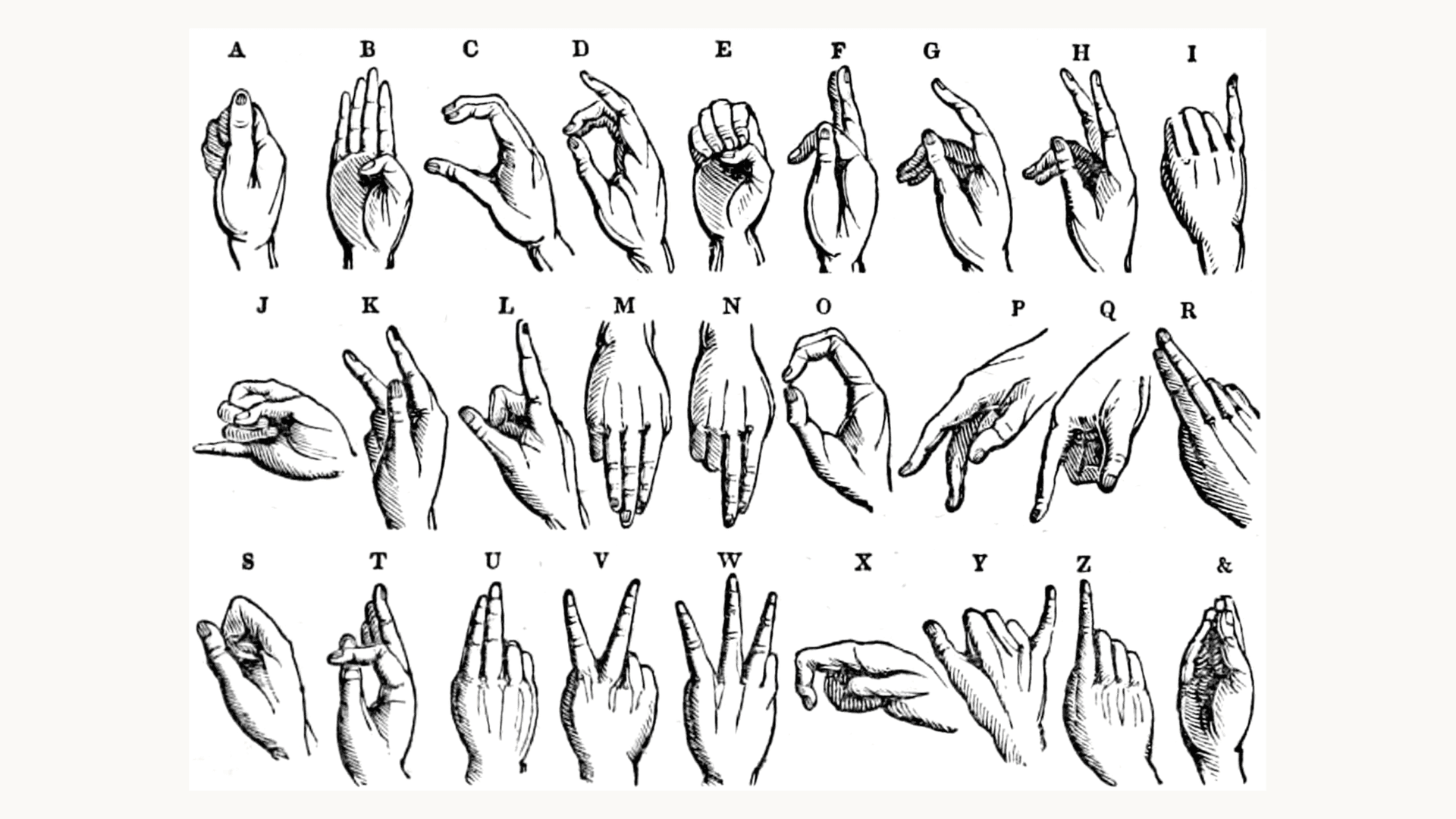
Hero image: Alphabet for the Deaf and Dumb, from the American Pocket Library of Useful Knowledge, by Thomas Curtis Clarke, public domain. Via Wikimedia Commons.
Take our professional IQ test
Want to know your IQ? Try the first ever professional online IQ test.