Does Tetris Make You Smarter? What the Research Shows | Riot IQ
Oct 30, 2026·Advanced Topics & Research
Does Tetris Make You Smarter? What the Research Shows
Does Tetris make you smarter? No study shows an IQ gain. The largest trial, with 366 adults, found Tetris did not even boost mental rotation scores.
Dr. Russell T. WarneChief Scientist
Share
Tetris has not been shown to make anyone smarter: no study has found that playing it raises IQ. The largest trial, a preregistered study of 366 adults who played for 10 hours over four weeks, found that Tetris players improved on mental rotation tests no more than people who played Solitaire, and the statistics favoured no effect.
Playing Tetris does make people much better at Tetris, and it changes how the brain handles the game. This page covers the brain-imaging studies behind the popular claim, what the training trials found for spatial skills, why practising a game rarely transfers to general ability, and who chooses to play falling-block puzzles in the first place.
Why people think Tetris trains the brain
Tetris looks like a pure test of spatial reasoning. Pieces made of four squares fall one at a time, and the player has a second or two to rotate each one mentally, see where it fits and drop it into place. "Mental rotation", the ability to turn a shape in your mind and judge whether it matches another, is a well-known spatial skill, and spatial items appear on many intelligence tests. Our page on visual-spatial reasoning and why it shows up on an IQ test explains how those items work.
The game also lingers in the mind. Stickgold and colleagues found that people who had played Tetris reported seeing the falling pieces as they drifted off to sleep, even three patients with severe amnesia who could not remember playing. This "Tetris effect" made a vivid story about the game rewiring the brain.
Brain-imaging studies supplied the rest of the reputation, and they deserve a careful look.
What the brain-imaging studies actually found
• Brain efficiency after practice: In 1992 Richard Haier's group used PET scans to measure how much glucose the brain used while 8 young men played Tetris, before and after 4 to 8 weeks of daily practice. Their performance rose more than sevenfold, yet glucose use across the cortex went down, and the men who improved most showed the largest decreases in several areas. The authors suggested that learning lets the brain stop using areas it does not need. The study became a classic of the "neural efficiency" idea. What it tracked was how eight people learned one game; it did not show that their general intelligence changed.
• Thicker cortex in adolescent girls: In 2009 Haier and colleagues randomly assigned 26 girls aged 12 to 15 either to practise Tetris (15 girls, about 1.5 hours a week on average) or to a no-Tetris control group (11 girls) for three months. Compared with controls, the Tetris group showed thicker cortex in two small regions of the left hemisphere, and lower activity, mostly in frontal areas, while playing the game after practice. The thicker regions did not overlap with the regions that became less active. The groups had similar IQs at the start (means of about 114 and 116), and the paper reports no IQ retest after practice.
These studies show that the brain changes as it learns a skill. A thicker patch of cortex is not the same thing as higher intelligence, and with 15 girls in the practice group the study was far too small to test whether any change in ability followed.
Does Tetris improve spatial skills?
Mental rotation is the outcome most often tested, because Tetris seems to train it directly. Even here, the evidence has weakened as studies have grown.
• Experts are fast with Tetris shapes: Sims and Mayer compared skilled Tetris players with non-players. The experts were better at mentally rotating Tetris shapes or very similar shapes, but no better on other tests of spatial ability, and they used the same mental rotation strategy, only faster. In a second experiment, non-players who received 12 hours of Tetris practice gained no more on spatial tests than matched controls.
• Gains that transferred to other spatial tasks: Terlecki, Newcombe and Little followed university students over months. Both repeated testing and Tetris practice produced large and durable improvements on a mental rotation test, and Tetris players improved faster at first, although final scores did not differ. The Tetris group also did better than the repeated-testing group on other spatial tasks, and that advantage was still visible several months later.
• Early positive studies: Okagaki and Frensch reported that older adolescents who played 6 hours of Tetris improved on paper-and-pencil spatial tests compared with a group that did not play. A later review by Latham and colleagues pointed out that this study lacked an adequate control condition.
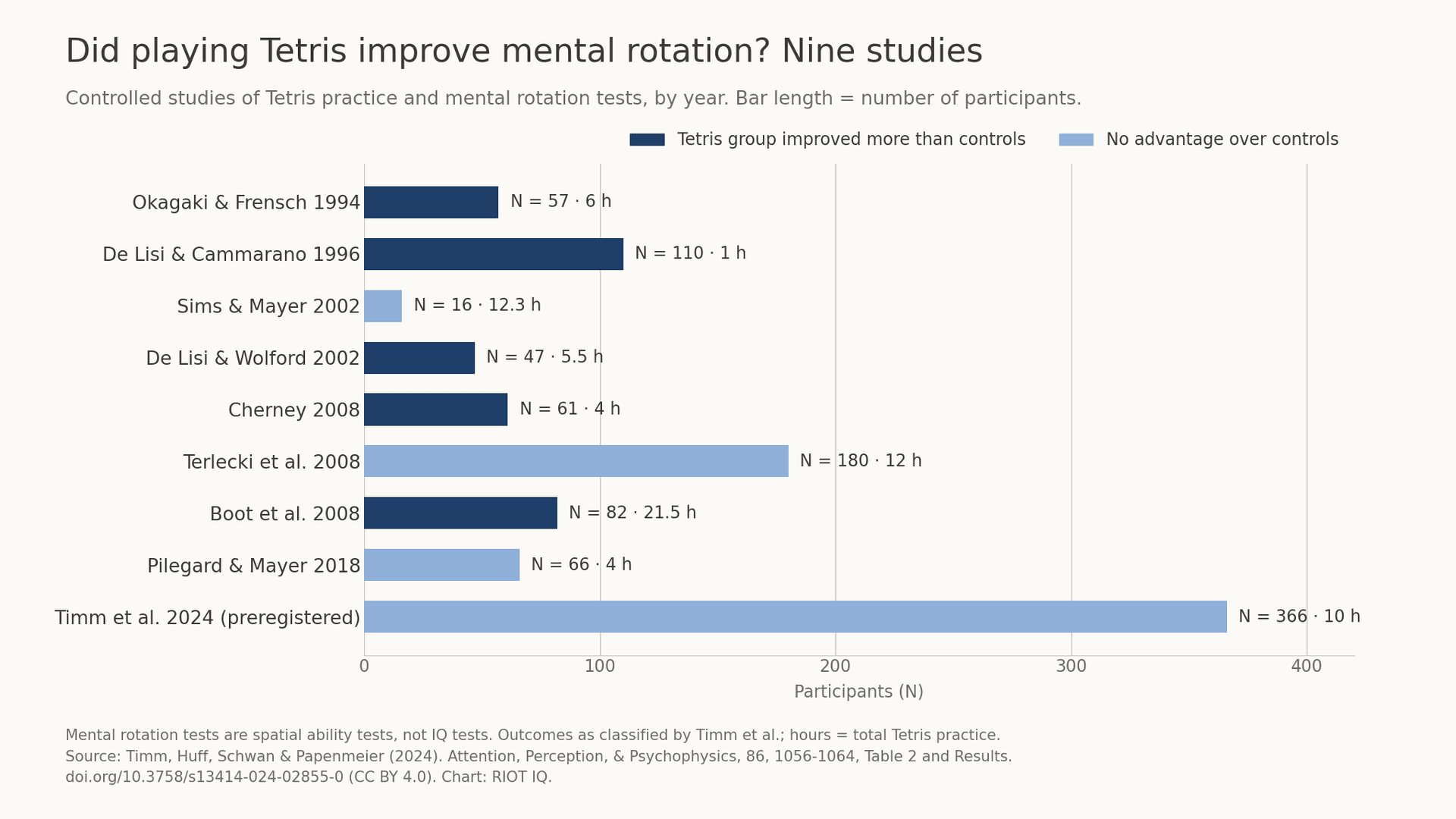
• The largest trial: Timm and colleagues compiled eight earlier controlled studies (five reported a Tetris advantage on mental rotation, three did not) and then ran a high-powered, preregistered replication. They randomly assigned 366 adults to play Tetris or Solitaire for 10 hours over four weeks. Both groups improved on all three mental rotation tests simply from taking them twice, by about 3.4 points on the main test, but the Tetris group did no better. Bayes factors of 0.12 and 0.13 on the two 3D tests crossed the preregistered threshold for evidence of no Tetris effect, and the third test was inconclusive. Participants expected Tetris to help far more than Solitaire, and even that expectation did not produce a difference.
None of these outcomes is an IQ score. Mental rotation tests measure one narrow spatial skill, and the strongest study found that Tetris did not improve even that.
Near transfer, far transfer and who plays Tetris
Psychologists call improvement on the trained task and close relatives of it "near transfer", and improvement on broad abilities such as general intelligence "far transfer". The Tetris research shows plenty of the first kind: players get much faster at placing Tetris pieces and at rotating Tetris-shaped figures. Evidence for the second kind is absent. Sala and Gobet's reviews of chess, music and working-memory training found that far-transfer effects shrink toward zero as studies become better controlled, and our page on whether video games make you smarter covers the wider gaming literature, where the same pattern holds. Expert players of board games show it too: competitive Scrabble players recognize words with unusual ease, yet were no faster or more accurate than controls on a similar task that used symbols instead of letters.
Selection explains some of the impression that Tetris players are sharp. People with strong spatial ability are likely to enjoy a game that rewards it and to stick with it long enough to become skilled. In the expert studies, that prior ability is mixed up with years of practice, and only randomized trials can separate the two.
One genuinely promising line of Tetris research has nothing to do with intelligence. In an experiment by Holmes and colleagues, volunteers watched a distressing film, and those who then played Tetris for 10 minutes reported fewer intrusive flashbacks of the film over the next week than those who sat quietly, while their deliberate memory of the film was unaffected. That work concerns trauma memories, and anyone struggling with flashbacks after a real event should speak to a doctor or a qualified mental health professional.
Frequently asked questions
Does Tetris make you smarter?
No study has shown that Tetris raises IQ. Practice makes you much better at Tetris, and the largest trial found no improvement in mental rotation compared with playing Solitaire.
Does Tetris increase brain size?
One study found slightly thicker cortex in two small regions after three months of practice, in 15 adolescent girls. That is evidence of the brain adapting to a new skill, and the study did not test whether intelligence changed.
Does Tetris improve spatial reasoning?
Several small early studies said yes, but the advantage did not hold up in the largest trials, including a preregistered study of 366 adults. Skilled players are faster at rotating Tetris-like shapes in particular.
Are people who are good at Tetris smarter?
Players with good spatial ability probably find the game easier and keep playing, so skilled players may score higher on spatial tests to begin with. That reflects who chooses the game more than what the game does.
Is Tetris better for your brain than other video games?
No study shows a special benefit for general intelligence. Its best-supported use is in research on reducing intrusive memories after a distressing experience, which is a different question.
The takeaway
Tetris is a satisfying puzzle that makes people very good at fitting falling blocks together, and the brain does adapt as players learn it. The evidence does not show that it makes anyone smarter, and the largest, best-controlled trial found it did not improve even the spatial skill it seems built to train. If you want an accurate measure of your reasoning ability, you can take a full-length online IQ test.
References
1. Stickgold, R., Malia, A., Maguire, D., Roddenberry, D., & O'Connor, M. (2000). Replaying the game: Hypnagogic images in normals and amnesics. Science, 290(5490), 350-353. [doi.org/10.1126/science.290.5490.350](. doi.org
2. Haier, R. J., Siegel, B. V., MacLachlan, A., Soderling, E., Lottenberg, S., & Buchsbaum, M. S. (1992). Regional glucose metabolic changes after learning a complex visuospatial/motor task: A positron emission tomographic study. Brain Research, 570(1-2), 134-143. [doi.org/10.1016/0006-8993(92)90573-R](. doi.org
3. Haier, R. J., Karama, S., Leyba, L., & Jung, R. E. (2009). MRI assessment of cortical thickness and functional activity changes in adolescent girls following three months of practice on a visual-spatial task. BMC Research Notes, 2, 174. [doi.org/10.1186/1756-0500-2-174](. doi.org
4. Sims, V. K., & Mayer, R. E. (2002). Domain specificity of spatial expertise: The case of video game players. Applied Cognitive Psychology, 16(1), 97-115. [doi.org/10.1002/acp.759](. doi.org
5. Terlecki, M. S., Newcombe, N. S., & Little, M. (2008). Durable and generalized effects of spatial experience on mental rotation: Gender differences in growth patterns. Applied Cognitive Psychology, 22(7), 996-1013. [doi.org/10.1002/acp.1420](. doi.org
6. Okagaki, L., & Frensch, P. A. (1994). Effects of video game playing on measures of spatial performance: Gender effects in late adolescence. Journal of Applied Developmental Psychology, 15(1), 33-58. [doi.org/10.1016/0193-3973(94)90005-1](. doi.org
7. Timm, J. D., Huff, M., Schwan, S., & Papenmeier, F. (2024). Short-term transfer effects of Tetris on mental rotation: Review and registered report. A Bayesian approach. Attention, Perception, & Psychophysics, 86(3), 1056-1064. [doi.org/10.3758/s13414-024-02855-0](. doi.org
8. Latham, A. J., Patston, L. L. M., & Tippett, L. J. (2013). The virtual brain: 30 years of video-game play and cognitive abilities. Frontiers in Psychology, 4, 629. [doi.org/10.3389/fpsyg.2013.00629](. doi.org
9. Sala, G., & Gobet, F. (2017). Does far transfer exist? Negative evidence from chess, music, and working memory training. Current Directions in Psychological Science, 26(6), 515-520. [doi.org/10.1177/0963721417712760](. doi.org
10. Holmes, E. A., James, E. L., Coode-Bate, T., & Deeprose, C. (2009). Can playing the computer game "Tetris" reduce the build-up of flashbacks for trauma? A proposal from cognitive science. PLOS ONE, 4(1), e4153. [doi.org/10.1371/journal.pone.0004153](. doi.org
11. van Hees, S., Pexman, P. M., Hargreaves, I. S., Zdrazilova, L., Hart, J. M., Myers-Stewart, K., Cortese, F., & Protzner, A. B. (2016). Testing the limits of skill transfer for Scrabble experts in behavior and brain. Frontiers in Human Neuroscience, 10, 564. [doi.org/10.3389/fnhum.2016.00564](. doi.org
Figure by RIOT IQ. Data from Timm, Huff, Schwan & Papenmeier (2024), Attention, Perception, & Psychophysics 86, 1056-1064 (doi.org/10.3758/s13414-024-02855-0), Table 2 and Results, CC BY 4.0.
Take our professional IQ test
Want to know your IQ? Try the first ever professional online IQ test.