What does a vocabulary test measure? Why word knowledge is one of the best single proxies for IQ, common test formats, and how large vocabularies get.
Dr. Russell T. WarneChief Scientist
Share
A vocabulary test measures the breadth and depth of a person's word knowledge, usually by asking them to define words, pick synonyms, or match spoken words to pictures. Word knowledge may sound like trivia, but it is one of the best single-subtest proxies for general intelligence and the classic marker of "crystallized intelligence," the store of knowledge and skill a person builds over a lifetime. This article explains why vocabulary tracks intelligence so closely, the main test formats, and how many words people actually know.
Why word knowledge tracks intelligence
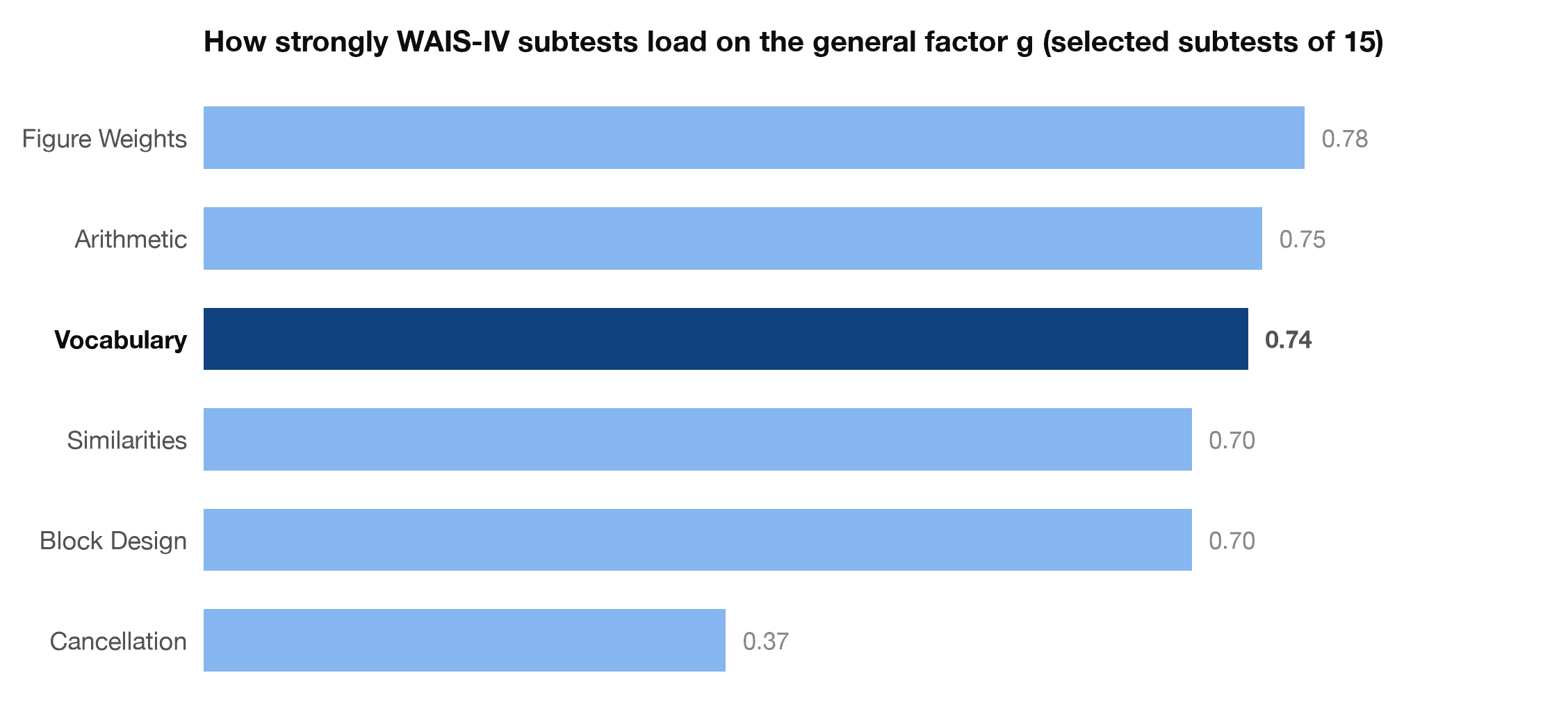
Every subtest in a cognitive battery can be scored for how strongly it correlates with "g," the general factor that runs through all mental tests; that correlation is called a "g loading." On the WAIS-IV, the most studied adult battery of the last two decades, the Vocabulary subtest loads .74 on g, among the top three of all 15 subtests and the highest of the verbal subtests. For comparison, the lowest-loading subtest, a clerical speed task called Cancellation, loads .37.
The reason is how words are learned. Nobody acquires tens of thousands of words from lists. Nearly all of them are inferred from context, one encounter at a time, across decades of reading and conversation. Each inference is a small act of reasoning, so a large vocabulary is the compound interest of a lifetime of thinking. That is why accumulated word knowledge ends up tracking crystallized intelligence more faithfully than almost any other single measure.
The main vocabulary test formats
Definition tests
In the Wechsler format, the examiner says a word and the test taker defines it aloud, with answers scored by quality: a precise definition earns full credit, a vague or partial one earns less. Vocabulary remains a core subtest of the WAIS-5, the current edition of the Wechsler adult scale published in 2024 and normed for ages 16 to 90.
Multiple-choice synonym tests
Group-administered and online tests usually present a word and four or five candidate synonyms, such as "reluctant" with the options unwilling, careless, hopeful, and tired. The format scores instantly and needs no examiner, which is why it dominates large-scale and web-based testing, including the verbal sections of many full IQ batteries.
Picture vocabulary tests
The Peabody Picture Vocabulary Test, now in its fifth edition (PPVT-5), measures "receptive vocabulary": the examiner says a word and the test taker points to the matching picture among four options. It takes 10 to 15 minutes, requires no reading, writing, or speaking, and is normed from age 2 and a half through 90 plus, reporting IQ-style standard scores with a mean of 100 and a standard deviation of 15. That makes it useful for young children and for anyone for whom reading or speech is a barrier.
How many words people actually know
The best modern estimates come from Brysbaert and colleagues, who tested word knowledge at scale in 2016. Counting "lemmas," the dictionary-style base forms of words (run, but not running or ran), they estimated that the average 20-year-old native speaker of American English knows about 42,000 lemmas. The spread is wide: about 27,000 for the bottom 5 percent of 20-year-olds and 52,000 for the top 5 percent.
Growth does not stop there. Between ages 20 and 60 the average person adds roughly 6,000 more lemmas, about one new word every two days, reaching around 48,200 by age 60. The study also found substantial differences by education level, which the authors read as the mark of reading and study on vocabulary growth.
Vocabulary across the lifespan
Vocabulary is the textbook example of a crystallized ability: it rises through middle age and holds up well beyond it, while fluid abilities such as novel reasoning and processing speed decline from early adulthood. The two trajectories moving in opposite directions is one of the most reliable patterns in cognitive aging, and it is a central reason test batteries report them separately. We unpack that distinction in our article on fluid versus crystallized intelligence.
What a vocabulary score can and cannot tell you
• It is a strong proxy, and only a proxy: Vocabulary is one subtest inside batteries like the WAIS-5. A full IQ score also samples fluid reasoning, spatial ability, working memory, and processing speed, so a vocabulary score alone approximates rather than replaces it.
• It is sensitive to language and schooling: Someone tested outside their native language, or with limited access to print, will score below their true ability. Formats like the PPVT-5 reduce the barrier; they do not remove it.
• Cramming distorts it: Memorizing word lists can lift a score without lifting the ability the score is meant to reflect. Vocabulary works as a measure precisely because it normally reflects decades of incidental learning.
Vocabulary is also only one strand of verbal ability. Analogies, comprehension, and inference tasks round out the picture, and we cover them in our guide to verbal reasoning.
Frequently asked questions
Why do IQ tests include vocabulary?
Because word knowledge is one of the strongest single indicators of general intelligence. On the WAIS-IV, Vocabulary's g loading of .74 places it among the top three of 15 subtests, since learning words over a lifetime draws on the same reasoning and memory abilities IQ tests target.
Is a vocabulary test an IQ test?
Not by itself. Vocabulary is one subtest within batteries like the WAIS-5, and a full IQ score also samples fluid reasoning, spatial ability, working memory, and processing speed. A vocabulary score is a good proxy rather than a substitute.
How many words does the average person know?
About 42,000 lemmas for the average 20-year-old native speaker of American English, ranging from roughly 27,000 for the bottom 5 percent to 52,000 for the top 5 percent, and rising to about 48,200 by age 60.
What is the PPVT test?
The Peabody Picture Vocabulary Test, Fifth Edition, is a norm-referenced measure of receptive vocabulary. The examiner says a word and the test taker picks the matching picture. It takes 10 to 15 minutes, needs no reading or writing, and reports standard scores with a mean of 100 and a standard deviation of 15.
Does vocabulary decline with age?
On average, no. Adults keep adding about one new lemma every two days between 20 and 60, so word knowledge grows while fluid abilities decline. That contrast is the classic signature of crystallized intelligence.
Can I raise my IQ by memorizing vocabulary lists?
Cramming can raise a vocabulary test score, but it does not raise the underlying ability the score is meant to reflect, and coaching narrow content weakens what the score means.
The takeaway
A vocabulary test measures accumulated word knowledge, and through it, a lifetime of reasoning and learning. It is a remarkably efficient window on intelligence, and still only a window. A trustworthy IQ score comes from measuring verbal and nonverbal domains together, which is what the Reasoning and Intelligence Online Test from RIOT IQ does. You can take the free IQ test to see the full picture.
References
1. Brysbaert, M., Stevens, M., Mandera, P., & Keuleers, E. (2016). How many words do we know? Practical estimates of vocabulary size dependent on word definition, the degree of language input and the participant's age. Frontiers in Psychology, 7, 1116. doi.org/10.3389/fpsyg.2016.01116
2. Dunn, D. M. (2018). Peabody Picture Vocabulary Test (5th ed.) [Measurement instrument]. Pearson. pearsonassessments.com
3. McCrea, S. M., & Robinson, T. P. (2011). Visual Puzzles, Figure Weights, and Cancellation: Some preliminary hypotheses on the functional and neural substrates of these three new WAIS-IV subtests. ISRN Neurology, 2011, 123173. pmc.ncbi.nlm.nih.gov